A Series C SaaS company headquartered in Austin acquired a thirty-person Seattle product team last quarter. The closing reps included a clean walk-through of the seller's standard non-compete: eighteen months, "the United States," all competing activities, Texas choice-of-law, Travis County venue.
The buyer's GC asked the obvious question. Counsel's answer, "we've used this template for three years and never had a problem," was true and also irrelevant. Every one of those covenants, applied to the Washington employees who were now part of the deal, was void on multiple independent grounds and about to be voider still.
Are non-competes enforceable in Washington? Right now (through June 29, 2027), a Washington non-compete is enforceable only against a worker who earns more than the indexed annual threshold ($126,858.83 for employees, $317,147.09 for independent contractors in 2026), was given the terms in writing before accepting the job, and is bound for no more than eighteen months. Starting June 30, 2027, the answer is mostly no: ESHB 1155 voids almost all employee and contractor non-competes regardless of pay, including ones already signed.
Washington, as of June 2026, is no longer a "threshold state" for employee non-competes. It is a "sunset state," on the second click of a two-step ratchet from threshold regime to near-total ban, and that distinction is the real multi-state drafting lesson.
RCW 49.62, in operation since 2020, already screens out the vast majority of workforce non-competes through wage thresholds, disclosure rules, and an anti-circumvention choice-of-law statute. ESHB 1155, signed March 23, 2026, will finish the job on June 30, 2027 with retroactive force.
The shift changes how multi-state employers should think about covenant lifecycles, because a covenant signed today is operative for, at most, twelve and a half more months before it becomes void by operation of statute.
Employers with Washington-based workers should stop drafting employee non-competes for that population now and rebuild the protection plan around trade secrets, non-solicits with teeth, garden leave, and confidentiality, before the 2027 effective date forces an emergency rewrite under time pressure.
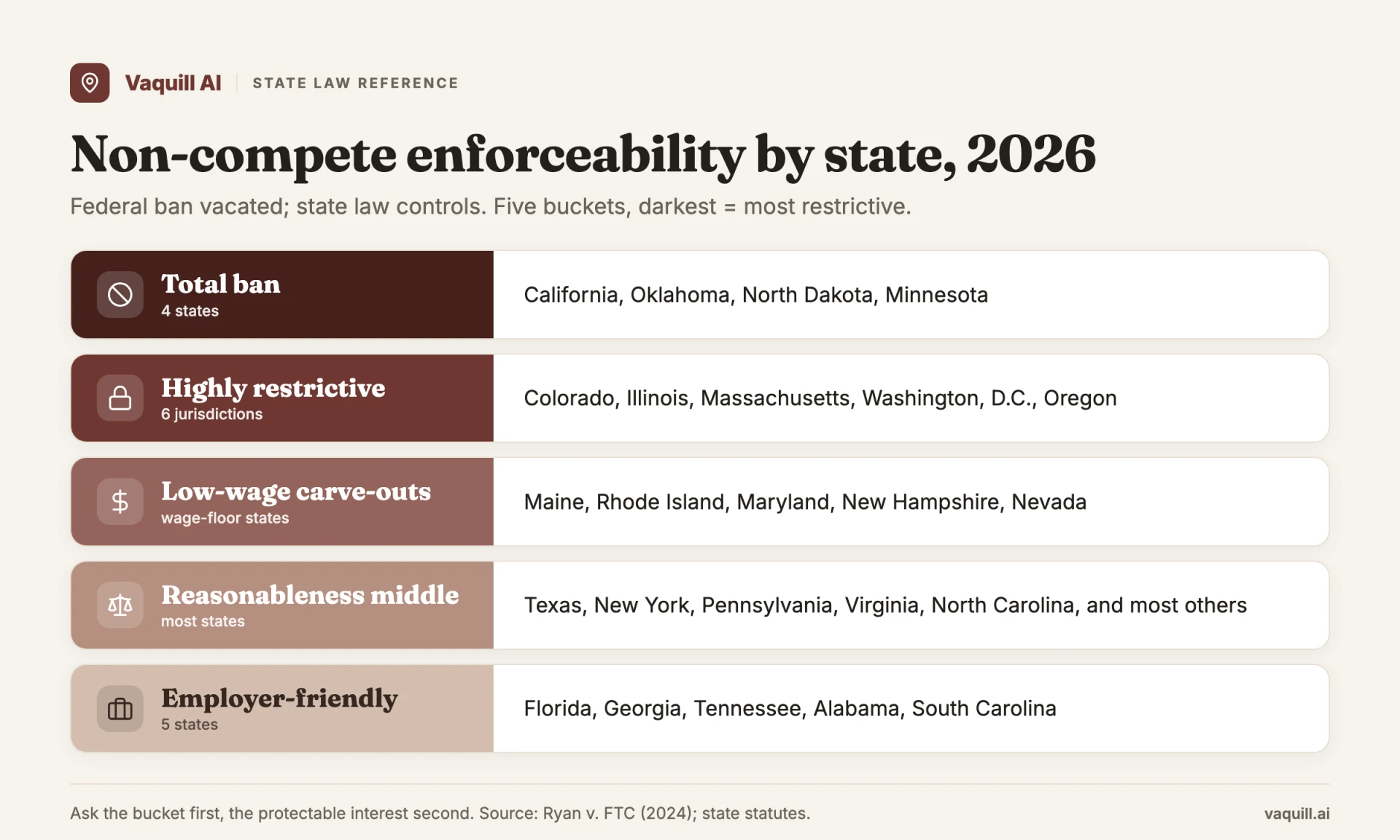
Every state sorts into one of five enforceability buckets; darkest is most restrictive.
TL;DR
- Washington's RCW 49.62, effective January 1, 2020, already makes employee non-competes unenforceable unless the worker's annual earnings clear an indexed threshold. The Department of Labor and Industries set that threshold at $126,858.83 for employees and $317,147.09 for independent contractors for 2026.
- ESHB 1155, signed by Governor Bob Ferguson on March 23, 2026, creates a near-total ban on non-competition agreements effective June 30, 2027. The ban applies retroactively to existing agreements and carries a statutory penalty of the greater of actual damages or $5,000, plus attorneys' fees.
- SB 5935 (effective June 6, 2024) already voids out-of-state choice-of-law and forum-selection clauses that would deprive a Washington-based worker of RCW 49.62's protections.
- The Washington Supreme Court's decision in Springer v. Freedom Vans LLC, No. 102566-1 (Jan. 23, 2025), narrowed the common-law duty of loyalty against the backdrop of RCW 49.62.070, signaling the same skeptical posture the legislature took.
- For multi-state employers, treat Washington non-competes as a dead asset. Move protection into trade secret programs, customer non-solicits drafted to survive the "functioning as a non-compete" test, garden leave, and well-instrumented confidentiality.
What is the 2026 income threshold for enforcing a non-compete against a Washington employee?
Part of our all-50-states legal reference series.
The RCW 49.62 framework: current law through June 29, 2027
Chapter 49.62 RCW took effect January 1, 2020 and is structured around six operating sections.
RCW 49.62.020 (employee threshold). A non-competition covenant against an employee is void and unenforceable unless the employee's earnings from the party seeking enforcement exceed an annually indexed threshold. The Department of Labor and Industries publishes the threshold each year based on the consumer price index for urban wage earners and clerical workers (CPI-W).
For 2026, the calculated figure is $126,858.83. The 2024 figure was $120,559.99 and 2025 was $123,394.17, which gives the line its trajectory: it climbs roughly with national wage inflation.
RCW 49.62.030 (independent contractor threshold). The parallel rule for independent contractors uses a much higher threshold. For 2026, $317,147.09. The legislature treated independent contractors as more sophisticated counterparties and set the bar accordingly, but the practical effect is that most contractor non-competes also fail at the wage gate.
RCW 49.62.020(1)(a) (pre-employment disclosure). The terms of a non-compete must be disclosed in writing to a prospective employee no later than the time of the acceptance of the offer of employment. If the covenant becomes enforceable only at a later date because of compensation changes, the employer must specifically disclose that.
A non-compete sprung on a new hire at orientation is void as a matter of statute, regardless of compensation.
RCW 49.62.020(1)(b) (mid-employment consideration). A non-compete entered into after the start of employment requires independent consideration beyond continued employment. Continued at-will employment is not consideration in Washington, which is the opposite of the Texas rule, and the opposite of what a national template usually assumes.
RCW 49.62.040 (duration). A non-compete with a post-termination duration exceeding eighteen months is presumed unreasonable and unenforceable. The presumption is rebuttable by clear and convincing evidence, a standard most employers cannot meet for a rank-and-file role.
RCW 49.62.050 (choice of law and forum). Any provision requiring a Washington-based worker to adjudicate a non-compete outside Washington, or to apply the substantive law of another jurisdiction, is void and unenforceable to the extent it deprives the worker of the protections of chapter 49.62. SB 5935, effective June 6, 2024, sharpened this language and made it retroactive to agreements signed before that date.
The statute closes the workaround that tech employers had historically used: signing a Seattle engineer to a Delaware-choice-of-law, California-venue agreement and hoping a non-Washington court would apply non-Washington law. That play does not work anymore, and any covenant relying on it should be treated as void.
RCW 49.62.070 (no moonlighting prohibition). Workers who earn less than twice the state minimum hourly wage cannot be barred from having a second job, a side business, or supplemental income, unless the work raises a safety issue or interferes with the employer's reasonable scheduling expectations. This is a separate, much lower pay line than the .020 non-compete threshold. The Washington Supreme Court read this section narrowly in Springer v. Freedom Vans LLC, No. 102566-1 (Wash. Jan. 23, 2025), holding that the common-law duty of loyalty survives chapter 49.62 but cannot be stretched into an implied non-compete that defeats the statute's protection for low-wage workers.
Springer is the most consequential Washington non-compete decision since the statute took effect, and the direction it points is the same direction the legislature was already walking.
RCW 49.62.020(2) (layoff rule). If the employer lays the worker off, the non-compete is void unless the employer pays the worker's base salary for the enforcement period, minus any pay the worker earns elsewhere during that window. This is the clause that catches employers in a downturn: you cannot enforce the covenant against someone you just let go without paying them through the restriction. Most employers, asked to fund a full enforcement period of garden-leave-style pay for a laid-off employee, drop the covenant.
Non-disclosure agreements and customer non-solicits are technically separate creatures from non-competes, but RCW 49.62.010(4) defines "noncompetition covenant" to include any covenant that "by its terms or through how the employer enforces" it, restrains an employee from engaging in a lawful profession, trade, or business.
A non-solicit drafted as a non-solicit but enforced to bar the employee from working at all in the relevant industry gets recharacterized as a non-compete and dies on the wage threshold or duration grounds. Drafters who think the carve-out for non-solicits is broad are reading only the first sentence of the statute.
ESHB 1155: the 2027 near-total ban
The legislature's verdict on its own 2020 statute is that it did not go far enough. ESHB 1155, signed by Governor Bob Ferguson on March 23, 2026 and taking effect June 30, 2027, removes the wage-threshold approach and prohibits non-competition agreements outright, with narrow exceptions.
The mechanics that matter.
Scope. The ban reaches written and oral covenants that directly or indirectly restrain a worker from competing after the employment ends. It explicitly covers forfeiture-for-competition provisions and clawback provisions tied to post-termination competitive activity. The statute closes the workaround of dressing a non-compete as an equity forfeiture or a deferred-compensation clawback.
Retroactivity. As enacted, ESHB 1155 voids existing agreements, not just those signed after the effective date. This is the structural feature that distinguishes Washington's approach from most other state non-compete legislation, which typically applies only prospectively.
An employer with a Washington worker subject to an otherwise enforceable 2022 non-compete on June 29, 2027 should, as enacted, treat the same covenant as void the next day by operation of statute. Whether the retroactivity provision will face a contracts-clause challenge is open, but the safe operating posture for employers is to assume the statute means what it says.
Notice. Employers must make reasonable efforts to give written notice, by October 1, 2027, to current and former workers who remain subject to a now-void covenant, telling them the covenant is unenforceable. The notice requirement is not symbolic. Failure to give notice exposes the employer to the same statutory penalty as enforcement.
Remedies. The statute provides for the greater of actual damages or a $5,000 statutory penalty per violation, plus reasonable attorneys' fees, costs, and expenses. The fee-shifting is one-way in favor of the worker, which is how the legislature ensured the statute would be enforced in practice through private plaintiffs and not just AG actions.
Exceptions. A handful of agreements survive: a covenant tied to the sale or purchase of a business signed by an owner holding at least one percent of the entity, customer and employee non-solicits (customer non-solicits capped at eighteen months), confidentiality and trade-secret agreements, franchise covenants that meet RCW 19.100.020(1), and qualifying educational-expense repayment agreements. The legislature preserved the seller-of-goodwill rationale that exists in every state that has banned employee non-competes, including California.
The exceptions are narrow and not a back door for re-papering an employee covenant as a deal covenant. The one-percent-owner sale fact pattern stays available; the rank-and-file equity-grant-with-non-compete fact pattern does not.
The reasonable inference is that the legislature concluded the 2020 threshold approach was insufficient because employers were still inserting covenants into agreements with sub-threshold workers (who would not litigate), still relying on out-of-state choice-of-law clauses (which SB 5935 then plugged), and still using equity forfeiture and clawback structures to do indirectly what the statute prohibited directly. ESHB 1155 closes those gaps simultaneously.
Recent appellate authority
Two decisions matter for the year-and-change of operative life remaining for RCW 49.62 in its current form.
Springer v. Freedom Vans LLC, No. 102566-1 (Wash. Jan. 23, 2025) is the headliner. The Washington Supreme Court took up RCW 49.62.070 in a case where two tradespeople earning less than twice the minimum wage signed covenants barring them from any competing business. The court held the common-law duty of loyalty survives chapter 49.62 but cannot be read as a blanket bar on working for a competitor, because that would undo the statute's protection letting low-wage workers supplement their income. A restriction on these workers stands only if it is narrowly tailored, and the court sent the case back to decide whether Freedom Vans' covenant met that test.
The drafting consequence: an employee handbook clause that says "while employed, you owe a duty of loyalty and may not work for any competitor" does not survive Springer when applied to a low-wage worker doing tangential side work. Handbooks for hourly and below-threshold roles need to be redrafted to focus on conflict-of-interest and confidentiality grounds, not generalized loyalty restrictions on outside work.
The other recurring thread in Washington trial-court practice is the anti-circumvention application of RCW 49.62.050. The reported practice pattern, scattered across King and Snohomish County trial-court dockets, has been to void Delaware, California, and Texas choice-of-law clauses in covenants signed by Seattle-based workers, regardless of where the employer is headquartered.
No single sweeping appellate decision has consolidated the doctrine, but the legislature's 2024 SB 5935 amendment functionally codified the trial-court consensus. The practical posture: any covenant whose choice-of-law clause looks like a Washington workaround is void at the threshold of the analysis.
What re-papering actually looks like
A practitioner snapshot from the 2020 to 2024 wave of compliance work, because the 2026 wave is going to follow the same shape.
After RCW 49.62 took effect, a recurring practitioner playbook in the Seattle bar was a three-step exercise. Step one: pull every existing employment agreement into a single inventory, tag each by worker location, comp band, and covenant terms.
Step two: void or sunset every covenant against a sub-threshold worker, document the decision, and send a short notice acknowledging non-enforcement (useful as evidence in subsequent disputes). Step three: re-paper the above-threshold roles with a Washington-choice-of-law covenant capped at twelve to eighteen months, a separately-considered non-solicit drafted not to function as a non-compete, and a garden-leave option the employer could elect at termination.
Employers that skipped step one ended up in the worst position: a stack of covenants signed in 2018 with Delaware choice-of-law and 24-month terms, none of which had been touched after 2020.
The recurring failure mode at TRO hearings in that era was a three-part collapse. First, the court applied Washington law through RCW 49.62.050 over the foreign choice-of-law clause. Second, the duration fell outside the eighteen-month presumption and the employer had no clear-and-convincing rebuttal. Third, the "any competing business in the United States" scope language failed on the reasonableness pillar.
Judges, in practice, focused hardest on the third point: a sales engineer whose actual territory was three Pacific Northwest accounts could not be enjoined from working anywhere in the country, and the employer's failure to plead a narrower restraint as an alternative was treated as a drafting concession.
The 2026 to 2027 transition will sort the same way. The employers that inventory their Washington workforce now and prepare the ESHB 1155 notice in advance close the window on June 30, 2027 with a clean book.
The employers that wait will be sending notices late, facing $5,000-per-worker statutory exposure for the lapse, and re-papering protection plans under litigation pressure.
Industry-specific notes
Tech. The pattern that drove the legislative reform was the use of out-of-state choice-of-law clauses by large Seattle-area employers to bind engineers to non-competes that would have failed under Washington law. The most-litigated example was Amazon's standard offer-letter covenant with its Delaware choice-of-law clause, which produced a string of district-court fights through the late 2010s before the legislature took the issue out of the courts' hands.
SB 5935 closed the choice-of-law door explicitly in 2024. ESHB 1155 closes it permanently in 2027. For tech employers, the protection strategy after June 30, 2027 has to live in three places: a serious trade-secret program (access controls, document classification, exit interviews that actually surface a list of materials touched), a customer non-solicit drafted not to function as a non-compete (focused on actual customer-relationship interference, not on the broader industry), and garden leave.
Garden leave (paid notice with no post-termination restriction) is the mechanism that survives because it pays the worker not to compete during a defined window without restricting future employment. It is also expensive, which is why it works.
Healthcare. Washington has not yet enacted a physician-specific carve-out the way Texas did with SB 1318 in 2025. Healthcare employer covenants run through the general RCW 49.62 framework now and the general ESHB 1155 framework after June 30, 2027.
Hospital systems and large physician groups that have relied on non-competes for retention should expect to shift to fixed-term contracts with liquidated damages for early termination, signing bonuses with pro-rated clawback (subject to the ESHB 1155 limit on competition-tied clawback), and recruitment-based retention. The covenants themselves will be void.
Financial services. Wealth managers and registered representatives have the additional layer of the Protocol for Broker Recruiting, which governs customer information at transition. The protocol is a contract among brokerage firms, not Washington statutory law, and operates independently of RCW 49.62.
Customer non-solicits between brokers continue to be governed by the protocol where the firms are signatories. Non-broker financial-services roles fall under the general framework and lose their non-compete protection on June 30, 2027.
Choice-of-law strategy for Washington-based workers
The most common drafting failure in the Washington context is the assumption that a foreign choice-of-law clause solves the problem. It does not.
RCW 49.62.050 voids both the substantive choice-of-law and the forum-selection components if they would deprive a Washington-based worker of chapter 49.62's protections. The "Washington-based" qualifier is fact-driven: a worker who lives in Vancouver, Washington and commutes to a Portland office is presumptively Washington-based. A remote engineer who lives in Spokane and reports to an Austin office is Washington-based.
The statute follows the worker, not the employer's HQ.
The implication for multi-state employers is that any national template has to apply Washington's rules to any worker who is Washington-based, regardless of where the employer signs the covenant or which forum is named. Pretending otherwise produces a covenant that looks enforceable in the file and is void in litigation. After June 30, 2027, the covenant is void even on its face.
Drafting checklist for the covenant that survives current law
A covenant signed now is operative for, at most, the period through June 29, 2027. That window is narrow enough that the drafting question is mostly an exercise in not creating downstream liability. The non-obvious pitfalls that catch national templates:
- Confirm threshold compliance with projected, not historical, earnings. A worker just barely above $126,858.83 on base salary loses the covenant if a soft year drops their actual W-2 below the line for the year of enforcement. Anchor in base plus reasonably-projected commission, and document the math at signing.
- Watch the non-solicit recharacterization risk under RCW 49.62.010(4). A customer non-solicit drafted to bar contact with "any client of the Company" gets recharacterized as a non-compete and dies on the threshold. Limit non-solicits to customers the employee actually serviced in a defined look-back window (twelve months is the practitioner default), and avoid "prospective customers" language entirely.
- Garden leave is the cleanest substitute, and the most underused. Pay the worker their full base salary during a defined notice period in exchange for no work obligation and a contractual non-compete during the leave. Garden leave is not voided by ESHB 1155 because it operates during, not after, employment. The reason it is underused is cost, not law.
- Do not use equity forfeiture or clawback as a non-compete proxy. ESHB 1155 explicitly reaches forfeiture-for-competition and clawback structures. A grant that vests "subject to non-competition" or a bonus that "must be repaid if the employee competes" is functionally a non-compete and void on the effective date. Use time-based vesting tied to continued service only.
- Cap duration at twelve months even though eighteen is permitted. The RCW 49.62.040 presumption kicks in past eighteen, but trial courts routinely reform twelve-to-eighteen-month covenants down to twelve at preliminary injunction. The marginal six months adds litigation risk without adding enforceable protection.
- Use Washington choice-of-law and Washington forum, full stop. Any other choice is void as to a Washington-based worker under RCW 49.62.050 and signals to the court that the drafter knew the covenant was vulnerable. Multi-state templates with a "Delaware unless prohibited" clause read worse, not better, in front of a King County judge.
- For mid-employment covenants, document independent consideration on the wire. A signing bonus, equity grant, or restricted unit grant tied to the covenant, with a contemporaneous offer letter referencing the consideration. Continued at-will employment is not consideration in Washington, regardless of what the template says.
- Build the ESHB 1155 affected-worker list and notice template now. The notice obligation attaches automatically on June 30, 2027. Employers that do the inventory in Q1 2027 will be drafting notices under pressure; employers that do it in Q3 2026 will be sending them at calendar speed.
The harder work is not the covenant. It is the protection plan that replaces the covenant.
An employer that spends the next twelve months rebuilding trade-secret programs, customer-relationship documentation, and non-solicit frameworks ends June 30, 2027 with the same workforce stability and far fewer voidable agreements. An employer that spends the same twelve months papering more non-competes ends June 30, 2027 with a stack of void agreements and a statutory-penalty exposure of $5,000 per worker plus fees.
Washington has been telegraphing this transition since 2019. The 2026 employer who is still arguing about thresholds is reading the wrong statute.
FAQ
Are non-competes enforceable in Washington in 2026?
Only narrowly. Through June 29, 2027, a Washington non-compete is enforceable against a worker who earns more than the indexed annual threshold ($126,858.83 for employees, $317,147.09 for independent contractors in 2026), received the terms in writing before accepting the job, got independent consideration if it was signed after hire, and is restricted for no longer than eighteen months. Miss any one of those and the covenant is void under RCW 49.62.
What is the income threshold for a Washington non-compete?
For 2026, $126,858.83 for employees (RCW 49.62.020) and $317,147.09 for independent contractors (RCW 49.62.030). The Department of Labor and Industries adjusts both figures each year for inflation using the CPI-W, so the line moves every January. The 2025 employee figure was $123,394.17.
When does Washington's non-compete ban take effect?
June 30, 2027. ESHB 1155, signed by Governor Bob Ferguson on March 23, 2026, voids almost all employee and independent-contractor non-competes in Washington on that date, regardless of pay, job title, or industry.
Does Washington's 2027 ban apply to non-competes signed before the law passed?
Yes. ESHB 1155 applies retroactively. On June 30, 2027 existing covenants become void no matter when they were signed, which sets Washington apart from most states that ban non-competes only going forward. Employers must make reasonable efforts to notify affected current and former workers by October 1, 2027.
Can my employer enforce a non-compete after laying me off in Washington?
Usually not without paying you. Under RCW 49.62.020(2), if you were laid off the covenant is void unless the employer pays your base salary for the enforcement period, minus what you earn elsewhere during that time. Few employers fund that, so most covenants fall away after a layoff. After June 30, 2027 the covenant is void either way.
Does a non-compete signed with out-of-state choice of law hold up in Washington?
No. RCW 49.62.050, sharpened by SB 5935 (effective June 6, 2024), voids any clause that makes a Washington-based worker litigate outside Washington or apply another state's law to escape chapter 49.62. The protection follows the worker's work location and residence, not the employer's headquarters.
Are non-solicitation and confidentiality agreements still allowed in Washington?
Yes, with limits. Customer non-solicits (capped at eighteen months under ESHB 1155), employee non-solicits, and confidentiality and trade-secret agreements survive the 2027 ban. The catch is RCW 49.62.010(4): a non-solicit drafted or enforced to bar the worker from the industry gets recharacterized as a non-compete and dies with the rest.
Related reading
For the broader map, see Non-Compete Enforceability by State: A 2026 Map. For neighboring regimes, compare California's near-total ban under Section 16600 and the Texas drafting playbook. On the choice-of-law trap that voids out-of-state clauses, see Choice-of-Law Clauses That Quietly Fail. Part of our all-50-states legal reference series.
The practical next step is a Washington-workforce covenant inventory mapped against the 2027 effective date, with a 50-state comparison for any worker whose primary work location is ambiguous. Vaquill AI pulls RCW 49.62 and parallel restrictive-covenant statutes in other jurisdictions with the underlying text, so the multi-state comparison runs against the live code rather than a stale memo.
New legal AI guides, weekly.
Further Reading
California Non-Compete Section 16600 in 2026: The Strictest Ban in the US
Read postColorado Non-Compete Law in 2026: HB 22-1317 and the Highly Compensated Threshold
Read postFlorida Non-Compete Enforceability in 2026: The CHOICE Act + Section 542.335
Read postGeorgia Restrictive Covenants Act in 2026: Drafting Non-Competes That Survive
Read postIllinois Freedom to Work Act in 2026: Non-Compete Rules, Income Thresholds, and Drafting
Read postMassachusetts Non-Compete Agreement Act: A 2026 Drafting Guide
Read post
Co-Founder & CEO · Attorney
Arshita leads product and strategy at Vaquill, building the legal AI suite that solo, small-firm, and in-house US lawyers use to run a matter end to end.