

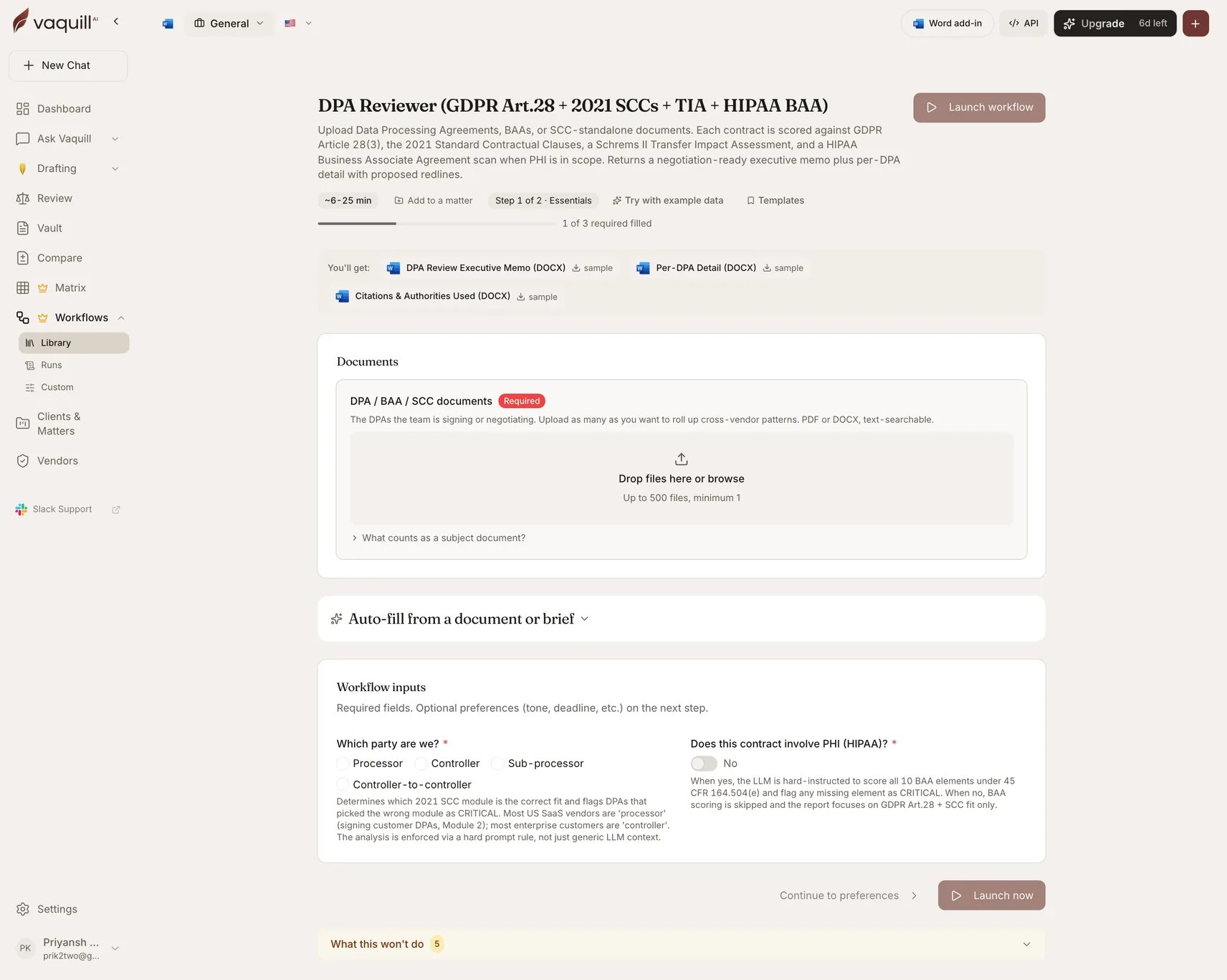
The DPA Reviewer launcher: document slots, inputs, and what you get
What you need
Inputs
Both required fields are enforced as hard prompt rules rather than as generic context, so a wrong-module DPA gets flagged rather than quietly passed over.
How it runs
A matrix-review pipeline:prepare → extract → wait for extraction → normalize and score → synthesize → render.
The matrix columns are the Article 28(3) sub-obligations, the SCC module-fit questions, the Schrems II TIA factors, and, when PHI is in scope, the ten BAA elements. Each cell is answered against one DPA with its supporting quote, then documents are scored, then a portfolio synthesis runs and is verified before persistence.
What you get
What this will not do
- Negotiate with the vendor counterparty on your behalf.
- Replace partner or privacy-counsel sign-off, especially on Schrems II TIA conclusions and HIPAA BAA gaps.
- Track regulatory updates after the run: Data Privacy Framework status, ICO IDTA changes, state law amendments.
- Assess data-flow facts that are not in the DPA, such as actual sub-processor identities, real security incident history, or encryption-key custody.
- Apply company-specific risk tolerance. Edit the overall recommendation if your policy differs.
Related
DPA review guide
The single-document interactive version.
Privacy and Data Protection Audit
Broader than DPAs: audits a whole document set for privacy posture.