Most Legora comparisons are written for the wrong reader. They stack feature grids against Harvey and CoCounsel, then assume the buyer is a big firm with a procurement team and a six-figure budget. That is who Legora sells to, and it sells to them well. The question nobody answers is simpler. What does a solo general counsel, a fractional GC, or a four-person legal team do when Legora runs $300 to $800 per user per month?
The honest answer is: don't buy Legora. Not because the product is weak. It isn't. The company is built to sell to bigger firms, and it does not size down to you. This page is the comparison Legora won't write: for in-house counsel and lean 2-10 person teams who want a tool they can buy with a card, not a quarter-long sales cycle. Vaquill AI is that tool. Here is the case.
TL;DR
- Legora is built for bigger firms. Pricing runs $300 to $800 per user per month for unlimited AI. It is a bundle, so your tier and add-ons set the per-seat number. There is also a pay-as-you-go credit plan. Every plan goes through a sales call. Good product, wrong fit for a lean team.
- Vaquill is self-serve at $99 per user per month ($990 per year, 17% off annual). You get a 7-day free trial, no seat minimum, no per-feature gating, and no procurement maze. Sign in at app.vaquill.ai and start.
- Vaquill is an in-house workbench, not a search bar. You get AI drafting, contract review, AI redlining with real Microsoft Word track changes, matter management, compliance checks, negotiation playbooks, document comparison, the Document Matrix across dozens of contracts, and workflows. Research is in the box. It is not the whole pitch.
- Legora's real edge: deep Word integration, Tabular Review for portfolio-scale due diligence, coverage across 50+ markets, and big-firm names like White & Case and Bird & Bird.
- The clean split: Legora if you are a multinational firm doing cross-border deals with a procurement process. Vaquill if you are a GC, fractional GC, or 2-10 person team that wants the workbench today, self-serve, without a sales cycle.
This is part of our legal AI vendor comparison series.
What Legora actually is, and where it's genuinely good
Legora (formerly Leya) is one of the best-funded names in the category. It has raised $266M, closed a $150M Series C in October 2025 at a $1.8B valuation, and runs on 600+ law firms and legal teams. That is not vapor. When you land White & Case, Bird & Bird, Cleary Gottlieb, and Linklaters, you have cleared the hardest procurement bars in the business. Give the strengths their due before the gripes, because the strengths are real.
Big funding and big logos. Legora has the balance sheet and the customer list. White & Case signed a strategic partnership. Bird & Bird rolled it out firmwide. The company is reportedly in talks at a $6B valuation. For a firm whose biggest fear is betting on a tool that won't exist in three years, that track record calms nerves.
Tabular Review for portfolio due diligence. Tabular Review turns a folder of contracts into a grid. You ask one question across hundreds of agreements and read the answers down a column. For M&A diligence or an audit where the job is bulk extraction, this is a strong design, and it is the feature most worth respecting.
Deep Microsoft Word integration. Legora's Word add-in puts AI right inside the drafting window, with comments, redlines, and playbooks. Transactional lawyers live in Word, and meeting them there with no context switch is the right call. Vaquill copies the principle: redlines export as real Word track changes, not a screenshot of suggestions.
Multi-market coverage. Legora works across 50+ markets through content partnerships. That includes Manupatra in India, Tirant lo Blanch in Spain and Latin America, and FromCounsel in the UK and Nordics. If your work spans borders, that reach is hard to beat.
None of that is in dispute. The dispute is about who gets to buy it, and at what floor.
What users actually say about Legora
Legora is cheaper than Harvey, and buyers notice. But on forums, reliability complaints take over the thread. A botched rollout earned the support team the nickname "Letgora." Users flag legal-hold and retention gaps. Several report answer quality dropping off once a document runs past about 200 pages, plus the old "wrapper over Claude" jab. You can read the r/legaltech pricing thread where lawyers compare it head to head with Harvey, CoCounsel, and Claude. The product is capable. Just go in knowing the rough edges, especially on big documents.
How Legora and Vaquill compare
| Capability | Legora | Vaquill |
|---|---|---|
| Access model | Sold to bigger firms through sales. Used by 600+ firms. No self-serve path for solos or lean teams. | Self-serve signup with a 7-day free trial. Built for in-house counsel and GCs, solo through 10-person teams. |
| Pricing | $300 to $800 per user per month for unlimited AI. A bundle, so tier and add-ons set the price. There is a pay-as-you-go credit plan too. Sold through sales. | Plain. $99 per user per month, $990 per year (17% off). No tiers, no per-feature gating, no seat minimum. |
| AI drafting | Word-native drafting and playbooks (strength). | Describe a doc in plain English. Draft with jurisdiction-aware clauses, edit in-app, export to Word. |
| Contract review | Tabular Review turns contract folders into grids. Strong at bulk due diligence (strength). | Clause-level review with risk flags. Eight guided Skills built into the chat. |
| AI redlining | Redlining inside the Word add-in (strength). | AI redlining that makes real Word track changes. Accept or reject in Word. |
| Word integration | Word add-in for drafting, comments, redlines, playbooks (strength). | Web workbench with native Word export and track-changes redlines that round-trip into Word. |
| Matter management | Project workspaces. No email-to-matter inbox or auto-built chronologies on record. | Matter workspaces. A matter inbox. 100-document chat. Auto-built chronologies. |
| Document comparison | Comparison inside review workflows. | First-class compare, plus the Document Matrix across dozens of contracts at once. |
| Negotiation playbooks | Static playbooks with set checks (strength for standard contracts). | Playbooks and guided Skills that hold your fallback positions and run on incoming drafts. |
| Compliance checks | Guided workflows across 50+ markets (strength). | Compliance Check Skill plus 4-layer answer checks, with confidence scores per claim. |
| Workflows | Guided research and workflows (strength). | Agent Mode chains up to 5 loops with 3 tool calls each. Memories hold your settings. |
| Multi-market coverage | 50+ markets via content partners (strength). | US-focused. Own database of US opinions, US Code, CFR, and all 52 state and territory codes. |
| Team controls | Firm-wide rollout (strength). | Team workspaces with roles: Owner, Admin, Member, Viewer. |
| Data posture | Enterprise terms via Legora. | SOC 2 / ISO 27001-aligned. US data on AWS. Never trains on your data. DPA/BAA on hand. |
The pattern is plain. Legora wins on enterprise breadth and big-firm proof. Vaquill wins on the in-house workbench shape, and on being a tool a single GC can actually buy.
The Vaquill workbench, in pictures
The fastest way to see the difference is to look at a workday inside Vaquill. It starts in drafting, not in a search box.
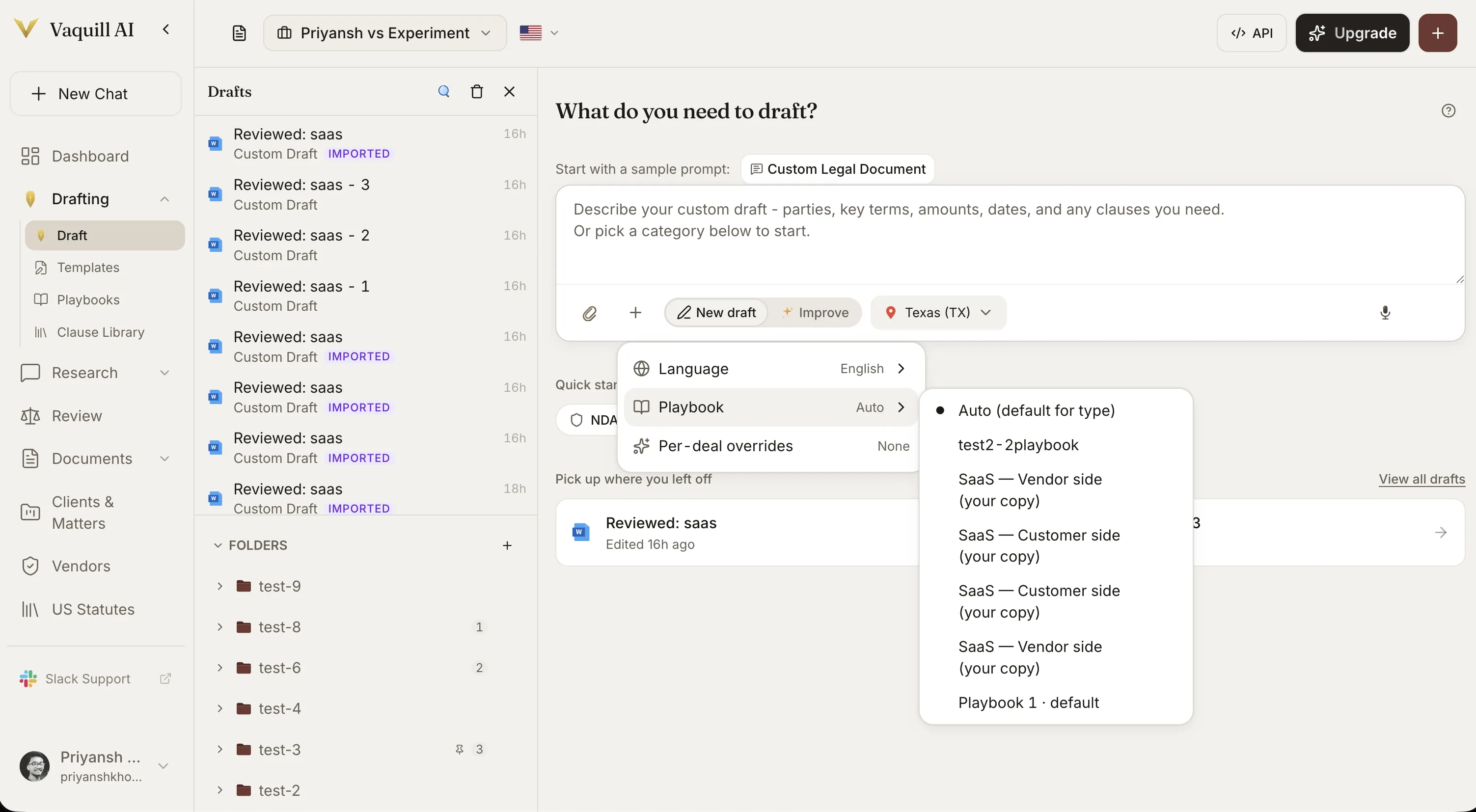 Drafting. Describe a vendor MSA, an NDA, or a board consent in plain English, draft with jurisdiction-aware clauses, edit in the workbench, and export to Word.
 Research, when you need it. Ask a question in plain English and get a cited answer grounded in statutes and case law, with every citation run through 4-layer verification. It supports the drafting work. It is not the product.
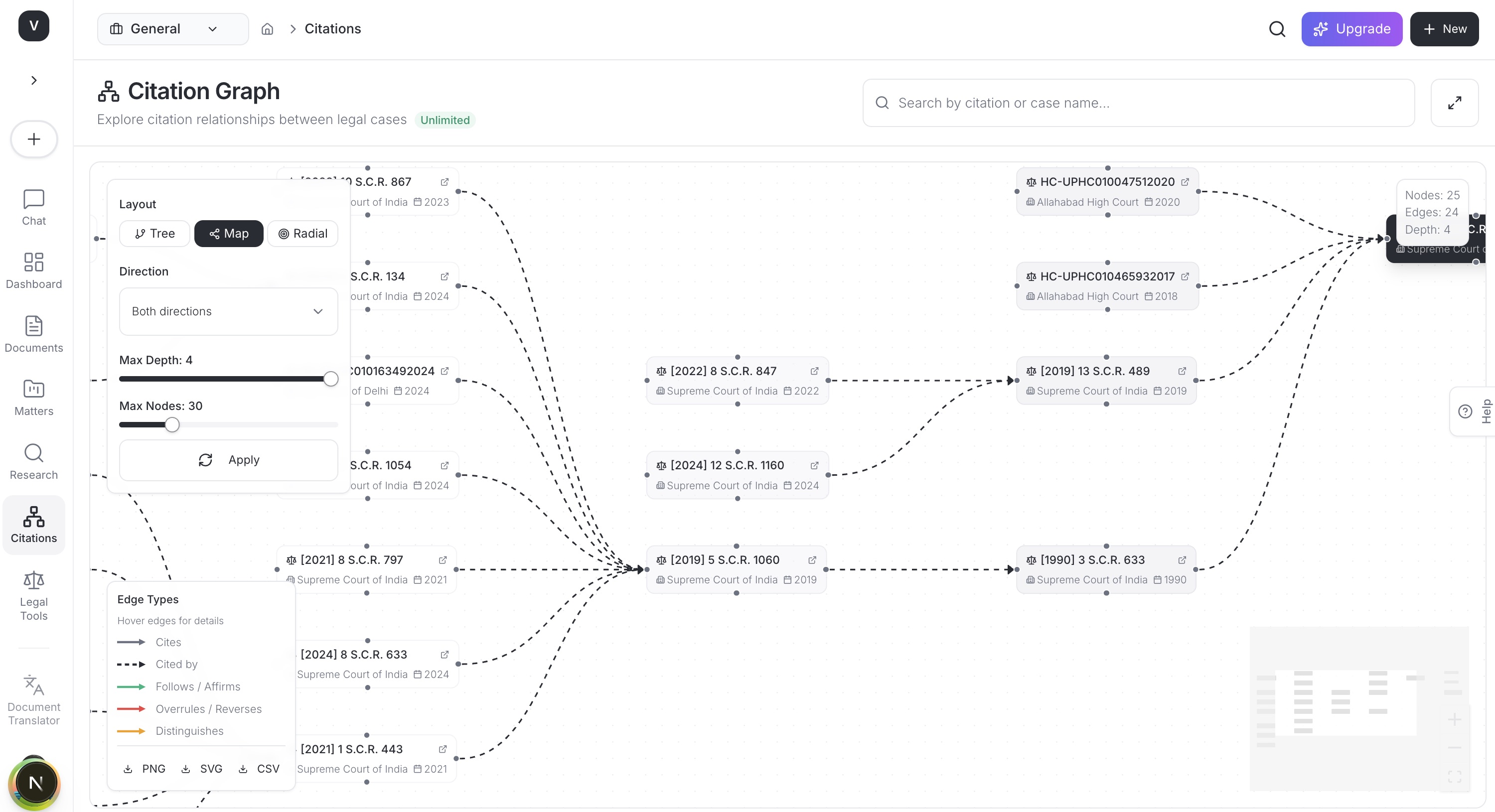 Authority checking. When a clause turns on a contested point, trace how an opinion has been followed, distinguished, limited, or overruled before you lean on it in a redline.
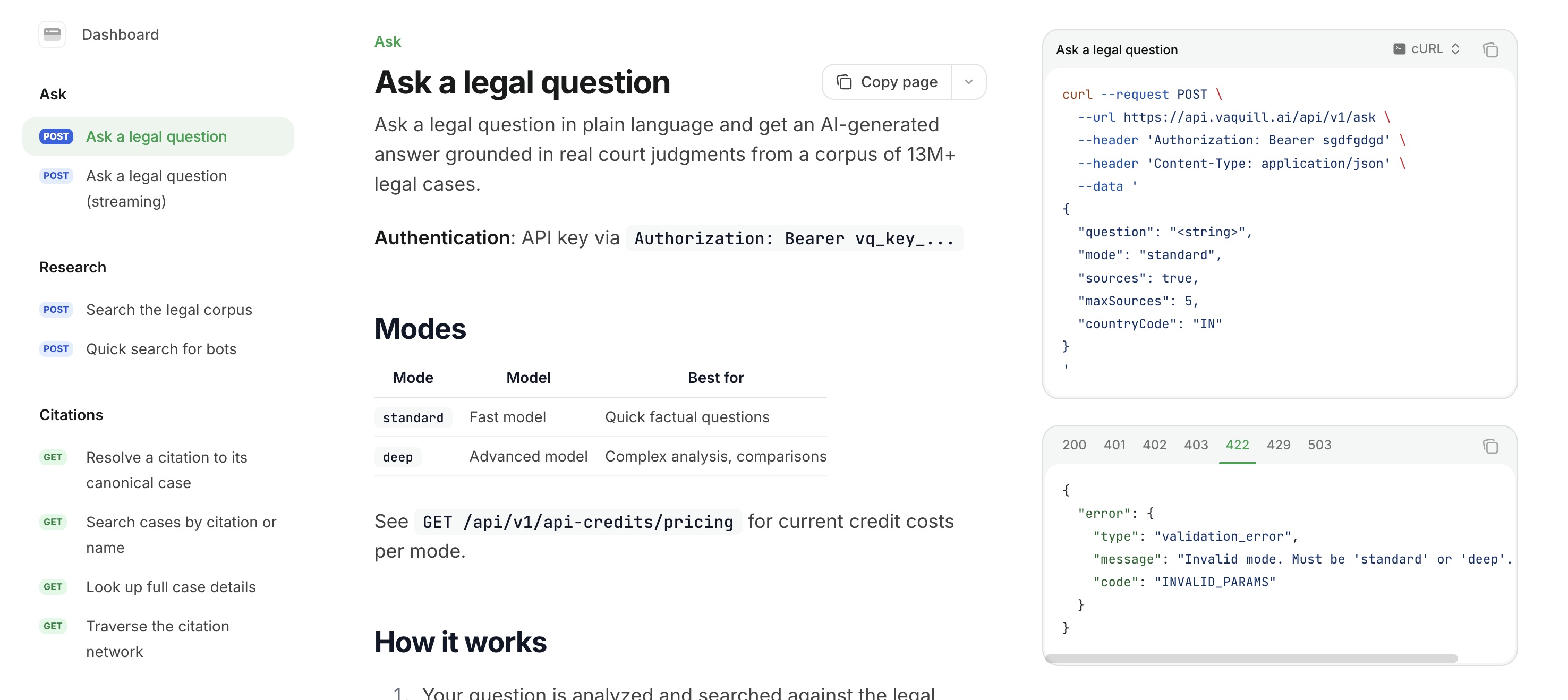 For legal-ops teams that automate. A self-serve REST API and MCP server let you wire Vaquill into the tools your team already runs, with no account rep in the loop.
The drafting, redlining, and matter surfaces are the daily-use core. See the full set on the legal tools page and the workflows page.
Where Legora's model creates limits for in-house teams
These are not knocks on Legora's engineering. They follow from building for the top of the market, and they bite the buyer Legora doesn't court.
Enterprise-shaped pricing and motion. Legora runs $300 to $800 per user per month for unlimited AI. It is a bundle, so your tier and add-ons set the per-seat price, and there is a pay-as-you-go credit plan too. Every plan goes through sales. The per-seat number plus the annual contract price out solo GCs, fractional GCs, and lean teams that want to start today. There is no self-serve path. A GC who needs a tool this quarter cannot wait on a sales cycle.
No self-serve trial for small teams. Adoption assumes a firm-wide rollout. A two-lawyer in-house team that wants to test AI redlining on next week's contracts has no way to do that on its own card. Vaquill's 7-day free trial exists for exactly that lawyer, the one who wants to prove value on real work before talking to anyone.
Tuned for transactional Word work, less for the in-house matter loop. Legora's playbooks are static with set checks, built for large-scale portfolio review. That is a strength for diligence and a gap for the in-house rhythm of many small matters over time. There you want a matter inbox, persistent matter memory, and auto-built chronologies, not a one-shot grid.
No public developer API. Legora's integrations (iManage, SharePoint) live inside the platform, with no public API for a legal-ops engineer to build on. A lean team that wants to automate intake, or wire review into Slack or n8n, has nothing to call. Vaquill ships a self-serve REST API and MCP server.
Coverage rides on partnerships. Legora's reach comes from content partnerships, not an owned database. For a US in-house team, that is a dependency on partnership terms you don't control. Vaquill indexes US opinions, the US Code, CFR, and all 52 state and territory codes directly.
Who each tool is actually for
The clearest way to choose is by the spot you are in, not the feature you are chasing.
In-house counsel and lean teams priced out of enterprise tools. You need AI drafting, redlining, and review, but Legora wants a sales call at a per-seat price a 2-10 person team can't justify. Vaquill gives you a 7-day free trial, plain $99 per user per month pricing, no seat minimum, and every feature on every seat. Start on real work, expand if it earns it.
Fractional and solo GCs running many small matters. You handle dozens of active matters across clients and need them organized, not flattened into one workspace. Vaquill's matter workspaces, matter inbox, 100-document chat, and auto-built chronologies are built for this loop. Legora's portfolio-grid model is not.
Teams that want AI redlining that survives the round-trip. The redline has to land in Word as real track changes a counterparty can accept or reject, not a list you retype. Vaquill's AI redlining exports native Word track changes. Legora does this well inside its add-in too. The difference is you can buy Vaquill without an enterprise contract.
Legal-ops teams that automate. You want to wire intake, review, or compliance checks into your stack. Vaquill's REST API and MCP server give you a self-serve programmatic surface. Legora's integrations are internal-only with no public API.
Multinational firms doing cross-border deals. You need coverage across 50+ markets, portfolio-scale Tabular Review, and a vendor with big-firm proof, and you have a procurement process to run. That is Legora's home turf, and you should look there first.
When Legora is the right call
You are at a large or multinational firm. You need coverage across 50+ markets, portfolio-scale due diligence through Tabular Review, and deep Word integration for high-volume transactional work. Your firm already runs enterprise procurement. An annual contract at $300 to $800 per seat is normal. Seeing White & Case and Bird & Bird on the customer list is part of how you de-risk the call. In that world, Legora is a proven, well-funded, capable platform. The enterprise shape is a fit, not a friction.
When Vaquill is the better fit
You are in-house counsel, a fractional GC, a CLO, or part of a lean 2-10 person team. You want the full workbench: drafting, review, redlining, matters, compliance checks, playbooks, comparison, the Document Matrix, and workflows. You want it without a sales cycle in the way. You want to swipe a card, not book a call. You want plain $99 per user per month pricing with no seat minimum and no per-feature gating. You want a 7-day free trial to prove value on this week's contracts. You want US data residency, no training on your data, and a DPA/BAA on hand. And you want a self-serve API if your team ever decides to automate. Legora is built for bigger firms. Vaquill was built for you. See how it maps to the role on the in-house counsel page.
FAQ
Does Vaquill have an agentic workflow mode like Legora's? Yes. Vaquill's Agent Mode picks the tools to use. It chains them across up to 5 iterations with 3 tool calls each. Then it pulls results together across your documents, statutes, and case law, with every claim run through 4-layer verification. Cross-session Memories hold your jurisdiction, practice area, and citation preferences. You get up to 1,000 per user, with the 5 most relevant added per query. Eight expert Skills give you guided playbooks built into the chat.
How does Vaquill organize work by matter compared to Legora? Vaquill organizes everything by matter or client. Roles run from Owner to Admin to Member to Viewer. Each matter has its own inbox. Forward a contract, pleading, or memo to your matter address and it lands indexed and ready to query, with answers in the same email thread. 100-document chat lets you query a whole deal room at once. Chronology Builder pulls dates and events across all matter documents into an exportable timeline. Legora's project workspaces don't document an email-to-matter inbox or auto-built chronologies.
What is Legora, and how is it different from Leya? Legora is the rebranded name of Leya, an AI legal assistant founded in 2023 in Stockholm. The company rebranded from Leya to Legora in February 2025 and has since raised $266M total at a $1.8B valuation, serving 600+ firms across 50+ markets.
How much does Legora cost, and how does that compare to Vaquill? Legora runs $300 to $800 per user per month for unlimited AI. It is a bundle, so your tier and add-ons set the per-seat price, and there is a pay-as-you-go credit plan too. In June 2026 Legora also moved its Agent Pro product to consumption-based pricing (source: legora.com). You contact sales for a quote. Vaquill publishes its price: $99 per user per month, or $990 per year on annual (17% off), with a 7-day free trial, no seat minimum, and no per-feature gating. For the full breakdown, see how much Legora costs in 2026.
Can a solo GC or a 3-person in-house team actually buy Legora? Not easily. Legora is sold to firms like White & Case, Bird & Bird, Cleary Gottlieb, and Linklaters through a sales process. At $300 to $800 per seat per month on an annual contract, it is shaped for bigger buyers than a solo or small in-house team. Vaquill is built for that buyer: self-serve signup, $99 per user per month, no seat minimum, and a 7-day free trial.
Does Vaquill do AI redlining in Microsoft Word like Legora? Yes. Vaquill produces AI redlines as real Microsoft Word track changes, so a counterparty can accept or reject them natively. Legora redlines well inside its Word add-in too. The practical difference is you can start with Vaquill on a self-serve plan instead of an enterprise contract.
Does Vaquill have a public API for legal-ops automation? Yes. Vaquill ships a self-serve REST API and an MCP server for tools like Claude Desktop, Cursor, and VS Code, so a legal-ops team can automate intake or review without an account rep. Legora's integrations (iManage, SharePoint) live inside the platform with no public API.
Sources
- Leya rebrands as Legora (Feb 2025).
- Legora $150M Series C, $1.8B value (Oct 2025).
- Legora $80M Series B, $675M value (May 2025).
- Legora in talks for $6B value (Feb 2026), Sifted.
- r/legaltech: Harvey vs Claude vs Legora vs CoCounsel.
- Legora Series C blog: clients in 40+ markets.
- Legora product page: Tabular Review, Word add-in.
- White & Case partners with Legora.
- Bird & Bird rolls out Legora firmwide.
- Legora and Manupatra partner (India).
- Legora partners with Tirant lo Blanch (Spain).
- Legora partners with FromCounsel (UK).
- Legora on Y Combinator.
Ready to try a workbench you can start without a sales call? Start a 7-day free trial at app.vaquill.ai, no sales call, no seat minimum. For role context, see Vaquill for in-house counsel, and for the cost breakdown, read how much Legora costs in 2026.


