Here are 100 generative AI prompts in-house lawyers can copy, paste, and adapt today. They are grouped into 10 categories: contract review, NDAs, drafting, negotiation, research, compliance, employment, corporate, vendor management, and litigation and ops.
Every prompt uses fill-in-the-blank placeholders like [contract], [jurisdiction], and [counterparty] so you can drop in your own facts. Treat the model's output as a fast first draft, then verify it.
TL;DR
- This is a working library of 100 prompts for in-house counsel, 10 per category, all numbered and ready to paste.
- Use them well by feeding the model real context: the document, your playbook, the governing law, and the output format you want.
- Always ask for the source of any legal claim, then check it. AI legal tools still hallucinate cites.
- Never paste privileged or confidential data into an ungrounded consumer chatbot. Use a tool that keeps your data private.
- These prompts speed up drafting and review. They do not replace your judgment or a final human read.
- Per ABA Formal Opinion 512, you stay responsible for the work product, so verify outputs before they leave your desk.
A Stanford HAI study cited in this post found that even purpose-built legal AI tools hallucinated how often?
How to use these prompts well
A prompt is only as good as the context you give it. The same prompt produces a generic answer with no input and a sharp one when you paste the actual document and your rules.
Four habits make these prompts work:
- Give the model context. Paste the full contract, the clause, the policy, or the fact pattern. Tell it your role, the jurisdiction, and who you represent.
- Hand it your playbook. If you have fallback positions or standard terms, include them. The model can only match your standard if it can see it.
- Ask for sources. Add "cite the specific clause, statute, or case and quote the language you relied on" to any research or review prompt.
- Verify everything. Open the cited clause or statute yourself. AI legal models still invent citations, so a cite you did not check is a cite you cannot trust.
A Stanford HAI study found that even purpose-built legal AI tools hallucinated on at least one in six benchmarking queries. That is the whole reason the verify step is not optional.
Every prompt below runs through the same loop.
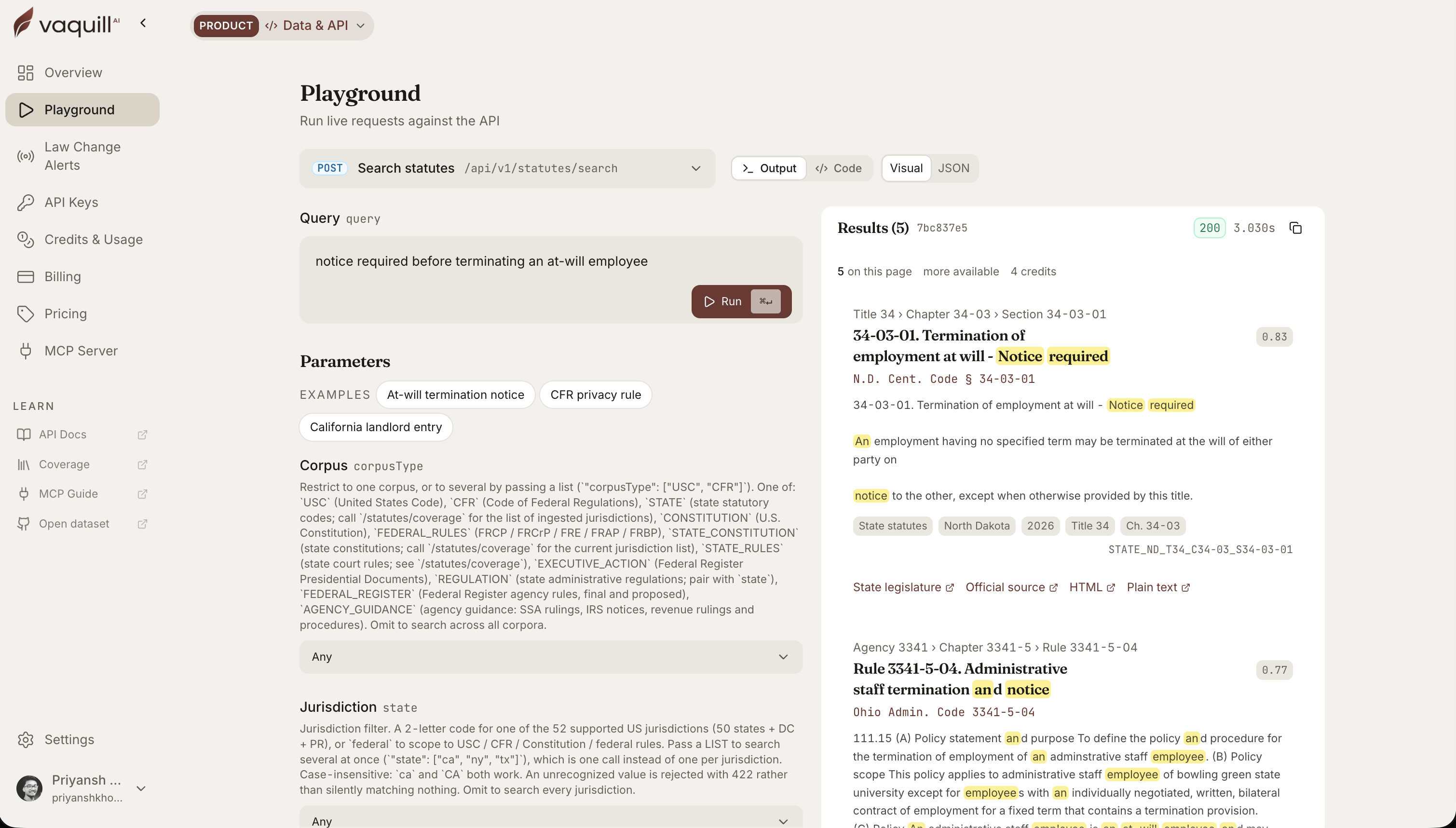 The same corpus behind this article, queried live. Every result carries its citation and a link to the official source.
Contract review and redlining
These help you triage an inbound draft, find the risk, and mark it up against your standard. Paste the full agreement and your playbook so the model grades against your positions, not a generic ideal.
1. Risk-rank an inbound contract against our playbook
You are in-house counsel for [COMPANY], reviewing the agreement below as the [customer / vendor / partner].
Our playbook positions: [paste, e.g. liability cap = 12 months fees; mutual indemnity; 30-day termination for convenience; no auto-renewal].
Agreement: [paste full text].

Tasks:
1. List the 8 highest-risk terms for us, ranked most to least severe. Quote the exact clause text and its section number.
2. For each, mark it Meets / Misses / Partial versus our playbook, with a one-line reason.
3. Propose redline language for the 3 worst, each with a one-line business rationale I can say on a call.
Return one Markdown table: Section | Clause (quoted) | Risk to us | Playbook status | Proposed redline | Why.
Do not reference any clause you did not quote. Add a final line listing anything you were unsure about.
2. Full clause-by-clause playbook compliance pass
Compare the attached agreement against our playbook, clause by clause.
Playbook: [paste standard positions and fallbacks].
Agreement: [paste].

For every clause that falls outside our standard, output a row: Section | What it says now | Why it misses our position | Replacement language (ready to paste) | Fallback if they reject it.
Group the rows under headings: Deal-breakers, Negotiate, Acceptable-with-edits. Quote section numbers. Do not invent positions our playbook does not state; if our playbook is silent on a clause, mark it "no playbook position" rather than guessing.
3. Business-terms extraction table for the deal owner
Read the agreement below and extract the business terms a non-lawyer owner needs.
Agreement: [paste].

Return a table with: Parties, Effective date, Term length, Renewal mechanics, Fees and payment timing, Price-increase rights, Liability cap, Indemnity scope, Termination rights (each side), Governing law and venue, Assignment/change-of-control, Key dates to calendar.
For any term that is missing from the contract, write "not addressed" instead of guessing. Add a 3-sentence plain-English summary at the top for the business owner.
4. Missing-clause gap check by agreement type
This is a [type of agreement, e.g. SaaS MSA] where we are the [role]. Agreement: [paste].
Tell me what a careful in-house lawyer would expect in this type of agreement that is missing or too thin here.
Check at least: limitation of liability, indemnity, IP ownership and license scope, confidentiality, data protection/DPA, security, termination and effects of termination, warranty and disclaimer, insurance, assignment, dispute resolution.
Return a table: Expected protection | Present? (yes/partial/no) | Section if present | Why it matters to us | Suggested clause to add. Do not pad the list with clauses irrelevant to this agreement type.
5. Targeted liability-cap redline with rationale
Redline the clause below so that: our aggregate liability is capped at [amount or "12 months of fees paid"], indirect and consequential damages are excluded for both parties, and the cap is uncapped only for [confidentiality breach / IP indemnity / gross negligence].
Clause: [paste current language].
Output: (1) the full revised clause in clean form, (2) a redline showing exactly what changed (additions and deletions), (3) a one-line rationale for each change I can give the counterparty. Keep defined terms consistent with the rest of the contract.
6. Defined-terms integrity audit
Audit the defined terms in the agreement below. Agreement: [paste].
Return three lists: (a) terms used in the body but never defined, (b) terms defined but never used, (c) terms whose definition and usage seem inconsistent. For each, give the section reference. This is a mechanical check, so quote the exact text and do not infer meaning the contract does not state.
7. Plain-English explainer of a heavy clause
Explain the clause below to me as if I am briefing a busy business owner, then as a lawyer.
Clause: [paste, e.g. the indemnification or limitation-of-liability section].
Give: (1) a 3-sentence plain-English version (who owes what to whom, triggered by what, with what limits and carve-outs), (2) the two scenarios where this clause would actually bite us, (3) the one change that would most reduce our exposure. Quote the operative language you are interpreting.
8. Hidden-term sweep (auto-renewal, exclusivity, MFN, most-favored)
Scan the agreement below for terms that quietly create long-term obligations or lock-in.
Agreement: [paste].
Find and quote any: auto-renewal or evergreen term, notice-to-terminate window, exclusivity or non-compete, most-favored-nation/pricing, minimum commitment or take-or-pay, unilateral change rights, perpetual license or survival clause.
Return: Term type | Quoted language | Section | Plain-English effect | How to neutralize it. If a category is absent, say "none found" rather than inventing one.
9. Governing-law enforceability flag
This agreement is governed by [jurisdiction] law. Agreement: [paste].
Flag any clause that may be unenforceable, unusual, or interpreted differently under [jurisdiction] law (for example, liability waivers, non-competes, liquidated damages, indemnity for one's own negligence, choice-of-law/venue).
For each, quote the clause, name the [jurisdiction]-specific concern, and cite the statute or doctrine by name. Mark anything you are not certain about as "verify with local counsel," and do not state a holding you cannot name a source for.
10. Three-tier redline options for a contested clause
Draft three redline options for the [clause, e.g. termination] below, so I can choose by appetite.
Current clause: [paste]. Our goal: [state what we want]. Their likely concern: [state if known].
Provide: Option A (aggressive, best for us), Option B (balanced/market), Option C (a fallback the counterparty is likely to accept). For each, give the full clause text plus one line on what we give up. Keep numbering and defined terms consistent with the contract.
NDAs and confidentiality
NDAs are high volume and low variation, so they are the easiest review to template. Tell the model which side you are on, because the same term reads very differently for the disclosing party and the receiving party.
11. Side-aware NDA review
Review the NDA below. We are the [receiving / disclosing / both] party, the purpose is [purpose], and we are based in [state].
NDA: [paste].
Flag every term that is off-market or unfavorable for our side specifically. For each: quote the clause, say why it hurts our side, and give replacement language. Pay special attention to: definition of Confidential Information, term and survival, permitted disclosures, residuals, non-solicit/non-compete riders, return/destroy, and remedies (injunctive relief, fees). End with a one-line "sign as-is / negotiate / escalate" recommendation.
12. Convert one-way to mutual, with a change log
Convert the one-way NDA below into a balanced mutual NDA where both parties have the same obligations and rights.
NDA: [paste].
Output: (1) the full mutual version, (2) a numbered change log describing each substantive edit and why it was needed to make the obligations reciprocal. Keep the original defined terms and numbering where possible.
13. Hidden-rider sweep inside an NDA
Read the NDA below and find anything beyond ordinary confidentiality that is buried in it.
NDA: [paste].
Specifically quote any: residuals clause, non-solicit of employees or customers, non-compete, IP assignment or license, publicity restriction, exclusivity, or obligation that survives indefinitely. For each, quote the language, give the section, and explain the real-world effect on us. If none exist, say "none found."
14. Confidentiality-period benchmark
The confidentiality period in this NDA is [duration], and the deal context is [industry, type of information, e.g. M&A diligence / source code / customer data].
Tell me whether that duration is market-standard for this context, what range is typical, and whether trade secrets should be carved out to be protected for as long as they remain secret. Propose a specific revised survival clause. Note that this is general market practice, not legal advice, and flag anything I should confirm.
15. Draft a tight mutual NDA
Draft a mutual NDA, under two pages, for a [purpose, e.g. potential partnership] discussion between [Party A, entity type and state] and [Party B].
Governing law: [jurisdiction]. Include: standard Confidential Information definition with the usual carve-outs, mutual obligations, [duration]-year term with trade secrets protected while secret, permitted disclosures to representatives on a need-to-know basis, compelled-disclosure procedure, return/destroy, no license/IP transfer, injunctive relief, and no implied warranty. Keep it plain and readable. Leave bracketed placeholders for names, dates, and notice addresses.
16. Two-NDA diff
Compare these two NDAs and produce a side-by-side difference table.
NDA A: [paste]. NDA B: [paste].
Columns: Topic | NDA A position | NDA B position | Which is better for the receiving party | Note. Cover at least: definition scope, term/survival, permitted disclosures, residuals, return/destroy, remedies, governing law. Flag any clause present in one and absent in the other.
17. Rebuild the Confidential Information definition
Rewrite the definition of Confidential Information in the NDA below so it is fair to the receiving party.
Current definition: [paste].
Add the four standard carve-outs (information that is or becomes public through no fault of the receiver, was already known, is independently developed without use of the confidential information, or is rightfully received from a third party) and require disclosures to be marked or confirmed in writing. Return the clean revised definition plus a one-line note on each carve-out you added.
18. Survival and term map
From the NDA below, map what survives and for how long.
NDA: [paste].
Return a table: Obligation | Survives termination? | Duration | Section. Cover confidentiality, return/destroy, non-solicit (if any), and any indemnity or remedy. Quote the survival and term language you relied on, and flag if the survival period is open-ended.
19. Permitted-disclosure check for representatives
Does the NDA below let us share Confidential Information with our affiliates, outside advisors, and counsel on a need-to-know basis, and does it make us responsible for their compliance?
NDA: [paste].
Tell me yes or no with the quoted clause. If it is too narrow, draft a permitted-recipients clause that covers affiliates, employees, and professional advisors who are bound to confidentiality, plus the standard compelled-disclosure (subpoena) procedure.
20. Return-or-destroy obligations at exit
Summarize what we must do with the other party's information when this NDA ends.
NDA: [paste].
Quote the return/destroy clause and tell me: what must be returned vs destroyed, the deadline, whether we may keep one archival copy or backups, whether written certification is required, and whether confidentiality continues after return. If the clause is silent on backups or legal-hold copies, flag that as a gap and propose carve-out language.
Drafting and templates
Use these to produce a first draft fast, then edit to your house style. Give the model your party details, governing law, and any house conventions so the draft lands close to final, not generic.
21. Draft a full agreement from a deal brief
You are in-house counsel drafting a [type of agreement, e.g. SaaS MSA / reseller / consulting] between [Party A, entity type and state] (we are this party) and [Party B, entity type and state].
Deal facts: purpose = [purpose]; fees = [amount and timing]; term = [length and renewal]; governing law = [jurisdiction]; key risks we care about = [e.g. our IP, data, liability cap].

Draft the full agreement with these standard in-house positions baked in: liability cap = [12 months of fees], consequential damages excluded both ways, mutual confidentiality, our IP stays ours, [30]-day termination for convenience, no auto-renewal without written notice.
Use clear section headers and numbered clauses. Leave [BRACKETED] placeholders for names, dates, addresses, and any number I did not give you. Do not invent commercial terms I did not state; where a business term is missing, insert a bracketed placeholder instead of guessing. End with a short list of the open items I still need to confirm with the business.
22. Draft a limitation-of-liability clause to spec
Draft a limitation-of-liability clause for a [type of agreement] where we are the [customer / vendor], governed by [jurisdiction] law.
Requirements: aggregate liability capped at [amount or "the fees paid in the 12 months before the claim"]; indirect, consequential, incidental, and punitive damages excluded for both parties; the cap and the exclusion do NOT apply to [confidentiality breach / IP indemnity / gross negligence or willful misconduct / a party's indemnity obligations].

Return: (1) the clean clause with defined terms in [BRACKETS], (2) a two-line plain-English note on what the cap and each carve-out mean in practice. Keep it mutual unless I told you otherwise. Do not add carve-outs I did not request.
23. Draft a data processing addendum
Draft a data processing addendum (DPA) for a [vendor type, e.g. analytics SaaS] that processes [type of data, e.g. customer contact data / employee PII] on our behalf. We are the [controller / business]; they are the [processor / service provider]. Applicable law: [GDPR / CCPA-CPRA / both].

Include: subject matter and duration of processing, nature and purpose, categories of data and data subjects, processor obligations (process only on documented instructions, confidentiality, security measures, subprocessor approval and flow-down, assistance with data subject requests, breach notification timeline, deletion or return at termination, audit rights), and an exhibit placeholder for technical and organizational measures.
Map clauses to the relevant articles or sections ([GDPR Art. 28 / CCPA service-provider terms]) in a comment after each. Leave [BRACKETS] for party names, subprocessor list, and notice contacts. Flag any term that depends on a fact I have not given you rather than assuming it.
24. Draft a termination-for-convenience clause
Draft a termination-for-convenience clause for a [type of agreement] where we are the [customer / vendor], governed by [jurisdiction] law.
Terms: either party (or just us, if I say so) may terminate without cause on [number] days' written notice; no early-termination penalty or fee; on termination we pay only for services properly delivered through the termination date; specify what happens to prepaid fees ([pro-rata refund / non-refundable]) and to work product and data.

Return the clean clause plus a one-line note on each effect-of-termination point. Use [BRACKETS] for the notice period and notice mechanics. Do not bundle in termination-for-cause language unless I ask.
25. Draft an indemnification clause
Draft an indemnification clause for a [type of agreement] where [counterparty] indemnifies us, governed by [jurisdiction] law.
Scope of what they indemnify us against: third-party claims that our use of their product or services infringes a [patent / copyright / trademark / trade secret]; third-party claims arising from their breach of confidentiality or a data security incident caused by them; [add others].
Include: defense obligation, our right to participate with our own counsel, cooperation, control of settlement (no settlement admitting our fault or imposing obligations on us without consent), and the standard IP-infringement remedies (procure the right, modify, replace, or refund).

Return: (1) the clean clause with [BRACKETS], (2) a short note on whether this should sit inside or outside the liability cap and why. Keep it one-way (them to us) as requested; flag if you think reciprocity is market here.
26. Turn deal terms into a clean term sheet
Turn the agreed business terms below into a clean, non-binding term sheet for a [transaction type, e.g. commercial partnership / investment].
Agreed terms: [paste bullet points].

Format as a two-column table: Term | Detail. Cover at minimum: parties, structure, economics/pricing, term and termination, exclusivity (if any), IP, confidentiality, conditions to signing, and a "binding vs non-binding" line. For any term the bullets do not cover but that this deal type normally needs, add a row and mark the detail "[to be discussed]" rather than inventing it. Add a header line stating the term sheet is non-binding except for the confidentiality and exclusivity provisions.
27. Draft a side letter to amend one term
Draft a side letter to an existing [contract type] dated [date] between [Party A] and [Party B] that changes only [specific term, e.g. the payment timing / the liability cap] without reopening the rest of the agreement.
Current language: [paste the clause being changed]. Desired change: [describe].

The side letter should: identify the underlying agreement and the exact section being modified, state the new language, confirm that all other terms remain in full force, and include effective date and signature blocks. Use [BRACKETS] for names, titles, and dates. Do not restate or alter any clause other than the one I named.
28. Draft a plain-English cover note for the business owner
Write a plain-English cover note to the business owner who will sign the [contract] below. Reader is a non-lawyer.
Contract: [paste].

In under one page, tell them: (1) what we are committing to and what we get, in 3 sentences; (2) the money (what we pay or receive, when, and any increases); (3) the dates they must remember (renewal, notice, key deadlines); (4) the 3 obligations on us that are easiest to accidentally breach; (5) any term I should flag as unusual. Quote the section number next to each point so they can find it. Write at a reading level a busy executive can skim in two minutes. Do not give legal conclusions; describe what the document says.
29. Draft a master services agreement skeleton
Draft a master services agreement (MSA) skeleton where we are the [customer / vendor], governed by [jurisdiction] law, designed to sit above future statements of work.
Include numbered, labeled sections (with brief placeholder text, not full clauses) for: structure and order of precedence between MSA and SOWs, scope and SOW process, fees and invoicing, taxes, term and renewal, termination and effects, confidentiality, data protection (DPA by reference), intellectual property and license scope, warranties and disclaimers, limitation of liability, indemnification, insurance, assignment and change of control, notices, governing law and dispute resolution, and a general/miscellaneous section.
For each section, add a one-line note on the position we should default to. Leave [BRACKETS] throughout. Mark any section where the right position depends on the deal as "decide per deal."
30. Rewrite a clause into plain language without changing its effect
Rewrite the clause below into plain language a non-lawyer can follow on first read, keeping the legal effect identical.
Clause: [paste].

Constraints: do not change any obligation, right, deadline, number, or carve-out; only change the wording and structure. Use short sentences, active voice, and break long conditions into a numbered list where it helps.
Return: (1) the plain-language version, (2) a two-column table mapping each original obligation to its rewritten counterpart so I can confirm nothing shifted. If any phrase is genuinely ambiguous in the original, flag it rather than silently resolving it.
Negotiation and playbooks
These help you walk into a call knowing your asks, your fallbacks, and the other side's likely moves. Paste the actual draft and your standard positions so the model reasons from your facts, not a generic deal.
31. Build a prioritized ask list with fallbacks
You are advising me, in-house counsel, before a negotiation of the [contract type] below with [counterparty], where we are the [role].
Contract: [paste]. Our must-haves: [list]. Our nice-to-haves: [list]. What we can give up: [list if known].

Produce a negotiation brief: our top 5 asks ranked by importance, and for each give our opening position, our realistic target, our walk-away, and a fallback we could trade for. Format as a table: Ask | Why it matters | Opening | Target | Walk-away | Possible trade. Tie each ask to a specific clause and section number in the draft. Do not list asks the contract does not actually implicate.
32. Draft a counter to a specific clause
We are negotiating the [clause type] below and our position is: [state position, e.g. "the cap must be at least 12 months of fees and IP indemnity must be uncapped"].
Counterparty's proposed clause: [paste].

Draft our counter-language as a clean redline (showing additions and deletions), plus a one or two sentence rationale I can say out loud on the call that frames it as reasonable and market. If a clean middle position exists, also give a second, softer version we could fall to. Keep defined terms and numbering consistent with the draft. Do not concede anything in my stated position.
33. Predict counterparty objections and prep responses
We are pushing the position below on the [clause type] in our [contract type]. Our proposed language: [paste]. Counterparty is a [type of company, e.g. enterprise vendor / early-stage customer].

Predict the 3 objections they are most likely to raise, in priority order. For each, give: the objection in their words, why they are raising it (their real interest), our response, and a fallback if they hold firm. Format as a table. Flag which objection is most likely to actually block the deal so I prepare hardest for it. Keep responses to things I can credibly say; do not invent facts about the counterparty.
34. Turn redlines into a negotiation tracker
Turn the marked-up draft (or the list of open points) below into a clean negotiation tracker the deal team can follow.
Input: [paste the redlined contract, the comment summary, or the list of disputed issues].

Output a table: # | Section | Issue | Our position | Their position | Importance to us (high/med/low) | Status (open / agreed / parked) | Next step. One row per substantive issue, ordered by importance. Where a position is unstated in the input, write "not yet stated" rather than guessing it. Add a one-line summary at the top: how many issues are open and which are the deal-blockers.
35. Build a clause playbook
Build a reusable clause playbook for [clause type, e.g. limitation of liability / data security / termination] for us as the [customer / vendor] in [type of deal].
Reflect our risk tolerance: [describe, e.g. "conservative on data, flexible on price"].

Produce three tiers with sample language for each: Ideal (best case for us), Acceptable (the market middle we are happy to land on), and Walk-away (the worst we will sign, below which we escalate). For each tier give: the clause language in [BRACKETS], the rationale, and the trade we would want in exchange for moving to that tier. Add a "red flags" list of counterparty asks on this clause that should always trigger escalation. Base the tiers on common market practice and label it as such, not as legal advice.
36. Draft an email rejecting a clause and proposing a middle path
Draft a short, professional email to [counterparty contact] explaining why we cannot accept their [clause type] as drafted and proposing a workable middle path.
Their clause: [paste]. Why it does not work for us: [reason]. The compromise we can offer: [describe].

Tone: collaborative and firm, not adversarial; frame our position around shared interest in closing. Keep it under 150 words. Lead with the proposed solution, not the rejection. Include the specific revised language we are offering or attach-by-reference. Do not over-explain or apologize. Leave [BRACKETS] for names and any specifics I have not supplied.
37. Summarize negotiation status from a thread
Read the email thread below and tell me exactly where this negotiation stands.
Thread: [paste].

Return: (1) a 3-sentence status summary; (2) a table of every open issue with our latest position, their latest position, and who owes the next move; (3) anything that appears agreed and should be locked; (4) any deadline, commitment, or concession that was made in the thread and should be tracked. Quote the line you relied on for each agreed point so I can confirm it. Flag anything ambiguous as "unclear, confirm" rather than resolving it yourself.
38. Score how favorable a draft is to us
Score the proposed [contract type] below from 1 to 10 on how favorable it is to us as the [role], where 10 is ideal for us and 1 is one-sided against us.
Contract: [paste]. Our priorities: [list]. Our playbook positions if any: [paste].

Give the overall score, then a breakdown table: Area (liability, indemnity, IP, termination, payment, data, etc.) | Sub-score 1-10 | One-line reason | Quoted clause and section. Finish with the 3 changes that would most improve our score and roughly how many points each would add. Score against our stated priorities and quote the language you relied on; do not score areas the contract does not address.
39. Draft the same ask in three tones
Draft three versions of the same negotiation ask so I can pick the tone for [counterparty].
The ask: [describe what we want, e.g. "extend payment terms to net 60" or "remove the auto-renewal"]. Context: [relationship status, leverage, deadline].

Give: Version A (firm, leverage-forward), Version B (collaborative and balanced), Version C (flexible, relationship-first). Each should be a short message of 3 to 5 sentences making the same substantive request, differing only in tone and framing. Add a one-line note on when each version is the right call. Keep the actual ask identical across all three.
40. Generate creative compromises to break a deadlock
We are deadlocked on [issue] in the [contract type] with [counterparty]. Our core interest underneath the position is [interest, e.g. "we need predictable cost, not necessarily a low cap"]. Their stated position is [theirs].

Suggest 3 creative compromises that protect our core interest while giving them something they can accept. For each: describe the structure, explain why it satisfies both interests, give sample contract language in [BRACKETS], and note the risk to us. Think beyond splitting the difference (e.g. trade across clauses, add conditions, phase the term, tie to a metric). Do not propose anything that sacrifices our stated core interest.
Legal research and memos
Use these to get oriented fast, but treat every output as a lead to verify, not an answer. Models invent citations, so every prompt here forces the model to name and quote its source and reminds you to open it before you rely on it.
41. Summarize the law on an issue with quoted authority
Summarize the current law on [legal issue] in [jurisdiction] for an in-house audience.
Give: (1) a 3-sentence bottom line; (2) the governing statute(s) by exact citation, with the operative language quoted; (3) the 2 to 3 leading cases by full citation, with the holding quoted in one line each; (4) how the rule applies to a typical fact pattern like [describe ours].
For every legal proposition, cite the specific statute section or case and quote the exact language you relied on. Do not state a rule you cannot tie to a named, quoted source; if you are unsure a citation is real, say so. End with: "Verify each citation against the primary source before relying on this; AI can fabricate cites." List any point you could not source.
42. Explain the difference between two legal concepts
Explain the difference between [legal concept A] and [legal concept B] under [jurisdiction] law, in plain terms for a non-specialist lawyer.
Cover: the definition of each, the practical consequence of the distinction, and a concrete example where it changes the outcome. Where the distinction comes from a statute or case, cite it exactly and quote the defining language.
Do not blur the two or invent a bright-line rule the law does not draw. Flag any part of the distinction that is jurisdiction-specific or unsettled. End with: "Confirm these definitions against current [jurisdiction] authority before relying on them."
43. Draft an issue-spotting memo
Draft a short issue-spotting memo on whether the fact pattern below creates risk under [law or regulation] in [jurisdiction].
Facts: [paste]. We are: [role / company].

Structure: (1) Question presented; (2) Short answer with a risk level (low / medium / high); (3) The specific provisions of [law or regulation] in play, cited exactly and quoted; (4) How each provision applies to our facts; (5) Open questions and what would change the answer.
Cite the exact section or case for every legal point and quote the language. Do not assert a requirement or penalty without a named, quoted source. Mark anything uncertain as "verify." End with: "These citations must be checked against the primary source before action."
44. List the elements of a claim and the supporting evidence
List the elements I must prove (or defend against) for a [claim type] claim in [jurisdiction].
For each element: state it, cite the statute or controlling case that establishes it (exact citation, quoted language), and list the kind of evidence that typically proves or rebuts it. Then map our facts to each element: [paste our facts].
Format as a table: Element | Source (cited and quoted) | Evidence needed | How our facts measure up. Do not list an element you cannot tie to a named authority. Flag any element where the standard varies by court. End with: "Verify each cited authority before relying on this element list."
45. Find the statute of limitations and cite the provision
Find the statute of limitations for a [claim type] in [jurisdiction].
Give: the limitations period, the exact statutory citation, the quoted text of the provision, when the clock starts (accrual rule, with its source), and any common tolling or discovery-rule exceptions with their citations.
Do not state a number you cannot tie to a specific, quoted provision. If multiple periods could apply depending on how the claim is characterized, list each with its trigger. End with: "Statutes of limitations are frequently mis-cited by AI; open the cited section and confirm the period and accrual rule before relying on it."
46. Summarize recent changes to a law
Summarize the changes to [law or regulation] in [jurisdiction] over the last [time period] and what they mean for [our industry / our company].
For each change: describe it, cite the amending statute, rule, or effective-dated provision exactly and quote the new language, give the effective date, and state the practical action it requires from us.
Format as a table: Change | Citation (quoted) | Effective date | What we must do. Do not include a change you cannot source to a specific instrument and date. Flag anything that is proposed but not yet in force. End with: "Confirm each change and its effective date against the official source; do not rely on AI for whether a law is currently in effect."
47. Draft a one-page BLUF memo
Draft a one-page memo answering this question: [legal question], in [jurisdiction], for us as [role].
Relevant facts: [paste]. Use a bottom-line-up-front structure: (1) Bottom line in 2 sentences; (2) the rule, with exact citations and quoted language; (3) application to our facts; (4) risks and caveats; (5) recommended next step.
Keep it to roughly one page. Cite a specific statute or case for every legal assertion and quote the operative text; do not pad with unsourced generalities. Mark any assumption you made and any point that needs verification. End with: "Verify all citations against primary law before this memo is relied on or circulated."
48. Compare a legal issue across two states
Compare how [legal issue] is treated in [State A] versus [State B].
Return a table: Aspect | [State A] rule (cited, quoted) | [State B] rule (cited, quoted) | Practical difference for us. Cover at least: the governing standard, key exceptions, and any notable penalty or remedy difference. Then add a 2-sentence takeaway on which state is more favorable for our situation: [describe].
Cite the exact statute or case for each state's rule and quote the language. Do not assume the two states are the same on a point you have not separately sourced. Flag any point where one state's law is unsettled. End with: "Confirm each state's rule against current authority before relying on the comparison."
49. Extract holdings from a case and apply them
Pull the key holdings from the case below and tell me how they apply to our facts.
Case: [paste the opinion text or the full citation]. Our facts: [paste].

Return: (1) the holdings, each stated in one sentence with the exact passage quoted and the page or paragraph cited; (2) the court's reasoning in brief; (3) a table mapping each holding to our facts: Holding | Quoted language | How it cuts for or against us | Confidence. Rely only on language actually in the case text I gave you (or, if I gave only a citation, flag that you are working from memory and it must be verified). Do not attribute a holding the opinion does not state. End with: "Verify the holdings against the actual opinion before relying on them."
50. List open research questions before relying on the analysis
I have done preliminary analysis on [legal issue] in [jurisdiction] and reached this tentative conclusion: [paste your conclusion and the authority you used].
Act as a skeptical senior lawyer. List the open questions I should research further before I rely on this, ranked by how much each could change the outcome.
For each: state the question, why it matters, and where I would look (specific statute, regulation, or line of cases, cited exactly). Flag any authority I cited that you think may be outdated, overruled, distinguishable, or not actually on point, and say why. Do not reassure me; find the weak spots. End with: "Confirm the status of every cited authority (still good law, not overruled) before relying on this analysis."
Compliance and privacy
These cover CCPA-CPRA, GDPR, HIPAA, and the policy work that lands on in-house desks. Tell the model exactly what data you handle and which law applies, and have it cite the provision so you can confirm it.
51. Map obligations under a privacy regime
Map our obligations under [CCPA-CPRA / GDPR / HIPAA] for a company that does the following: [describe data activities, e.g. "we collect customer email and usage data via our SaaS app, and share it with analytics and payment vendors"].
We are based in [location] and serve [markets].

Return a table: Obligation | What the law requires | The provision (cited and quoted) | What we must have in place (policy, contract, process, or record) | Likely gap for a company like ours. Cover notices, individual rights, vendor/processor contracts, security, recordkeeping, and breach response.
Cite the specific article or section for each obligation and quote the operative language. Mark anything that depends on a fact I have not given as "depends, confirm." End with: "Verify each cited provision before relying on this map."
52. Audit a privacy policy for missing disclosures
Review the privacy policy below against [CCPA-CPRA / GDPR] and flag every required disclosure that is missing or inadequate.
Privacy policy: [paste].

Return a table: Required disclosure | Provision (cited) | Present in our policy? (yes / partial / no) | Quote of what we say now (or "absent") | Suggested language to add. Cover at least: categories of data collected, purposes, sources, sharing/selling/sharing-for-ads, retention, individual rights and how to exercise them, and contact details.
Quote the policy text you relied on; do not credit us with a disclosure that is not actually there. Cite the specific provision for each requirement. Flag any requirement that depends on facts about our processing I have not confirmed.
53. Draft a DSAR response procedure
Draft an internal procedure for responding to data subject access requests (and deletion and correction requests) that meets the [GDPR / CCPA-CPRA] timelines.
Our setup: requests come in via [channel]; data lives in [systems]; the responsible team is [team].

Include: how a request is received and logged, identity verification, the response deadline and any permitted extension (cite the provision), how we locate data across systems, what we must provide or do, permitted refusals and exceptions, how we document the response, and an escalation path. Format as numbered steps with the owner and deadline for each.
Cite the timeline provisions exactly. Leave [BRACKETS] for our specific systems, teams, and contacts. Flag any step where the requirement varies by request type.
54. Check a vendor contract for data-protection gaps
Check the vendor contract below for the data protection terms required when a [processor / service provider] handles [type of data] under [GDPR / HIPAA / CCPA-CPRA].
Contract: [paste].

Return a table: Required term | Provision that requires it (cited) | Present in this contract? (yes / partial / no) | Quoted clause or "missing" | Replacement or additional language to add. Cover at least: processing only on our instructions, confidentiality, security measures, subprocessor controls, assistance with individual rights, breach notification timing, deletion/return at termination, and audit rights.
Quote the contract language you relied on; do not assume a protection exists if it is not written. Cite the provision behind each requirement. Flag anything that needs a separate DPA or BAA rather than inline terms.
55. Draft a breach-notification decision tree
Draft a breach-notification decision tree for [jurisdiction(s)] covering [type of data, e.g. personal data / PHI] for a company like ours: [describe].
Walk through, as a branching set of questions: Is it a reportable incident under the applicable law? Which individuals and which regulators must we notify? By when (cite each deadline)? In what form and with what content? Are there exceptions (encryption safe harbor, low-risk threshold)? When does law enforcement delay apply?
Format as numbered decision points with yes/no branches and the resulting action. Cite the statute or rule for each notification trigger and deadline, and quote the deadline language. Flag where multiple jurisdictions' rules overlap or conflict. End with: "Confirm each deadline and trigger against the current statute before acting; breach timelines are unforgiving and AI mis-cites them."
56. Explain controller vs processor and assign our role
Explain the difference between a data controller and a data processor under GDPR (and the business / service provider distinction under CCPA-CPRA, if I name it), then tell me which role we play for this activity: [describe the activity and the data flow].
Cover: the definition of each role with the provision cited and quoted, the practical consequences (who decides purposes, who carries which obligations), and how to tell them apart in a mixed situation.
Apply it to our facts and state our role, with the reasoning. If our role is genuinely ambiguous or we could be a joint controller, say so rather than forcing a label. Cite the defining provisions exactly. End with: "Confirm the role analysis against current guidance before relying on it."
57. Draft a records-of-processing-activities template
Draft a records-of-processing-activities (ROPA) template for our [department, e.g. marketing / HR] aligned to GDPR Article 30.
Include every field Article 30 requires (cite and quote the article), as table columns: name and contact of controller/processor, purposes of processing, categories of data subjects, categories of personal data, categories of recipients, third-country transfers and safeguards, retention periods, and a general description of security measures.
Then pre-fill one example row for a typical [department] processing activity so the team sees how to use it, and leave the rest as [BRACKETS]. Do not omit a required field; if a field rarely applies to this department, keep it and note "usually N/A, confirm."
58. Review a marketing plan for consent and opt-out issues
Review the marketing plan below for consent, opt-out, and disclosure issues under [CCPA-CPRA / GDPR / CAN-SPAM / TCPA, as applicable].
Plan: [paste]. Channels and data involved: [describe, e.g. email, SMS, retargeting pixels, purchased lists].

Return a table: Activity | Issue | Provision (cited) | Risk level | What to fix. Cover at least: lawful basis or required consent, opt-out/unsubscribe mechanics and timing, sale/share-for-ads disclosures, sender identification and physical address (CAN-SPAM), and any SMS-specific consent (TCPA).
Cite the specific provision for each issue and quote the requirement. Quote the part of the plan that triggers each flag. Mark anything that depends on facts not in the plan as "confirm." End with: "Verify each cited rule before relying on this review."
59. Draft a HIPAA business associate agreement skeleton
Draft a HIPAA business associate agreement (BAA) skeleton between us as the [covered entity / business associate] and a [vendor type] that will create, receive, maintain, or transmit protected health information (PHI) on our behalf.
Include the provisions the HIPAA rules require (cite the relevant CFR sections and quote the key obligations): permitted uses and disclosures, prohibition on other use, safeguards, reporting of unauthorized use and breaches with timing, subcontractor flow-down, access and amendment, accounting of disclosures, availability to HHS, and return or destruction of PHI at termination.
Leave [BRACKETS] for party names, notice contacts, and breach-reporting timelines. Do not omit a required element; if a term depends on the arrangement, mark it "complete per deal." Flag any provision I should confirm against the current rule.
60. Rank privacy gaps in a process by exposure
Identify and rank the privacy gaps in the process described below by exposure (likelihood times impact) for a company subject to [applicable laws].
Process: [describe the data flow, systems, and who touches the data].

Return a ranked table: Gap | Why it is a gap (provision cited) | What could go wrong | Likelihood (high/med/low) | Impact (high/med/low) | Priority | Fix. Order most to least urgent.
Cite the provision behind each gap and quote the requirement it falls short of. Do not invent gaps the process does not actually create; if you need a fact to judge a gap, list it as a question. End with: "Confirm each cited requirement before acting on this ranking."
Employment and HR
These handle the policy, offer, and termination questions that come to in-house counsel daily. Employment law is intensely state-specific, so always set the state and have the model flag what to confirm against current law.
61. Review an employment agreement for enforceability and market terms
Review the employment agreement below for an employee in [state] in the role of [role].
Agreement: [paste].

Flag every term that is unenforceable, off-market, or risky under [state] law. For each: quote the clause and section, say why it is a problem in [state], and give replacement language. Pay special attention to: at-will language, restrictive covenants (non-compete, non-solicit), confidentiality and IP assignment, arbitration and class waivers, compensation and clawbacks, and choice of law. End with a "sign / negotiate / escalate" line.
Cite the [state] statute or doctrine for each enforceability flag and quote it. Mark anything uncertain as "confirm against current [state] law before relying on this." Do not state a clause is enforceable or void without a named source.
62. Draft an offer letter
Draft an offer letter for a [role] based in [state], for us as the employer.
Include: position and start date, reporting line, at-will employment language appropriate for [state], compensation in [BRACKETS] (base, bonus or commission, equity if any), benefits-by-reference, a confidentiality and IP-assignment acknowledgment, contingencies (background check, work authorization), and a signature block.
Keep it warm but clear. Use [BRACKETS] for all names, numbers, and dates. Avoid any language that could undercut at-will status (no promises of continued employment, no "permanent" or fixed-term implication). Flag any clause whose enforceability or wording I should confirm against current [state] law.
63. Check a non-compete for enforceability
Check the non-compete (and any non-solicit) below for enforceability in [state] for a [role] earning [comp level if relevant].
Clause: [paste].

Tell me: whether [state] permits non-competes for this kind of role at all, the limits [state] imposes (duration, geographic scope, consideration, notice, income thresholds, garden-leave or fee requirements), and exactly what would need to change to make this enforceable or to fall back to an enforceable non-solicit. Quote the current clause and propose revised language.
Cite the [state] statute or controlling case and quote the governing standard. Non-compete law is changing fast and varies sharply by state, so end with: "Confirm against current [state] law before relying on this; this area changes frequently."
64. Draft a PTO policy section for the handbook
Draft a paid-time-off policy section for our employee handbook that complies with [state] law, for employees based in [state].
Cover: accrual or grant method, eligibility, how PTO is requested and approved, carryover and any cap, what happens to accrued PTO at termination (this is state-specific), interaction with [state]'s sick-leave law if separate, and blackout or notice rules.
Write it in plain handbook English. Where [state] mandates a specific treatment (e.g. whether accrued PTO must be paid out, whether "use it or lose it" is allowed), reflect it and cite the source. Leave [BRACKETS] for our specific accrual rates and caps. Flag every point I should confirm against current [state] law before publishing.
65. Review a termination plan for legal risk
Review the termination plan below for a [role] in [state] and flag the legal risks before we proceed.
Plan: [paste the reason, timing, severance, and any documentation]. Employee details relevant to risk: [tenure, age over 40?, protected activity or complaints?, leave status?, part of a larger reduction?].

Flag risks across: discrimination and retaliation, WARN/mini-WARN (if a layoff), final-pay timing, accrued PTO payout, benefits/COBRA, restrictive covenants, and documentation gaps. For each: the risk, why it applies here, the cited [state] or federal source, and the mitigation step. Rank by severity.
Cite the provision for each risk and quote the key requirement. Mark anything fact-dependent as "confirm." End with: "Confirm all timing and notice requirements against current [state] law before the termination date."
66. Summarize final-pay and PTO-payout rules
Summarize [state]'s requirements for final paycheck timing and accrued-PTO payout when an employee [quits / is terminated].
Tell me: the deadline to deliver the final paycheck in each scenario, what must be included (wages, accrued unused PTO, commissions, expense reimbursements), whether accrued PTO must be paid out at all in [state], permissible deductions, and the penalty for getting it wrong (waiting-time or late-payment penalties).
Cite the exact [state] statute and quote the deadline and payout language. Distinguish the quit vs terminated rules clearly. End with: "Final-pay deadlines carry penalties and are frequently mis-stated by AI; confirm against current [state] law before acting."
67. Draft a separation agreement with a release
Draft a separation agreement with a general release of claims for an employee in [state], age [over/under 40], role [role].
Include: separation date, severance consideration in [BRACKETS], a general release of claims (with the carve-outs that cannot be waived), if the employee is 40 or over the ADEA/OWBPA requirements (the [21 or 45]-day consideration period and 7-day revocation period, citing the requirement), return of property, confidentiality and non-disparagement (with the protected-activity carve-outs), reaffirmation of surviving covenants, and a no-admission clause.
Cite the OWBPA provisions for the review/revocation periods and quote them. Leave [BRACKETS] for amounts, dates, and names. Flag any clause whose enforceability I should confirm against current [state] law, and note that non-disparagement and confidentiality must respect [state] and federal limits on restricting protected disclosures.
68. Review a job posting for pay-transparency compliance
Review the job posting below for pay-transparency and related posting compliance in [state] (and any city if I name one).
Posting: [paste].

Tell me: whether [state] requires a pay range or other disclosures in the posting, exactly what must be included (range, benefits, etc.), whether the posting meets it, and the language to add to comply. Also flag any discriminatory or non-compliant language (salary-history questions, age or status signals).
Quote the posting text you relied on. Cite the [state] (and local) statute and quote the disclosure requirement. End with: "Confirm against current [state] and local law before posting; pay-transparency rules vary by city and change often."
69. Draft a manager script for a hard conversation
Draft a short script a manager can use for a [performance warning / layoff / investigation] conversation with an employee in [state], written to stay legally clean.
Context: [describe the situation and the message].

Give: an opening, the core message stated factually, what to say and what to avoid (no admissions, no medical or protected-status references, no promises), how to handle likely responses, and a clear close with next steps. Keep it to a one-page script in plain language.
Flag any phrasing that could create legal risk (implied contract, retaliation, discrimination) and offer a safe alternative. Note any documentation the manager should complete afterward. Add: "Have HR/legal confirm the approach against current [state] law for sensitive terminations."
70. Flag worker-classification risk in a contractor agreement
Flag the worker-classification (employee vs independent contractor) risk in the contractor agreement below under [state]'s applicable test [e.g. ABC test / common-law test] and the federal standard.
Agreement: [paste]. What the worker actually does day to day: [describe].

Apply each prong of the [state] test to the facts and the contract language. Return a table: Test prong | What it requires | Our facts/clause (quoted) | Pass or fail | Why. Then give an overall risk rating and the specific contract or operational changes that would reduce misclassification risk.
Cite the [state] statute or case establishing the test and quote the standard. The legal-vs-practical reality (what actually happens) controls over the contract label, so weigh both. End with: "Confirm the applicable test against current [state] law; classification standards differ by state and by agency."
Corporate and board
Use these for entity housekeeping, board materials, and signature authority questions. Paste the actual governing document so the model reasons from your charter, not a generic one.
71. Draft board resolutions approving an action
Draft board resolutions for [Company, entity type and state] approving [action, e.g. opening a bank account / executing the [contract] / issuing equity / appointing an officer].
Background facts: [paste relevant details].

Include: recitals (the "WHEREAS" background establishing why the board is acting), the operative resolutions (the "RESOLVED" clauses authorizing the action), and an omnibus/further-action resolution authorizing officers to do what is needed to carry it out. Use formal resolution style.
Leave [BRACKETS] for names, titles, amounts, dates, and counterparties. Do not state that a particular vote threshold or approval is satisfied; insert a placeholder for the approval mechanics. Flag any approval that may also require stockholder or member consent under the charter.
72. Summarize a governance document and locate authority
Summarize the section of our [bylaws / operating agreement / charter] below on [topic, e.g. officer authority / quorum / amendments / transfer restrictions] in plain English, and tell me who has authority to [act, e.g. sign a lease / approve a budget / admit a new member].
Document section: [paste].

Give: (1) a plain-English summary; (2) who holds the authority and any limits, dollar thresholds, or approval steps; (3) the exact clause and section you relied on, quoted. If the document is silent or ambiguous on the authority question, say so explicitly rather than inferring it. Do not state a rule that is not in the text I provided. Flag if a default rule under [state] entity law would fill the gap and that I should confirm it.
73. Draft a unanimous written consent in lieu of a meeting
Draft a unanimous written consent of the [board of directors / members / managers] of [Company] in lieu of a meeting, approving [action].
Background: [paste].

Include: a heading identifying it as action by written consent without a meeting, recitals, the resolved clauses, an omnibus authorization, and a signature block for each [director / member] with a date line. Add a line confirming it is effective when signed by all required parties and may be executed in counterparts.
Leave [BRACKETS] for names, dates, and specifics. Note whether our governing document permits action by written consent and at what threshold (unanimous vs majority); if I have not given you that, flag it as something to confirm in the [bylaws / operating agreement].
74. Check a stock option grant against the plan
Review the stock option grant below and confirm whether it matches the terms of our approved equity plan.
Grant / award agreement: [paste]. Plan terms (or the relevant excerpts): [paste].

Return a table: Grant term | What the grant says (quoted) | What the plan requires (quoted) | Match? (yes / no / unclear) | Issue. Check at least: grant type (ISO vs NSO) and eligibility, number of shares vs pool/individual limits, exercise price vs fair-market-value requirement, vesting schedule, expiration and post-termination exercise windows, and required board/committee approval.
Quote both the grant and the plan language for each comparison; do not assume a match you cannot verify from the text. Flag any term in the grant that the plan does not authorize, and any tax-sensitive item (e.g. exercise price, ISO limits) to confirm with tax/409A advisors.
75. Draft an approvals memo for a transaction
Draft a short memo on the approvals required to complete [transaction, e.g. a credit facility / acquisition / new equity round / material contract] under our [bylaws / operating agreement / charter] and [state] entity law.
Relevant governing-document excerpts: [paste]. Transaction summary: [paste].

Structure: (1) bottom line on what approvals are needed and in what order; (2) a table: Approval | Who must approve | Threshold | Source (quoted clause/section) | Status. Cover board, any committee, stockholder/member, and any third-party or contractual consents.
Quote the governing-document language for each approval; do not assert a requirement the text does not support. Flag any approval that turns on [state] statutory default rules and should be confirmed. Note any consent that needs lead time.
76. Build a closing checklist
Build a closing checklist for a [transaction type, e.g. asset purchase / Series A financing / commercial lease] where we are the [role].
Deal summary: [paste key terms].

Organize the checklist into sections: Conditions to closing, Transaction documents (with the party responsible for drafting each), Corporate approvals and consents, Third-party and regulatory consents, Deliverables at closing (signatures, certificates, schedules), and Post-closing items with deadlines. For each item give: owner, status placeholder, and dependency if any.
Format as a table per section. Leave [BRACKETS] for parties and dates. Mark items that depend on facts I have not given as "confirm." Do not omit standard items for this deal type; flag anything unusual that this specific deal seems to require.
77. Summarize a SAFE or convertible note
Summarize the key terms of the [SAFE / convertible note] below in a table for our records and the founders.
Instrument: [paste].

Table columns: Term | Detail | Section (quoted). Cover at least: investment amount, valuation cap, discount rate, whether cap and discount both apply, interest rate and maturity (note only), conversion triggers (qualified financing threshold, change of control, maturity), conversion mechanics and price, pro-rata/MFN rights, and any pre-money vs post-money distinction.
Quote the operative language for each term; write "not addressed" for anything the instrument omits rather than assuming a market default. Add a 2-sentence plain-English summary of what this instrument means for our cap table, and flag any term that is unusual or off-market.
78. Draft board meeting minutes from notes
Draft minutes for the [board of directors / members] meeting of [Company] held on [date], from the bullet notes below.
Notes: [paste].

Include: date, time, location/means (e.g. video), attendees and quorum confirmation, approval of prior minutes, each agenda item with a brief factual record of the discussion and the action taken (resolutions adopted, votes), and adjournment. Keep the tone factual and restrained: record decisions and key points, not verbatim debate or anyone's individual opinions.
Leave [BRACKETS] for attendees, times, and any detail not in the notes. Do not invent discussion or outcomes the notes do not support; if a vote count or approval is unclear, insert a placeholder. Flag any item that looks like it needs a formal resolution attached.
79. Check signer authority against the delegation policy
Tell me whether the signer on the document below has authority to bind us, under our delegation-of-authority policy.
Signature block / signer and title: [paste]. The commitment being signed: [type and dollar value]. Our delegation-of-authority policy (or the relevant excerpt): [paste].

Return: (1) yes / no / needs higher approval; (2) the policy provision that governs, quoted, with the applicable threshold; (3) if the signer lacks authority, who does, and what additional approval or resolution is needed. Quote the policy language you relied on; do not assume an authority level the policy does not state. Flag if the policy is silent on this type or size of commitment.
80. List annual corporate maintenance filings and deadlines
List the recurring corporate maintenance filings and obligations for a [entity type, e.g. Delaware C-corp / California LLC] formed in [formation state] and operating in [other states where we are registered].
For each: the filing or obligation, the agency, the deadline or frequency, the approximate fee, and the consequence of missing it (penalty, loss of good standing). Cover at least: annual report/statement of information, franchise tax, registered agent, foreign-qualification renewals, and beneficial-ownership reporting if applicable.
Cite the governing statute or agency rule for each deadline. Mark anything fact-dependent (e.g. revenue-based franchise tax) as "depends, confirm." End with: "Confirm each deadline and fee with the relevant Secretary of State or agency before relying on this; filing dates and fees change."
Vendor and procurement
These speed up the intake and review of inbound vendor paper. Tell the model we are the customer and paste the full paper, including any documents the contract links to.
81. Five-minute triage of an inbound vendor contract
Triage the vendor contract below for us as the customer. I have five minutes before a call.
Contract: [paste]. What we are buying: [describe]. Annual spend: [amount].

Give me only what matters: (1) the 3 terms I must fix before signing, each with the quoted clause, the section, the risk, and a one-line redline; (2) a one-line overall recommendation (sign / negotiate / escalate). Focus on the high-leverage terms (liability cap, indemnity, data/security, auto-renewal, termination, IP/usage rights). Quote what you flag; do not pad with minor points. If a critical protection is simply missing, say so.
82. Reconcile an order form against master terms
Compare the vendor's order form against the master terms it incorporates, and flag every conflict or surprise.
Order form: [paste]. Master terms / linked agreement: [paste].

Return a table: Topic | Order form says (quoted) | Master terms say (quoted) | Conflict or gap | Which governs (per the order of precedence) | Risk to us. Pay attention to the order-of-precedence clause itself, pricing and term, auto-renewal, liability, data, and anything the order form silently overrides.
Quote both documents for each row; do not assume a term that is not written. Call out anything in the master terms that materially changes the deal the business thinks it is signing. Flag if there is no clear order-of-precedence clause.
83. Review an SLA and the remedy for a miss
Review the service level agreement (SLA) in the vendor contract below and tell me exactly what we get if they miss it.
Contract / SLA: [paste].

Return: (1) the committed service levels (uptime, response, resolution), quoted with sections; (2) the remedy if they miss (service credits, termination right, refund), quoted, including how credits are calculated and capped; (3) the exclusions and "excused downtime" carve-outs that shrink the commitment; (4) whether the remedy is our sole remedy and whether it is worth anything in practice.
Quote the language for each point. Flag where the remedy is illusory (tiny credits, customer must request them, broad exclusions) and propose stronger language, including a chronic-failure termination right. Write "not addressed" for anything the SLA omits.
84. Check and draft data-security and audit rights
Check the vendor contract below for the data security and audit rights we require, and draft the missing language.
Contract: [paste]. Data the vendor will handle: [type]. Our requirements: [e.g. SOC 2 / encryption at rest and in transit / breach notice within 48 hours / annual audit or report rights / subprocessor approval].

Return a table: Requirement | Present? (yes / partial / no) | Quoted clause or "missing" | Replacement or additional language to add. Cover security standards and certifications, breach notification and timing, audit or assessment rights, subprocessor controls, and data return/deletion.
Quote the contract language you relied on; do not credit a protection that is not written. Draft ready-to-paste clauses for each gap, in [BRACKETS] where a specific number is needed. Flag anything that belongs in a separate DPA.
85. Draft a vendor intake questionnaire
Draft a vendor intake questionnaire that the business completes before a vendor reaches legal review, designed to surface privacy, security, IP, and commercial risk early.
Our context: [company type, what we care about most].

Group questions into sections: Vendor and service basics, Data (what data they touch, where it is stored, subprocessors, certifications), Security (controls, breach history, SOC 2/ISO), IP and confidentiality (who owns outputs, use of our data, AI/model training), Commercial (price, term, auto-renewal, termination), and Compliance (regulatory exposure). For each question, note which answers should auto-escalate to legal.
Keep questions plain enough for a non-lawyer to answer. Output as a numbered questionnaire plus a short "escalate to legal if..." trigger list at the end. Leave [BRACKETS] for our specific thresholds.
86. Summarize renewal and price-increase terms
Summarize the renewal and price-increase terms in the vendor contract below and pull out the dates we must calendar.
Contract: [paste].

Return: (1) the renewal mechanics (auto-renew or not, renewal term length, the deadline and method to give notice of non-renewal), quoted with sections; (2) the price-increase rights (cap or no cap, notice required, frequency), quoted; (3) a clean dated list of every action we must take and by when, working back from the renewal date, e.g. "Notice of non-renewal due by [date]."
Quote the operative language for each. Write "not addressed" for anything the contract omits. Flag if non-renewal notice must be given through a specific channel or window that is easy to miss.
87. Flag auto-renewal and draft an opt-out notice
Check the vendor contract below for any auto-renewal or evergreen term, and if there is one, draft the notice we can send to opt out.
Contract: [paste].

First: quote the auto-renewal clause and the exact notice requirement (deadline before renewal, method, address). Tell me the last date we can send notice. Then draft a short, clean non-renewal notice letter addressed to the vendor that satisfies those requirements, with [BRACKETS] for our details, the contract reference, and dates.
Quote the clause you relied on. If the contract has no auto-renewal, say "none found" and skip the notice. If the notice channel or deadline is ambiguous, flag it rather than guessing.
88. Assess an assignment or change-of-control clause
Review the vendor contract below for assignment and change-of-control provisions and tell me how they affect us.
Contract: [paste].

Tell me: (1) whether the vendor can assign the contract or transfer it on a change of control, and whether our consent is required, quoted with section; (2) whether WE can assign, including to an acquirer or affiliate, and on what conditions; (3) the practical risk (e.g. the vendor gets acquired by a competitor and we are stuck, or we cannot transfer the contract in our own M&A).
Quote the clause for each point. If the clause is one-sided against us, draft balanced replacement language (mutual consent, with a carve-out letting each side assign to an affiliate or acquirer of substantially all assets). Write "not addressed" if the contract is silent, and flag that silence as its own risk.
89. Draft a vendor risk memo for the business owner
Draft a short risk memo on the vendor contract below for the business owner who wants to sign it. Reader is a non-lawyer.
Contract: [paste]. Vendor and service: [describe]. Spend: [amount].

Structure: (1) 2-sentence bottom line and a recommendation; (2) a ranked table of open issues: Issue | Why it matters in plain English | Risk level | Our ask | If they refuse. Keep it to the issues worth a business person's attention; do not list trivial legal nits.
Quote the relevant clause and section for each issue so the owner can find it. Write at a level a busy executive can skim. Flag the one or two issues that should block signature if unresolved.
90. Build a standard fallback set for recurring vendor terms
Build a reusable fallback set for the terms we most often negotiate with vendors as the customer: [list the terms, e.g. liability cap, indemnity, data security, auto-renewal, termination for convenience].
Our risk tolerance: [describe].

For each term, give three tiers with sample language: Ideal (best for us), Acceptable (the market middle), and Walk-away (the floor below which we escalate). Add, for each tier, the one-line rationale we can say to the vendor and the trade we would seek for moving down a tier. Finish with a quick "escalate if" list of vendor asks on these terms that should always go to senior legal.
Put numbers in [BRACKETS] so the set is reusable. Base the tiers on common market practice and label it as practice, not legal advice.
Litigation and matter management
These help you manage outside counsel, disputes, and the operations layer of the legal team. Paste the actual documents and keep the model anchored to what they say.
91. Summarize a complaint and map defenses
Summarize the complaint below filed against us, for an in-house audience.
Complaint: [paste]. Our side of the story / key facts: [paste if available].

Return: (1) a 3-sentence summary of what is alleged and who the parties are; (2) a table of every claim: Count | Claim | Core allegation (quoted) | Relief sought | Elements the plaintiff must prove | Our likely defenses | Our factual response; (3) the key dates (answer deadline, any hearing) if stated; (4) the 3 allegations that worry me most and why.
Quote the complaint for each count; do not invent allegations or relief the document does not contain. Frame defenses as possibilities to evaluate, and flag where a defense depends on facts we have not confirmed. Note: deadlines and elements must be verified with outside counsel.
92. Draft a litigation hold notice
Draft a litigation hold (preservation) notice for [matter / dispute] directed to the custodians listed, instructing them to preserve relevant documents.
Custodians: [list roles or names]. Document types and sources to preserve: [e.g. emails, Slack/Teams, contracts, the [system] records, texts, notes]. Relevant time period: [dates]. Subject matter: [describe].

Include: a plain statement that litigation is anticipated or pending, the duty to preserve and not delete or alter, the specific categories and sources, the relevant time frame, suspension of any auto-deletion, a contact for questions, and an acknowledgment line. Keep the tone clear and serious without alarming. Leave [BRACKETS] for names, dates, and the legal contact. Do not describe the merits or anyone's potential liability.
93. Review an outside counsel budget
Review the outside counsel budget or invoice below and flag anything that looks high or off for a [matter type, e.g. employment single-plaintiff / commercial breach].
Budget / invoice: [paste]. Matter stage: [pleadings / discovery / trial prep].

Return a table: Line item / phase | Amount or hours | Rate | Looks reasonable? | Concern. Flag at minimum: rates above what I would expect for this matter type, partner time on tasks an associate should do, block billing, vague descriptions, duplicate staffing, and phases that seem over-budgeted for the stage. Quote the line you are flagging.
Then give 3 questions to raise with the firm and 2 ways to control cost (phase caps, staffing changes, alternative fee). Base "reasonable" on general market expectations and label it as such; do not assert a specific market rate as fact.
94. Draft a matter status email to the business
Draft a status-update email on [matter] to the business stakeholders. Reader is a non-lawyer executive.
Current state: [paste the facts, recent developments, and what is next].

Structure: (1) one-line bottom line (where it stands, risk trend); (2) what happened recently; (3) what happens next and when; (4) what (if anything) we need from them; (5) key dates. Keep it under 200 words, plain and calm, no legalese. Do not overstate certainty or include privileged analysis the audience does not need. Mark the email as privileged/confidential if it contains legal advice. Leave [BRACKETS] for names and dates I did not provide.
95. Summarize a deposition transcript and pull admissions
Summarize the deposition transcript below and pull out the most useful testimony.
Transcript: [paste]. Whose deposition: [witness and role]. The issues that matter: [list].

Return: (1) a short summary of the witness and what they covered; (2) the 5 most important admissions or helpful statements, each with the exact quote and the page:line cite; (3) the 5 most damaging statements for us, same format; (4) topics where the witness was evasive or contradicted earlier testimony, with cites.
Quote testimony verbatim and cite page and line for every item; rely only on what is in the transcript I gave you. Do not characterize testimony the transcript does not support. Flag any quote where the surrounding context might change its meaning.
96. Build a chronology from documents
Build a chronology of events for [dispute / matter] from the documents and notes below.
Source materials: [paste documents, emails, notes].

Return a table: Date | Event | Source (document name and quoted line or reference) | Significance to the dispute. Order chronologically. Include only events supported by the materials; for each, cite and quote the source line you relied on.
Do not infer dates or events the materials do not state; where a date is approximate or unclear, mark it "approx., confirm." At the end, list gaps in the timeline where we likely need more documents. This is a working chronology to verify, not a finished factual record.
97. Draft questions for outside counsel before approving strategy
Outside counsel has proposed the strategy below for [matter]. Draft the questions I should ask before I approve it and the budget.
Proposed strategy: [paste]. Matter summary: [paste]. Our business goals and risk tolerance: [describe].

Group the questions into: Strategy and alternatives (what else did they consider, why this path), Likelihood and risk (best/worst/likely outcomes, key assumptions), Cost and timeline (budget by phase, what could blow it), Decision points (where we can reassess or settle), and Business impact (disruption, exposure, optics). Make the questions pointed, not generic. Add a short note on which answers would make me want to push back. Do not assume the strategy is correct; pressure-test it.
98. Build an open-matters tracker
Turn the list of open matters below into a clean tracker for the legal team.
Matter list: [paste].

Return a table: Matter | Type | Status | Stage | Next deadline | Owner | Outside counsel | Estimated exposure | Risk level (high/med/low) | Next action. Order by risk level, then by nearest deadline. For any field the input does not provide, write "TBD" rather than guessing.
After the table, give a 3-line summary: how many matters are high-risk, which deadlines fall in the next 30 days, and any matter that looks under-owned or stalled. Flag where the input is too thin to assess risk.
99. Draft a settlement analysis
Draft a settlement analysis for [matter] to help us decide whether to settle or continue.
Matter facts: [paste]. Claims and demand: [paste]. What we know about liability and damages: [describe].

Cover: (1) our realistic exposure if we lose (range, with the assumptions behind low/likely/high); (2) the probability of each outcome as a reasoned estimate, clearly labeled as judgment not certainty; (3) the cost of continuing (fees, time, distraction, business risk) versus settling now; (4) a recommended settlement range and the reasoning; (5) non-monetary factors (precedent, confidentiality, relationship, publicity).
Be explicit about which numbers are estimates versus known. Do not present a probability as fact. Flag the assumptions that most drive the result and that outside counsel should confirm. This is a decision aid to validate, not a guarantee.
100. Summarize team workload and flag overload
Summarize our legal team's current workload from the matter and task list below and flag where we are over capacity.
List: [paste matters and tasks, with owners if known]. Team: [list members and rough capacity].

Return: (1) a table per person: Person | Active matters/tasks | Rough load (high/med/low) | Nearest deadlines | Over capacity?; (2) a list of bottlenecks (who is overloaded, what is at risk of slipping); (3) 3 concrete rebalancing moves (reassign, deprioritize, send to outside counsel, or push a deadline). For any workload you cannot assess from the input, mark it "needs estimate."
Base the assessment only on the list provided; do not invent matters or assume capacity I have not stated. Flag the single most at-risk deliverable.
A safety note
Confidentiality comes first. Do not paste privileged documents, client data, or trade secrets into a free consumer chatbot that may train on your inputs or store them without limits.
Use a tool with clear data terms: no training on your data, encryption, and access controls. If you would not email it to a stranger, do not paste it into an ungrounded public model.
ABA Formal Opinion 512 makes the duty plain. You stay responsible for the output, so you must understand the tool well enough to use it competently, protect client confidences, and check the work before it goes out. A prompt is a head start, not a substitute for your review.
Where Vaquill AI fits
You can run all 100 of these prompts in any chatbot. The catch is that a general chatbot has no access to your matter, your playbook, or verified law, so you carry the full verification load.
Vaquill AI runs these prompts grounded in your own matter documents and your playbook, and it returns answers with verified citations you can click and check. It is built for in-house teams, with a no-train-on-your-data policy. If your week is contracts and compliance, that grounding is what turns a prompt into a draft you can actually use.
FAQ
Are AI prompts safe for confidential legal work? They are safe when you use a tool that does not train on your data and that keeps your inputs private. They are not safe in a free consumer chatbot where your inputs may be stored or used for training. Check the data terms before you paste anything sensitive.
What is the best AI for legal prompts? The best tool is one that grounds its answers in real law and your own documents, then shows verifiable citations. General chatbots are fine for low-stakes drafting, but for review and research, a legal-specific tool with source linking reduces your verification burden. Always test it on work you can already check.
Can I use ChatGPT for legal work? Yes, for first drafts, summaries, and brainstorming, with caution. Do not paste privileged or confidential data into the consumer version, and never rely on a legal claim it makes without checking the source yourself. Treat it as a junior drafter whose work you must review.
Do AI legal tools still hallucinate citations? Yes. A Stanford HAI study found purpose-built legal AI tools hallucinated on at least one in six benchmarking queries. That is why every prompt here ends with the same rule: open the cited statute or case and confirm it before you rely on it.
How do I write a good legal AI prompt? Give the model context (the document, the jurisdiction, your role), hand it your playbook or standard, ask it to cite specific clauses or law, and tell it the output format you want. Specific inputs produce specific outputs. Vague prompts produce generic ones.
What does ABA Opinion 512 say about using AI? ABA Formal Opinion 512 (July 2024) confirms that lawyers stay responsible for AI-assisted work. You must use the tool competently, protect client confidences, and verify the output before relying on it. The duty does not transfer to the software.
Can AI review contracts for in-house teams? Yes, and it is one of the highest-value uses. AI can triage an inbound draft, flag off-market terms against your playbook, and propose redlines in minutes. A lawyer still makes the final call on each change.
Will these prompts work in any AI tool? Yes. They use plain language and placeholders, so they work in general chatbots and legal-specific tools alike. The difference is that a grounded legal tool can pull from your documents and verified law, which a general chatbot cannot.
Keep going
- Legal AI for in-house counsel
- Generative AI for legal teams: an in-house guide
- Best legal AI tools for in-house counsel (2026)
- The NDA playbook template, AI-enforced
New legal AI guides, weekly.
Further Reading
How AI Is Transforming In-House Legal Teams in 2026
Read postWill AI Replace In-House Lawyers? An Honest 2026 Answer
Read postWhat Vaquill AI Can Actually Do: Agentic Workflows, Verification Depth, and Open Benchmarks
Read postLegal AI in Microsoft Word: Contract Review, Redlining, and Research in a Word Add-In
Read postBuilt-In Legal AI Skills: Which One to Run for Each Task
Read postWhat a Legal AI Agent Actually Does: One In-House Task, Start to Finish
Read post
Co-Founder & CEO · Attorney
Arshita leads product and strategy at Vaquill, building the legal AI suite that solo, small-firm, and in-house US lawyers use to run a matter end to end.