No, AI will not replace in-house lawyers. It replaces specific tasks inside your week, slows the growth of your headcount, and pushes the in-house role toward judgment and oversight.
That is the honest version. The scary version ("a bot does your job by Friday") sells headlines and software. It does not match what is happening inside real legal departments right now, where the lawyer who used to draft the NDA now checks the machine's draft of it.
TL;DR
- AI replaces tasks, not lawyers. First-pass contract review, clause extraction, research summaries, and routine NDAs are the exposed work. Judgment is not.
- The real change is slower hiring. The third hire gets deferred more often than the second hire gets fired. AI compresses headcount growth, it does not zero it out.
- Accuracy is still a problem. A Stanford study found leading legal AI tools hallucinate on a meaningful share of queries. A human has to verify the output, which is itself a legal job.
- The work that stays human: risk appetite, board trust, negotiation, privilege calls, owning the decision. None of these are language tasks an LLM can finish.
- Most at risk are junior roles defined by one repetitive task (think contract-review-only seats), and the mid-level hire that now never gets approved. The GC role is the safest and is getting more strategic.
- The skill shift is real. The lawyers who win learn to direct AI like a junior associate: brief it, check it, and stay accountable for it.
What share of legal tasks did Goldman Sachs estimate could be automated by current AI?
How we think about this
The "will AI replace lawyers" question is the wrong unit. Lawyers do not have one job, they do a bundle of tasks. Some of those tasks are language work that AI is genuinely good at. Many are not.
So the useful question is narrower. Which tasks in an in-house week are exposed, and which are not? Sort that, and the headcount question answers itself.
We also hold one rule throughout: AI does not carry liability. When a contract goes wrong, the GC answers for it, not the model. That single fact keeps a human in the loop no matter how good the tooling gets.
What AI genuinely does for in-house teams now
Modern legal AI is strong at first-pass contract review, pulling clauses and obligations out of long documents, summarizing case law and statutes, and drafting routine documents from a playbook.
For a in-house department, that is hours back every week. The work that used to eat a Friday afternoon (reading a 60-page MSA, flagging the off-market terms) now starts as a draft you check instead of a blank page you build.
Thomson Reuters estimates AI could free up around 240 hours per professional per year on this kind of routine work (Thomson Reuters, 2024). That is real time, and most of it lands on the highest-volume, lowest-judgment tasks.
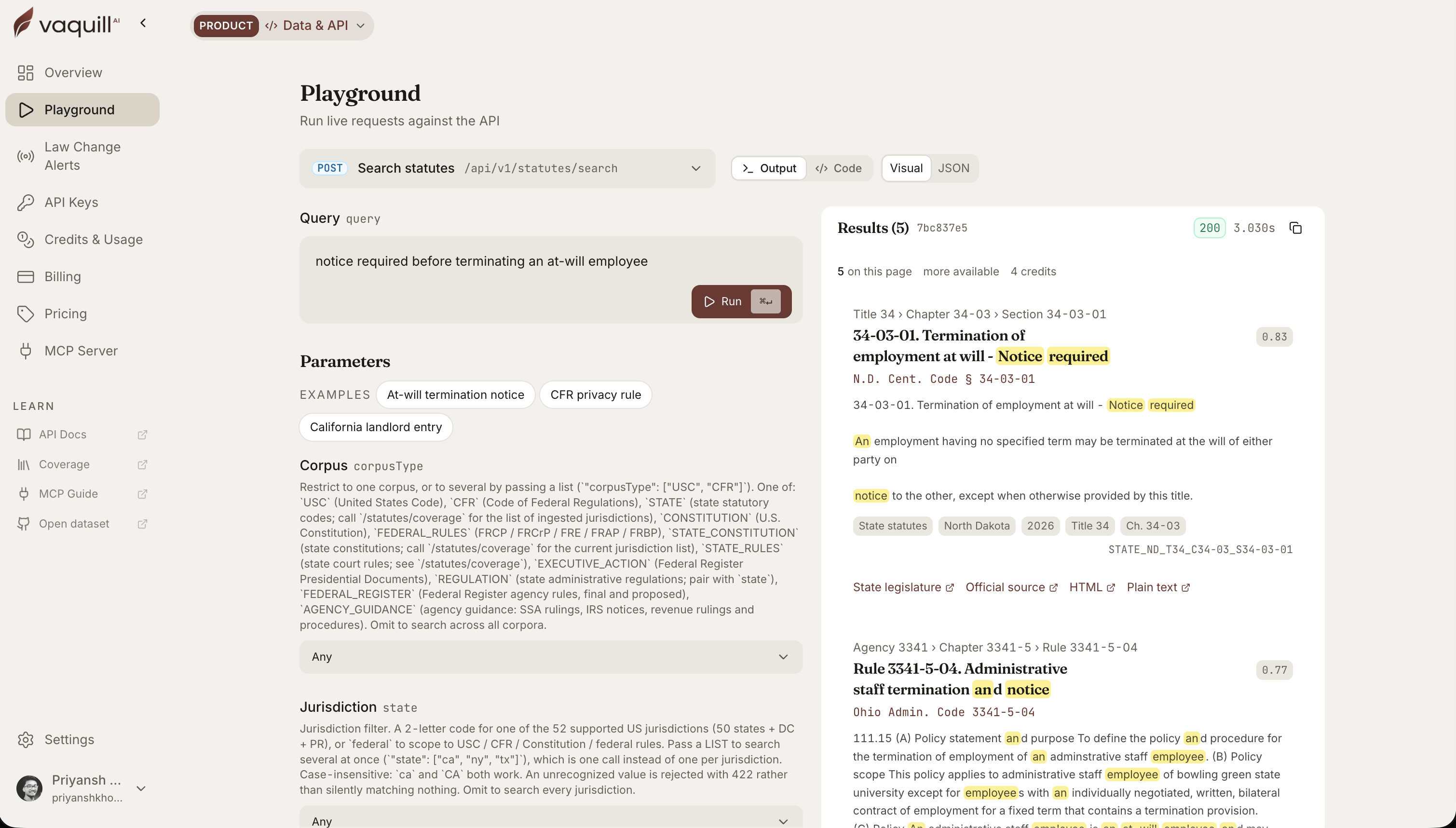 The same corpus behind this article, queried live. Every result carries its citation and a link to the official source.
Adoption backs this up. Generative AI use in corporate law departments more than doubled in a single year, from 23 percent in 2024 to 52 percent in 2025, per the ACC "Generative AI's Growing Strategic Value" survey of 657 in-house professionals (2025).
But adoption is not dependence. The Bloomberg Law State of Practice 2026 survey of 760 practitioners (June 2026) found only 23 percent of in-house lawyers use AI tools daily. Plenty of teams have a seat. Far fewer have a tool they lean on.
The exposed tasks vs the work that stays human
The exposed column is language-heavy and pattern-based. The human column carries judgment and the signature on the file. The change is not which tasks exist but where the lawyer's hours land.
| Exposed to AI (task gets automated or sped up) | Stays human (AI assists, does not own) |
|---|---|
| First-pass contract review and redlining | Setting the company's risk appetite |
| Clause and obligation extraction | Negotiation strategy and reading the room |
| Research summaries and case digests | Privilege calls and litigation judgment |
| Routine NDAs and templated drafts | Board and executive trust |
| Document comparison and matrices | Owning the final decision and the liability |
AI eats the work where the right answer is mostly in the documents. It does not touch the work where the right answer depends on what the business is willing to risk.
Goldman Sachs estimated in 2023 that around 44 percent of legal tasks could be automated by current AI (Goldman Sachs, 2023). That number counts tasks, not jobs. The other 56 percent is where in-house lawyers actually earn their seat, and it is the half that does not shrink when the tooling gets better.
What the data says about accuracy (and why a human stays in the loop)
The tools are not accurate enough to run unsupervised, and the gap is wide enough that "let the model do it" is not yet a safe instruction.
A Stanford HAI study benchmarked the legal research tools lawyers actually buy. It found leading products hallucinate on a meaningful share of queries, with the headline finding that errors show up in one out of six queries or more.
The detailed numbers are worse than the marketing suggests. Per the underlying paper, Lexis+ AI was accurate on about 65 percent of queries with roughly 17 percent hallucinations, and Westlaw's tool was accurate on about 42 percent with roughly 33 percent hallucinations.
So someone has to check the output. That someone is a lawyer, and checking AI work for hallucinated cites and wrong reasoning is itself skilled legal work. The verification job grows as the drafting job shrinks.
ABA Formal Opinion 512 (July 2024) makes this a duty, not a preference. It tells lawyers their existing obligations, including competence and the duty to protect client confidences, follow them straight into generative AI use. You cannot outsource the judgment, and the bar says so.
How the in-house role is changing
The change is not "fewer lawyers." It is the same small team absorbing more work without growing. The clearest way to see it is to walk one task through both eras.
A 60-page MSA review, 2022. It lands on a two-lawyer team. A junior or a mid-level counsel reads the whole thing, marks the indemnity cap, the liability carve-outs, the auto-renewal, the data terms, and writes up the redline. Call it most of a working day, six to eight hours, much of it on the mechanical pass. The GC reviews the markup and takes the two or three real fights to the counterparty.
The same MSA, 2026. The lawyer feeds it to a tool with the company playbook attached. In minutes there is a draft redline: the liability cap flagged against the company's 12-month standard, the missing limitation-of-liability mutual carve-out called out, the data clause compared to the template. The lawyer's job is now the check, not the read. Confirm the cap math, count the obligations the tool extracted against the document, verify the two cites it leaned on, and decide which deviations are worth a fight. Estimate two to three hours, and the saved hours go to the negotiation and the risk call, not to a second contract.
(Those hour figures are illustrative ranges from how in-house teams describe the shift, not a measured benchmark. The direction is the point: the mechanical pass collapses, the judgment pass does not.)
The role moves up the stack. Less time on the first draft, more time on the call. The GC of 2026 spends more of the week on risk strategy, vendor and AI governance, and the decisions that carry liability.
A new skill is showing up in job descriptions: the "legal engineer" or AI-literate lawyer. Someone who can build a playbook a model follows, prompt and direct the tool, and catch its mistakes. We wrote about building this muscle when you make your first legal hire.
Who is actually at risk
Not the GC. The GC role is the safest seat in the building, because it is the one that signs.
The clearest exposure is the role defined by a single repeatable task. A junior seat whose whole day is first-pass contract review sits right on top of what AI does best and cheapest.
The more interesting story is the middle. Watch the hire that does not happen. The third lawyer a growing department would have added in 2023 is the one most often replaced by a tool, because that hire existed to absorb volume, and volume is exactly what AI now soaks up. Mid-level counsel who built a career on being the reliable processor of routine work feel this first. The ones who reframe toward judgment work and owning the process around the tooling stay valuable. (In my experience working with in-house teams, the deferred third hire is the pattern, not layoffs of the existing two. Treat that as an observation from the field, not a measured statistic.)
There is a quieter shift in the other direction too. Work that used to go to outside counsel, routine NDAs, first-draft commercial agreements, low-stakes research memos, gets pulled back in-house once a small team can clear it with AI for the cost of a subscription. That raises the value of the lawyers who stay, because they now own more of the work, not less.
The protection is range. A junior lawyer who only reviews contracts is exposed. A junior lawyer who reviews contracts, manages a process, and learns to direct the tooling is not. The narrow role is the risk, not the person.
How to adapt (practically)
You do not need to become a developer. You need to treat AI like a capable junior you are responsible for.
-
Learn to brief it. Give it your playbook, your fallback positions, and your standards, the same way you would brief a new associate. A workable NDA-review instruction is short and specific:
Review this NDA as counsel for the disclosing party. Flag any term that breaks our playbook: a confidentiality period under 3 years, a mutual obligation where we expect one-way, a carve-out that lets the recipient share with affiliates without notice. For each flag, quote the clause, name the rule it breaks, and propose our fallback wording.
-
Always verify, on a fixed checklist. Do not eyeball it. Before you rely on an AI draft, run the same pass every time:
- Cite-check: open every authority the tool cited and confirm it exists and says what the draft claims.
- Obligation count: count the obligations the tool extracted against the ones in the document, so nothing was dropped.
- Defined-term match: confirm each capitalized term is defined and used consistently, since models quietly invent or merge definitions.
-
Move your hours up the value chain. Spend the time AI gives you on negotiation, risk, and stakeholder trust, not on redoing the 44 percent of tasks the tool already handled.
-
Own an AI governance policy. Someone in legal has to decide how the company uses these tools. Make it you.
-
Measure the right things. If AI is doing the routine work, your metrics should track cycle time and risk outcomes, not document count. We cover this in legal department KPIs for 2026.
Adapting takes effort, but it is not out of reach. The lawyers who lose ground are the ones who refuse to touch the tools, not the ones who get replaced by them.
If you want a workbench built for a in-house team (research, drafting with real Word track changes, and matter context in one place, with a no-train-on-your-data policy), that is what we built Vaquill AI to be. It is the assistant, you stay the lawyer.
FAQ
Will AI replace lawyers entirely?
No. AI replaces specific language-based tasks like first-pass review and research summaries. It does not replace the part of the job that weighs risk, runs the negotiation, and answers for the call. The decision, and the liability for it, still belongs to a human.
Which legal jobs are most at risk?
Roles defined by a single repetitive task are most exposed, especially junior seats whose whole day is first-pass contract review. The way to reduce that risk is to broaden the role: add process ownership, judgment work, and the skill of directing AI tools.
Will companies hire fewer in-house lawyers?
They are more likely to slow hiring than to cut existing teams. The change usually shows up as a deferred next hire rather than a layoff: the additional lawyer who would have been brought in to absorb routine volume is the one a tool now displaces, while the current team stays.
What skills should in-house lawyers learn?
Learn to direct AI like a junior associate: write playbooks it can follow, prompt it well, and verify its output for hallucinated cites and missed terms. The emerging "legal engineer" skill, pairing legal judgment with AI fluency, is now a real career edge.
Can AI give legal advice?
Not on its own. AI can draft and summarize, but giving legal advice requires applying judgment to a client's specific situation and standing behind it, which AI cannot do. ABA Formal Opinion 512 (July 2024) holds the supervising lawyer responsible for the work.
Is AI accurate enough to trust?
Not without a human check. A Stanford HAI study found leading legal AI tools hallucinate on a meaningful share of queries, with one tool accurate on about 42 percent of queries and another on about 65 percent. You have to verify every output before relying on it.
Does using AI create ethics problems for lawyers?
It can if you skip oversight. ABA Formal Opinion 512 (July 2024) says duties of competence, confidentiality, and supervision apply to generative AI use. Verifying the output and protecting client data are now part of using these tools responsibly.
How should a small legal team start with AI?
Start with one high-volume, low-judgment task like first-pass NDA review, build a playbook the tool follows, and keep a human verifying every result. Our guide to legal AI for in-house counsel and our 2026 tool roundup walk through the rollout.
New legal AI guides, weekly.
Further Reading
100 Generative AI Prompts for In-House Lawyers (2026)
Read postHow AI Is Transforming In-House Legal Teams in 2026
Read postWhat Vaquill AI Can Actually Do: Agentic Workflows, Verification Depth, and Open Benchmarks
Read postLegal AI in Microsoft Word: Contract Review, Redlining, and Research in a Word Add-In
Read postBuilt-In Legal AI Skills: Which One to Run for Each Task
Read postWhat a Legal AI Agent Actually Does: One In-House Task, Start to Finish
Read post
Co-Founder & CEO · Attorney
Arshita leads product and strategy at Vaquill, building the legal AI suite that solo, small-firm, and in-house US lawyers use to run a matter end to end.