A friend who runs contracts at a mid-size SaaS company told me she ran the same inbound NDA past two of her associates on the same afternoon. One flagged the unilateral indemnity and waved through a three-year survival clause. The other did the reverse: redlined the survival period, said nothing about indemnity.
Same document, same playbook PDF sitting in the shared drive, two different sets of redlines. She wasn't angry at the associates. She was angry at the playbook, because the playbook was the thing that was supposed to make this consistent, and it didn't.
That gap is the whole subject of this post. An NDA playbook is only useful to the extent it produces the same answer twice. Most of them don't, and that failure has nothing to do with whether you've bought AI. It has to do with how the playbook is written.
If you want an AI to enforce your positions consistently, the work is 80 percent playbook engineering and 20 percent model. Vendors sell you the model. The consistency you actually want comes from the spec you bring to it.
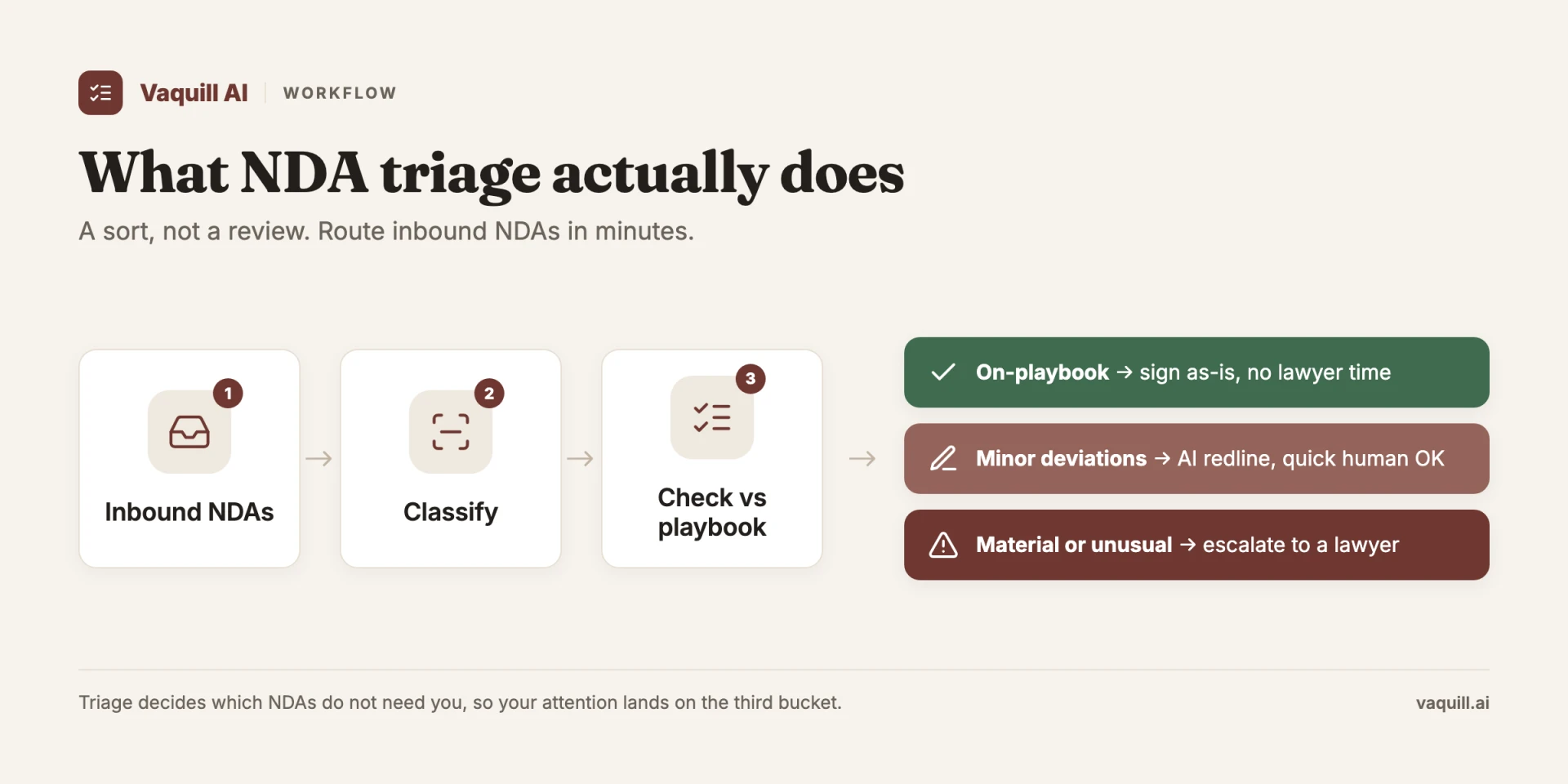
Triage is a sort, not a review: most NDAs never need a lawyer's attention.
TL;DR
- Most NDA playbooks are prose memos full of "generally," "usually," and "consider." That ambiguity is exactly what an AI cannot enforce, and it's why two humans reading the same playbook disagree.
- A playbook your AI can enforce is not a longer document. It's a structured decision spec: every negotiable term gets an acceptable range, a preferred position, a fallback ladder, a hard-stop, and an escalation trigger.
- A playbook doesn't bind your counterparty. It governs the reviewer (human or AI). Enforceability of the resulting NDA still rests on contract and trade-secret law, not on your playbook.
- Roughly two-thirds to three-quarters of inbound NDAs sit inside playbook tolerance and can auto-path. The rest deviate enough to route to a human. That routing is the design, not a failure.
- The lawyer still owns verification (Mata v. Avianca, ABA Formal Opinion 512). So the playbook must encode "escalate" and "verify," never "auto-accept and move on."
In the worked redline, what did the reviewer cut the seven-year survival period down to?
Part of our document tools, redline, and matrix guide series.
For related document-tools coverage, see What an NDA Triage AI Is Actually Doing (And How to Evaluate Yours in 2026), What Is NDA Triage? How Lawyers Sort Inbound NDAs in Minutes With AI, and the DPA negotiation playbook for in-house counsel.
Why most playbooks fail the moment an AI touches them
Pick up almost any internal NDA playbook and you'll find sentences like this: "We generally prefer a mutual confidentiality obligation, but a one-way NDA may be acceptable where we are the disclosing party. Survival periods should be reasonable given the sensitivity of the information."
A senior lawyer reads that and fills in the blanks with judgment they've accumulated over a decade. "Reasonable" means three years for ordinary commercial info and indefinite for trade secrets, because they've litigated the difference. The playbook isn't really instructing them. It's reminding them of things they already know.
An AI has none of that accumulated judgment, and neither does a junior associate on their second week. When the spec says "reasonable," the model does what an under-instructed human does: it guesses, and it guesses differently depending on the surrounding text, the phrasing of the clause, the time of day in a manner of speaking.
The team at digitalapplied made this point well in their 2026 agentic legal playbook write-up: five lawyers will flag five different sets of issues on the same NDA, and so will one lawyer on Friday versus the same lawyer on Tuesday. The variance isn't a technical problem. It's a human one, baked into prose instructions that assume a reader who already knows the answer.
This is the part most teams get backwards. They buy a tool, feed it the existing prose playbook, watch it produce inconsistent redlines, and conclude the model isn't good enough. The model is usually fine.
The instructions are ambiguous, and ambiguity in equals inconsistency out. You don't fix that with a smarter model. You fix it with a better spec.
If you're earlier in the process and still choosing which tool to point at the playbook, that's a different question with a different answer, and I wrote it up separately in what an NDA triage AI is actually doing. This post assumes you already have a tool. The question here is how to make any tool enforce your positions.
The reframe: a playbook is a decision spec, not advice
Here is the shift that makes everything else work. Stop writing the playbook as advice to a colleague. Write it as a decision specification for a machine that has no judgment of its own.
For every negotiable term in an NDA, a decision spec answers five questions explicitly:
- Preferred position. What we ask for first.
- Acceptable range. What we'll live with without escalating.
- Fallback ladder. If they push back, what we offer next, in order.
- Hard-stop. The line we never cross without a named human signing off.
- Escalation trigger. The specific condition that routes this term to a human instead of auto-redlining.
Notice what disappears: "generally," "usually," "reasonable," "consider." Those words are placeholders for judgment, and a decision spec replaces them with values. "Reasonable survival period" becomes "preferred 2 years; acceptable 1 to 3 years; trade-secret carve-out survives indefinitely; hard-stop at 5 years for non-trade-secret info; escalate if counterparty ties survival to an undefined term."
Spellbook, which reports over 4,500 legal teams using its contract tooling, makes a point in its own materials that's easy to skim past and worth pausing on: a playbook is not legally binding. It exists for consistency and compliance, not enforcement against the other side.
That line is the entire mental model. Your playbook governs your reviewer's behavior. It does not govern the counterparty. So when you write it, you're not drafting a contract. You're programming the reviewer, and the reviewer happens to be an AI that takes every word literally.
Building the spec, term by term
Let's make this concrete. A workable NDA decision spec is just a table (or a small structured file) with one row per negotiable term. The columns are the three positions every incumbent template names (preferred, fallback, walk-away) plus the one most leave out: the escalation trigger that tells the reviewer when to stop negotiating and route the file. Here is the shape of it for the terms that actually move in practice.
The NDA playbook template, term by term
| Term | Preferred (open here) | Fallback (grant without sign-off) | Walk-away / hard-stop (escalate, never auto-accept) | Escalate when |
|---|---|---|---|---|
| Mutuality | Mutual obligations both ways | One-way only if we are purely the disclosing party | One-way where we receive confidential info | Counterparty is a competitor in our market |
| Definition of confidential info | Marked, oral, and reasonably-understood-as-confidential | Marked plus oral confirmed in writing within 15 days | "Marked in writing only" with no oral coverage | Definition excludes data we know we will share orally |
| Confidentiality term | 3 years | 2 to 5 years | < 1 year, or perpetual for non-trade-secret info | Term tied to an undefined event ("until no longer confidential") |
| Survival of obligations | 2 years post-termination | 1 to 3 years; trade secrets survive indefinitely | > 5 years for non-trade-secret info | No separate trade-secret carve-out |
| Permitted use | Defined evaluation purpose only | Purpose plus named affiliates and advisors | "Any business purpose" or implied license | Any sublicense or assignment right appears |
| Residuals | No residuals clause | Residuals limited to unaided memory, no IP license | Residuals that grant a license to our IP | Clause lets them use "retained knowledge" freely |
| Non-solicit | None (NDA is not the place for it) | Non-solicit of named individuals, 12 months | Broad non-solicit or no-hire of all staff | Any no-hire that blocks general job ads |
| Governing law | Our home state | Either party's home state | A jurisdiction where we do not operate | Foreign governing law or foreign exclusive forum |
| Remedies | Injunctive relief plus fees | Injunctive relief only | No equitable relief, or a liquidated-damages cap | Any cap on confidentiality remedies |
| Return / destruction | Both, on written demand | Destruction with officer certification | No return-or-destroy obligation at all | Retention allowed beyond a defined legal-hold need |
This is not the whole playbook. It's the skeleton, and your real one will have more rows and the values your firm actually negotiates to. But the structure is the point: three positions plus a trigger, stated as values a literal reader can check.
An AI reading this row by row produces the same redline for the same clause every time, because there's nothing left to interpret. When the survival clause says "obligations survive for seven years," the spec says hard-stop, escalate. No judgment call, no Friday-versus-Tuesday drift.
Write the fallback ladder, not just the floor
The single most common omission I see: teams encode the preferred position and the hard-stop, then leave the middle blank. That middle is where negotiations actually live.
If the counterparty rejects your two-year survival and you've told the AI nothing about what to offer next, it either capitulates to whatever they sent or it escalates every single time, which defeats the purpose.
Spell out the ladder. "Open at 2 years. If rejected, offer 3 with a trade-secret carve-out surviving indefinitely. If rejected again, escalate." Now the AI can run two rounds of the negotiation inside policy before a human ever sees it, and the human only gets the genuinely contested files.
Make hard-stops unambiguous and few
Hard-stops are the clauses that protect you from an automated system quietly agreeing to something catastrophic. Keep them sharp and keep them rare. "No clause that grants the counterparty any license to our IP" is a clean hard-stop. "Avoid overly broad confidentiality definitions" is not, because "overly broad" is judgment again.
If you can't state the hard-stop as a condition a machine can check, it isn't a hard-stop yet. It's a worry you haven't finished writing down.
A worked redline, start to finish
Here is one inbound survival clause run through the spec above, so you can see the playbook do the work instead of describing it.
What they sent:
"The obligations of confidentiality set forth herein shall survive for a period of seven (7) years following termination of this Agreement."
What the playbook says: Survival row. Preferred 2 years, fallback 1 to 3 years with trade secrets indefinite, walk-away above 5 years for non-trade-secret info. Seven years is past the walk-away line, and there is no trade-secret carve-out, which is also an escalation trigger.
The redline the reviewer (or AI) produces:
"The obligations of confidentiality set forth herein shall survive for a period of
seven (7)three (3) years following termination of this Agreement, provided that obligations with respect to trade secrets shall survive for as long as the information remains a trade secret under applicable law."
The one-line flag attached to it: "Survival cut from 7 to 3 years (playbook fallback ceiling). Added trade-secret carve-out (required; was missing). Counter sent. If they reject 3 years, escalate to GC, do not accept above 5."
Two things happened that prose playbooks miss. The reviewer did not "consider a reasonable period," it applied the fallback ceiling, three years, as a value. And it did not silently accept the missing trade-secret carve-out; the absence was itself a trigger. Run the same clause next Tuesday and you get the same redline, because nothing was left to interpretation.
Encode it as a reusable Skill, then build the feedback loop
Once the spec exists, it stops being a PDF in a shared drive and becomes a thing the system runs. Most modern contract-review tools have some version of this.
The artifact often lives under a label like Skills, where you encode a contract-review or NDA playbook as a reusable object the AI applies the same way on every document. The mechanism matters less than the principle: the playbook should be a versioned, structured object the tool reads, not a memo a person is trusted to remember.
What we see in practice on this loop: the row that quietly causes most of the trouble is the escalation rule, not the redlining rule. Teams write escalation triggers too broadly ("escalate any clause not on the acceptable list") and every file routes to human review. Two weeks in, the reviewers are drowning, the auto-path benefit has evaporated, and someone proposes turning the AI off.
The fix is almost always the same: rewrite the escalation row as a specific, conditioned trigger, not a fallback for any uncertainty. "Escalate if survival period is tied to an undefined term" is enforceable. "Escalate if anything looks unusual" turns the playbook back into prose.
The benefit of structure shows up in the numbers people report. GC AI's December 2025 survey of more than 100 in-house users reported an average of 14 hours per week saved and a 14 percent reduction in outside-counsel spend, and noted that purpose-built legal AI showed 21 percent greater perceived accuracy than generalist AI on the same legal tasks. Read those as reported figures, not laws of nature, but the direction is the part to internalize: the gains come from configuration and fit, not from the raw model being magic.
And a spec is never done at version one. The feedback loop is the other half of the job. Every time a human overrides the AI's redline, that override is signal. Either the AI misread the clause (a model problem, log it) or your spec had a gap (a playbook problem, fix the row).
Treat overrides as bug reports against the playbook. After a few dozen, the escalation rate drops because the spec has absorbed the edge cases your senior lawyers were carrying in their heads. That's the moment the playbook starts doing what the prose version only pretended to do.
The escalation rule is where the lawyer stays in the loop
Here is the line you cannot engineer away. The playbook can automate redlining. It cannot automate responsibility.
In 2023, the Mata v. Avianca sanctions happened because lawyers filed a brief full of AI-hallucinated cases and didn't verify a word of it. In July 2024, ABA Formal Opinion 512 made the duty explicit: a lawyer's obligations of competence and candor don't transfer to the tool. The lawyer owns verification, full stop.
For an NDA playbook, that has a precise design consequence. Your spec must never contain a row whose action is "auto-accept and close." The terminal good outcome is always either "auto-redline within policy" or "escalate to a named human."
The escalation triggers aren't an admission that the AI is weak. They're how you keep a licensed lawyer accountable for the output, which is exactly where accountability legally belongs.
This is also why the tiered reality reported in the field is a feature, not a shortfall. When roughly two-thirds to three-quarters of inbound NDAs sit inside tolerance and auto-path, and the remaining quarter to third route to a human, you've built the thing correctly.
The machine handles the routine volume the way a machine should, and the genuinely novel or risky files land on a desk with a name on it.
A playbook that escalates nothing is a playbook nobody should trust.
A few mechanics worth getting right
Keep confidentiality in scope. NDAs are, by definition, the documents you're most careful about. Before you pipe a stack of them through any tool, know where the data goes and what the vendor does with it. I went deep on that in where your legal AI's data actually goes, and it's a check worth doing once, properly, rather than assuming.
Verify the law behind a clause, don't guess it. When a spec row depends on statute (a governing-law choice, a trade-secret carve-out), pull the actual text rather than trusting memory. Statute language drifts and varies by state. A self-serve statutes API exists for exactly this: searching and fetching U.S. Code, the CFR, and all 52 state and territory codes so the rule your playbook encodes matches the rule on the books. Scope it to statutes; the verification of the clause text is the job.
Version the spec like code. A playbook that changes silently is worse than no playbook, because nobody knows which version produced which redline. Date it, track changes, and tie each version to the override data that drove the change. If you're building an AI contract-review practice more broadly, the lawyer's guide to AI contract review walks the wider workflow that this NDA spec slots into.
The uncomfortable conclusion
The reason most NDA playbooks don't survive contact with an AI is that they were never really specifications. They were notes to people who already knew the answer. The prose worked, badly, because a human reader silently supplied the missing judgment, and you couldn't see the inconsistency until you put two of them side by side or pointed a literal-minded model at the same document twice.
The fix is unglamorous and it's mostly writing. Acceptable ranges instead of "reasonable." Fallback ladders instead of a single floor. Hard-stops you can state as conditions. Escalation triggers that keep a named lawyer accountable.
Do that, and the same NDA produces the same redlines every time, which was the entire point of having a playbook in the first place. The model is the easy part. The spec is the work, and it's yours to bring.
FAQ
What is an NDA playbook? An NDA playbook is an internal decision sheet that tells whoever reviews an inbound NDA exactly which positions to take on each clause. For every negotiable term it sets a preferred ask, one or more fallbacks you can grant without sign-off, and a walk-away line that routes the file to a named lawyer. It governs your reviewer, not the counterparty, so it is not a contract and not legally binding on the other side.
What should an NDA playbook template include? At minimum: mutuality, the definition of confidential information, confidentiality term, survival of obligations, permitted use, residuals, non-solicit, governing law, remedies, and return-or-destruction. Each term gets four entries, a preferred position, an acceptable fallback range, a walk-away or hard-stop, and the specific condition that triggers escalation. The table near the top of this post is a working starting point you can adapt.
What is the difference between a preferred, fallback, and walk-away position? The preferred position is what you open with, the most protective language you would write if the counterparty agreed to everything. The fallback is the compromise you can grant without asking anyone, usually a range rather than a single value. The walk-away (or hard-stop) is the line you never cross without a named human signing off, which is why it routes to escalation instead of auto-accepting.
How long should an NDA confidentiality term be? Three years is a common preferred position for ordinary commercial information, with one to five years as a workable fallback range. Trade secrets are the exception: most playbooks let confidentiality obligations on trade secrets survive indefinitely, for as long as the information stays a trade secret under applicable law. A perpetual term on non-trade-secret information is usually a walk-away.
Should an NDA be mutual or one-way? Default to mutual when both sides may share confidential information, because it is faster to agree and harder for either party to argue is unfair. Accept a one-way NDA only when you are purely the disclosing party. A one-way NDA that binds you as the receiving party is worth escalating, especially if the counterparty is a competitor.
Can an AI enforce an NDA playbook? An AI applies a playbook consistently only if the playbook is written as values a literal reader can check. Swap vague adjectives like "reasonable" or "generally" for concrete ranges. Once the positions are concrete, a contract-review tool can run the preferred, fallback, and escalation logic on every inbound NDA the same way. The lawyer still owns verification of the result, per Mata v. Avianca and ABA Formal Opinion 512.
How is an NDA playbook different from NDA triage? Triage is the sort step: it classifies an inbound NDA and decides whether it can auto-path or needs a human. The playbook is the rulebook triage and review apply once a clause is in front of them. They work together, and we cover the sort step in what is NDA triage and how to evaluate a triage tool in the NDA triage AI evaluation guide.
Is an NDA playbook legally binding? No. A playbook exists for internal consistency and compliance, not enforcement against the counterparty. Whether the resulting NDA is enforceable depends on contract law and, for trade-secret protection, statutes like the Defend Trade Secrets Act and state law, not on your playbook. Spellbook makes the same point in its contract playbook materials: a playbook is not legally binding.
Vaquill AI runs negotiation playbooks like this as structured objects and applies them on contract review with AI redlining in native Word track changes, so the same spec drives the same markup on every document. If you want to see your NDA positions enforced this way, you can try it free for 7 days.
New legal AI guides, weekly.
Further Reading
Top 13 Legal Redline Software Tools (2026)
Read postLegal AI Workflows: How Law Firms Chain Multi-Step AI Tasks in 2026
Read postHow to Build a Document Matrix to Compare Contracts, Leases, and Filings
Read postHow to Compare Documents and Export Clean Redlines (Step-by-Step)
Read postBulk Contract Review: How to Review Many Contracts at Once With a Document Matrix
Read postLegal Document Version Control: Which Platforms Track Versions
Read post
Co-Founder & CEO · Attorney
Arshita leads product and strategy at Vaquill, building the legal AI suite that solo, small-firm, and in-house US lawyers use to run a matter end to end.