AI is changing the in-house legal department in five concrete ways in 2026: work is moving back in-house from outside counsel, small teams are handling more volume, the business is self-serving routine legal questions, matter management is becoming AI-native, and legal leaders are finally measuring output instead of guessing at it.
This is not a "will AI replace lawyers" piece. The interesting story is operational, not existential.
The general counsel role is shifting from gatekeeper to operator. The teams pulling ahead are the ones treating AI as a way to change how work flows, not as a faster search bar.
This guide is the playbook: what is actually shifting, what to measure, the new roles to staff, the risks to manage, and a 90-day path to get moving. It is written for GCs, heads of legal, and legal ops leaders at in-house teams.
TL;DR
- Routine work is moving back in-house. Tasks that used to get sent to outside counsel (first-pass contract review, research memos, policy drafting) now stay in-house because AI makes them fast enough to keep.
- Small teams are doing more without adding headcount. A two-to-ten-person department can cover the volume that used to need a much larger team.
- The business self-serves the easy stuff. Sales, HR, and procurement get answers from a legal-owned AI layer instead of opening a ticket for every NDA.
- Matter management is going AI-native. Intake, triage, drafting, and tracking live in one place, with AI doing the first pass and the lawyer reviewing.
- The "legal engineer" is a real role now. Someone owns the prompts, playbooks, and quality checks that make the AI trustworthy.
- Measurement is the unlock. Cycle time, contract turnaround, outside-counsel spend, and hours saved are the numbers that prove the transformation worked.
In the ACC and Everlaw survey cited here, what share of legal departments expected GenAI to reduce their reliance on outside counsel?
Part of our in-house counsel guide series.
The five shifts happening in 2026
The transformation is not one big change. It is five smaller shifts that compound. Each one is already happening at teams that adopted AI early, and each one changes what the department looks like.
Shift 1: Work moves back in-house from outside counsel
For years the logic was simple. If a task was too time-consuming for a in-house team, it went to a law firm. The expensive work stayed expensive because in-house teams could not absorb it.
The math behind that logic was never small. A basic contract runs about $6,900 to process end to end at average organizations, $3,800 at best-in-class ones, and a mid-complexity contract runs $21,300 average or $14,000 best-in-class, per the IACCM (now World Commerce and Contracting) cost study of more than 700 large organizations (LawGeex summary of IACCM/WorldCC data, 2017). When that cost sits with a firm, routine volume drains the budget.
AI lowers the in-house cost of the same routine work, so it stops leaving the building. A first-pass review of a vendor contract, a research summary on a state law question, a policy redraft: these used to be billable hours at a firm. In a controlled in-house pilot, the same first pass can run in well under an hour, with a lawyer reviewing and signing off on the output (worked example, not an industry stat).
The shift is already in the survey data. The Thomson Reuters Institute 2024 State of the Corporate Law Department report found departments moving work in-house and to lower-cost providers, with contracts the most common category to bring home (Thomson Reuters Institute, 2024). In the ACC and Everlaw survey "GenAI and Future Corporate Legal Work," 58% of legal departments expected GenAI to reduce their reliance on outside counsel and 25% already reported cost savings from it (ACC and Everlaw, October 2024).
Firms do not disappear. Bet-the-company litigation, novel regulatory questions, and deals that need specialist depth still go out. What changes is the floor: the routine volume that never needed a partner stays home.
Shift 2: Smaller teams, higher throughput
The old way to handle more legal work was to hire more lawyers. That is slow and expensive, and a in-house team rarely gets the headcount anyway.
What changes is the unit of output. One lawyer with a good AI workbench reviews more contracts, answers more questions, and turns around more drafts per week than the same lawyer did two years ago. The team stays small and the throughput goes up.
The question moves from "how many lawyers do we have" to "how much work can each lawyer clear." That reframe is what lets a four-person department support a fast-growing company without falling behind.
Watch the review load, though. AI produces a first draft fast, but a human still has to check it. The bottleneck moves from drafting to reviewing, and managing that review queue becomes the new skill.
Shift 3: Self-serve legal for the business
Most legal teams drown in small requests. A sales rep needs an NDA. An HR manager has a question about a policy. Procurement wants to know if a vendor clause is fine.
A legal-owned AI layer answers a lot of that without a lawyer touching it. The business gets a fast answer from approved templates and playbooks, and the lawyer only gets pulled in on the edge cases.
This is the highest-leverage shift for a in-house team because it removes the interruption tax. Every self-served NDA is a request that never hits the queue.
There is a guardrail to set first. Self-serve only works when legal owns the content the AI draws from, sets clear limits on what it can answer, and routes anything outside those limits to a human.
Shift 4: AI-native matter management
Old matter management was a system of record. You logged the matter after the work happened, so the data was always a step behind the work.
AI-native matter management inverts that. Intake, triage, drafting, and tracking live in one workbench, and the AI does the first pass on each step while the system captures the data as the work flows.
That means a request comes in, gets classified and routed, a draft gets generated, and the matter is tracked, all in one place. The lawyer reviews and approves instead of stitching tools together.
We go deeper on choosing a system in our roundup of matter management software for in-house teams. The point here is that the workbench, not the spreadsheet, is becoming the center of the department.
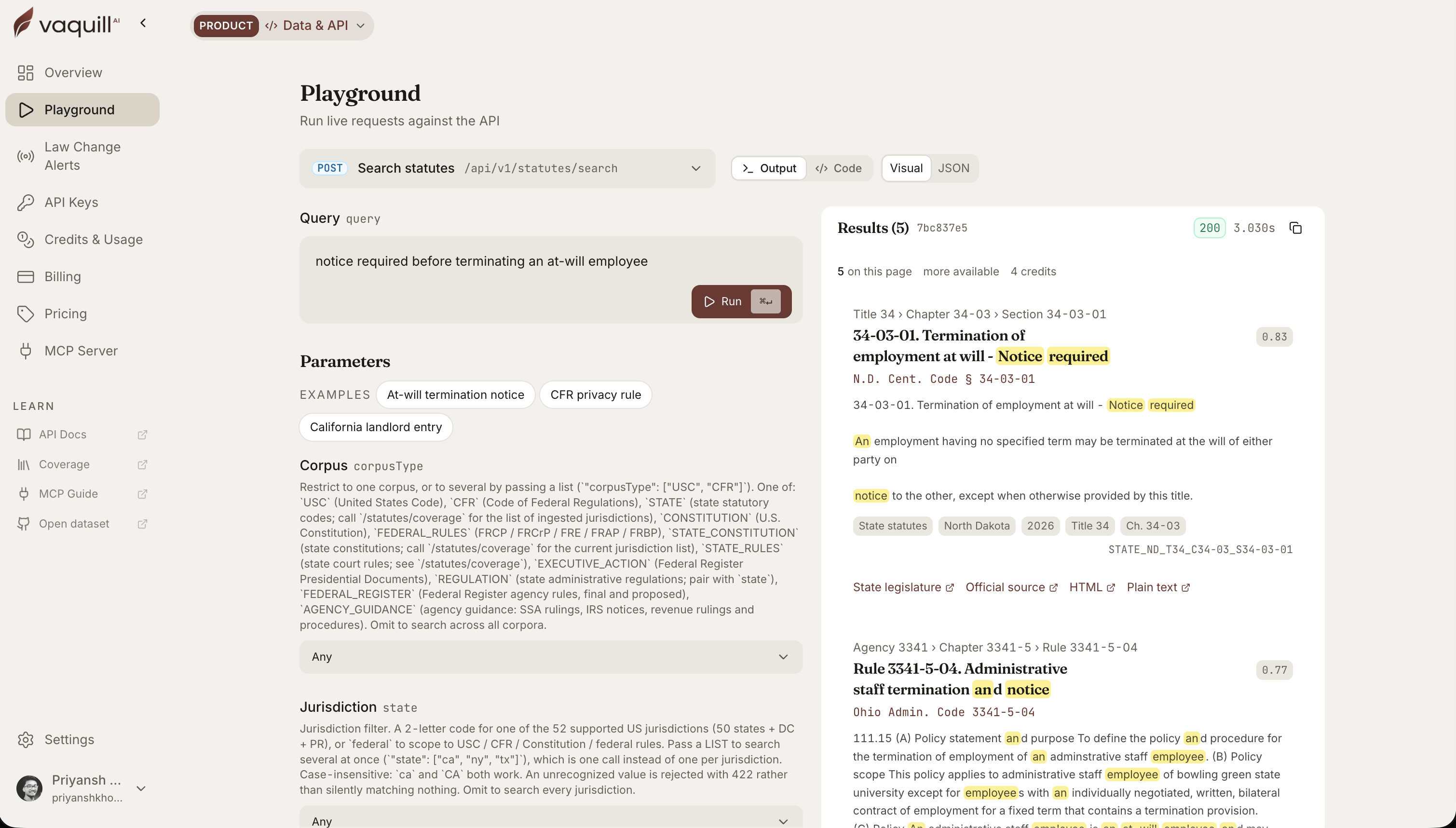 The same corpus behind this article, queried live. Every result carries its citation and a link to the official source.
Shift 5: From gut feel to measurement
For most legal departments, the honest answer to "how is the team performing" has been a shrug. The work is hard to count, so it does not get counted.
AI-native tools change that because the data is captured as the work happens. Cycle time, turnaround, and volume are no longer estimates. They are logged.
That is what makes the transformation provable. A GC can walk into a board meeting with a real before-and-after on contract turnaround and outside-counsel spend, pulled from the system, instead of "we are busy." The number to cite is your own logged delta against the baseline you set in week one, not a borrowed industry figure.
Measurement is also what keeps the program honest. If the numbers do not move after adoption, the tool or the workflow is wrong, and you find out in weeks instead of quarters.
Before AI vs after AI: a in-house team
Here is what the five shifts look like in practice for a small department. The "before" cost and timing figures are labeled by source; the "after" figures are worked examples from a controlled in-house pilot, not industry stats, so treat them as targets to test against your own baseline.
| Area | Before AI | After AI |
|---|---|---|
| Routine contract review (NDA, vendor) | 3 to 7 business days out at outside counsel; a basic contract costs about $6,900 to process, $3,800 best-in-class (IACCM/WorldCC via LawGeex, 2017) | First pass in-house same day; lawyer review under 1 hour per contract (worked example) |
| Mid-complexity contract | $21,300 to process average, $14,000 best-in-class (IACCM/WorldCC via LawGeex, 2017) | First pass drafted in-house, 1 to 2 hours of lawyer review (worked example) |
| Team size for the volume | Add a lawyer ($150K to $250K+ loaded) to add capacity | Same team, higher throughput per person (worked example) |
| Business requests (NDAs, policy Qs) | Every request opens a ticket, 1 to 3 day wait | Routine requests self-served from playbooks, answer in minutes (worked example) |
| Matter tracking | Logged after the fact in a spreadsheet | Captured live in one AI-native workbench |
| Research memo | Half a day of drafting in-house, or billed out at firm rates | Draft in 15 to 30 minutes, lawyer verifies and edits (worked example) |
| Performance reporting | "We are busy," few hard numbers | Cycle time, turnaround, spend, hours saved logged automatically |
| Outside-counsel spend | High floor of routine billable work | Floor drops; 58% of departments expect AI to cut outside-counsel reliance (ACC/Everlaw, Oct 2024) |
What to measure
The transformation is only real if the numbers move. Pick four metrics, baseline them before you start, and check them every month. Do not measure everything; measure what proves the case. Each metric below gets a formula and a target so you can tell progress from noise.
Cycle time. Average days from request opened to matter closed. Formula: sum of (close date minus open date) across matters, divided by number of matters closed that month. Target: cut the baseline by 30% to 50% within two quarters (worked target, set against your own week-one number, not an industry stat). This is the broadest signal that the department is faster, and the one the business feels.
Contract turnaround. Median days from a contract landing in the queue to signature-ready. Formula: median of (signature-ready date minus intake date) for contracts of one type, tracked per type so an outlier deal does not skew it. Good looks like routine NDAs and vendor contracts clearing in under 2 business days. This is the cleanest number to put in front of sales and the board, because it ties legal speed to revenue speed.
Outside-counsel spend. Total spend, split into routine versus high-stakes work. Formula: routine-spend ratio = routine outside-counsel invoices divided by total outside-counsel invoices, tracked monthly. Target: routine ratio trends toward zero as you in-source; 58% of departments expect AI to reduce outside-counsel reliance, so a flat line after in-sourcing means the workflow is not working (ACC/Everlaw, October 2024).
Hours saved. Hours reclaimed on the tasks AI now does first-pass. Formula: for each task type, (tasks per week) x (pre-AI minutes per task minus post-AI lawyer-review minutes per task), summed across task types, divided by 60 for hours. Worked example: 20 NDAs/week at 45 pre-AI minutes versus 12 review minutes = 20 x 33 = 660 minutes, about 11 hours/week on one task type. Be conservative; an inflated number falls apart under scrutiny.
We lay out the full metric set, including how to baseline each one, in our guide to legal department KPIs for 2026. Start with these four and add from there.
The new skills and roles
AI does not remove the need for legal judgment. It moves where the judgment is applied, and it creates one real new job: the legal engineer.
The legal engineer makes the AI trustworthy. They own the prompts, the playbooks, the templates the self-serve layer draws from, and the quality checks that catch bad output. The role does not require a computer science degree. It requires a lawyer willing to learn how the tools work and to treat playbook quality as a real product. On a in-house team it is usually a current lawyer carrying it part-time, not a new hire.
What that looks like in the first month is concrete, not abstract:
- Week 1: ship two playbooks. Write the standard positions for the two highest-volume document types, usually mutual NDAs and standard vendor agreements. For NDAs, codify 8 to 12 fallback positions (term length, mutual versus one-way, governing law, liability cap, carve-outs for confidential information, residual-knowledge clauses) and tag each position auto-approve or escalate-to-lawyer.
- Week 2: build the escalation map. Decide exactly what the self-serve layer can answer alone and what it routes to a human, written down so it is auditable. Anything touching indemnity, IP assignment, or non-standard liability caps escalates by default.
- Weeks 3 to 4: run QA on every output. Read 100% of AI outputs during the pilot, log each miss against the playbook, and fix the playbook the same week. Once volume is steady, drop to a sampled QA cadence of at least 20% of outputs reviewed, with 100% review kept for any new document type.
Review and verification discipline is the other half of the job. As drafting gets cheap, careful review gets valuable. The team's edge moves from "can we produce this" to "can we trust what was produced," so the QA cadence above is the part you do not skip.
If you are staffing this from scratch, our guide on the first legal hire for an in-house function covers how to build the role with AI in mind from day one.
The risk side
The upside is real, and so are the risks. Two of them matter most for in-house teams, and both have clear controls.
Verification duty. AI gets things wrong, and in legal a confident wrong answer is dangerous. A Stanford study found that even legal-specific AI tools hallucinated on roughly one in six or more benchmark queries (Stanford HAI, 2024). Every AI output that touches a real matter needs a human check before it goes out.
The ABA has also weighed in on a lawyer's duties when using generative AI, covering competence, confidentiality, and supervision (ABA Formal Opinion 512). The short version: the tool does not carry the professional duty, the lawyer does.
Data posture. Client and company data is sensitive, and feeding it to the wrong tool is a real problem. Before you put any matter data into an AI system, know where it goes, whether it is used for training, and what the vendor's security posture is.
The practical control is policy. Decide which tools are approved, what data can go where, and who signs off. Our AI governance policy template for in-house legal gives you a starting point you can adapt.
A 90-day adoption path
You do not transform the department in one move. Here is a sequence that gets you from zero to measurable results in a quarter.
Days 1 to 30: baseline and pick one workflow. Measure your current cycle time, contract turnaround, and outside-counsel spend so you have a before number. Then pick one high-volume, low-risk workflow to start, usually NDA or vendor contract review.
Do not start with the hardest thing. Start with the workflow that has the most volume and the lowest stakes, so a mistake is cheap and a win is obvious.
Days 31 to 60: build the playbook and run the pilot. Write the standard positions for that one workflow and load them into the tool. For NDA review, that means codifying 8 to 12 fallback positions (term, mutual versus one-way, governing law, liability cap, confidentiality carve-outs) and tagging each one auto-approve or escalate, so the AI knows when to flag a clause versus accept it. Run it live with one or two lawyers, review every output, and log each miss against the playbook so you can fix it the same week.
This is where the legal-engineer work starts. The pilot is as much about tuning the playbook as it is about testing the tool.
Exit gate before you expand: do not move to a second workflow until the first pass needs no substantive edit on 80% or more of outputs across a rolling two-week window. If you are still rewriting positions, the playbook is not ready and expanding just spreads the rework.
Days 61 to 90: measure, expand, and set policy. Compare the new cycle time and turnaround to your day-one baseline. Once the workflow clears the exit gate above, expand to a second workflow and turn on self-serve for the business on the first one.
Lock in your governance policy here too, before usage spreads past the pilot team. It is far easier to set the rules while the program is small.
If you are still deciding whether to build your own stack or buy a workbench, read our build vs buy guide for legal AI before you commit budget.
Where Vaquill AI fits
Vaquill AI is a legal AI workbench built for in-house teams: research, drafting, and matter management in one place, so a in-house department can in-source routine work and track the results. You can see how it maps to the shifts above on our in-house counsel page, then run a pilot on one workflow.
FAQ
How is AI changing in-house legal teams in 2026?
AI is shifting routine work back in-house from outside counsel, letting small teams handle more volume, enabling the business to self-serve simple legal questions, and making matter management AI-native. The biggest change is operational: the department measures its output instead of guessing at it.
Will AI replace in-house lawyers?
No. AI handles first-pass drafting and routine review, but a lawyer still verifies every output and owns the professional duty. The work shifts from producing documents to reviewing and judging them, which raises the value of legal judgment rather than removing it.
What should an in-house legal team measure to prove AI is working?
Track four numbers: cycle time, contract turnaround, outside-counsel spend, and hours saved. Baseline each one before you start, then check monthly. If the numbers do not move after adoption, the tool or the workflow needs to change.
What is a legal engineer?
A legal engineer is the person on the team who makes the AI trustworthy by owning the prompts, playbooks, templates, and quality checks. It is usually a lawyer who learns how the tools work, not a software engineer, and on a in-house team it is often a part-time role for a current lawyer.
How does AI move legal work back in-house from law firms?
Tasks that were too time-consuming for a in-house team, like first-pass contract review and research memos, become fast enough to keep in-house. That drops the floor of routine billable work going to firms, while bet-the-company litigation and specialist matters still go out.
What are the main risks of using AI in a legal department?
The two biggest are verification duty and data posture. AI can produce confident wrong answers, so every output touching a real matter needs a human check, and you must know where your data goes and whether it is used for training before you feed it in.
How long does it take to see results from legal AI?
A focused 90-day pilot is enough to show measurable results. Spend the first month baselining and picking one workflow, the second building the playbook and running it live, and the third measuring against the baseline and expanding.
Should a lean legal team build its own AI or buy a tool?
Most in-house teams should buy. Building requires an engineer to own the pipeline, an evaluation set, and ongoing maintenance that a small department rarely has. Building makes sense only for large engineering-heavy orgs with proprietary data and hard data-residency needs.
New legal AI guides, weekly.
Further Reading
100 Generative AI Prompts for In-House Lawyers (2026)
Read postWill AI Replace In-House Lawyers? An Honest 2026 Answer
Read postWhat Vaquill AI Can Actually Do: Agentic Workflows, Verification Depth, and Open Benchmarks
Read postLegal AI in Microsoft Word: Contract Review, Redlining, and Research in a Word Add-In
Read postBuilt-In Legal AI Skills: Which One to Run for Each Task
Read postWhat a Legal AI Agent Actually Does: One In-House Task, Start to Finish
Read post
Co-Founder & CEO · Attorney
Arshita leads product and strategy at Vaquill, building the legal AI suite that solo, small-firm, and in-house US lawyers use to run a matter end to end.