A family-law associate I know once described her job as "drowning in PDFs while being paid to make one good judgment." That line stuck with me, because it is the whole problem in a sentence.
The custody fight she was working on came down to a single best-interest argument. Getting there meant reading 1,400 text messages, three years of bank statements, two CPS reports, and a school attendance log, then turning all of it into a sworn declaration that would not get her sanctioned. The judgment was an hour of work. The drowning was three weeks.
That gap is exactly where AI for family law firms earns its keep, and exactly where it gets oversold. The honest version of the pitch is not "AI drafts your custody motion." It is "AI removes most of the document-handling tax so the lawyer spends their hours on the part that actually moves a case."
Family law is the practice area where AI's leverage is highest and its risk is highest at the same time, because the inputs are messy and emotional and the outputs are sworn under penalty of perjury. This is a playbook for using it that way: stage by stage, with the bottlenecks AI removes and the ones it does not.
Short answer: A family law AI workflow inserts automation at the document-heavy stages (intake extraction, financial disclosure grids, discovery first-pass review, chronology assembly, statute lookup) and keeps a human on the judgment stages (conflict checks, relevance calls, negotiation, and certifying anything sworn to a court). The leverage is in assembly. The lawyer still owns truth. The eight-stage breakdown below maps who does what at each step, with a worked custody example.
If you want a tool-by-tool buyer's guide instead of a process playbook, read the companion piece, AI for solo and small-firm family lawyers. This post is the workflow: the matter lifecycle and the automation steps inside it.
TL;DR
- AI adoption among legal professionals jumped to 79% in 2025, up from 19% in 2023 (Clio Legal Trends Report). The wave already happened. The question is no longer whether, it is where.
- The load-bearing stat: Clio found up to 74% of hourly billable tasks are automatable, but unevenly. Roughly 81% of legal-secretary and admin work versus only 57% of lawyer work. AI hits the intake and discovery layer hardest, not the lawyering layer.
- Family law's pipeline (intake to disclosures to discovery review to declaration drafting to filing) is mostly information-assembly. That is where the time goes and where AI compresses it.
- AI does not remove the gates that decide outcomes: the best-interest judgment, credibility calls, negotiation, and certifying truth to a court. A declaration is sworn. The lawyer owns it.
- The guardrails are real and named: Mata v. Avianca (2023) sanctions for fabricated cases, and ABA Formal Opinion 512 (July 2024) on a lawyer's duties with generative AI.
Which family law stage does this post call the biggest, most underrated AI win?
Part of our legal AI vendor comparison and pricing series.
Why family law is the sharpest test case
Most "AI for lawyers" content treats practice areas as interchangeable. They are not. A securities lawyer's bottleneck is precedent depth. A transactional lawyer's bottleneck is redlining volume.
A family lawyer's bottleneck is something stranger: the sheer mass of low-structure personal evidence that has to be read, organized, and converted into a story a judge will believe.
Think about what lands on a family lawyer's desk. Screenshots of text threads with no timestamps in order. A parent's phone dump. Venmo histories. School records. Medical bills. A CPS investigation report written by someone who was in the room for ten minutes.
None of it arrives clean. All of it might matter. And the lawyer cannot bill for most of the hours it takes to make sense of it, because clients in a divorce are already terrified of the meter.
That is why the Clio split matters more here than anywhere else. The 2025 Legal Trends Report found that up to 74% of hourly billable tasks could be automated by AI, but it broke down by role: about 81% of a legal secretary's tasks versus only 57% of an lawyer's.
Family law is unusually heavy on the 81% layer. The reading, sorting, extracting, and assembling is the job's bulk, and that is precisely the layer AI is good at. The 57% layer (the argument, the strategy, the call on whether this client will help or hurt themselves on the stand) is where the lawyer still has to be a lawyer.
Adoption already reflects this. Clio reported AI use among legal professionals hit 79% in 2025, up from just 19% in 2023, with solo firms around 71% and large firms around 87%.
Everlaw's 2025 survey had generative-AI users reporting time savings of up to 32.5 working days a year, roughly six and a half weeks. Treat the Everlaw number as self-reported optimism, not a guarantee. But even discounted heavily, the direction is not in dispute.
The pipeline, stage by stage
Here is a real intake-to-filing pipeline for a contested custody or divorce matter, mapped to where AI compresses time and where it does not.
Stage 1: Intake
The bottleneck AI removes: turning an unstructured client story into a structured matter. A new family-law client shows up with a shoebox of documents and a two-hour emotional account.
Historically a paralegal spends a day building the file: parties, dates, prior orders, assets, the names of every relevant person. AI can do the first pass of that extraction from uploaded documents and a transcript, producing a draft matter profile in minutes.
The bottleneck it does not remove: the conflict check and the human read on the client. AI does not tell you that this prospective client is the third one this month from the same opposing spouse's orbit, and it does not register that the client went quiet when you asked about the protective order.
Intake is also the first confidentiality decision point. The moment you upload a CPS report or a financial disclosure into any tool, you have made a data-handling choice, and family-law documents are about as sensitive as data gets.
Stage 2: Financial disclosures
Every contested divorce runs on mandatory financial disclosure. In California it is the Schedule of Assets and Debts and the Income and Expense Declaration. Other states have their own forms, but the shape is the same: the parties must lay out everything, under oath.
The bottleneck AI removes: pulling numbers out of dozens of bank statements, pay stubs, brokerage summaries, and tax returns, then arranging them into a single comparable grid. This is the most underrated win in family practice.
When you have 18 months of statements across four accounts, the value is not summarizing one document, it is extracting the same fields across all of them at once and seeing the pattern. This is the difference between single-document chat and a multi-document extraction grid: the grid is what surfaces the $40,000 that moved out of the joint account the month before the petition.
A multi-document document matrix is built for exactly this kind of tabular extraction across dozens of files, and it is the capability I would prioritize for any disclosure-heavy practice.
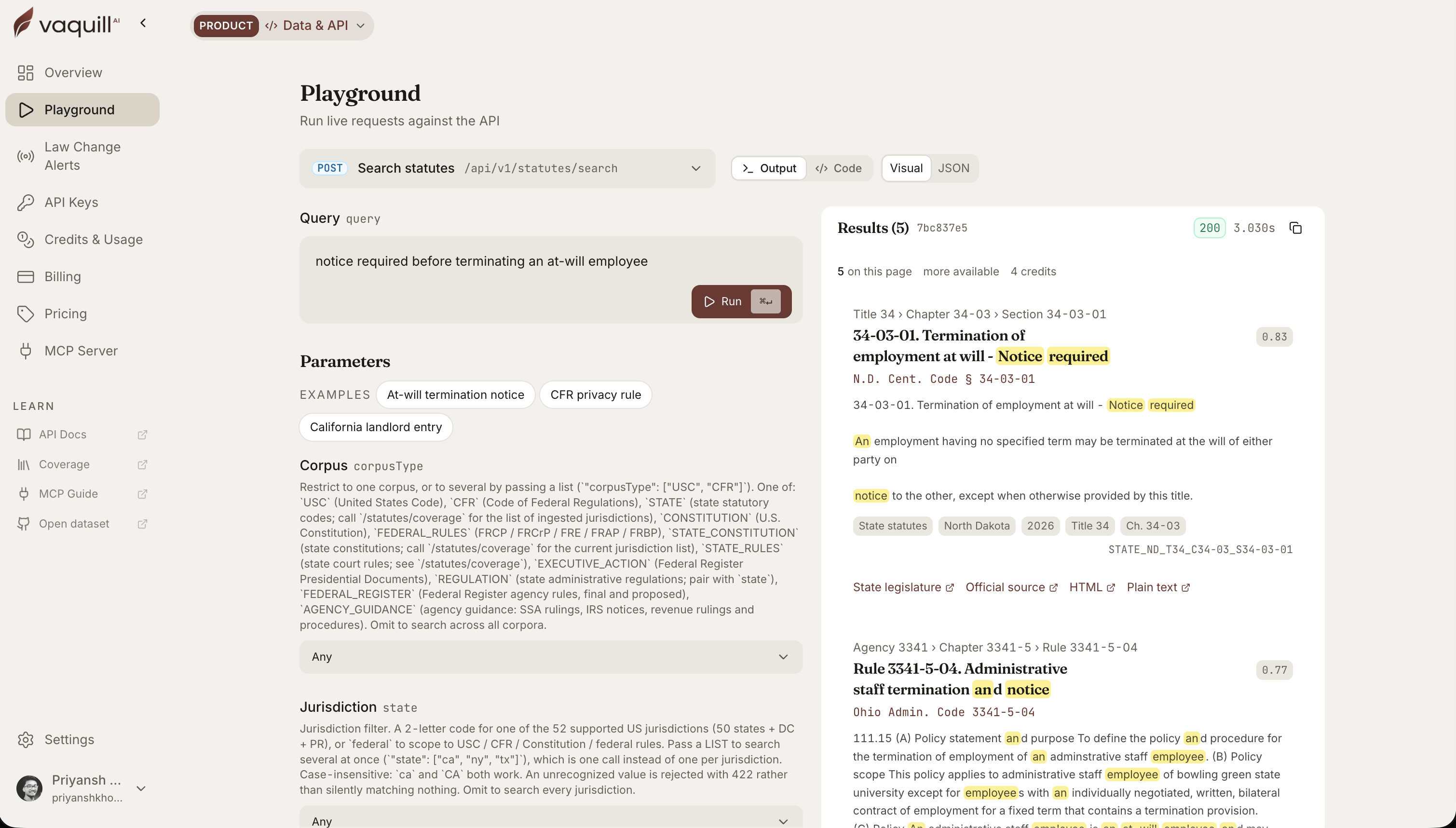 The same corpus behind this article, queried live. Every result carries its citation and a link to the official source.
The bottleneck it does not remove: the disclosure is sworn. A client certifies it under penalty of perjury. AI assembling the numbers does not relieve the lawyer of confirming they are complete and accurate, and it does not catch the asset the client deliberately did not mention.
Assembly is automatable. Truth is not.
Stage 3: Discovery review
Discovery in family law is less about volume than about emotional signal buried in volume. The smoking gun is one text in a thread of two thousand, or one transaction in a year of normal spending.
The bottleneck AI removes: first-pass review and tagging across large document sets. Reviewing tens of thousands of messages for relevance, responsiveness, and privilege is the canonical use case, and it is the same muscle AI uses for contract review at scale.
If you want to see how multi-document extraction works in a non-family context, our guide to AI contract review walks through the same grid-based approach applied to clauses instead of custody-relevant events.
The bottleneck it does not remove: judgment about what is actually relevant to the best-interest standard. AI can flag every message containing "drunk." It cannot tell you which one a judge will find persuasive, which one is hearsay you will never get in, and which one makes your client look worse than the other parent.
That filtering is lawyering, and 57% automatable is generous for it.
Stage 4: Building the chronology
Family-law matters live or die on timeline. Who had the kids on which weekends. When the threats started. When the income changed. When the move-away was floated. A clean chronology is half the argument.
The bottleneck AI removes: assembling a dated sequence of events from messy, multi-format inputs. Pulling dates and events out of texts, emails, financial records, and reports, and stitching them into one ordered timeline, is slow manual work that AI does well.
A chronology builder that ingests the documents and proposes the sequence turns a two-day task into a review-and-correct task.
The bottleneck it does not remove: the narrative. A chronology is a list of events. A theory of the case is an argument about what those events mean for this child's best interest.
AI gives you the spine. The lawyer decides which vertebrae carry weight.
Stage 5: Declaration and motion drafting
This is the stage most vendors put on the billboard, and it is the stage with the highest risk.
The bottleneck AI removes: the blank page and the boilerplate. Generating a first draft of a declaration from the chronology and the disclosures, or a procedural motion from a template plus matter facts, genuinely saves hours.
Multi-step workflows that chain extraction, drafting, and a consistency check against the record are where this gets real, because the draft is grounded in the documents rather than invented from a prompt.
The bottleneck it does not remove, and this is the one that ends careers: certification. A declaration is testimony, sworn under penalty of perjury. A motion's citations must be real and on point.
In Mata v. Avianca (2023), lawyers filed a brief full of cases ChatGPT had hallucinated, and they got sanctioned for it. The lesson was not "do not use AI." It was "you sign it, you own it, you verify every citation and every factual assertion before it touches a court."
ABA Formal Opinion 512 (July 2024) made the duties explicit: competence, confidentiality, candor, and supervision do not get suspended because a model wrote the first draft. In family law, where the declaration is your client's sworn word about their own children, the certification gate is not a formality. It is the job.
Stage 6: Statute and procedure checks
Family law is intensely jurisdictional. The waiting period, the residency requirement, the child-support calculation, the relevant family-code section: all of it varies by state and changes more often than people assume.
The bottleneck AI removes: finding the right current statutory section fast. Tools that index the U.S. Code, the CFR, and all fifty state codes let you pull the governing family-code provision without paging through a publisher's interface.
A scoped statutes API here covers statutes and legislation across USC, CFR, and 50-state codes. That is statutory text, not a case-law search engine and not a substitute for confirming the provision is still in force.
The bottleneck it does not remove: applying the standard. Knowing that a section exists is not the same as knowing how your local bench reads it.
Stage 7: Negotiation and settlement
Most family matters settle. The four-way meeting, the mediation, the marital settlement agreement, and the parenting plan are where the case actually ends, long before any trial date.
The bottleneck AI removes: turning a settlement framework into clean, comparable drafts. Generating a first-pass parenting plan or property-division term sheet from the chronology and the disclosure grid, then producing redline variants for two or three negotiation positions, is fast first-draft work.
A multi-step workflow can take the same set of facts and spin three offer scenarios (a base, a fallback, and a reach) so you walk into mediation with numbers already laid out instead of building them in the hallway.
The bottleneck it does not remove: reading the room. AI does not know that opposing counsel will trade holiday schedule for the 529 account, or that your client will accept less custody time to end the fight faster. Negotiation is the judgment layer, and it stays with the lawyer.
AI drafts the offer. The lawyer reads the table.
Stage 8: Filing, hearing prep, and the rejection cycle
The last mile is mechanical and unforgiving. Family-law filings get bounced for the wrong form version, a missing signature page, an unfiled proof of service, or a mismatched caption, and each rejection adds days or weeks.
The bottleneck AI removes: assembling a hearing binder and a filing checklist. Pulling exhibits in order, cross-checking that every fact in the declaration ties to a document in the record, and generating a witness-question outline from the chronology is the kind of assembly AI handles well.
The bottleneck it does not remove: court-specific compliance and advocacy. The local rules on tabbing exhibits, the judge's standing order on declaration length, and the actual argument at the podium are not things you hand to a model. Treat AI form-population as a draft to verify, never as a filed document, because a tool that auto-fills the wrong field still produces a clean-looking rejection.
For related vendor / pricing / buyer-guide coverage, see AI for Family Law: How Solo and Small-Firm Family Lawyers Use It and The Best Legal Research Tools for Solo Attorneys Doing Mostly Family Law.
A worked example: one custody matter, start to finish
Abstract stages are easy to nod along to. Here is the same eight-stage workflow run against one realistic contested-custody matter, so you can see exactly where the hours move.
The matter: Mother files for sole legal and physical custody of two kids. Father cross-petitions for joint. The evidence is a phone export of 1,800 text messages, 18 months of statements across four bank accounts, a CPS referral that was closed without action, and two years of school records.
| Stage | Old way | With AI in the loop | Human gate |
|---|---|---|---|
| Intake | Paralegal builds the file over a day | Draft matter profile (parties, dates, prior orders) extracted from uploads in minutes | Conflict check; read on the client |
| Disclosures | Manually keying figures from four accounts | One extraction grid across all 18 months; flags a $12,000 transfer out the month before filing | Confirm completeness; client swears to it |
| Discovery | Reading 1,800 texts line by line | First-pass tag for relevance and privilege; surfaces 40 candidate messages | Which 6 a judge will actually credit |
| Chronology | Two days stitching a timeline | Dated event sequence proposed from texts, statements, records | The theory: what the timeline means for these kids |
| Drafting | Blank-page declaration | First draft grounded in the chronology and disclosures | Verify every citation; certify the truth |
| Statute check | Paging a publisher's interface | Pull the current custody and support code sections fast | Apply the local standard |
| Negotiation | Building offer math in the hallway | Three settlement scenarios drafted from the facts | Read the room; make the trade |
| Filing | Hand-assembling the binder | Exhibits ordered, facts cross-checked, checklist generated | Local-rules compliance; the argument |
The mechanical work, the part the client hates paying for, compresses from roughly three weeks to a few days of review. The best-interest judgment, the one good call the whole case turns on, takes exactly as long as it always did. That is the point.
The honest scorecard
Lay the pipeline out and the pattern is obvious. AI is excellent at the information-assembly layer (intake extraction, disclosure grids, discovery first-pass, chronology assembly, statute lookup) and merely a starting point at the judgment layer (relevance calls, narrative, negotiation, certification).
| Stage | What AI compresses | The gate a human owns |
|---|---|---|
| Intake | Structuring the file from raw documents | Conflict check, read on the client, the upload decision |
| Disclosures | Extracting figures across many statements | Completeness and the sworn certification |
| Discovery | First-pass review and tagging at volume | Relevance to the best-interest standard |
| Chronology | Assembling a dated event sequence | The theory of the case |
| Drafting | First draft and boilerplate | Verifying citations and certifying truth |
| Statute checks | Finding the current code section | Applying the standard locally |
| Negotiation | Drafting offer scenarios from the facts | Reading the room and making the trade |
| Filing | Ordering exhibits and the filing checklist | Local-rules compliance and the argument |
This is why the framing matters for small firms specifically. The ABA's 2024 survey found 67% of lawyers rely on paid research, with solos reporting under $3,000 a year on technology and 2-9 lawyer firms in the $10,000 to $20,000 range.
A solo family lawyer is not buying a six-figure platform. They are buying back hours on the assembly layer so they can take more matters without hiring.
If you are weighing options at that budget, our guide for solo attorneys and our breakdown of what firms actually pay are the right places to start, and our look at Harvey, Legora, and CoCounsel pricing covers the high end if you want to see what you are not paying for.
What most people get wrong
Two mistakes, both common.
The first is selling AI as a substantive drafting magic-button. The Clio split (81% admin, 57% lawyer) tells you the leverage is on the intake and discovery layer, not the custody motion itself.
A vendor pitching "AI writes your declarations" is pointing at the riskiest, least-automatable part of the pipeline and calling it the easy win. It is the opposite.
The second is treating the certification gate as an afterthought. In family law the documents are sworn and the disclosures are mandatory. AI can assemble the financial grid, draft the declaration, and build the timeline, but it cannot stand in front of the judge and vouch for any of it.
The error rate is not hypothetical. A Stanford HAI study found that even purpose-built legal AI tools hallucinated on more than one in six benchmarking queries (Stanford HAI, May 2024). That is fine for a first draft you will verify. It is a sanction waiting to happen for anything filed unchecked. We keep a running file on AI hallucinations and legal sanctions if you want the case list.
Mata and Opinion 512 are not edge cases to wave away. They are the operating manual. The lawyer who internalizes that AI handles assembly while the human owns truth will get the leverage without the sanction. The lawyer who blurs the line will eventually find out which side of it they were on.
The leverage is real, and in family law it is larger than in almost any other practice area. So is the responsibility. Use the tool where the work is mechanical. Keep your hands on the wheel where the work is sworn.
If you are about to put this in front of a team, start with one stage, not all eight. Our guides on running a 30-day legal AI pilot and rolling out legal AI to your team cover the order of operations so adoption does not stall at the first messy matter.
FAQ
What is a family law AI workflow?
It is the standard family-law matter lifecycle (intake, financial disclosures, discovery review, chronology, drafting, statute checks, negotiation, and filing) with AI inserted at the document-assembly steps and a human kept on the judgment steps. AI compresses the reading, sorting, and extracting. The lawyer still owns relevance calls, negotiation, and anything sworn to a court.
How does AI help family lawyers specifically?
Family law runs on a high volume of low-structure personal evidence: text exports, bank statements, school and medical records, CPS reports. AI is good at pulling fields and dates out of that mess and arranging them into grids and timelines. According to Clio's 2025 Legal Trends Report, roughly 81% of legal-secretary and admin tasks are automatable versus about 57% of lawyer tasks, and family law is unusually heavy on that admin layer.
Can AI for family law firms draft custody motions and declarations?
It can draft a first pass from your chronology and disclosures, which saves real hours. It cannot certify it. A declaration is testimony sworn under penalty of perjury, and motion citations must be verified by the lawyer who signs. A Stanford HAI study found legal AI tools hallucinated on more than one in six queries, so unchecked filing is how lawyers get sanctioned (see Mata v. Avianca, 2023).
Is it ethical for family lawyers to use AI?
Yes, with supervision. ABA Formal Opinion 512 (July 2024) confirms the duties of competence, confidentiality, candor, and supervision still apply: a model writing the first draft does not transfer them. The practical rule is to use AI for assembly and verify everything before it is filed or sworn.
What family law tasks should AI not touch?
The judgment layer: the conflict check, the read on the client, deciding which evidence a judge will credit, the theory of the case, negotiation strategy, and certifying truth to a court. Those decide outcomes and carry the liability, so they stay with the lawyer.
How much time can a family law AI workflow save?
Estimates vary and most are self-reported, so treat them as directional, not guaranteed. Everlaw's 2025 survey had generative-AI users reporting up to 32.5 working days saved a year. In practice the win concentrates on the assembly stages: a contested matter's document handling can drop from weeks to days, while the core best-interest judgment takes as long as it ever did.
Which family law stage gives the biggest AI win?
Financial disclosures. Extracting the same fields across dozens of bank statements, pay stubs, and tax returns into one comparable grid is where the pattern (the transfer out of the joint account the month before filing) actually surfaces. It is the most underrated win in family practice.
Does AI replace paralegals in family law?
No, it shifts what they do. The repetitive extraction and file-building moves to AI review-and-correct, and the paralegal moves up to coordination, verification, and client-facing work. The role changes shape; it does not disappear.
For more on multi-document family-law workflows, see the US primary law API.
New legal AI guides, weekly.
Further Reading
AI for Family Law: How Solo and Small-Firm Family Lawyers Use It
Read postLegal AI Tools for Solo Practitioners: 7 Picks That Fit a One-Person Firm
Read postPersonal Injury AI in 2026: What It Actually Does for Plaintiff Lawyers
Read post7 Ways AI Helps Personal Injury Lawyers Win Cases Faster
Read postAI for Criminal Defense: Research, Timelines, Evidence Review
Read postLegal AI Suite Intake-to-Filing Workflow: A Day in the Matter
Read post
Co-Founder & CEO · Attorney
Arshita leads product and strategy at Vaquill AI, the US primary law data API. As an attorney, she decides which law we carry, how each section is sourced and cited, and what legal AI and compliance teams need from the data.