A public defender in Clark County, Nevada, had 19 hours of body-camera footage across 21 separate videos sitting in a discovery folder. Trial was close. Watching all of it the old way, at the speed of human attention, was not going to happen before the case resolved.
Using AI built for audiovisual review, an investigator got through the entire set in about two hours. In another matter, a team facing roughly 140 hours across 157 court videos narrowed it to the 12 clips that actually mattered.
That is the real story of AI for criminal defense, and it is not the story most people tell. The pitch you usually hear is AI that drafts motions or answers research questions in a chat box.
The actual leverage is somewhere less glamorous: it closes the discovery-volume gap that quietly tilts the field against the defense. And it raises a confidentiality problem that, in criminal work, is sharper than in any civil practice, because what is at stake is not a settlement number. It is a person's liberty.
Short answer: AI for criminal defense is most useful for triaging audiovisual discovery (body-cam, jail calls, interrogation video), building sourced timelines, drafting first-pass suppression and sentencing documents, and grounding case-law research. Criminal defense AI tools earn their place by finding the contradiction fast while the lawyer keeps the judgment about the case. The hard limits are constitutional confidentiality and a duty to verify every citation and every clip against the original record before you rely on it.
TL;DR
- The high-value, lower-risk use of AI in criminal defense is audiovisual discovery triage (body-cam, jail calls, interrogation video) and timeline-building, not motion drafting.
- Tools like JusticeText (used by 70+ public defense agencies and 300+ private firms, per the Thomson Reuters Institute) cut review of dozens of hours of footage to hours. The leverage is finding the contradiction, not summarizing the haystack away.
- Prosecution-side AI is now writing reports from evidence at scale. That is an arms race, and summarization that drops exculpatory context is a Brady problem, not a convenience.
- The confidentiality bar is higher here than in civil work. 18 U.S.C. § 3006A expressly protects the defendant's Fifth Amendment, Sixth Amendment, attorney-client, and work-product interests. A consumer chatbot on a privileged jail call is a constitutional problem, not a terms-of-service checkbox.
- Verification is non-negotiable. Mata v. Avianca and ABA Formal Opinion 512 make checking every citation a duty.
Per the post, what makes the confidentiality bar in criminal defense higher than in civil work?
Part of our legal AI vendor comparison and pricing series.
The structural problem AI actually addresses
Start with what is broken, because the tool only makes sense against the gap it fills.
Criminal discovery has changed shape in the last decade. A single arrest now generates body-camera video from three officers, dash-cam, surveillance pulls, recorded interrogations, and, once your client is in custody, jail calls that the state records and indexes. The volume is not measured in pages anymore. It is measured in hours of audio and video.
The defense, especially the public defense side, does not have those hours. A line public defender carrying a triple-digit caseload cannot watch 19 hours of body-cam on one file and still meet the others.
So the footage gets skimmed, or it gets watched at the worst possible moment, the night before a hearing, or it does not get watched at all and the plea gets taken on the strength of a police narrative nobody fully tested.
Prosecutors face volume too, but the asymmetry is real. The state controls when the evidence is collected and how it is organized. The defense receives it, often late, in whatever format the system spits out. That timing gap is where wrongful pleas and missed suppression issues live.
This is the gap AI is genuinely good at. Not reasoning about guilt. Triage. Point a transcription-and-search tool at 21 videos and it will tell you which thirty seconds contain the Miranda warning, where the officer's account on the stand diverges from what the camera recorded, which jail call references the witness who later recanted.
The Nevada numbers above are not marketing gloss; they were reported by the Thomson Reuters Institute in its writeup of JusticeText, the platform co-founded by Devshi Mehrotra and Leslie Jones-Dove, now used by more than 70 public defense agencies and 300-plus private firms. The work that used to be impossible inside a caseload becomes a Tuesday afternoon.
This is the same mechanism that makes AI useful in personal injury record review, where the bottleneck is 1,400 pages of medical records instead of 19 hours of video. Different medium, identical move: extract the facts from a volume no human has time to read, then point the lawyer at the parts that matter.
The honest framing: find the needle, never summarize away the haystack
Here is the line that separates useful from dangerous, and most vendor decks blur it.
AI in criminal defense should help you find things. The contradiction between the report and the footage. The Brady moment buried at hour eleven. The jail call that undercuts the cooperating witness. Search, surface, jump-to-timestamp. That is the needle.
What it should not do is replace your judgment about the whole. The temptation, once a tool can transcribe and summarize 140 hours, is to read the summary instead of the evidence and call it done.
In civil practice, a summary that misses a nuance costs money. In criminal defense, a summary that omits the three seconds where your client says "I want a lawyer" costs a suppression motion you will never know you had.
The Center for Democracy and Technology's Tom Bowman put the prosecution-side version of this sharply, telling The Record that summarizing hours of footage "is really just editorializing and, when liberty is at stake, these shortcuts are really dangerous."
He was talking about police using AI to compress evidence into reports. The warning cuts both ways. A defense lawyer who lets a model decide what is important has handed off the one thing the Sixth Amendment guarantees the client, which is a human advocate who actually looked.
So the practical rule: use AI to make the haystack searchable, then go look at the needle yourself, on the original footage, before you rely on it. The tool earns its place by getting you to the right thirty seconds. You still have to watch them.
For related vendor / pricing / buyer-guide coverage, see 7 Ways AI Helps Personal Injury Lawyers Win Cases Faster and Best AI Legal Research for Solo Attorneys on a Budget (2026).
The arms race nobody warns defense lawyers about
This is the part that does not show up in the "AI for lawyers" content, and it is the most important shift in 2026.
Law enforcement is now using AI to synthesize evidence at scale. The Record reported on a cluster of products doing exactly this: TimePilot, from Tranquility AI, launched in February 2025 and adopted by more than a dozen agencies; Truleo, which by mid-2025 was selling a roughly $200-per-user-per-month service into hundreds of departments. These tools ingest body-cam and other footage and help officers write reports from it.
Sit with what that means for the defense. The narrative you are cross-examining may have been assembled, in part, by a model that was, in NACDL counsel Jumana Musa's framing to The Record, "not trained to be a prosecutor" but "trained to look for particular things and put them together."
A model optimized to produce a coherent incident report is, by construction, a model that smooths over the parts that do not fit the incident. The exculpatory ambiguity, the hesitation, the detail that complicates the clean story, is precisely what a summarization engine is built to drop.
That creates two new jobs for defense counsel:
- Probe how the report was made. If an officer's report was AI-assisted, the gap between the generated narrative and the raw footage is a cross-examination target and, potentially, a Brady issue. The footage is the evidence. The AI report is an argument dressed as a record.
- Use the same class of tool to check the work. The defense answer to AI-synthesized reports is not to avoid AI. It is to run your own audiovisual review against the raw files so you can show the jury where the narrative and the camera disagree.
The field is not level, and AI did not level it. It armed both sides. The defense use is defensive: catch what the other side's tooling smoothed over.
The admissibility question hiding inside AI-assisted evidence
There is a second front. When the state offers output that an algorithm produced or shaped (a facial-recognition match, an AI-enhanced image, a probabilistic genotyping result, an AI-summarized report), its reliability is a live admissibility fight. In federal court and the many states that follow it, expert testimony has to clear the Daubert v. Merrell Dow Pharmaceuticals standard, which asks whether a method is tested, peer-reviewed, has a known error rate, and is generally accepted. A model whose training data, error rate, and validation you cannot inspect is an obvious target for that challenge. Treat AI-touched prosecution evidence as something to probe (demand the method, the error rate, the validation), not something to concede because it looks technical.
Where the constitutional stakes change the calculus
Now the part that should govern every tool decision you make, and the reason "just use ChatGPT" is malpractice-adjacent in this practice area specifically.
In civil work, confidentiality is a contractual and ethical concern. In criminal defense, it is constitutional. When Congress wrote the Criminal Justice Act, it did not treat the defense file as ordinary business data.
The statute is worth pulling directly. Using Vaquill AI's US statutes API, the text of 18 U.S.C. § 3006A enumerates, among the interests the system must protect, the defendant's Fifth Amendment privilege against self-incrimination, the Sixth Amendment right to effective assistance of counsel, the attorney-client privilege, and the attorney work-product privilege. Four protected interests, named in one provision, all of them implicated the moment you upload discovery to a tool.
That changes the analysis from "is this vendor SOC 2 compliant" to "does feeding this material to this system threaten a constitutional protection my client cannot waive casually."
Concretely:
- A privileged jail call (the recorded ones the state keeps, plus your own privileged communications) dropped into a consumer chatbot is not a vendor-terms question. It is a potential breach of attorney-client privilege and, depending on the tool's data handling, a Sixth Amendment problem.
- A sealed juvenile record or a sealed indictment pasted into a model that retains and trains on inputs has left the protected envelope. You cannot un-share it.
- Work product, your theory of the case encoded in the questions you ask the AI, is itself privileged. The prompt history is discovery you are creating about your own strategy.
The bar to clear before any tool touches criminal discovery is therefore higher than the civil bar. The questions are: does the vendor train on your inputs, where does the data live, who can subpoena it, and can you produce a defensible answer if a court asks how you handled a sealed file.
We have written separately about where your legal AI data actually goes and about verifying a no-training commitment rather than taking it on faith. In criminal work, those are not best practices. They are the floor.
The shorthand a lot of lawyers use, "consumer AI is fine for low-stakes stuff," does not have a low-stakes version in a public defender's caseload. Every file is someone's liberty.
The other half: research, drafting, chronology, sentencing
Discovery review is the headline. Four more uses earn their keep, with the usual guardrails.
Grounded legal research
Suppression and constitutional argument is precedent-heavy work. The line of authority from Miranda v. Arizona through Terry v. Ohio to Carpenter v. United States is the spine of a lot of pretrial motions, and you need the controlling and persuasive cases for your jurisdiction, not a model's confident paraphrase of cases that may not exist.
This is where the hallucination problem is not abstract. Mata v. Avianca, the 2023 case where lawyers filed six fabricated citations generated by ChatGPT and drew sanctions, is the cautionary tale every practice area now cites, and criminal defense is no exception. The pattern keeps repeating, which is why AI hallucinations in legal research keep drawing sanctions across jurisdictions.
The fix is grounded research: a system that returns real opinions with citations you can open and read, rather than a chatbot improvising. Vaquill AI's in-app legal research is built on this model, grounded in 8M-plus US federal and state opinions. Whatever tool you use, the test is the same: can you click the citation and read the actual opinion.
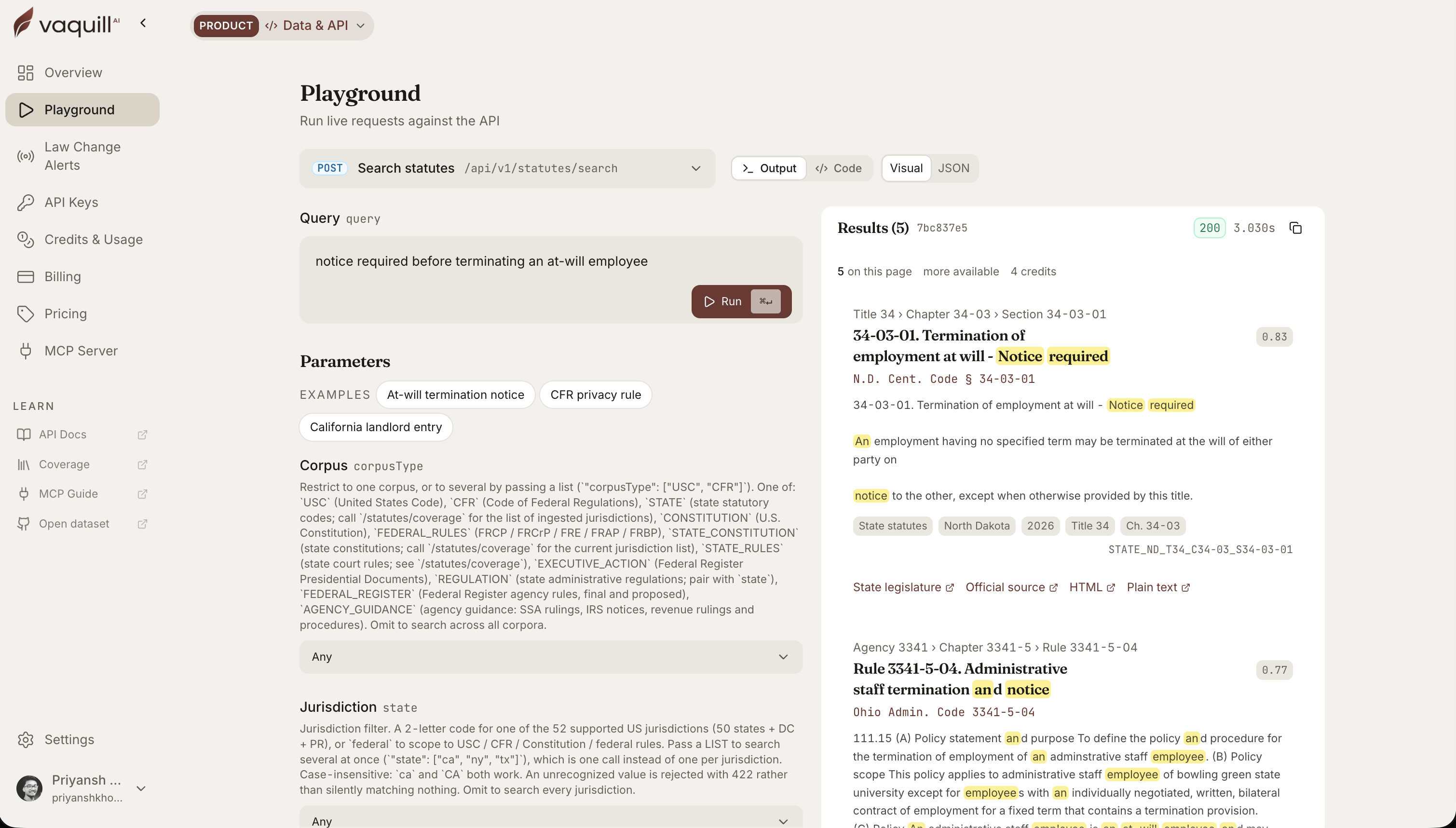 The same corpus behind this article, queried live. Every result carries its citation and a link to the official source.
And then you verify. ABA Formal Opinion 512 makes competence-with-AI a duty, which means checking every citation before it goes in a motion is not optional diligence. It is the rule. The same applies if you let a research tool run in agent mode: autonomy raises the verification burden, it does not remove it.
Motion drafting, first draft only
This is the use every vendor leads with, so be clear about what it is good for. A model that has read your suppression facts can produce a competent first draft of a motion to suppress, a motion in limine, a bail argument, or, in a federal case, a response to a prosecution filing measured against the charging and plea policy in the DOJ Justice Manual. CoCounsel Legal and Paxton AI both market exactly this for criminal practice, with Paxton publishing a 94% accuracy figure on the Stanford hallucination benchmark for its grounded research (Paxton AI, criminal-law solutions page, accessed June 2026).
A first draft is not a filing. The model can structure the argument and pull the standard, but it cannot be trusted with the citations. Mata v. Avianca is the standing reminder, and the duty does not soften because the document is a routine motion to suppress instead of a brief.
A worked example. Say the issue is a warrantless car search and your theory is that the inventory-search exception does not apply because the department had no standardized inventory policy. A useful prompt is not "write my suppression motion." It is: "Draft the legal-standard section for a motion to suppress a warrantless vehicle search under the automobile exception and the inventory-search exception, for [your state], and flag where a missing standardized-inventory-policy fact would defeat the inventory rationale." What comes back is a scaffold with the elements and the open factual question marked. You then pull the actual controlling cases for your jurisdiction, read them, and write the fact section yourself. The AI saved the first hour. It did not write the motion.
Sentencing and mitigation research
Sentencing is where volume and pattern meet, and it is underused. Mitigation work means assembling a client's history (medical, educational, trauma, employment) into a narrative a judge will weigh, and sentencing advocacy means knowing the Sentencing Guidelines math behind the range and what comparable defendants actually received. Tools like SentencingStats analyze federal sentencing data to support data-backed mitigation, per the Berkeley Law Criminal Law and Justice Center's tools list (accessed June 2026).
The AI move here is the same as everywhere else in this practice. Use it to pull the records into a draft mitigation chronology and to surface the guideline calculations and comparable outcomes, then write the human story yourself, because that is the part a model cannot do and a judge can tell.
Chronology and timelines
Criminal cases live and die on sequence. When was the stop, when was the warning given, when did the search happen, when did custody attach, when did the alleged statement get made. The Fourth and Fifth Amendment questions often turn on the order of events down to the minute, and that order is scattered across reports, footage timestamps, dispatch logs, and your client's account.
Pulling those moments into a single, sourced timeline is exactly the kind of structured, verifiable task AI does well, because every entry traces back to a document or a timestamp you can check.
Vaquill AI's Chronology Builder assembles this from the underlying records, and for cases where the same facts (a stop time, an officer's account) need to be compared across many documents at once, a document matrix lays them out in a grid so a contradiction jumps off the page instead of hiding in the fortieth file.
The discipline is the same as with footage: the timeline gets you to the conflict fast, and then you confirm it against the source before you build an argument on it.
What this adds up to
Strip away the hype and the position is straightforward. AI's real contribution to criminal defense is not eloquence. It is reach. It lets a defender carrying an impossible caseload actually engage with the volume of audiovisual evidence the modern system produces, find the contradictions and the Brady moments, and build the timeline that grounds a suppression motion. That is a force-multiplier on a field that has been uneven for a long time.
But it is a force-multiplier with two hard limits. The confidentiality bar in criminal work is constitutional, not contractual, so the tool you choose has to clear a higher floor than anything you would tolerate in a civil matter.
And the technology that helps you is the same technology helping the other side compress evidence into clean narratives, which means your job is increasingly to find what their tooling smoothed over. For the full practice-area workflow, see our criminal defense solution.
Find the needle. Never summarize away the haystack. And never, ever put a sealed file somewhere you cannot account for it.
FAQ
How do criminal defense lawyers use AI?
Most often for audiovisual discovery triage: transcribing and searching body-cam, jail calls, and interrogation video to find the thirty seconds that matter. After that, the common uses are building sourced timelines, drafting first-pass suppression and sentencing documents, and running grounded case-law research. The constant is that AI surfaces the contradiction and the lawyer verifies it against the original record.
What are the best AI tools for criminal defense?
The field splits by job. For audiovisual review, JusticeText and Reduct.Video are built for body-cam and recorded-call transcription, and the Berkeley Law Criminal Law and Justice Center maintains a public list of tools used by defenders. For grounded research and drafting, general legal-AI platforms like CoCounsel Legal, Paxton AI, and Vaquill AI apply. The right choice depends on whether your bottleneck is hours of video or pages of law.
Is it ethical to use AI in criminal defense?
Yes, with conditions. ABA Formal Opinion 512 treats competence with AI as a professional duty, which means you must understand the tool, protect client confidentiality, and verify every output. Using AI is not the violation. Filing unverified AI output or exposing privileged material is.
Can I use ChatGPT for a criminal case?
For privileged material, no. A consumer chatbot that may retain and train on inputs can compromise attorney-client privilege, work product, and Sixth Amendment protections that a criminal defendant cannot casually waive. If you use general AI at all, keep sealed records, jail calls, and case theory out of it, and prefer a tool with a verified no-training commitment and clear data handling.
Does AI replace a criminal defense lawyer?
No. AI handles volume: it reads the footage and the records a human cannot get through inside a real caseload. Judgment about guilt, strategy, the human mitigation story, and what to actually file stays with the lawyer. A model that decides what is important has taken over the one thing the Sixth Amendment guarantees the client.
Can AI write a motion to suppress?
It can draft the legal-standard scaffold and structure the argument, which saves the first hour. It cannot be trusted with the citations or the fact section. You pull the controlling cases for your jurisdiction, read them, write the facts, and verify every cite before filing. Treat the first draft as a starting point you still have to finish and check.
How does AI affect discovery in criminal cases?
It closes the volume gap. A single arrest can generate dozens of hours of body-cam, dash-cam, and jail calls that a defender carrying a triple-digit caseload cannot watch. Transcription-and-search tools make that haystack searchable so the lawyer can jump to the Miranda warning, the contradiction, or the Brady moment, then watch the original clip to confirm it.
Try it on your next question
Vaquill AI is an AI legal research and drafting suite built for US firms, not AmLaw price tags. Ask a question and get an answer grounded in real federal and state court opinions, with citations you can open and verify. Compare documents, build chronologies, and keep every matter organized in one workspace.
New legal AI guides, weekly.
Further Reading
Legal AI Tools for Solo Practitioners: 7 Picks That Fit a One-Person Firm
Read postPersonal Injury AI in 2026: What It Actually Does for Plaintiff Lawyers
Read post7 Ways AI Helps Personal Injury Lawyers Win Cases Faster
Read postAI for Family Law: How Solo and Small-Firm Family Lawyers Use It
Read postAI for Family Law Firms: A Workflow Playbook for Intake, Discovery, Filings
Read postTop AI Legal Research for Solo Attorneys on a Budget
Read post
Co-Founder & CEO · Attorney
Arshita leads product and strategy at Vaquill AI, the US primary law data API. As an attorney, she decides which law we carry, how each section is sourced and cited, and what legal AI and compliance teams need from the data.