A litigator I know learned what is matter management in legal AI the hard way. She had been using a consumer AI assistant for months, the kind that remembers everything across sessions, because it felt like a brilliant junior associate who never forgot a fact.
One afternoon, on a new defense matter, she asked a general question about settlement strategy. The model casually referenced a very specific number. It took her a second to place it: that figure had come from a completely different client, an unrelated case she had worked through the same assistant weeks earlier.
Nothing leaked outside her account. No breach, no headline. But she had just watched a machine bridge two clients on its own, with no human deciding to open the second file. That is the moment matter management in legal AI stops being a filing-cabinet conversation and becomes an ethics conversation.
The honest answer to what is matter management in legal AI is not "a way to organize your documents." It is the discipline of scoping every AI action, the context it sees, the memory it keeps, the documents it retrieves, the answer it produces, to a single client matter, so the tool physically cannot do what that assistant just did.
The opinionated version, and the one I will defend here: per-matter segregation is not a UX nicety. It is the safeguard. The mega-prompt that remembers all your clients is the anti-pattern.
What is legal matter management, in one paragraph
Legal matter management is the practice of organizing, tracking, and managing every piece of work tied to a single client matter, from intake to close, in one place. A "matter" is the unit of legal work: a contract, a dispute, an investigation, a regulatory question. Matter management keeps that matter's documents, deadlines, communications, spend, and people together so the team has one source of truth instead of scattered email threads and spreadsheets. It is the layer in-house legal teams and law firms use to see what is open, who owns it, and where each matter stands.
The term has a second meaning now that AI sits inside the work. Matter management in legal AI adds an isolation rule: every AI action, the context it sees, the memory it keeps, the documents it retrieves, the answer it produces, is scoped to one matter. That scoping is the part the rest of this post defends, because it is where AI either protects privilege or quietly breaks it.
Matter management vs case management
People use the two terms loosely, but the SERP and the profession draw a line. The short version: case management is for law firms running litigation; matter management is for in-house legal departments running all kinds of legal work.
| Matter management | Case management | |
|---|---|---|
| Primary user | In-house / corporate legal teams | Law firms |
| Scope of work | All legal work: contracts, disputes, compliance, IP, advice | Litigation and client cases |
| Core goal | Visibility, spend control, risk, alignment to the business | Casework, deadlines, billing, client representation |
| Outside counsel | Tracks and manages external firms and their spend | Is the firm doing the work |
| Unit of work | The matter | The case |
This is the distinction Wikipedia draws too: matter management covers "all aspects of the corporate legal practice (matters)," while case management refers to "law firm related activities (cases)" (Wikipedia, Legal matter management, accessed June 2026). The mechanics overlap heavily. The professional duties, confidentiality, conflicts, and privilege, are identical whether the lawyer sits in a firm or inside a company.
What a matter workspace holds
A matter is more than a folder. A well-run matter workspace keeps these together, scoped to that one client matter:
- The record. Contracts, filings, exhibits, and correspondence for this matter, in one repository, across 50+ file formats.
- The facts. Every fact extracted from the file, sorted into key facts, parties, amounts, obligations, and conflicts, with a click back to the exact source line so nothing is taken on trust.
- The summary. A per-document summary and a detailed summary of the whole matter, so anyone can pick up the file cold and be current in minutes.
- The timeline. Deadlines, tasks, owners, and status, plus a timeline that includes the chats run against the matter, so nothing falls through.
- The communications. Email and notes routed to the matter, not buried in someone's inbox. Every matter has its own address, so forwarding a document files it automatically.
- The spend. Budget, invoices, and outside-counsel cost, attributable to this matter.
- The people. Internal team, business stakeholders, and the client the matter is associated with.
- The AI context. With an AI-native tool, the memory and retrieval the assistant uses, bounded to this matter and aware of the client and matter metadata behind every question.
That last row is the one the old practice-management vendors never had to think about. It is also where the risk lives.
TL;DR
Part of our in-house counsel guide series.
- Matter management in legal AI means isolating context, memory, retrieval, and output to one client matter, not pooling everything into a single assistant that "knows everything."
- The feature people brag about, one chatbot that remembers all your clients, is the exact mechanism that erodes privilege and silently creates Rule 1.7 and 1.9 conflicts.
- Courts are now testing AI and privilege directly. Early 2026 decisions split on the facts but agree on the principle: if a platform's terms let it use or disclose your inputs, you may have no reasonable expectation of confidentiality.
- ABA Formal Opinion 512 already warns that "self-learning" tools risk one client's input surfacing in another client's output, which is a Rule 1.6 problem.
- Segregation is also how the economics behave: scoped, metered work bounds cost and audit scope. One giant context does the opposite.
Per the post, which ABA opinion warns that self-learning tools risk one client's input surfacing in a different client's output?
The matter lifecycle: intake to close
Before we get to the AI part, the operational spine. Every matter moves through the same arc, whether it is a routine vendor NDA or a bet-the-company dispute. Getting that arc into one system, instead of email threads and a shared drive, is what matter management meant before AI and still means underneath it.
| Stage | What happens | Where it breaks without a system |
|---|---|---|
| Intake | A request lands: a contract to review, a dispute, a compliance question | Requests arrive by email and Slack, so nobody knows the real queue |
| Triage | The matter is classified by type, urgency, and risk | Everything looks equally urgent, so the wrong things get worked first |
| Assignment | An owner is set: internal counsel, a business partner, or an outside firm | Work stalls in "who has this?" limbo, or two people do it twice |
| Handling | Documents, research, deadlines, and communications accumulate on the matter | Context scatters across inboxes and folders; the record is never whole |
| Close | The matter resolves; outcome, spend, and learnings are captured | Nothing is captured, so the next similar matter starts from zero |
The AI question sits on top of the Handling row. That is where documents get drafted and reviewed, research gets run, and terms get extracted, and it is the stage where an assistant either respects the matter boundary or quietly reaches across it.
"Matter management" is not a paralegal word anymore
For thirty years, matter management meant the practice-management layer: open a matter number, attach the documents, track time, close it out. Clio, Smokeball, the billing system. Useful, but plumbing. The lawyer did the thinking; the software remembered where the folders lived.
AI breaks that clean division of labor, because now the software does some of the thinking, and to think it needs context. The question becomes: which context?
The naive instinct, and it is a strong one, is to let it see everything. Feed it your whole practice. Let it remember every client, every matter, every conversation, so it gets smarter over time and you never have to re-explain yourself.
That instinct is exactly backwards. In a law practice, the thing that makes a general assistant feel smart, persistent cross-client memory, is the same thing that makes it a liability. The smarter it gets by remembering everyone, the more dangerous it gets.
This is why matter management in the AI era is no longer a paralegal's organizational concern. It is an architectural decision about isolation, and it sits on top of three professional duties: confidentiality, conflicts, and privilege.
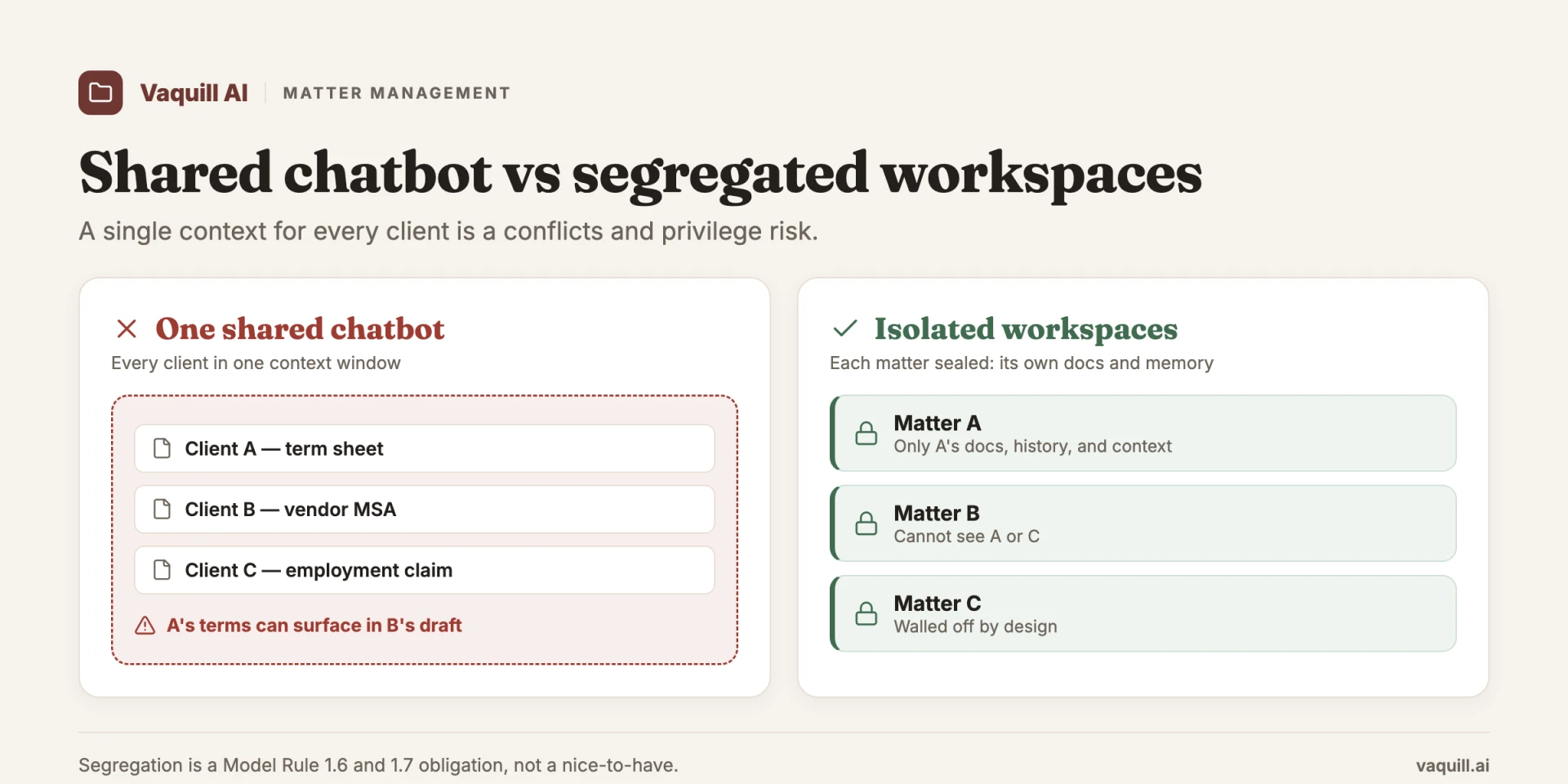
One shared context bleeds across clients; isolated matter workspaces don't.
The case against the mega-prompt
Call the anti-pattern what it is: the mega-prompt. One assistant, one shared context window, one growing memory that accumulates everything you have ever told it. Vendors market this as a feature. "It learns your practice." "It never forgets." "Ask it anything and it has the full picture."
Here is what the full picture actually means in a law firm. It means Client A's confidential strategy and Client B's confidential strategy live in the same recall surface. It means the model can draw on the first when answering about the second, not because anyone asked it to, but because that is what a single shared context does by design. It means there is no wall.
Lawyers spent a century building walls. We call them ethical screens. The entire apparatus of conflicts checking, of screened lawyers, of "I can't talk about that matter," exists because the profession decided information has to be compartmentalized to protect clients.
A shared-memory AI assistant is, structurally, a wall-removal machine. It is optimized to do the one thing the rules of professional conduct spent decades trying to prevent.
The matter is the correct unit of isolation because the matter is already the unit the rules use. Rule 1.7 and Rule 1.9 are written in terms of matters and clients, not in terms of "your overall AI assistant." Scope the AI to the matter and you are not inventing a new boundary. You are aligning the tool with one that already governs your license.
Why this is real now: conflicts that happen with no human in the loop
The most useful framing I have seen came from Gabe Pereyra, co-founder and president of Harvey, in a 2026 piece on ethical walls and AI. His point cuts to the structural problem rather than the hype. AI agents, he notes, access underlying data directly, maintain context across sessions and across time in ways humans simply do not, and operate at a scale that makes manual monitoring impractical.
Sit with that for a second. A human associate creates a conflict by making a decision: I am going to open that file, call that lawyer, use what I learned over there. There is an act, an actor, and usually a record.
An AI that retains context from a prior matter and applies it to an adverse one does not make a decision. It just has the context, and it uses it, automatically, at machine speed, across thousands of interactions you will never individually review. That, Pereyra argues, creates exactly the kind of conflict Rules 1.7 and 1.9 are designed to catch, except the triggering act has been automated away.
This is the part most people get wrong. They imagine the risk as a dramatic leak: the AI emails Client A's secrets to Client B. That almost never happens.
The real risk is quiet and ambient. The answer on Matter 2 is subtly shaped by what the model absorbed on Matter 1, the adverse one, and no one can point to the moment the screen was breached because there never was a screen. You cannot audit a wall that was never built.
The privilege problem just became case law
Until recently, the AI-and-privilege debate was a CLE thought experiment. In early 2026 it became something a court will actually rule on.
In United States v. Heppner (S.D.N.Y.), a court declined to extend attorney-client privilege, and work-product protection, to materials created with a consumer-grade AI tool. The reasoning is the part that should make every lawyer pause: where a platform's terms permit it to use or disclose the inputs it receives, there is no reasonable expectation of confidentiality in those inputs.
No reasonable expectation of confidentiality means no privilege. You typed your client's confidence into a box whose terms of service said the provider could use it, and in doing so you may have handed it to the other side.
A different court, in Warner v. Gilbarco (E.D. Mich.), came out the other way on its own facts, which tells you the law is still forming, not that the risk is imaginary. The two decisions are usefully summarized in Sidley Austin's February 2026 analysis, "Generative AI and Privilege: Practical Lessons from Two Early Decisions", and the practical lesson is consistent across both: the privilege analysis turns on what the tool is allowed to do with your inputs and whether you took reasonable steps to keep them confidential.
Connect that back to architecture. A mega-prompt assistant that pools every client into one persistent memory is, almost by definition, a place where inputs from one matter are retained and reused. That is precisely the fact pattern courts are now scrutinizing.
Per-matter segregation is the reasonable step: the architecturally enforced boundary you can point to when a court asks whether you had a reasonable expectation of confidentiality.
This is the same family of risk the profession learned the hard way in 2023, when lawyers in Mata v. Avianca were sanctioned for filing AI-fabricated citations. The lesson then was that the tool's behavior becomes your professional liability.
The privilege cases are the confidentiality-side sequel: the tool's data behavior becomes your professional liability too. (I wrote more about the citation side of this in our piece on AI hallucinations and sanctions.)
ABA 512 saw this coming
None of this is a surprise to anyone who read ABA Formal Opinion 512, issued in July 2024. The opinion ties generative AI use directly to Model Rule 1.6 and flags the exact mechanism at issue: with "self-learning" tools, there is a risk that one client's information, entered as input, later surfaces in a response to a different client.
Lawyers, the opinion says, have to evaluate the likelihood that a given tool discloses or reuses inputs, and where the risk is meaningful they need the client's informed consent.
Read that against the mega-prompt and the implication is blunt. If your assistant's value proposition is that it remembers all your clients and gets smarter from everything you feed it, you are using, by the ABA's own description, the precise category of tool that triggers the disclosure analysis.
Segregation is how you make the answer to "could one client's input surface in another's output" a structural no instead of a hopeful maybe. (We unpacked the full opinion in our ABA 512 guide, if you want the chapter and verse.)
What good segregation actually looks like
Saying "scope it to the matter" is easy. Here is what it means in a product that takes it seriously, and where the lines fall.
Memory is per-matter, not per-user. Recall should be bound to the matter you are working in. When you open a different client's matter, the assistant starts from that matter's context, not from a global pool of everything you have ever discussed. The recall surface follows the wall the rules already drew. This is the segregation primitive, and it is the whole reason a feature like per-matter memories exists instead of one omniscient chat history.
Retrieval is grounded, not trained. There is a world of difference between an AI that retrieves the documents in this matter to answer a question, and one that has been trained on, or persistently remembers, every matter at once.
Retrieval-augmented generation pulls scoped context at query time and drops it; it does not bake your clients into a shared model. That is the difference between a tool that answers "what does this matter's record say" and one that quietly carries Client A into Client B. (If the RAG-versus-training distinction is fuzzy, here is how grounded legal research actually works.)
Output is structured to the matter, not dumped into one endless thread. One reason the single-chatbot model encourages cross-contamination is that everything lands in the same conversation. Structured, per-matter output, extracting terms across this matter's documents into a document matrix, building a chronology, running a compliance check on these files, keeps the work anchored where it belongs.
Public data stays separate from client data. Worth being precise, because vendors blur it. Looking up a federal statute or a court opinion is not the same act as exposing your client's file.
Statutory text from the U.S. Code and the CFR is public reference data and can come from a neutral statutes API. Case-law research over millions of US court opinions runs as an in-app feature over public opinions.
Pulling public law into a matter is fine. What you segregate is the client's confidential context, not the public legal universe.
This is the architectural bet behind matter-scoped tools generally: research, drafting, and document work organized around the matter, not around one global assistant. The principle stands on its own regardless of whose logo is on it.
The economics point in the same direction
There is a quieter argument for segregation that has nothing to do with ethics and everything to do with cost and auditability.
A single mega-context is expensive and unbounded. Every query drags the whole accumulated history along, and you cannot easily say where the cost came from or which client to bill.
Scoped, metered work behaves the opposite way: when work is bounded to a matter, so is consumption. You can see what a matter cost, attribute it, and audit it. A neutral example: a public statutes API metered per call (a statutes search runs on the order of a few cents, full-text section retrieval slightly more) is the natural shape of scoped consumption: you pay for the specific lookups a matter needs, not for one ever-growing context.
The market is drifting this way for its own reasons. Reporting through 2026, including Artificial Lawyer's coverage of the shift away from per-seat pricing, points to usage and outcome-based models replacing flat seats.
Usage-based pricing only makes sense if usage is attributable, and usage is only cleanly attributable if work is scoped. Segregation and sane economics are the same architecture from two angles. (We dug into the per-seat unwind in our take on Harvey's pricing moves.)
The companion argument: accuracy, not just compliance
If you want the other half of the case for matter-scoping, we made it separately. This post is the confidentiality and conflicts argument: segregation protects privilege and prevents Rule 1.7 and 1.9 problems.
The matter-folder workspace post makes the accuracy and economics argument: scoping context to the matter is also how you get grounded, non-hallucinated answers, because the model is reasoning over the right, bounded record instead of a noisy global blob. And if your matters involve more than one lawyer, shared per-matter workspaces extend the same wall to collaboration.
They are two sides of one coin. The mega-prompt is worse on both: it is less accurate because it cannot tell which context is relevant, and less safe because it cannot tell which context is privileged. Segregation fixes both at once, usually the sign you have found the right unit of design rather than a workaround.
So, what is matter management in legal AI, finally
It is the recognition that in a law practice the unit of work is the matter, so the unit of isolation for any AI touching that work has to be the matter too. Not the user. Not the firm. Not one all-seeing assistant. The matter.
The single chatbot that remembers all your clients is seductive because it feels like leverage. It is actually a quiet transfer of risk onto your license.
Courts are now reading platform terms to decide whether your client ever had a reasonable expectation of confidentiality. The ABA already told you self-learning tools can leak one client into another. The structural conflicts problem fires with no human in the loop, which means no human to catch it.
Against all of that, "scope it to the matter" is not a limitation. It is the design that keeps the walls the profession built standing once a machine is doing the work behind them.
Segregation is not the thing you give up to get a smart assistant. It is the thing that makes a smart assistant safe enough to use on real clients.
FAQ
What is AI-powered matter management? AI-powered matter management keeps every matter, its documents, email, and research in one workspace, then scopes the AI to that matter. The assistant reasons over the files for the matter you are in, not your whole client list. That scoping is what makes it safe to use on live clients.
Is matter management for legal departments different from a law firm? The mechanics are the same. Matter management for legal departments maps a matter to a business unit or an intake request, so in-house counsel can track status, route email to the right matter, and keep work product separate. The privilege and conflicts logic does not change because the lawyer sits inside the company.
Do I need separate tools for matter management and legal AI? No. The old stack split matter management into one tool and legal AI into another. The point of AI-powered matter management is that the two belong together, because the AI is only trustworthy when it is bounded to the matter you are working.
What is the difference between matter management and case management? Case management is built for law firms running litigation and client cases. Matter management is built for in-house legal teams running every kind of legal work: contracts, disputes, compliance, IP, and general advice. The unit of work differs (a case versus a matter), but the confidentiality and conflicts duties are the same for both.
Who uses legal matter management software? Mostly corporate and in-house legal departments, from a solo general counsel to a lean legal team, plus the operations people who track spend and outside counsel. Law firms doing contentious work tend to lean on case management instead, though the categories overlap and many tools cover both.
What are the stages of the legal matter lifecycle? Intake, triage, assignment, handling, and close. A request comes in, gets classified by type and urgency, gets routed to the right owner (internal or outside counsel), gets worked, and gets closed with the outcome and spend captured for reporting. Matter management software carries a matter through all five in one place instead of across email and a shared drive.
What is the difference between matter-level and portfolio-level management? Matter-level management is running one file: its documents, deadlines, and spend. Portfolio-level management is running the whole book at once: which matters are open, what they cost, and where risk concentrates. In-house teams need both, and the reporting layer is usually where the portfolio view lives.
How much does legal matter management software cost? It ranges widely. Most enterprise legal management vendors quote based on seats, matter volume, and modules rather than publishing a price, so the honest answer for those is quote-based. AI-native tools tend to be more transparent: Vaquill AI publishes a self-serve seat. Before you sign anything, ask two questions: whether pricing is per seat or usage-based, and whether your matter data is used to train shared models.
For related operational playbooks, see The Legal Research Platform With Folder & Matter Workspace Organization (the accuracy-and-economics companion to this post) and Law Firm-Client Collaboration With AI. To compare tools, see the best matter management software for in-house teams; to see scoping in action, see how to search matter files conversationally. For more on per-matter memory and segregation in practice, see matter workspaces and how legal AI memory works across sessions.
New legal AI guides, weekly.
Further Reading
Legal AI DPA, GDPR, and EU vs US Data Hosting: Vendor Guide
Read postLaw Firm-Client Collaboration With AI: Shared Matter Workspaces
Read postWhere Your Data Actually Goes When You Use Legal AI (2026)
Read postLegal Research Platforms: Why Matter & Folder Organization Wins
Read postABA Formal Opinion 512 (2024): Generative AI Duties for Lawyers
Read postAI for Criminal Defense: Research, Timelines, Evidence Review
Read post
Product & Content
The US primary law data API: statutes, regulations, constitutions, court rules, executive orders and agency guidance across 53 US jurisdictions, each section cited and linked to its official source, via REST, MCP or SQL.