A fractional general counsel is a senior lawyer who acts as the in-house legal lead for several companies at once, on a fixed monthly retainer instead of a full-time salary. Think of a former GC who runs legal for six startups two days a month each, embedded in each business but employed by none. Fees usually land in the low thousands per month per client, far below the cost of a full-time hire.
A full-time general counsel is a six-figure hire, often deep into six figures with benefits and the recruiting cycle on top. A fractional GC sells the same seniority for a monthly retainer in the low thousands, with no headcount and no equity. That arbitrage is the entire business model.
It also explains why legal AI for in-house counsel is a different problem for a fractional GC than for anyone else in the profession: the fractional GC is not trying to do legal work faster. They are trying to be five lawyers at once, with one calendar, and bill all five.
Most coverage of legal AI treats the in-house lawyer as a single buyer with a single docket. The fractional GC breaks that frame.
You are not one in-house counsel. You are three to eight in-house counsel, each working for a different company, each with its own board, its own contracts, its own secrets. The tool that works for a salaried GC with one employer can quietly sink a fractional practice the moment client A's term sheet shows up in a draft for client B.
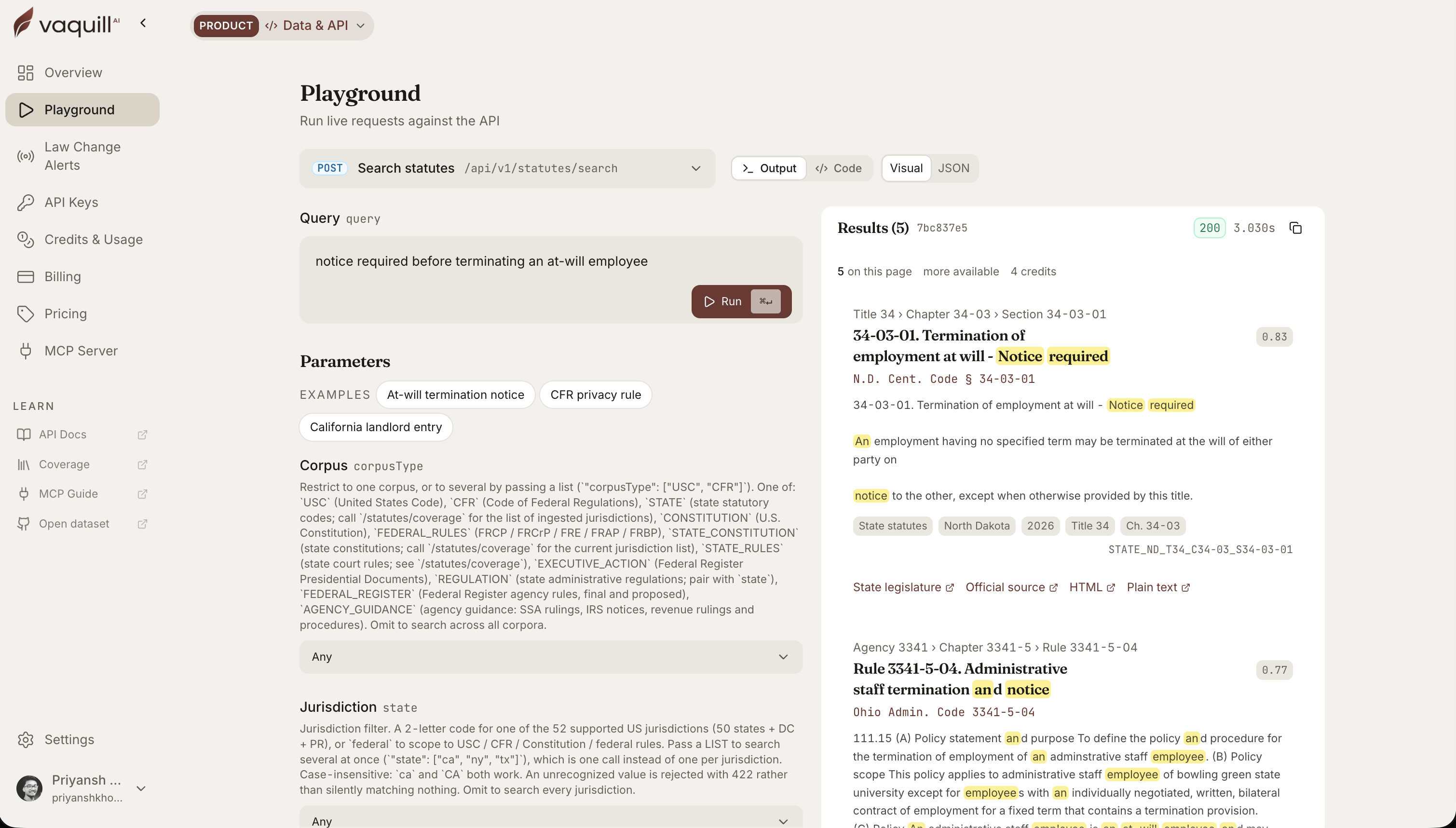 The same corpus behind this article, queried live. Every result carries its citation and a link to the official source.
Volume drafting is where the fractional GC's hours compound. Vaquill AI turns repeat contract shapes across clients into fast first drafts.
TL;DR
- The fractional GC's real constraint is not legal skill, it is throughput across clients. The model only works if your tooling scales you, not your hours.
- Client and matter segregation is not a nice-to-have. It is a Model Rule 1.6 obligation and a 1.7 conflicts question, and one bleed kills the practice.
- Fast turnaround is the billable wedge. Founders feel an NDA sitting in your queue for four days; they do not feel the two hours you saved on research.
- Volume drafting and first-pass review are where AI pays for itself, because the fractional book is mostly repeat contract shapes across different companies.
- The economics: more clients without more hours is the only way the retainer math improves. Tooling that does not multiply you is just overhead.
- Clients now run data-posture diligence on their fractional GC. SOC 2 Type 2, zero data retention, and no model training are table stakes, not selling points.
What is the fractional GC's real constraint?
What is a fractional general counsel, and what does it cost?
A fractional general counsel does almost everything a full-time GC does, contract negotiation, compliance, risk, employment matters, and the corporate counsel work of board-level advice, but splits that time across a portfolio of clients. The difference from a full-time GC is the employment relationship: a fractional GC is an independent contractor serving multiple companies, not an employee of one. The difference from traditional outside counsel is posture: a fractional GC embeds in the business and works proactively, while outside counsel is usually reactive and matter-by-matter, which is part of how companies reduce outside counsel spend with AI and a predictable retainer.
Most companies hire one when legal volume has outgrown "ask the founder's lawyer friend" but has not yet justified a full-time salary. The trigger is usually fundraising, a first enterprise deal with real contract terms, or a hiring wave that brings employment paperwork.
Pricing varies by experience and scope, but the published ranges cluster tightly. Here is what the cost looks like against the alternatives:
| Model | Typical cost | Source |
|---|---|---|
| Full-time GC (total comp) | $350,000 to $600,000+ per year | NexEra Legal pricing guide, 2026 |
| Traditional outside counsel | $400 to $1,500+ per hour | NexEra Legal pricing guide, 2026 |
| Fractional GC, monthly retainer | $1,500 to $15,000+ per month by tier | NexEra Legal pricing guide, 2026 |
| Fractional GC, hourly overage | roughly $400 to $550 per hour | Scott Resnick Law, 2026 |
| Staffing or placement counsel | $150 to $350+ per hour | NexEra Legal pricing guide, 2026 |
The retainer is the part that decides whether the practice scales, because it is fixed while the work is not. That fixed-fee structure is exactly why AI economics hit a fractional book differently than a salaried seat or a billable-hour firm, which is the rest of this guide.
The throughput problem nobody puts on the website
Read any fractional GC's pitch page and you get the same promise: senior legal judgment, on demand, at a fraction of the cost. True, and that is the easy part. The hard part is the part that never makes the website, which is that you have agreed to be on call for, say, six companies, and any two of them can have a bad week at the same time.
A salaried GC has one queue. A fractional GC has a queue per client, and the queues do not coordinate.
Client 1 needs an MSA redlined before a Friday signing. Client 2's founder forwards an inbound NDA at 9pm and wants it back "whenever, no rush" (translation: tomorrow). Client 3 got a data-processing addendum and has no idea whether to sign it. Client 4 wants an offer letter for a hire starting Monday.
None of these are hard for someone with your experience. All of them are hard to do at once, well, while keeping each client feeling like you work only for them.
This is why legal AI for fractional general counsel has to be measured on throughput, not capability. The benchmark question is not "can this draft a good indemnification clause." Of course it can. It is "can I move four clients' work through this today without dropping context between them."
Basic drafting capability is no longer the differentiator. Workflow containment, running a portfolio through one tool without bleed, is.
What legal AI for fractional general counsel must do differently: segregation is an ethics rule
Here is the failure mode that ends fractional practices, and it has nothing to do with bad drafting. It happens on a fast Tuesday, not a careless one.
You represent two SaaS companies in adjacent markets. You are three deals deep, working from your last good template, the founder of client B is texting for the redline, and client A's pricing schedule, the one with the confidential enterprise discount structure, ends up referenced in the draft you send to client B.
Maybe it was a copy-paste. Maybe an AI tool you pointed at "your contracts" pulled from the wrong client's history because it had no idea your clients were supposed to be walled off from each other. Either way you have just disclosed one client's confidential information to another, and under ABA Model Rule 1.6 that is not a workflow hiccup. It is a confidentiality breach.
The conflicts dimension is just as live. Model Rule 1.7 requires you to identify concurrent conflicts before they bite, and where clients have adverse or overlapping interests you may need each one's informed consent confirmed in writing.
A fractional GC carrying six clients in one vertical is running a standing conflicts-check problem. The tooling has to keep clients apart, not blur them together for a slicker autocomplete.
This is the precise reason matter management matters more for a fractional GC than for almost anyone else in legal. A salaried GC's "matters" are all one employer's; segregation is convenience. For a fractional GC, each client is a hard wall, and every document, every AI prompt, every retrieved precedent stays inside that client's container.
We have written separately on what matter management and AI segregation actually mean; for the fractional model, that explainer is not background reading, it is the core spec.
Segregation actually means four separate things, and a tool can pass one while failing another:
- Storage: a real matter or workspace boundary per client, so documents and templates never share a folder. Matter management built for separation is the structural answer, not a naming convention you maintain by hand.
- Retrieval scope: when the AI pulls precedent, it sees only this client's history, not a blended average across your book.
- Prompt and context scope: what gets fed into a given AI call is this client's material, so "use my standard mutual NDA" returns this client's standard.
- Model retention: nothing from one client persists into the model's view of another, and an audit trail per client survives the inevitable diligence question.
Turnaround is the wedge, not research
New fractional GCs think the value they sell is judgment. They are right about what is rare and wrong about what gets felt. Founders cannot evaluate the quality of your indemnity carve-out. They absolutely can feel an NDA sitting unsigned for four days while a deal cools.
The data backs the instinct. SpotDraft's contract turnaround guide (2026) notes that even standardized NDAs commonly cycle in days, and that non-standard confidentiality terms can take three times longer to approve, while surveys of corporate legal teams routinely show NDAs and similar low-stakes paper soaking up a large share of weekly hours.
For a fractional GC, that is the opportunity hiding in plain sight: the routine, high-volume paper, NDAs, order forms, offer letters, run-of-the-mill vendor agreements, is exactly the work AI handles well and exactly the work clients judge you on for speed.
So the wedge is turnaround on the boring stuff. An inbound NDA back in two hours instead of two days reads as "my lawyer is fast and responsive," which is what gets the retainer re-signed.
The genuinely hard question, the bet-the-company contract, the regulatory gray area, still gets your full unhurried attention, because AI cleared the queue of everything that did not need it.
This reframes the AI budget. Do not buy a tool to do your one hardest task slightly better. Buy one that makes the fifty easy tasks disappear from your week, so the hardest task gets the hours it deserves.
Drafting and review at volume: the fractional advantage
There is a counterintuitive thing about a fractional book that makes AI unusually valuable: your clients are different companies, but their contracts are mostly the same shapes. NDAs, MSAs, DPAs, offer letters, SOWs, vendor agreements, the same dozen instruments over and over, across employers.
A salaried GC sees one company's flavor of each. You see the whole distribution.
That means two things. First, first-pass review is highly automatable for you specifically, because you already know what a market-standard mutual NDA looks like across thirty companies, and AI can flag deviations from that baseline faster than you can read for them.
Second, your drafting compounds: a clause you refined for client A is, with the confidential bits stripped, a better starting point for client D, and a tool that lets you build a real clause library or playbook lets you draft the next one faster than you wrote the last.
The mechanics that matter for the fractional case:
- AI redlining inside real Microsoft Word track changes, not a separate web viewer. Clients and opposing counsel live in Word; a redline they cannot accept or reject natively in their own document creates work instead of saving it.
- Bulk or matrixed review across a set of agreements, so when a client sends twelve active vendor contracts to check for one risky term, you are not opening twelve files by hand.
- Playbooks that encode your positions per client, because client A's risk tolerance is not client B's, and "always push for mutual indemnity" is wrong for the client who told you to never derail an NDA over it.
Here is what first-pass review actually produces, not the recipe for it. A client forwards an inbound vendor MSA. The flag you want back in seconds reads like this:
Section 9.2, Limitation of Liability: "Vendor's aggregate liability shall not exceed the fees paid in the 12 months preceding the claim." Your playbook for this client caps acceptable exposure at 24 months of fees for a data-handling vendor. Deviation flagged. Suggested redline: change "12 months" to "24 months" and add a carve-out so the cap does not apply to breach of confidentiality.
That is the artifact: the clause, the position it breaks, the specific fix, scoped to one client's playbook. You read it, you accept or adjust, you move to the next file. Multiply that across a dozen inbound contracts a week and the time saved is the whole game.
The adoption curve says the rest of the market is catching on. Per The General Counsel Report 2025 from FTI Consulting and Relativity (May 2025), 44 percent of surveyed general counsel said their teams were actively using generative AI, up from 28 percent the year before. For a fractional GC the incentive to be in that 44 percent is sharper than for a salaried peer, because the time saved turns into margin or a new client rather than mere convenience.
The deeper point: at volume, the value is not the model writing one clause. It is the model carrying your standards across a portfolio without you re-deciding the same thing fifty times.
The economics: scale the lawyer, not the hours
Now the part that decides whether a fractional practice grows or stalls. The retainer model has a built-in ceiling: there are only so many hours in a week, and if every new client adds proportional hours, you cap out at the number of clients your calendar physically holds.
Add seniority-priced overage, commonly around $400 an hour, and you have a business that punishes you for routine work, because the routine work burns the hours that should go to the high-judgment work clients actually retain you for.
The only escape is to break the link between clients and hours. That is the whole reason to bring AI into a fractional practice, and it is a different reason than a law firm has.
A firm bills time, so faster work can mean less revenue, which is why firm adoption is genuinely conflicted. A fractional GC on a fixed retainer has the opposite incentive: every hour AI removes from the routine queue is an hour of pure margin, or an hour you can sell to a seventh client without working a longer week.
Put numbers on it. Say you carry six clients at a $5,000 retainer, $30,000 a month, and roughly eighteen routine contract turns a week between them.
If AI takes first-pass review on those from forty-five minutes to fifteen, that is nine hours back every week, more than a full working day. At a fractional GC's effective rate that is the most expensive day on your calendar, and you just got it back for a tool that costs less than one billable hour a month.
Run the math at the practice level, not the task level. A self-serve tool priced at a fraction of a single $5,000 retainer is rounding error against that retainer. The question is never "is the tool worth its price." It is "does this let me carry one more client without adding a workday."
If yes even once, it has paid for a decade of itself. If no, it is overhead no matter how cheap, and a lot of seat-priced enterprise legal AI, which commonly runs several hundred dollars a seat per month, is overhead for a solo fractional practice by that test.
That priced-out reality is exactly why fractional GCs end up looking at accessible alternatives to GC AI and the enterprise tier: enterprise pricing assumes a department, and you are not a department, you are a portfolio.
This is the question that separates a fractional GC from a salaried one. A salaried GC asks "will this make my team better." A fractional GC asks "will this make me bigger without making me busier." Only the second one scales a retainer book.
The data posture your clients will quietly check
A few years ago a fractional GC could choose tools privately. That window is closing. Clients now run AI vendor diligence and increasingly extend it to outside and fractional counsel, because your data posture is their data posture. Feed their privileged documents into a tool that retains data or trains on it, and their confidentiality just walked out the door through you.
Separate two things, because they get conflated. The ethical floor, under Model Rules 1.1 and 1.6, is that you make reasonable efforts to prevent unauthorized disclosure and understand the tools you use. That is a duty, full stop.
What enterprise clients now demand on top of that is a specific contractual setup: SOC 2 Type 2, zero data retention, and a contractual no-training commitment on your inputs. The rules bind you; those contract terms are what sophisticated buyers ask for in writing, increasingly from fractional counsel too.
The subtle trap is the model layer underneath, and it is worth getting precise rather than alarmist. Most legal AI tools call a foundation model from OpenAI, Anthropic, or Google.
Those providers' enterprise APIs generally do not train on API inputs, but some retain data briefly for abuse monitoring, which is a different setting from a negotiated zero-data-retention agreement, which is different again from consumer products that may train on inputs. So "we use a secure model" is not an answer. The answer is which retention tier the vendor actually contracted for, and that belongs in writing.
For the fractional GC the stakes compound, because a security failure is not one client's problem, it is contagion across your whole book.
How to choose: the fractional GC's actual checklist
Strip away the demos and feature lists and the buying decision comes down to a short, unforgiving list:
- Does it wall off each client by default, so AI context and retrieval never cross client lines? If not, stop here.
- Does it speed up the routine, high-volume paper, the work clients judge for turnaround, more than it speeds up the rare hard task?
- Does it work where clients work, meaning real Word track changes and real documents, not a parallel universe they have to learn?
- Does it let you carry one more client without adding a workday, at a price that is noise against a single retainer?
- Can you state its data posture, in writing, before a client asks?
A tool that passes all five scales you. One that fails either of the first two is a risk dressed as a productivity gain, no matter how good the drafting demo looked.
For the broader buying framework across the whole category, the complete guide to legal AI for in-house counsel covers the salaried and team cases too; this is the fractional cut of that logic, where the segregation and economics constraints are sharpest.
The fractional general counsel is, quietly, the highest-leverage buyer of legal AI right now. Not because they have the biggest budget, they do not, but because the model has the cleanest incentive: every hour the tooling gives back is margin or a new client, with none of the billable-hour conflict that slows down firms.
The fractional GCs who understand they are buying throughput and segregation, not a smarter chatbot, are the ones whose retainer books are growing in 2026.
FAQ
What is a fractional general counsel?
A fractional general counsel is a senior lawyer who serves as the in-house legal lead for several companies at once, on a fixed monthly retainer rather than a full-time salary. They handle the work a full-time GC would, contracts, compliance, risk, board advice, but split their time across a portfolio of clients as an independent contractor.
How much does a fractional general counsel cost?
Most fractional GCs charge a monthly retainer that ranges from about $1,500 to $15,000 or more depending on tier and scope, per the NexEra Legal pricing guide (2026). Hourly overage beyond the retainer commonly runs $400 to $550 an hour. That is far below a full-time GC's $350,000 to $600,000+ total compensation.
What is the difference between a fractional GC and outside counsel?
A fractional GC embeds in the business and works proactively, joining leadership conversations and owning legal as a quasi-internal executive. Outside counsel is usually reactive and engaged matter by matter. The fractional model trades the project-based relationship for an ongoing, on-call one at a predictable monthly fee.
Can a fractional general counsel use AI tools?
Yes, and the fixed-retainer model gives them more reason to than most lawyers, because every hour AI removes from routine work is margin rather than lost billable time. The ethical floor under ABA Model Rules 1.1 and 1.6 is that they make reasonable efforts to prevent unauthorized disclosure and understand the tools they use.
How does a fractional GC keep multiple clients' data separate?
Through hard segregation: a separate matter or workspace per client so documents, templates, AI retrieval, and prompts never cross client lines. This is a Model Rule 1.6 confidentiality obligation rather than a convenience, since one bleed between clients is a breach.
How many clients can one fractional GC handle?
Most carry somewhere between three and eight clients, and the ceiling is set by hours in the week, not legal skill. The whole point of bringing in AI is to break the link between adding a client and adding a workday, so the retainer book can grow without the calendar filling up.
When should a company hire a fractional GC instead of a full-time one?
When legal volume has outgrown ad-hoc help but does not yet justify a six-figure salary, usually around a fundraise, a first real enterprise contract, or a hiring wave. A fractional GC gives senior judgment on demand at a fraction of the cost until the workload supports a full-time seat.
Run your portfolio on one workbench
If the tooling is what is holding your book back, Vaquill AI is built for this shape of practice: per-client matter segregation, AI redlining in real Word track changes, drafting and bulk review, playbooks, and a data posture you can hand to clients, self-serve with a 7-day trial and no seat minimum.
Start the 7-day trial.
New legal AI guides, weekly.
Further Reading
Legal AI for Chief Legal Officers (CLOs) in 2026
Read postRolling Out Legal AI to Your Team (Adoption Playbook)
Read postAI Compliance Check: CCPA, GDPR, and SOX for In-House Teams (2026)
Read post12 Best Legal AI Tools for In-House Counsel (2026)
Read postBuild vs Buy: Legal AI for In-House Teams (2026)
Read postYour First Legal Hire: Building an In-House Function With AI
Read post
Co-Founder & CEO · Attorney
Arshita leads product and strategy at Vaquill, building the legal AI suite that solo, small-firm, and in-house US lawyers use to run a matter end to end.