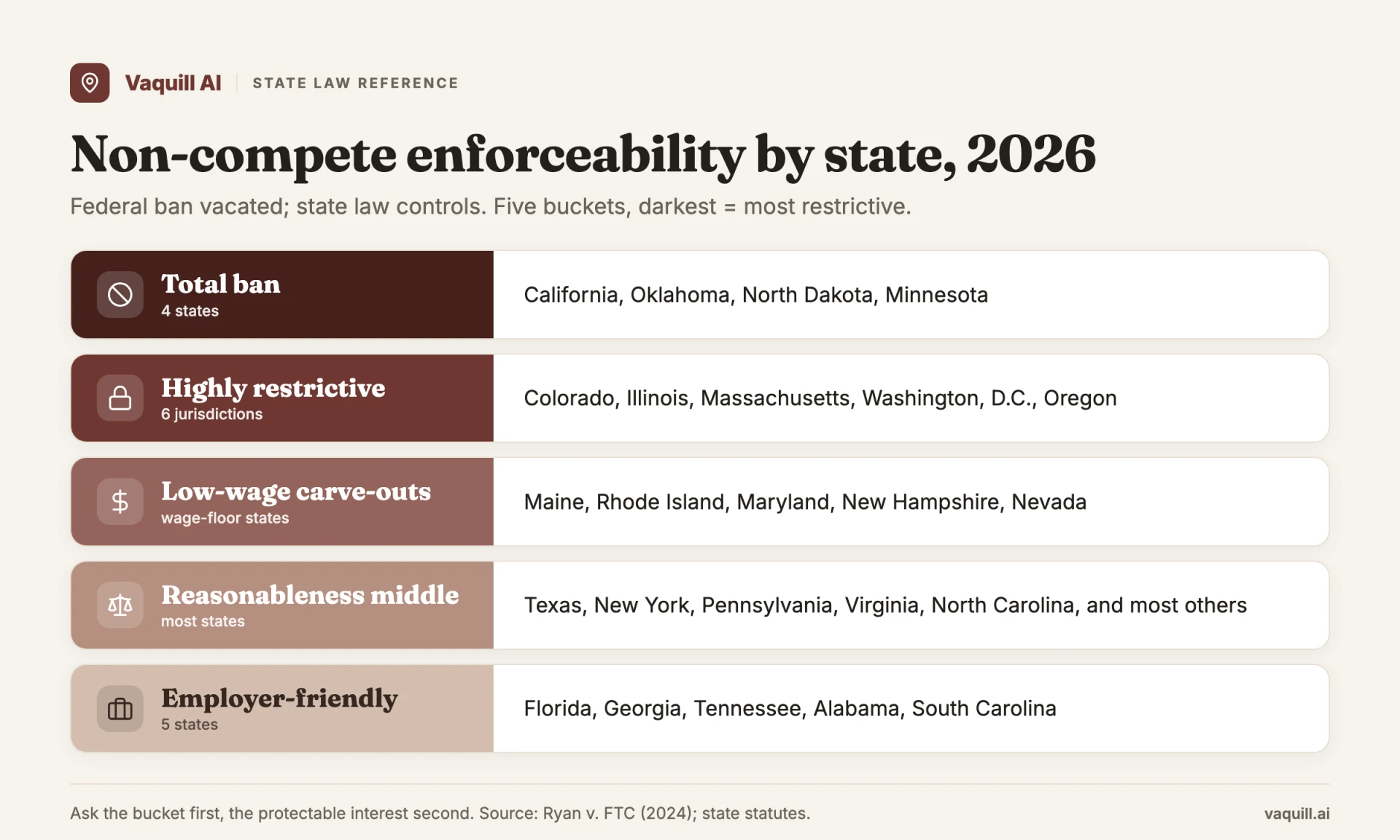
Every state sorts into one of five enforceability buckets; darkest is most restrictive.
The short version for mid-2026: the FTC's nationwide non-compete ban is gone for good (the rule was formally removed from the Code of Federal Regulations effective February 12, 2026), and the action has moved to the states. Four new state laws land between May and July 2026: Tennessee's $70,000 wage floor, Utah's healthcare-worker ban, Virginia's severance-or-void rule, and Washington's near-total ban that voids existing covenants in mid-2027. If you run a multi-state workforce, your old national template is out of date in roughly half your covenants.
2026 non-compete changes at a glance
| Jurisdiction | What changed | Effective | Source (verified) |
|---|---|---|---|
| Federal (FTC) | 16 C.F.R. Part 910 removed from the CFR; ban dead, enforcement now case-by-case | Feb 12, 2026 | Federal Register, 2026-02866 |
| Utah | Near-total ban on healthcare-worker non-competes (H.B. 270) | May 6, 2026 | Beck Reed Riden 50-state chart |
| Tennessee | $70,000 minimum-compensation floor; 2-year reasonableness presumption (H.B. 1034) | Jul 1, 2026 | Beck Reed Riden 50-state chart |
| Virginia | Void against any worker fired without cause unless severance is paid (S.B. 170) | Jul 1, 2026 | Beck Reed Riden 50-state chart |
| Washington | Near-total ban; voids existing covenants, notice due Oct 1, 2027 (ESHB 1155) | Jun 30, 2027 | Katz Banks Kumin tracker |
| Florida | CHOICE Act lets employers write up to 4-year covenants/garden leave for high earners | Jul 1, 2025 | Katz Banks Kumin tracker |
Florida is the outlier moving the other way. Most of the country is tightening; a handful of states (Florida, plus Kansas on non-solicits) are giving employers more room.
The quarter the map redrew itself
A GC at a 200-person SaaS company emailed on April 16, 2026: "Did the FTC just kill non-competes again?" She had seen a Bloomberg push about the Rollins consent order and assumed the rule was back. It was not.
The federal rule has been dead since August 2024, and as of February 12, 2026 it is also off the books. What was happening in April was the new shape of federal enforcement under a Republican-chaired FTC, against the most active stretch of state non-compete legislation in years.
The non-obvious failure in her template was not the covenant text. It was the choice-of-law clause pinned to Delaware (her HQ) for a workforce 23% Washington, 14% Virginia, 9% Tennessee.
The 2026 statutes assume the employee's state controls. The template wasn't wrong in 2022. It is wrong now in roughly half her covenants.
What to change this week: pull every active covenant, regroup by employee work state (not HQ), flag the four jurisdictions below, queue the Washington notice for October 2027.
TL;DR
- The FTC formally removed its non-compete rule (16 C.F.R. Part 910) from the Code of Federal Regulations effective February 12, 2026, the last step after it dropped its Ryan v. FTC appeal on September 5, 2025 (3-1). Federal action is now case-by-case enforcement, with the Rollins consent order (April 15, 2026, 18,000+ workers) as the template.
- Four headline state actions land between May and July 2026: Tennessee's $70,000 minimum-compensation threshold (eff. July 1, 2026), Utah's near-total ban on healthcare non-competes (eff. May 6, 2026), Virginia's severance-or-void rule for terminations without cause (eff. July 1, 2026), and Washington's near-total ban that voids existing covenants on June 30, 2027.
- Healthcare is the pressure point. Utah, Montana (Jan. 1, 2026), and FTC warning letters in September 2025 all point the same way.
- New York's S9759, Maryland's H.B. 1016, and New Jersey's recurring ban bill are the Q4 2026 / Q1 2027 watches.
- The compliant 2026 covenant is shorter, jurisdiction-tagged, and severance-conditioned rather than free.
As of July 1, 2026, what is Tennessee's minimum-compensation floor below which a non-compete cannot be enforced?
Part of our all-50-states legal reference series.
The federal status, briefly
Three things happened federally; they keep getting conflated.
The rule was vacated. The FTC's final non-compete rule, published April 23, 2024 (16 C.F.R. Part 910), would have voided nearly every existing employee non-compete.
Ryan, LLC v. FTC, No. 3:24-cv-00986-E (N.D. Tex. Aug. 20, 2024) set it aside nationwide under 5 U.S.C. § 706, holding the FTC lacked substantive rulemaking authority over unfair methods of competition. The Eleventh Circuit hit a parallel result in Properties of the Villages v. FTC.
The appeals were abandoned. On September 5, 2025, the Commission voted 3-1 to dismiss both appeals and accede to vacatur. A future FTC reviving a categorical ban would have to restart rulemaking under a fresh statutory theory the courts already rejected.
The rule was removed from the books. On February 12, 2026, the FTC published a final action in the Federal Register removing the Non-Compete Clause Rule from the Code of Federal Regulations, effective the same day (Fed. Reg. doc. 2026-02866). 16 C.F.R. Part 910 no longer exists. There is nothing left to revive without new rulemaking.
Enforcement continues, narrower. Same day, the FTC issued a Request for Information on employee non-compete agreements (comment deadline November 3, 2025), focused on healthcare. The Joint Labor Task Force, formed February 26, 2025, is the operational arm.
On April 15, 2026, the FTC ordered Rollins, Inc. (parent of Orkin and HomeTeam) to stop enforcing non-compete restrictions against more than 18,000 employees for ten years, covering pest-control technicians inside a 75-mile radius of any of Rollins' 700-plus locations. Warning letters went to 13 additional pest-control companies.
The honest read for in-house counsel: federal exposure in 2026 is consent-order risk on an overbroad clause (low-wage workforce, no protectable interest, no consideration), not a categorical ban.
The Rollins facts are the pattern. If your covenant could be Rollins on a slightly worse day, it is the one to redraft now.
The four 2026 state laws to act on now
Four states. Real bills, real signatures, real effective dates inside the next twelve months.
Tennessee: $70,000 minimum compensation threshold
Statute: Tenn. Code Ann. § 50-1-1101 et seq. (House Bill 1034, signed by Gov. Bill Lee on May 7, 2026). Effective: July 1, 2026.
Tennessee was an employer-friendly common-law state. It now has a wage floor. As of July 1, 2026, an employer cannot require, request, or enforce a non-compete against any employee whose annualized compensation is below $70,000.
The threshold includes wages, salary, commissions, and non-discretionary bonuses; hourly is rate times 40 times 52.
The statute pairs the floor with a friendly presumption for higher earners: a covenant of two years or less is presumed reasonable, shifting the burden to the employee. Prospective only, to agreements entered into, renewed, or amended on or after July 1, 2026.
Tennessee just joined the income-threshold club, making it thirteen jurisdictions plus D.C. The drafting move is a representation in the covenant that the employee meets the threshold on the signing date.
Utah: healthcare worker non-compete ban
Statute: Utah Code Ann. § 34-51-101 et seq., as amended by House Bill 270 (signed by Gov. Spencer Cox on March 24, 2026). Effective: May 6, 2026.
Utah's general non-compete statute has had a one-year cap since 2016. H.B. 270 layers a near-total prohibition for healthcare workers: any agreement restricting post-separation practice within the scope of the worker's license. "Healthcare worker" covers physicians, PAs, advanced-practice and registered nurses, and a long list of other licensees.
Two exceptions survive: covenants tied to a "reasonable mutually agreed" severance, and sale-of-business covenants. Prospective only. The law also bars blocking a departing worker from notifying former patients of a new location.
Montana voided healthcare non-competes effective January 1, 2026 (Mont. Code Ann. § 28-2-712). The FTC's September 2025 warning letters singled out healthcare. If you draft for hospital systems, urgent-care chains, dental groups, or staffing agencies, the practice-area covenant is dead in any state that has acted in the last twenty-four months.
Virginia: severance-or-void for terminations without cause
Statute: Va. Code Ann. § 40.1-28.7:8, as amended by Senate Bill 170 (signed by Gov. Abigail Spanberger on April 13, 2026). Effective: July 1, 2026.
Virginia already had a low-wage carve-out (the 2026 indexed figure is roughly $76,000 annualized). SB 170 adds a new gate: as of July 1, a non-compete is void against any employee discharged without cause, unless the employer paid a severance benefit or other monetary payment, disclosed in writing at execution.
The statute does not define "cause" and does not set a minimum severance amount. Both will be litigated. Civil penalties run up to $10,000 per violation, plus damages, fees, and injunctive relief.
Bake a severance trigger into the covenant: "in the event of involuntary termination without cause, Employer shall pay [X weeks] of base salary, conditioned on continued compliance with Section [Y]."
Severance cost is now table stakes in Virginia.
Washington: near-total ban as of June 30, 2027
Statute: Wash. Rev. Code § 49.62 et seq., as amended by Engrossed Substitute House Bill 1155 (signed by Gov. Bob Ferguson on March 23, 2026). Effective: June 30, 2027.
Longest fuse, biggest blast radius. Washington's 2020 statute was already restrictive (income thresholds, garden-leave, notice-at-offer). SB 1155 replaces the threshold regime with a near-total ban.
As of June 30, 2027, all non-compete covenants are void and unenforceable, including covenants entered into before that date. Washington is the first state to render existing non-competes void retroactively by statute.
Employers must notify current and former employees by October 1, 2027. Exceptions: confidentiality agreements, trade-secret and invention covenants, properly structured non-solicits, sale-of-business covenants tied to at least 1% ownership, narrow educational-expense provisions.
The retroactive piece will be tested on Contracts Clause and Takings Clause theories. Smart money is that the statute is upheld: the FTC's vacated rule failed on rulemaking-authority grounds, not on a Contracts Clause merits ruling. A legislature can do what an agency could not. (Full breakdown in our Washington non-compete law guide.)
Enforcement trend lines in 2026
The trackers line up with the legislative pattern. Beck Reed Riden's 50-State Noncompete Chart, updated January 21, 2026, tracks restrictive-covenant wage thresholds in 12 states plus D.C. (Tennessee makes 13 as of July 1).
Katz Banks Kumin's noncompete tracker, updated March 1, 2026, sorts the country into outright bans (CA, OK, ND, MN), the income-threshold club, and the moderate middle. The Economic Innovation Group state tracker catalogs introduced bills.
All three datasets show the same shape: roughly one new restrictive state per year since 2018, accelerating in healthcare since 2023.
Two states ran the other way in 2025. Florida's CHOICE Act (effective July 1, 2025) lets employers write covenants up to four years for high earners and is the most employer-friendly law in the country (details in our Florida non-compete guide). Kansas (S.B. 241, effective July 1, 2025) made employee and customer non-solicits presumptively enforceable, though it left traditional non-competes alone. The split is real, but the restrictive side is winning on volume.
A 2018 multi-state non-compete with one carve-out (California) is now a multi-jurisdiction conditional with carve-outs across at least 19 states and D.C.
A worked conflict. A Series C software company fires a director-level engineer earning $185K, originally hired in Tennessee, relocated to Washington in 2025 without updating the HRIS record. Termination is without cause; the 2024 covenant is 18 months and silent on severance.
In Tennessee the covenant probably holds (above the $70K floor, under the two-year presumption). In Washington it is voidable today on notice-and-consideration grounds and goes void retroactively on June 30, 2027.
The Tennessee choice-of-law clause is the kind California's § 16600.5 neutralizes for California residents; Washington courts are likely to follow within twelve months. The right call: treat the engineer as a Washington employee, drop the non-compete, fall back on a non-solicit and tightened invention-assignment, and cut a severance check only if the employer needs a clean separation.
Tradeoffs to name out loud: drop the covenant in any role under $100K (FTC inquiry-letter risk outweighs the protection); switch to non-solicit-plus-NDA for engineering and product where the interest is trade secret; pay the severance and keep the covenant for sales leaders and executives where customer relationships are the asset.
Spend dollars on the few covenants worth defending; stop spending hours on the long tail.
The boilerplate national non-compete is dead for the multi-state employer. The defensible 2026 covenant is shorter (one year or less), tied to a documented protectable interest, jurisdiction-aware, and increasingly severance-coupled.
The severance is now the price of enforceability. Employers who treat it as optional are buying litigation.
Operational gotchas: offer-letter timing matters more than covenant text in notice-at-offer states, and has to land on the recruiter's checklist; HRIS jurisdiction tagging breaks the moment an employee relocates without updating their work-location field; severance triggers conditioned on continued compliance require payroll to actually withhold severance on a breach, an integration few teams have built.
What's coming in Q4 2026 and Q1 2027
Three watches, in order of likelihood.
New York S9759 and the Hochul desk. A Senate-passed bill (S4641, June 2025) sits in the Assembly with a $500,000 highly-compensated carve-out and a one-year cap on permitted covenants. Senator Gianaris re-introduced a parallel ban bill (S9759) on April 6, 2026.
Governor Hochul vetoed a broader 2023 ban but has signaled openness to a more targeted version. If it passes, the New York covenant for sub-$500K employees disappears, which is most of any in-house team's workforce. (Current state of play in our New York non-compete law guide.)
Maryland H.B. 1016. Introduced January 2026. Voids non-competes where the employer relocates, reorganizes, or otherwise ceases to have a majority of its employees in the state. The "ceases to have a majority" trigger is novel, converting a relocation decision into a non-compete dissolution event.
New Jersey ban (recurring). SB 1407 / A1829, introduced repeatedly since 2022. The 2026 version brings a senior-executive carve-out around $151,164 and a 30-day employer notice obligation. 2026 odds are below 50%.
An FTC variable too. The Rollins order is the public template. The next consent order, likely in healthcare staffing or another low-wage sector, is the leading indicator. Treat warning letters as a six-month canary on consent-order risk.
Drafting checklist for the 2026 multi-state employer
Run any new non-compete through this before signing it out:
- Controlling jurisdiction. California's § 16600.5 reaches out-of-state employers attempting to bind California residents. Default to the employee's principal work location, not headquarters. For the full picture across every state, start with our non-compete enforceability by state guide.
- Wage threshold. Now 13 states plus D.C. Bake a representation into the covenant: "Employee represents that annualized compensation meets or exceeds the threshold under [statute cite]."
- Industry prohibitions. Healthcare in Utah and Montana. Broadcasters in Utah. Lawyers everywhere (ABA Model Rule 5.6). Physicians in an expanding list of states.
- Duration. One year is the new normal. Two years is the litigation tail outside Tennessee's presumption. Three years is sale-of-business only.
- Severance pairing. Virginia post-July 1, 2026, is the live example. Massachusetts has had garden-leave since 2018 (Mass. Gen. Laws ch. 149 § 24L). Build a severance trigger that conditions enforceability on payment.
- Notice at offer. Massachusetts, Washington, Illinois, Maine, New Hampshire, Oregon, and others require notice at offer, often 10 business days before signing.
- Washington wind-down. Inventory affected employees, draft notice letters for October 1, 2027, pick the substitute (non-solicit, NDA, invention assignment).
- Protectable interest. Trade secrets, customer relationships, specialized training. A covenant without a documented interest is the kind the FTC Rollins order targeted.
Counsel hours per agreement are climbing. Litigation exposure on sloppy agreements is climbing faster.
A prediction
Three years out, the U.S. non-compete map will look closer to the European Union than to 1990s America: outright bans on the coasts and in healthcare, a wage-threshold middle covering most of the workforce, a "severance is the price of enforceability" default in another quarter of the country, and a small residual of employer-friendly states for the highest earners.
The federal layer stays enforcement-first, not rulemaking, until the next presidential transition. Static templates are dead.
FAQ
Is the FTC non-compete ban still in effect in 2026? No. A federal court vacated it in August 2024, the FTC dropped its appeals on September 5, 2025, and the agency formally removed the rule (16 C.F.R. Part 910) from the Code of Federal Regulations effective February 12, 2026. There is no federal ban. The FTC now acts case-by-case, mostly against overbroad covenants on low-wage workers.
What new non-compete laws take effect in 2026? Four big ones. Utah banned healthcare-worker non-competes (effective May 6, 2026). On July 1, 2026, Tennessee's $70,000 wage floor and Virginia's severance-or-void rule both take effect. Washington's near-total ban is signed but does not bite until June 30, 2027.
What is the Tennessee non-compete threshold for 2026? $70,000 in annualized compensation. As of July 1, 2026, Tennessee employers cannot require or enforce a non-compete against any worker earning below that figure (H.B. 1034, signed May 7, 2026). For higher earners, a covenant of two years or less is presumed reasonable.
Does Virginia require severance to enforce a non-compete? As of July 1, 2026, yes, for terminations without cause. Under S.B. 170, a non-compete is void against any employee fired without cause unless the employer paid a severance benefit disclosed in writing at signing. Violations carry civil penalties up to $10,000 each, plus damages and fees.
Are existing non-competes void in Washington? They will be. ESHB 1155, signed March 23, 2026, voids almost all non-competes effective June 30, 2027, including ones signed before that date. Washington is the first state to wipe out existing covenants by statute. Employers must notify affected current and former workers by October 1, 2027.
Which states ban non-competes outright? California, North Dakota, Oklahoma, and Minnesota ban nearly all employee non-competes today. Washington joins them in 2027. Many other states (13 plus D.C. as of July 2026) allow them only above a wage threshold or with other conditions.
Did any state make non-competes easier to enforce in 2026? Florida did. Its CHOICE Act (effective July 1, 2025) lets employers write enforceable covenants and garden-leave agreements up to four years for high earners, the most employer-friendly framework in the country. Kansas also strengthened non-solicitation agreements in 2025.
How long can a non-compete last in 2026? It depends on the state, but one year or less is the practical default for a defensible covenant. Two years is the litigation tail outside states like Tennessee that presume it reasonable. Multi-year terms generally survive only in sale-of-business deals or under Florida's CHOICE Act.
This week: run your covenant inventory against the four 2026 statutes, regroup by employee work state, and queue the Washington October 2027 notice.
Once the audit tells you which covenants to redraft, the rewrite is where most of the hours go. Vaquill AI handles the drafting, with playbooks that keep your jurisdiction-tagged positions consistent as you turn a static national template into state-aware covenants. You can try the drafting workflow free for 7 days.
New legal AI guides, weekly.
Further Reading
California Non-Compete Section 16600 in 2026: The Strictest Ban in the US
Read postColorado Non-Compete Law in 2026: HB 22-1317 and the Highly Compensated Threshold
Read postFlorida Non-Compete Enforceability in 2026: The CHOICE Act + Section 542.335
Read postGeorgia Restrictive Covenants Act in 2026: Drafting Non-Competes That Survive
Read postIllinois Freedom to Work Act in 2026: Non-Compete Rules, Income Thresholds, and Drafting
Read postMassachusetts Non-Compete Agreement Act: A 2026 Drafting Guide
Read post
Co-Founder & CEO · Attorney
Arshita leads product and strategy at Vaquill, building the legal AI suite that solo, small-firm, and in-house US lawyers use to run a matter end to end.