Most Lexis+ AI comparisons ask one thing: which research tool is more accurate. For an in-house team, that question misses the point. A general counsel, or a fractional GC running a lean 2-10 person team, does not spend the week on appellate research. The week is contracts. NDAs, vendor MSAs, DPAs. A renewal that showed up on the counterparty's paper. A product manager asking if a clause is fine. A board deck that needs a one-line risk read by Thursday. Research is part of that. It is not the center of it. So the real buying question is not "is Lexis+ AI good at research." It is good. The question is "does this tool cover the whole in-house week, and what does it cost to find out."
That reframe matters. Lexis+ AI, now shipping as Lexis+ with Protege, is a strong research incumbent. It also comes with enterprise pricing and a sales call before you can try it. Vaquill AI is a full in-house workbench. It does drafting, contract review, AI redlining with real Word track changes, matter management, compliance, Document Matrix, and agentic workflows. Research is one surface among many. It costs $99 per seat per month, with a 7-day self-serve trial. This post compares the two fairly. It gives Lexis its due and tells you which one fits which team.

TL;DR
- Lexis+ AI (now Lexis+ with Protege) is a research-first platform built on LexisNexis's 138B+ document library and Shepard's Citations, the gold-standard US citator. For BigLaw firms already inside the LexisNexis world, it is one of the best options out there.
- Pricing is quote-based and contract-locked. There is no clean public per-seat price for the AI product. You call sales for a number. The free trial for the AI product is 2 days.
- Accuracy is strong for the category, but it is not "hallucination-free." A peer-reviewed Stanford study found Lexis+ AI hallucinated on about 17% of queries. That was the best result among the paid tools tested, but it still is not safe to cite without checking.
- Vaquill is an all-in-one in-house workbench, not a cheaper research box. It covers drafting, contract review, AI redlining with real Word track changes, matter management (inbox, 100-doc chat, auto-chronologies), compliance checks, Document Matrix, and Agent Mode. Research grounded in US case law and statutes sits alongside all of it.
- The wedge is scope and cost. Lexis sells enterprise research behind a sales call. Vaquill sells the whole in-house workbench at $99/seat, self-serve, with a 7-day trial. You can run a real pilot this afternoon, no procurement.
- The honest split: Lexis+ AI for large firms that need Shepard's editorial depth and deep iManage / NetDocuments / Office integration. Vaquill for in-house counsel and lean legal teams that want the full workbench without enterprise gating.
Part of our legal AI vendor comparison series.
What Lexis+ AI is good at (giving Lexis its due)
This is not a hit piece. Lexis+ AI earns its name, and an honest in-house buyer should know exactly what they would give up.
The largest legal content library in the world. LexisNexis holds 138B+ documents and adds about 2.2 million new legal documents a day. No competitor, Vaquill included, matches that raw breadth across statutes, case law, secondary sources, news, and public records in dozens of jurisdictions. If your work crosses many jurisdictions and leans on treatises, that depth is real and hard to copy.
Shepard's Citations, the gold standard. Shepard's has been the US standard for case validation since the 1800s. Lawyer-edited signals (red, orange, yellow, green), appellate history, and citing-decision analysis carry editorial trust no algorithm has fully earned. When you need a human read on a borderline authority, Shepard's is the name partners trust.
Protege agentic workflows. In February 2026, LexisNexis launched Lexis+ with Protege. It replaced the old Lexis+ AI with one platform that runs 300+ workflows for drafting, summaries, timelines, and document review. The multi-model setup (Claude Sonnet 4.5, GPT-5.1) has a "Best Fit" mode that picks the model per task. That is real engineering, not a thin wrapper.
Deep integration ecosystem. Lexis+ AI plugs into iManage, NetDocuments, SharePoint, and Microsoft Office, with a developer portal for enterprise clients. For a large firm already living in the LexisNexis stack, that depth is a real advantage and a real switching cost.
If you are at a firm where Shepard's, treatise depth, and iManage are non-negotiable, stop reading and call Lexis. The rest is for in-house teams who do not start there.
How Lexis+ AI and Vaquill compare
| Capability | Lexis+ AI | Vaquill |
|---|---|---|
| US case coverage | 138B+ documents, deep US and UK coverage: SCOTUS, all circuits, federal district, state supreme and appellate | Millions of US federal and state opinions (SCOTUS, all circuits, district, state) with documented, verifiable coverage |
| Statutes and regulations | Broad US statute and regulation coverage at enterprise pricing | 3.5M+ sections: full US Code (54,855 USC sections), CFR (219,745 sections), all 52 state and territory codes (1.95M+ sections), per-state scoping |
| Source opinion PDFs | Opinion text provided; source PDFs with page-level referencing not prominent in core US product | Source opinion PDFs with exact page numbers and character offsets for precise highlighting in filings |
| Citation system | Shepard's Citations: gold-standard, lawyer-edited signals (red/orange/yellow/green), appellate history | Citation graph with treatment flags (followed, distinguished, overruled, criticized), multi-hop traversal across federal and state courts |
| AI accuracy | Markets "hallucination-free linked citations"; Stanford study found a 17% hallucination rate | 4-layer verification: exact text match, citation check, meaning analysis, AI cross-check, with per-claim confidence scores |
| AI drafting and workflows | Protege: 300+ agentic workflows, deep iManage / NetDocuments / SharePoint / Office integration | Full workbench: drafting, contract review, AI redlining with real Word track changes, Document Matrix, compliance, matter workflows |
| Developer API | Enterprise-only, application and sales approval required, no self-service key | Self-serve REST API, MCP server (Claude Desktop, Cursor, VS Code, Windsurf), Python SDK on PyPI |
| Matter management | Folder-based workspaces inside Lexis+ | Matter inbox (forward docs by email), 100-document chat, auto-built chronologies, per-matter workspaces |
| Agent mode, memories, skills | Protege workflows for BigLaw; no documented cross-session memory or in-chat Skills for small teams | Agent Mode (up to 5 iterations, 3 tool calls each), Memories (up to 1,000/user), 8 expert Skills built into chat |
| Team collaboration | Enterprise team management in the LexisNexis world | Team workspaces with RBAC (Owner, Admin, Member, Viewer) |
| Target market | AmLaw, BigLaw, large enterprise legal departments | In-house counsel, fractional GCs, CLOs, lean 2-10 person US legal teams |
| Pricing | Quote-based, sales-gated, annual lock-in; no clean public per-seat price | Flat $99/user/month, $990/user/year (17% off), no tiers, no per-feature gating |
| Free trial | 2-day trial for the AI product | 7-day free trial, self-serve, no enterprise contract afterward |
Where the workbench shows up
The table makes the scope gap clear. It is worth pulling out the surfaces that do not exist in a research-only product, because that is the real wedge.

AI legal research. Ask in plain English and get a cited answer grounded in statutes and case law, every citation 4-layer verified.
Research is the part of Vaquill that lines up most directly with Lexis+ AI, so start there for an apples-to-apples read. You ask in plain English. You get an answer grounded in statutes and case law. Every citation runs through verification before it reaches you. This is the "Vaquill as a Lexis alternative" story, and it holds up. But it is one tab.
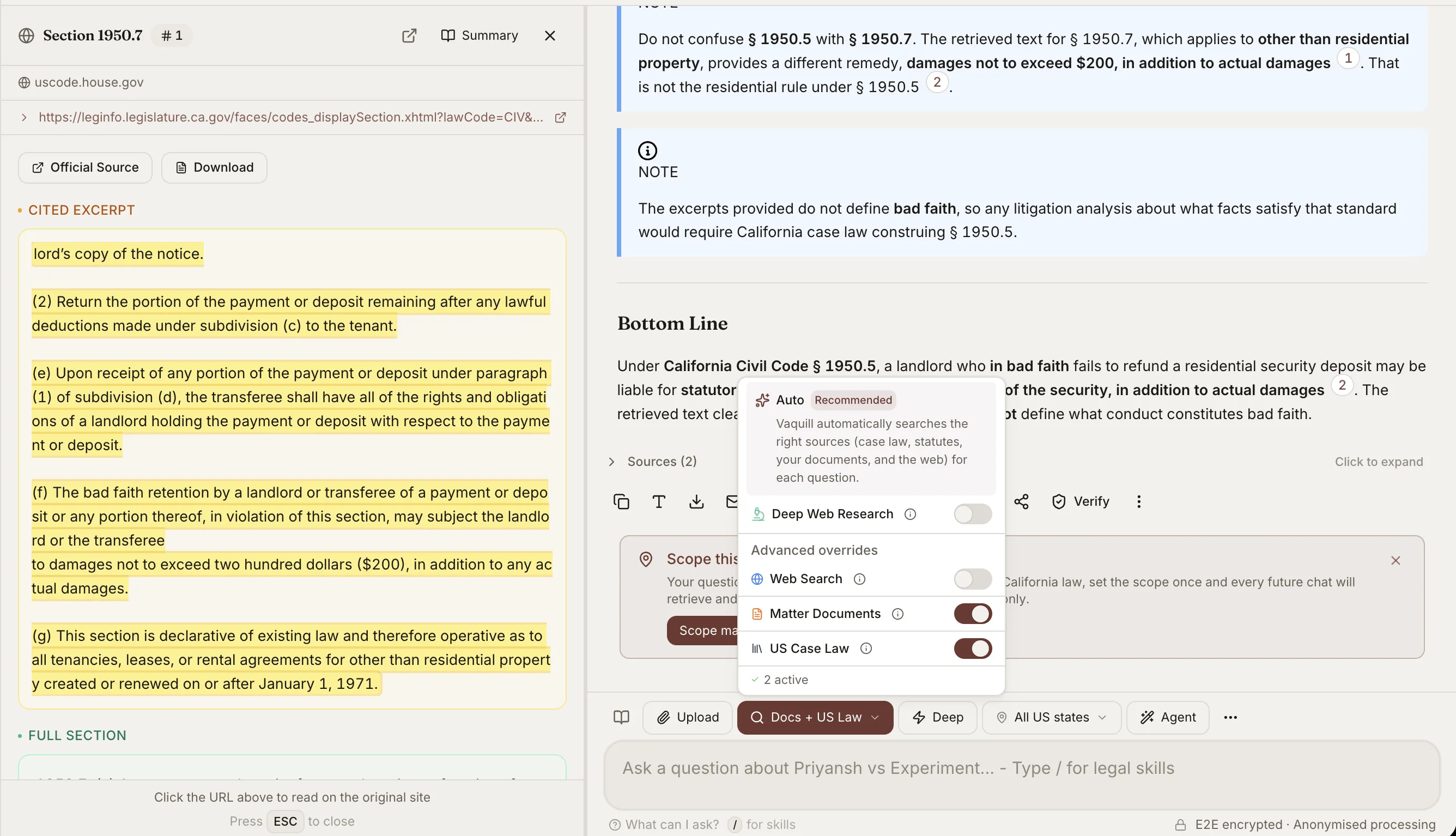
Verified citations. Each answer links to its source with confidence scoring, so you can file with confidence.
The verification layer is the answer to the 17% problem. Instead of marketing "hallucination-free," Vaquill runs four checks: an exact text match against the source, a citation check, a meaning analysis, and an AI cross-check. Then it attaches a confidence score to each claim. After Mata v. Avianca and under ABA Formal Opinion 512, the duty of competence with AI is not met by a vendor slogan. It is met by showing your work. That is what the confidence scoring is for.
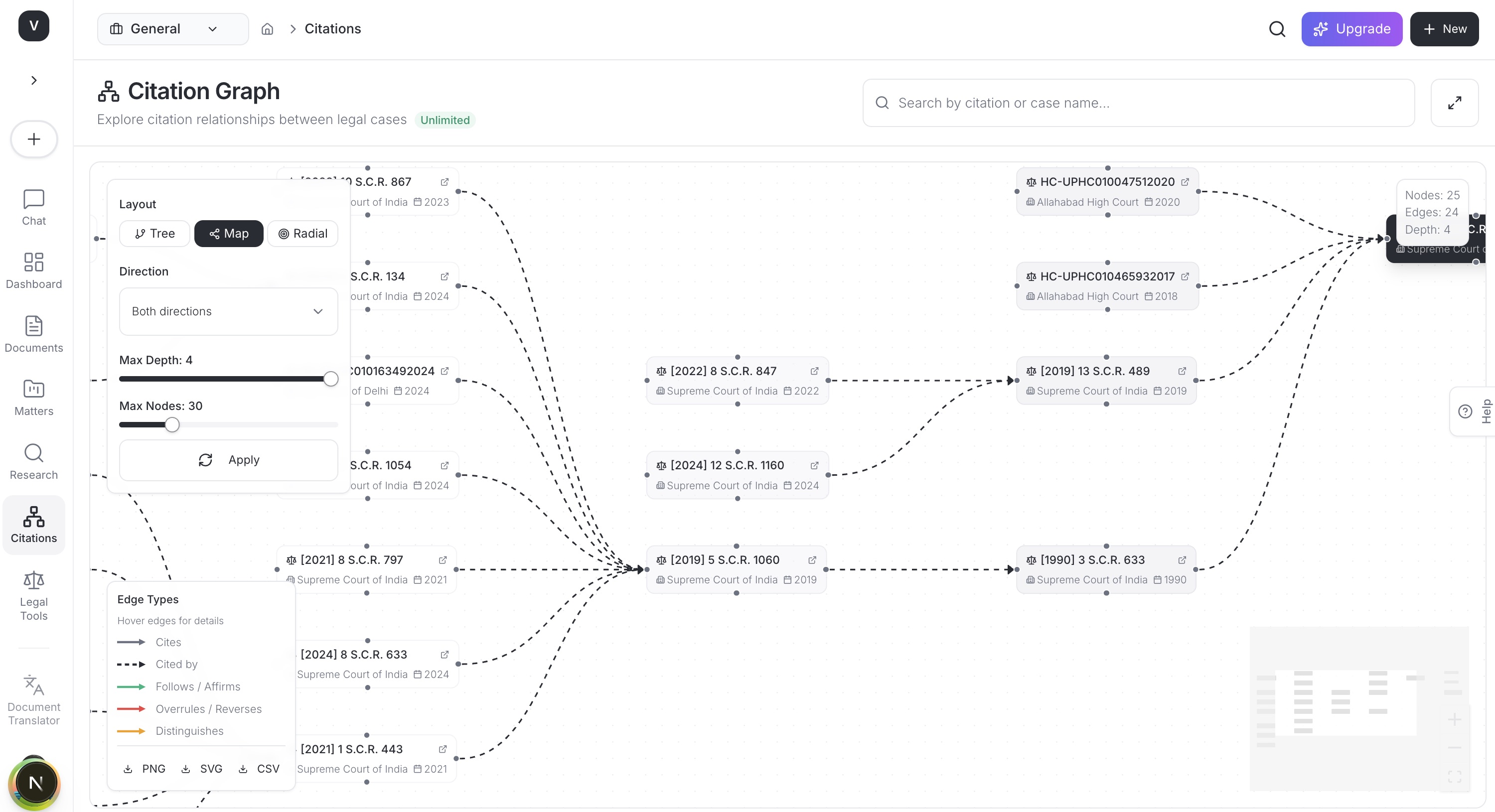
Citation graph. See how any opinion has been followed, distinguished, limited, or overruled across federal and state courts.
The citation graph is Vaquill's answer to Shepard's. It is not lawyer-edited the way Shepard's is, and an honest buyer should weigh that. What it gives you instead is treatment flags on every authority plus multi-hop traversal you can walk programmatically. You see how an opinion was followed, distinguished, limited, or overruled across federal and state courts, all inside the base price.
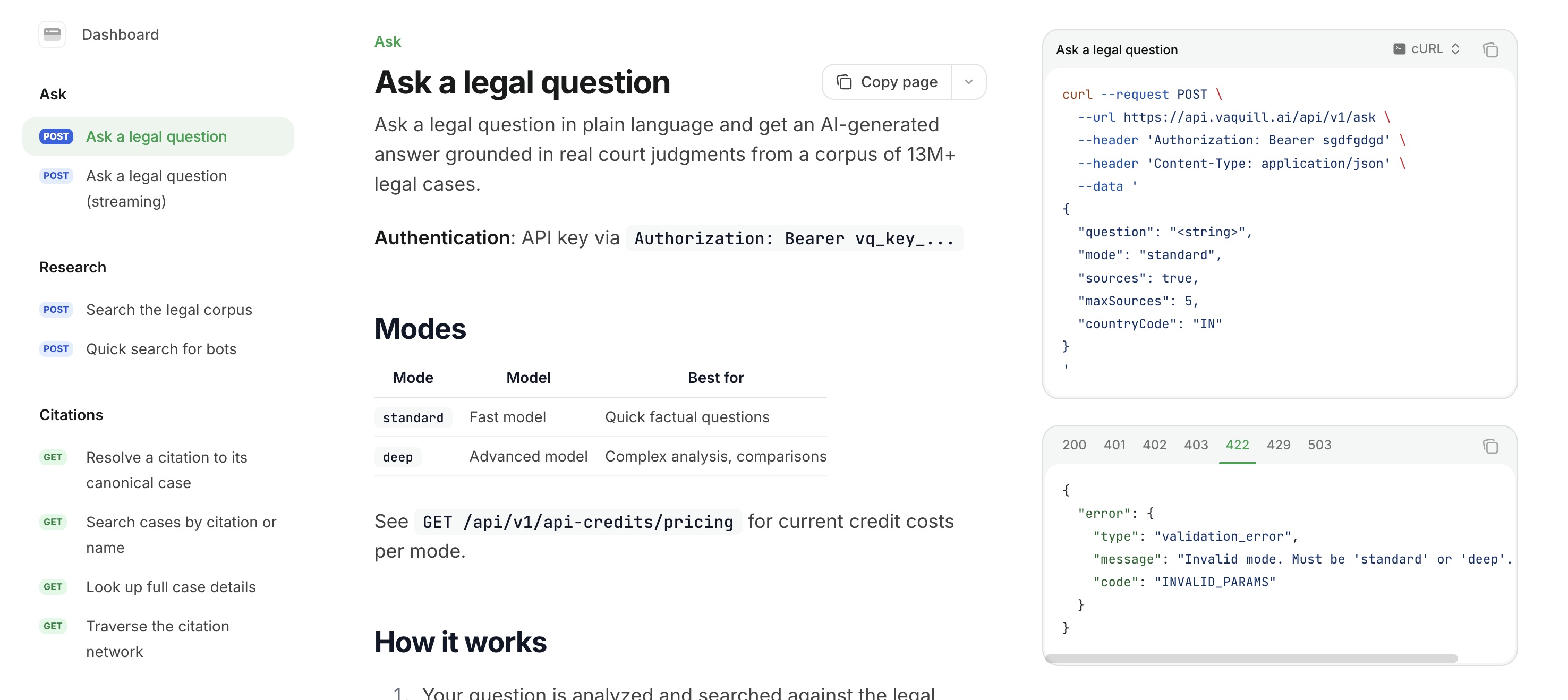
Developer API. AI answers, statute search, and section lookup over REST and MCP, already indexed and hosted.
The API is where the buying motion really splits. Lexis APIs exist, but they sit behind an enterprise agreement and a sales approval. Vaquill ships a self-serve REST API, an MCP server for Claude Desktop, Cursor, VS Code, and Windsurf, and a Python SDK on PyPI. A legal-ops engineer wiring research into an internal tool can grab a key and start in an afternoon, no account rep needed.
Past those four surfaces sit the parts of the in-house week a research tool was never built for. Drafting from your own templates. Contract review with clause-level risk flags. AI redlining that makes real Word track changes a counterparty's lawyer can accept or reject. The Document Matrix, which pulls the same field across forty contracts at once. Compliance checks. And matter management: forward any document to a matter inbox and get cited answers back in the same thread. Chat across 100 documents at once. Get auto-built chronologies. That is the suite. It is the reason this is not "cheaper Lexis."
Where Lexis+ AI's gaps bite in-house teams
The accuracy gap is documented, not guessed. LexisNexis markets "hallucination-free linked legal citations." The peer-reviewed Stanford / Yale study tested the leading tools. It found Lexis+ AI hallucinated about 17% of the time. The authors concluded that "hallucination-free" claims are overstated. A Canadian law professor separately gave it "a failing grade" for repeating headnotes word-for-word as summaries and citing legislation that does not exist. To be fair, 17% was the best result of the paid tools tested. But "best of the bunch" is not "safe to cite without checking." Lexis+ AI is also seen as overly cautious and costly. An in-house lawyer signing a filing owns that gap personally.
Quote-based pricing and contract lock-in. There is no clean public per-seat price for the AI product. You call sales for a number, and the contract carries an annual term. The BBB has multiple complaints about firms stuck in multi-year terms with auto-renewal clauses that are hard to exit. For a three-lawyer in-house team, that procurement gauntlet is friction the budget can feel.
Enterprise-gated API. The developer portal needs an enterprise agreement, application approval, and issued credentials. There is no self-service key and no free tier. A lean legal-ops function that wants to plug research into Zapier, Make, or an internal tool cannot just start.
Built for AmLaw and BigLaw. The procurement, the sales-led onboarding, the contract structure, all of it is built for firms with hundreds of seats. For in-house counsel and fractional GCs on solo through 10-person teams, that friction and cost do not match how those buyers decide.
No real free trial. The AI product offers a 2-day trial. Two days is barely enough to find the login button, let alone load real matters and measure anything. After that, you need an enterprise contract.
What in-house teams actually use this for
These are the recurring jobs where the scope gap shows, mapped to the in-house chair, not the research desk.
Covering the full in-house week, not just research. A GC whose week is 70% contracts and 30% research needs drafting, redlining, contract review, and matter management as much as case law. A research-only tool handles the 30% well and leaves the 70% to other software. Vaquill handles the whole week in one place at one price.
Verifying citations in the post-Mata era. Need to confirm an opinion is still good law? You get 4-layer verification, a citation graph with treatment flags, and source opinion PDFs with exact page references. That is something you can file, in line with ABA Formal Opinion 512.
Running many matters at once. A lean team juggling dozens of active matters uses per-matter workspaces and a matter inbox. Forward a pleading or contract by email, and cited answers come back in the thread. 100-document chat lets you query a whole deal room at once. Auto-built chronologies pull the timeline for you. RBAC keeps the right people on the right matters.
Building on top of legal data. A legal-ops engineer who needs programmatic access gets a self-serve REST API, MCP server, and Python SDK with no sales cycle. That is the exact door Lexis keeps locked.
Watching software spend. A team that cannot justify quote-based, contract-locked pricing gets flat $99/user/month. Every feature on every seat, no tiers, cancel anytime, and a 7-day trial to prove it first.
When Lexis+ AI is the right call
Choose Lexis+ AI if you are at an AmLaw or BigLaw firm that needs Shepard's Citations, Protege's 300+ agentic workflows, or deep iManage, NetDocuments, and Office integration. Maybe your firm already runs inside the LexisNexis world and wants AI on top of that 138B+ document library, plus a lawyer-edited citator and treatise coverage across many jurisdictions. Then Lexis is the natural pick and the safe one. The enterprise motion that frustrates a small in-house team is exactly what a 400-lawyer firm expects.
When Vaquill is the better fit
Choose Vaquill if you are in-house counsel, a fractional GC, or a CLO running a solo through 10-person US legal team. You need the full workbench. That means drafting, contract review, AI redlining with real Word track changes, Document Matrix, compliance, and matter management. It also means research across millions of US opinions, the US Code, CFR, and 50-state statutes with per-state scoping. You want a citation graph with treatment flags and 4-layer answer verification built for the post-Mata world. And you want a privilege architecture (PII anonymization, zero data retention with LLM providers, US data residency, no model training, DPA and BAA available) without sales gating. At $99/seat, self-serve, with a 7-day trial, you can prove the whole thing on real matters before anyone signs. Vaquill is the real alternative for in-house teams that want capability and trust without lock-in. It competes on the workbench, not on being a discount Lexis.
For the head-to-head feature breakdown, see the Lexis+ AI honest review and the three-way Lexis+ AI vs Westlaw AI vs Vaquill comparison. For the in-house buyer's view, see the in-house counsel solution page and the legal research feature page.
FAQ
Does Vaquill have an agentic research mode like Lexis+ with Protege? Yes. Agent Mode decides which research tools to use. It chains them across up to 5 iterations with 3 tool calls each. It pulls results together across millions of US opinions, the US Code, CFR, and all 52 state and territory codes (1.95M+ sections). It reads URLs, fetches PDFs, runs Boolean searches, and follows citation chains. Every claim runs through 4-layer verification. Memories tune answers to your jurisdiction, practice area, and citation habits across sessions (up to 1,000 per user, 5 most relevant per query). 8 expert Skills (Contract Review, NDA Triage, Risk Assessment, Compliance Check, and more) are guided playbooks built into the chat, with no enterprise contract.
Is Vaquill just a cheaper Lexis+ AI? No. Lexis+ AI is a research platform. Vaquill is an in-house workbench. It does drafting, contract review, AI redlining with real Word track changes, Document Matrix, compliance, and matter management (inbox, 100-document chat, auto-chronologies). Research is one surface. The comparison is scope, not just price. The price gap is a result of the buying motion, not the point of the product.
How does Vaquill organize work by matter compared to Lexis+? Vaquill organizes everything by matter or client with role-based access (Owner, Admin, Member, Viewer). Each matter has its own inbox. Forward a pleading, contract, or deposition to your matter address. It lands indexed and queryable, with answers back in the same email thread. 100-document chat lets you upload a whole deal room and query it at once. Chronology Builder pulls dates and events across all matter documents into an exportable timeline. Lexis+ uses folder-based workspaces, with no documented email-to-matter inbox or auto-built chronologies.
Is Lexis+ AI accurate? What about hallucinations? LexisNexis markets "hallucination-free linked legal citations." A peer-reviewed Stanford / Yale study tested the leading tools and found Lexis+ AI hallucinated about 17% of the time, concluding the "hallucination-free" claims are overstated. A Canadian law professor gave it "a failing grade" for repeating headnotes word-for-word and citing legislation that does not exist. Vaquill uses 4-layer verification with per-claim confidence scores, built for the post-Mata v. Avianca world.
What does Lexis+ AI cost, and what does Vaquill cost? Lexis+ AI does not publish a clean per-seat price. You contact sales for a custom quote, on an annual contract with auto-renewal (and BBB complaints about lock-in). Vaquill is a flat $99/user/month, $990/user/year on annual (17% off), every feature on every seat, with a 7-day free trial. Start at app.vaquill.ai.
Does Lexis+ AI have a self-serve API? No. LexisNexis offers APIs through a developer portal, but access needs an enterprise agreement, application approval, and issued credentials. Vaquill provides a self-serve REST API, an MCP server for Claude Desktop, Cursor, VS Code, and Windsurf, and a Python SDK on PyPI.
Does Vaquill replace Shepard's Citations? Not exactly. Shepard's is lawyer-edited and carries editorial trust no algorithm has fully matched. Vaquill gives you a citation graph with treatment flags (followed, distinguished, overruled, criticized) and multi-hop traversal across federal and state courts. It is included in the $99/user/month base price. If your work demands a human-edited citator, Shepard's is still the standard. For most in-house validation needs, the treatment graph is enough.
Can I trial Vaquill without talking to sales? Yes. Vaquill is self-serve with a 7-day free trial. You can sign up, load real matters and contracts, run research, and test redlining before any contract. Lexis+ AI offers a 2-day trial for the AI product, after which you need an enterprise contract.
Sources
- Stanford / Yale: "Hallucination-Free? Assessing the Reliability of Leading AI Legal Research Tools" (about 17% hallucination rate for Lexis+ AI, least bad of the paid tools tested)
- National Magazine (CBA): "Law professor gives Lexis+ AI a failing grade" (headnotes reproduced word-for-word, non-existent legislation, 2024)
- LawNext: "LexisNexis Launches Lexis+ with Protege, Replacing Lexis+ AI" (300+ workflows, agentic AI, February 2026)
- LawNext: "LexisNexis Unveils Next Generation Protege General AI" (Claude Sonnet 4.5, GPT-5.1, Best Fit mode, December 2025)
- LexisNexis About page (138B+ documents, 2.2 million new legal documents daily)
- LexisNexis: Shepard's Citations Service (signal indicators, appellate history, citing decisions)
- LexisNexis: "Hallucination-Free Linked Citations" marketing claim
- LexisNexis: Lexis APIs product page (enterprise developer portal, OAuth, REST/web services)
- Artificial Lawyer: "LexisNexis Launches API Dev Portal" (self-service portal for enterprise clients, March 2022)
- LexisNexis: Lexis+ AI free trial page (2-day trial for the AI product)
- BBB: LexisNexis Legal & Professional complaints (contract lock-in, auto-renewal)


