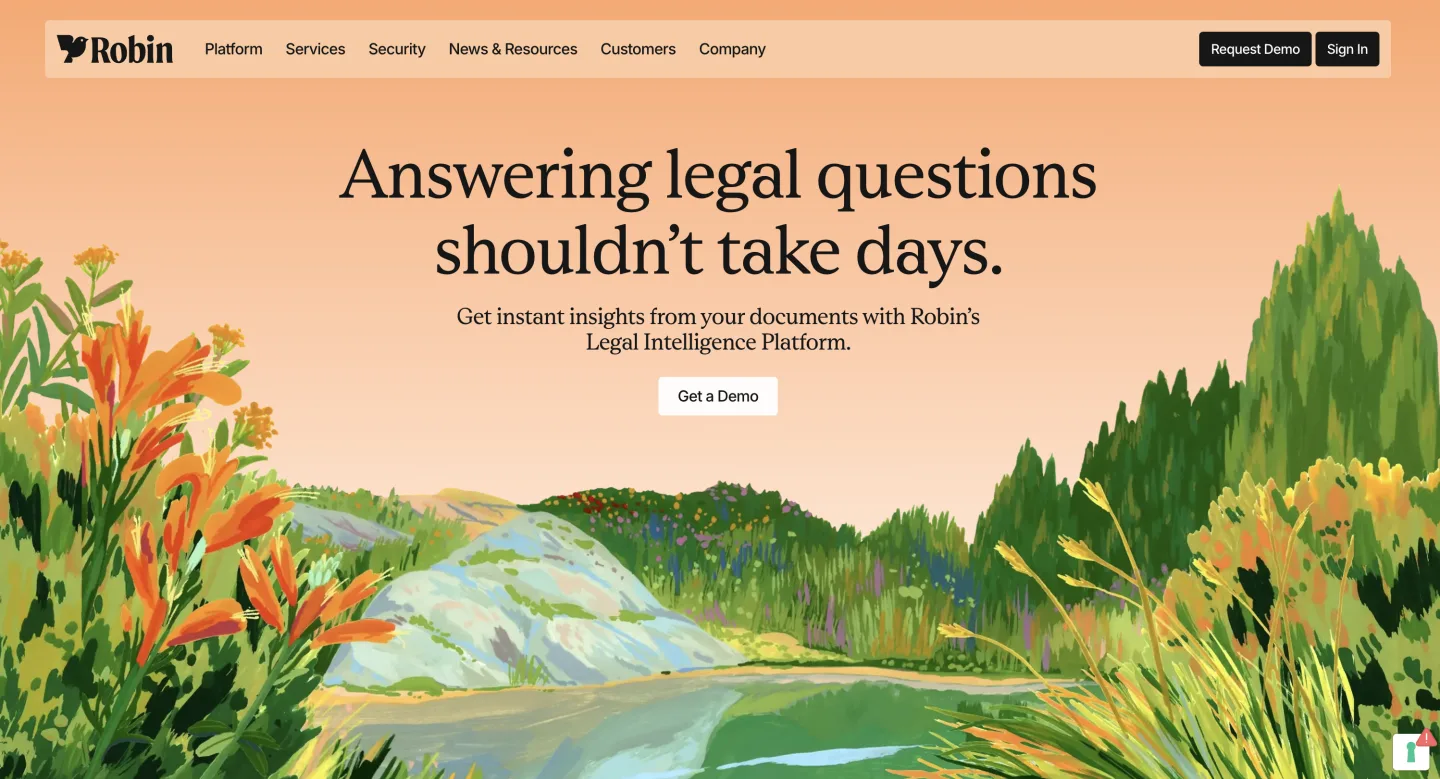
Here is the short version. If you are shopping for a Robin AI alternative in 2026, the first thing to check is not the features. It is whether the vendor will still be around to support the tool next year. Robin AI is the cleanest reason that question now belongs on your checklist.
Vendor survival used to be a footnote. It is now a checklist step, right next to model quality. A quiet sale of a services arm can strand a good product. So can an acqui-hire. The lawyer who bought it is left holding a tool nobody ships fixes for.
Robin AI was one of the best-funded contract AI startups of 2024. It built a "lawyer-in-the-loop" review and drafting tool for big legal teams. Then 2025 went badly. Per the reports (linked in the Sources below), Robin AI failed to close a roughly $50M raise in October 2025 and cut about a third of its staff. In December 2025, Scissero (an AI-enabled UK law firm) bought Robin AI's managed legal services arm and about 75 of its people. In January 2026, Microsoft hired a large group of Robin AI's engineers into its Word team. Microsoft has said it has no plans to buy Robin AI itself. So this was a hire of people, not the product.
This page sets Robin AI against Vaquill AI for in-house counsel. We are biased. Vaquill is our product. We kept the facts straight anyway. The part that matters is corporate news, not a marketing claim. Check the sources yourself before you decide.
TL;DR
- Robin AI built a respected enterprise contract review and drafting assistant. It raised more than $60M before it hit trouble.
- In 2025 it failed a roughly $50M raise, cut about a third of its staff, and put itself up for sale. Trade reporting also notes a winding-up petition over unpaid taxes. In December 2025 Scissero bought its managed services arm (about 75 people). In January 2026 Microsoft hired much of its engineering team.
- The issue for a Robin AI buyer is product survival. Much of the team that built and supported the software has left for Scissero and Microsoft. The reports we read do not say who now owns, runs, or supports the contract software.
- Robin AI lists at $500 per user per month. Vaquill is $99 per user per month, or $990 per year (about 17% off). Vaquill has a 7-day free trial, is self-serve, and puts each feature on each seat.
- Vaquill covers the in-house core Robin AI was known for (AI drafting, clause-by-clause review, redlining). It also goes wider: AI redlining as real Microsoft Word track changes, a Document Matrix across many contracts, negotiation playbooks, compliance checks, document comparison, and matter management. All on one tier.
- If you need the work Robin AI did but want a vendor whose support and roadmap you can verify first, Vaquill is built for a lean US in-house team.
Mapping the wider market first? Our guide to legal AI for in-house counsel covers how to test any of these tools against a real in-house week.
What Robin AI is good at
It would be unfair to wave off Robin AI's tech. So start with what it did well.
A real, focused contract product. Robin AI was founded in 2019 by Richard Robinson, a former Clifford Chance lawyer, and James Clough, a machine-learning researcher. It paired large language models with its own contract data in a "lawyer-in-the-loop" design. The AI takes the first pass. A human checks the output. That habit aged well. After Mata v. Avianca made fake AI citations a known malpractice risk, a tool that forces a human check on each output had made the right bet.
Enterprise reach and a serious customer base. Robin AI sold up-market and won. Its customers spanned large firms. It ran both a software product and a managed legal services arm that served more than 100 firms. The funding (reported at more than $60M across rounds, including a $26M Series B in early 2024 led by Temasek) showed real investor faith at the time.
Engineering talent good enough that Microsoft hired it. The clearest sign is where the team landed. In January 2026 Microsoft brought a large group of former Robin AI engineers into its Word team, including former CTO Carina Negreanu and former director of AI Diana Mincu. You do not get hired by Microsoft Word for building bad contract software.
None of that is in dispute. The problem is what happened to the company around the tech.
What the talk is about now. Forum talk about Robin AI is no longer about the product. It is about the 2025 collapse: the layoffs, the winding-up petition, the managed services sold to Scissero, the engineers absorbed by Microsoft. Robin AI now gets named the "legal AI bubble" warning tale (see Artificial Lawyer and Geek Law Blog). When the news about a tool is all about whether its maker lives, that tells you what to weigh first.
How Robin AI and Vaquill compare
| Capability | Robin AI | Vaquill |
|---|---|---|
| Company status (2026) | Services arm sold to Scissero (Dec 2025), engineers hired by Microsoft Word (Jan 2026), no clear public roadmap | Independent, operating, shipping. One product, one roadmap |
| Target buyer | Big legal teams at large companies | In-house counsel, fractional GCs, CLOs, lean 2 to 10 person teams |
| Pricing | $500 per user per month (list) | $99 per user per month, or $990 per year (about 17% off). No tiers, no add-on fees |
| Free trial | Sales-led | 7-day, self-serve, start instantly |
| AI drafting | Contract drafting assistant | Drafting for NDAs, MSAs, and vendor agreements, with an in-app editor |
| Contract review | "Lawyer-in-the-loop" AI review (a strength) | Clause-by-clause review with flagged risk and compliance checks |
| Redlining | In-product redlining | AI redlining as real Microsoft Word track changes you can accept or reject |
| Negotiation playbooks | Limited public detail | Negotiation playbooks plus expert Skills (NDA Triage, Risk, Compliance, and more) in chat |
| Document comparison | Version and document comparison | Document comparison with real track changes export |
| Document Matrix | Not a built-in feature | Pull the same terms (liability cap, governing law, end date) across many contracts at once |
| Compliance checks | Not a built-in feature | CCPA, GDPR, and HIPAA compliance checks with flags |
| Matter management | Contract-centric workspaces | Matter workspaces, 100-doc matter chat, email-to-matter inbox, auto-built timelines |
| Multi-step workflows | Agentic review flows | Agent Mode chains steps for you across multi-step tasks |
| Data posture | Enterprise terms | PII masked before model calls, zero data retention with OpenAI and Anthropic, US-based, no training on your data, BAA available |
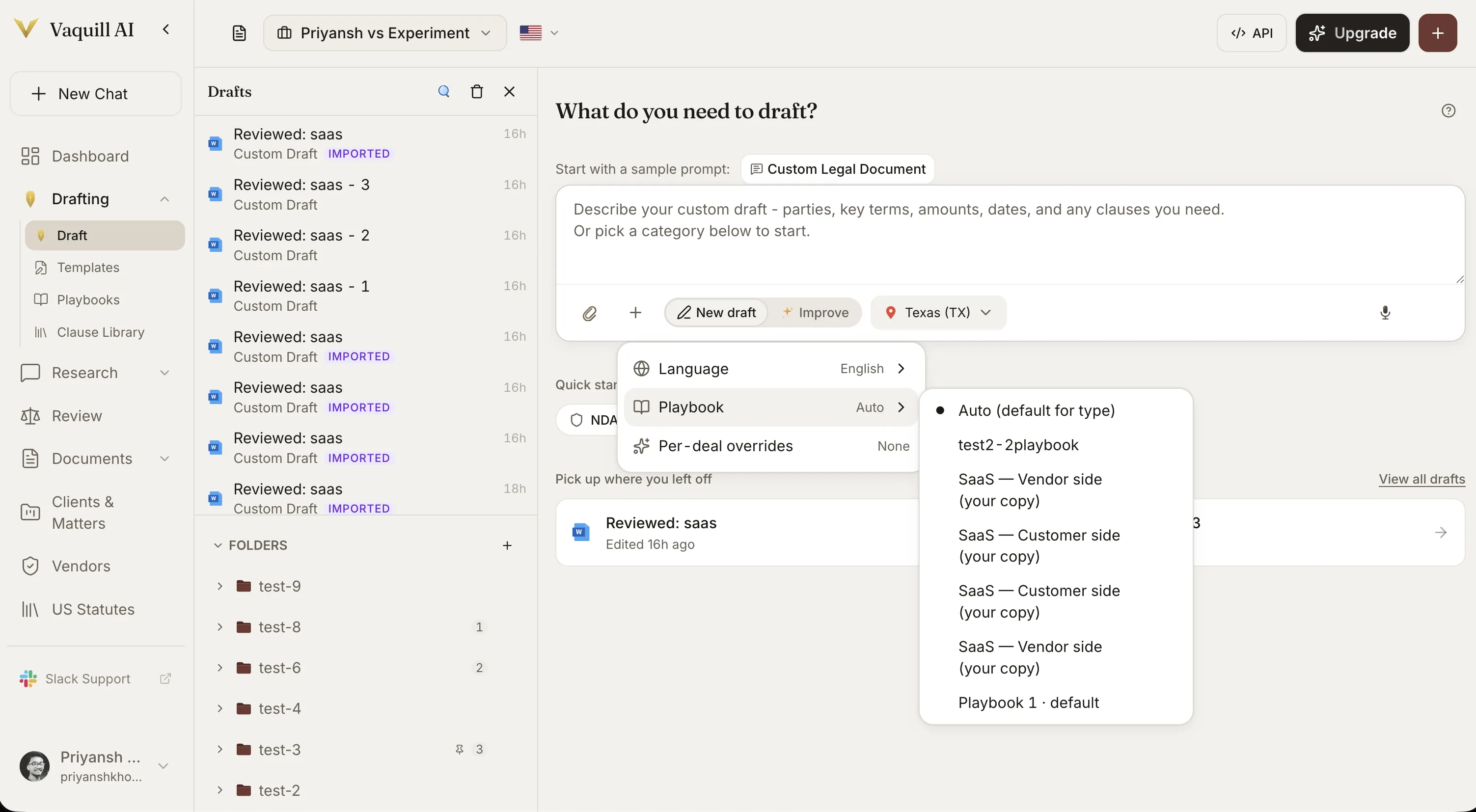
AI drafting. Generate NDAs, MSAs, and vendor agreements, then refine clause by clause in the editor instead of starting from a stale template.
Where the risk sits for a Robin AI buyer
Robin AI's tech was good. The problem in 2026 is the company around it. The wider lesson for legal ops is plain. Vendor-failure risk is now its own check for contract AI, the same way a security review is. A tool can pass a demo and still fail you. That happens when the maker cannot fund support, ship fixes, or get your data back out. Robin AI is a clean case study. A vendor-survival check belongs next to your security questionnaire.
Continuity is unsettled. This is the core of the comparison. It tracks the dated public reports, all linked in the Sources below. In late 2025 Robin AI failed a roughly $50M raise and cut about a third of its staff. Trade reporting also notes an HMRC winding-up petition over unpaid taxes. In December 2025 the managed services arm and about 75 people moved to Scissero. Per those reports, the contract software was not part of the deal. In January 2026 a group of engineers, including former CTO Carina Negreanu and former director of AI Diana Mincu, joined Microsoft. As of June 16, 2026, the reports we read name no clear plan for the software's roadmap, support, or owner. That is not a claim that no plan exists. The team moves above are on the record. The software's future is not. Check directly for newer news, because this can change. For a tool you lean on each week, that open question is a real risk. Close it in writing before you rely on the product further.
Why the Microsoft hire matters, and why it does little for existing customers. Word is where most in-house lawyers do contract work. Moving Robin AI's engineers into the Word team likely helps Word and Copilot in time. Good for Microsoft. On its own, it does not give a Robin AI customer a kept-up product, a support desk, or a roadmap. Talent going to a platform you also use does not pass to the standalone tool you bought. Read the hire as a sign of where the people went. Not as continuity for the software.
The migration pain a lean team actually feels. Say you do have to move off a distressed contract-AI tool mid-quarter. The cost is rarely the new subscription. It is the switching friction. You have to export your clause library and standards into a portable format. You have to re-teach playbooks to a new engine. You have to re-run a security and SSO review your IT lead has no time for. And you have to confirm the new tool's redlines open as clean Word track changes, not mangled comments. For a two-person legal function, any one of those can eat a week you did not budget. So test export rights and redline fidelity during a trial, before you depend on the tool. Not after the vendor's situation forces your hand.
No clear self-serve path for a lean team. Robin AI sold to enterprise legal departments through a sales-led motion at $500 per user per month. A solo GC, a fractional GC, or a 2 to 10 person team has no procurement runway and no patience for a sales cycle to test a tool. Less so when the vendor's future is in doubt. Vaquill is self-serve. A 7-day trial, one seat at $99, and you are using the workbench the same day. No quote, no contract.
A point tool, not a workbench. Robin AI was, at its core, a contract review and drafting assistant. That is the heaviest part of an in-house week. It is not the whole week. Compliance reads. Pulling terms across a stack of contracts. Running a matter over six weeks. Negotiation prep. Those all sit outside a pure contract-review tool. Vaquill puts them in one place. Consolidating into one suite is not always right. A team whose only bottleneck is contract management may still want a dedicated CLM platform. But for a lean team carrying the whole legal function, one tool that covers the week beats a point tool whose support picture is unclear.
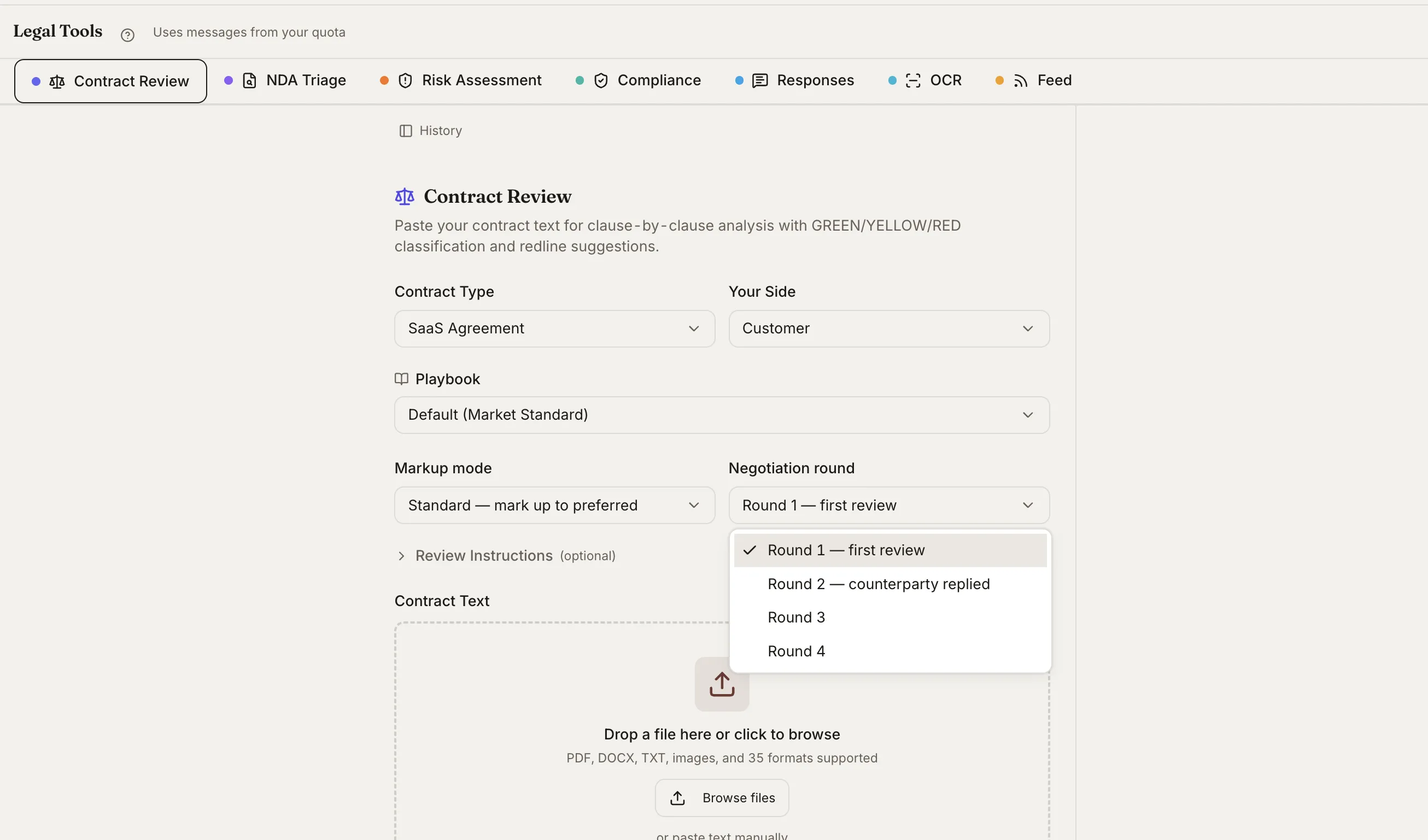
Contract review and compliance. Clause-by-clause risk flags plus CCPA, GDPR, and HIPAA checks, with severity so you triage instead of reading every line cold.
The practical Robin AI alternative test for in-house teams
Before you name a replacement, run the vendor through a survival check. These questions fit Robin AI today. They also guard you against the next legal-tech vendor to run out of cash. Ask sales or support, and watch for hedging.
- Who owns and maintains the product now? For Robin AI, get a named entity and a named support contact in writing. "We are working through the transition" is a red flag, not an answer.
- What is the support and SLA commitment for the next twelve months? A vendor that just lost most of its engineers cannot promise the same speed. Pin it down.
- Can you export your data and work product? Confirm you can pull your clause library, playbooks, review history, and matter files in standard formats (DOCX, PDF, CSV) without paid help. Clause-library and playbook lock-in is the costly part of switching.
- What happens to your data on exit? Ask for a written deletion process and a deletion certificate. A vendor in distress may be slow to give you either.
- How does the company's situation affect security posture? A failed raise and a smaller team can stall a SOC 2 renewal or thin out the people who handle security reviews. Ask when the last audit closed and who owns the next one.
- Run a 14-day parallel test. Point the candidate tool at 10 real inbound contracts from your live queue, alongside your incumbent. Use a mix: a couple of NDAs, an MSA or two, a DPA, a vendor SaaS agreement, an order form. Do not use a vendor demo set. Watch for the usual failure modes. Redlines that do not export as clean Word track changes. Lost matter context between sessions. Bold edits to clauses that were already fine. And review that quietly drops a clause type your standards flag.
Score each document on four axes. Then weight them for a lean team.
| Axis | What you measure | Suggested threshold | Weight |
|---|---|---|---|
| Redline acceptability | Share of edits you would send as-is, no rework | 70%+ to be useful, 85%+ to trust | 35% |
| Issue recall | Did it catch the changes you flag by hand (liability cap, indemnity carve-out, auto-renewal, governing law) | Misses zero high-severity issues | 35% |
| False positives | Edits you had to delete | Under 1 per page | 15% |
| Turnaround | Minutes to a usable markup, end to end | Beats your manual baseline | 15% |
Weight issue recall and acceptability highest. For in-house work, a fast tool that misses an indemnity carve-out is worse than none. Here is the failure to plan for. Redlines are 70% acceptable, but the tool misses an indemnity carve-out on a DPA, or a one-sided limitation-of-liability clause. That is a near-pass, not a pass. The fix: keep a short, mandatory human-review checklist for high-severity clause types (indemnity, liability cap, IP assignment, data processing), no matter how good the AI looks. And reject any tool whose issue-recall on those categories is not complete across all 10 documents.
This is also the time to set the choice in the wider market. A Robin AI replacement is not only a one-for-one swap. Based on your workload, you might weigh a few types. A contract-lifecycle platform (Ironclad, LinkSquares). A Word-based drafting copilot (Spellbook, and now Microsoft Word's own Copilot, staffed in part by former Robin AI engineers). Or a broad legal AI suite (Harvey, and Vaquill). The right pick depends on your bottleneck: review, drafting, the full in-house week, or pure contract management. Say your lean team wants drafting, review, redlining, compliance, and matters in one place, with no enterprise contract. Then a single self-serve suite usually beats stitching point tools together.
Vaquill answers these the verifiable way. One product and one roadmap. Self-serve export of your documents and redlines as standard Word and PDF files. A written data deletion process. Zero-data-retention contracts with OpenAI and Anthropic. And a 7-day trial you can run against your own queue without talking to sales. You do not have to take that on faith. Check each item yourself during the trial.
What in-house teams actually use this for
Picture a normal week for a solo or two-person legal function. Notice how much of it sits outside pure contract review. Monday, a vendor MSA lands at 4pm with a Friday signature ask. You run it against your standards, get a ranked list of changes (liability cap, indemnity carve-outs, auto-renewal, governing law), and ship a markup. This is the work Robin AI was built for, and it is the heaviest single block of the week. But Tuesday a founder needs an NDA drafted for a partner call. Wednesday diligence asks what your liability cap and governing law are across every active vendor agreement, which is 40 PDFs you do not want to read by hand. Thursday a data processing addendum needs a CCPA, GDPR, or HIPAA read before it goes out. And under all of it, a dispute is running into its sixth week, and you do not want to re-upload the same documents every session.
A pure contract-review tool handles Monday and part of Tuesday. The rest is where a single workbench earns its seat: bulk term extraction across a contract stack, compliance reads, drafting, and matter context that holds over weeks. Vaquill covers Monday's redline with clause-by-clause review and real Word track changes. Then it keeps going. A Document Matrix pulls the same field across many contracts into one grid. Compliance checks flag issues. Drafting lives in the same editor. Matter workspaces hold a 100-document matter chat and an email-to-matter inbox, so the six-week dispute does not live only in your head. The contract review still has to be good. For a lean team, though, it is one job out of five, not the whole role.
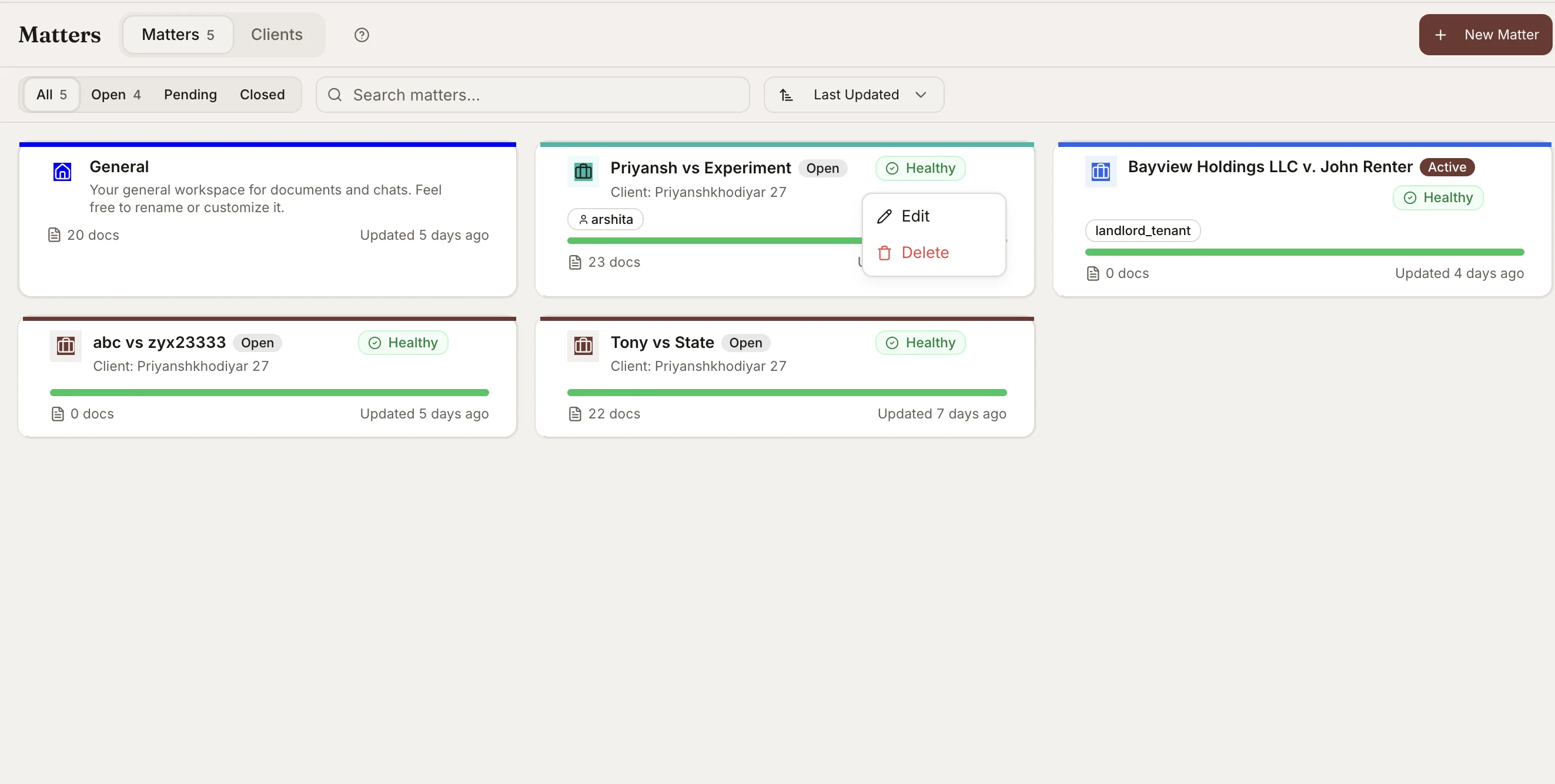
Matter workspaces. Keep documents, research threads, and an auto-built chronology together per matter, with an email-to-matter inbox so nothing lives only in your inbox.
When Robin AI is the right call
Maybe you are an existing Robin AI customer whose deployment is working. Contracts flow through it. And you hold a current, written commitment on roadmap and support from whoever now controls the software. Then there may be no reason to rip it out tomorrow. The contract tech was genuinely good, and switching tools always has a cost. The test is narrow. Get a clear answer, in writing, on who owns the product now, who maintains it, and what the support commitment is. If you can get that and it satisfies you, staying put is defensible. The catch: as of early 2026, the public record does not make that answer easy to find.
When Vaquill is the better fit
Choose Vaquill if you are in-house counsel, a fractional GC, a CLO, or running a lean 2 to 10 person legal team. You want the contract work Robin AI did, inside an independent workbench you can adopt today. You get drafting, clause-by-clause review, AI redlining in real Word track changes, the Document Matrix, compliance checks, document comparison, and matter management. All on one self-serve seat at $99 per user per month. Privilege-grade data handling is the default. No enterprise sales cycle, no procurement, and no open question about whether the vendor still supports the product next quarter.
Robin AI built strong contract tech. The reports show much of the team behind it moved to Scissero and Microsoft. What it does not show is who carries the software forward. Vaquill is an independent, full in-house option for lawyers who would rather not carry that open question. They want a vendor whose support and roadmap they can check first.
FAQ
Is Robin AI still operating in 2026?
Scissero bought Robin AI's managed legal services arm in December 2025. Microsoft hired much of its engineering team into the Word group in January 2026 (sources below). As of June 16, 2026, the reports we read do not say who owns, runs, and supports the contract software going forward. That is not the same as saying no plan exists. Already using or testing Robin AI's software? Get a written answer on who owns and supports it now, before you rely on it further.
Did Microsoft buy Robin AI?
No. Microsoft hired former Robin AI staff. That is an acqui-hire of talent. Microsoft did not buy Robin AI or its product, per Bloomberg Law (cited below). The engineers joined Microsoft's Word team. That helps Microsoft Word's roadmap. It does not give existing Robin AI software customers a clear path or support commitment.
How much does Robin AI cost?
Robin AI lists at $500 per user per month. It sold through a sales-led enterprise motion. Vaquill is $99 per user per month, self-serve, with a 7-day free trial.
Is Vaquill a real alternative to Robin AI for in-house counsel?
Yes. Both target the in-house contract workflow: drafting, clause-by-clause review, and redlining. Vaquill delivers that core plus more. AI redlining as real Word track changes. A Document Matrix across many contracts. Compliance checks, document comparison, and matter management. All on a self-serve seat at $99 per user per month. The difference today is that Vaquill is independent and shipping. So you can check its support and roadmap before you commit.
How much does Vaquill cost?
Vaquill is $99 per user per month, or $990 per year on annual (about 17% off), with a 7-day free trial. There are no tiers and no add-on fees. Each seat gets each feature. Sign up and start the same day, self-serve. No quote, no enterprise contract.
Does Vaquill integrate with Microsoft Word?
Vaquill makes AI redlines as real Microsoft Word track changes. Open them in Word and accept or reject clause by clause. The output drops straight into the tool in-house lawyers already use.
What does "privilege architecture" mean for Vaquill?
PII is masked before any document reaches a model. Vaquill runs zero-data-retention contracts with OpenAI and Anthropic. Data stays in the US on AWS. Customer data is never used to train models. And a BAA is available. That adds up to a data setup a small in-house team can defend in a board meeting or an audit, with no custom enterprise rider to haggle over.
Where to go next
- Vaquill for in-house counsel: the workbench, mapped to the in-house week.
- Legal AI for in-house counsel: how to test any of these tools against your actual workload.
- Document comparison: compare versions and export real track changes.
- Start a 7-day free trial: self-serve, one seat, no procurement.
Sources
- Robin AI lays off staff as growth disappoints (Artificial Lawyer)
- Is the collapse of Robin AI a one-off or a sign of a legal tech AI bubble? (Geek Law Blog)
- Scissero buys managed services team of Robin AI (Global Legal Post)
- AI-enabled law firm Scissero buys Robin services arm (Artificial Lawyer)
- Microsoft brings former Robin AI legal tech employees into fold (Bloomberg Law)
- Microsoft "to acqui-hire Robin AI tech team" (Artificial Lawyer)
- Struggling Robin AI offloads managed services arm to Scissero (Nonbillable)
- Robin AI raises $26 million as legal sector embraces AI (PR Newswire)


