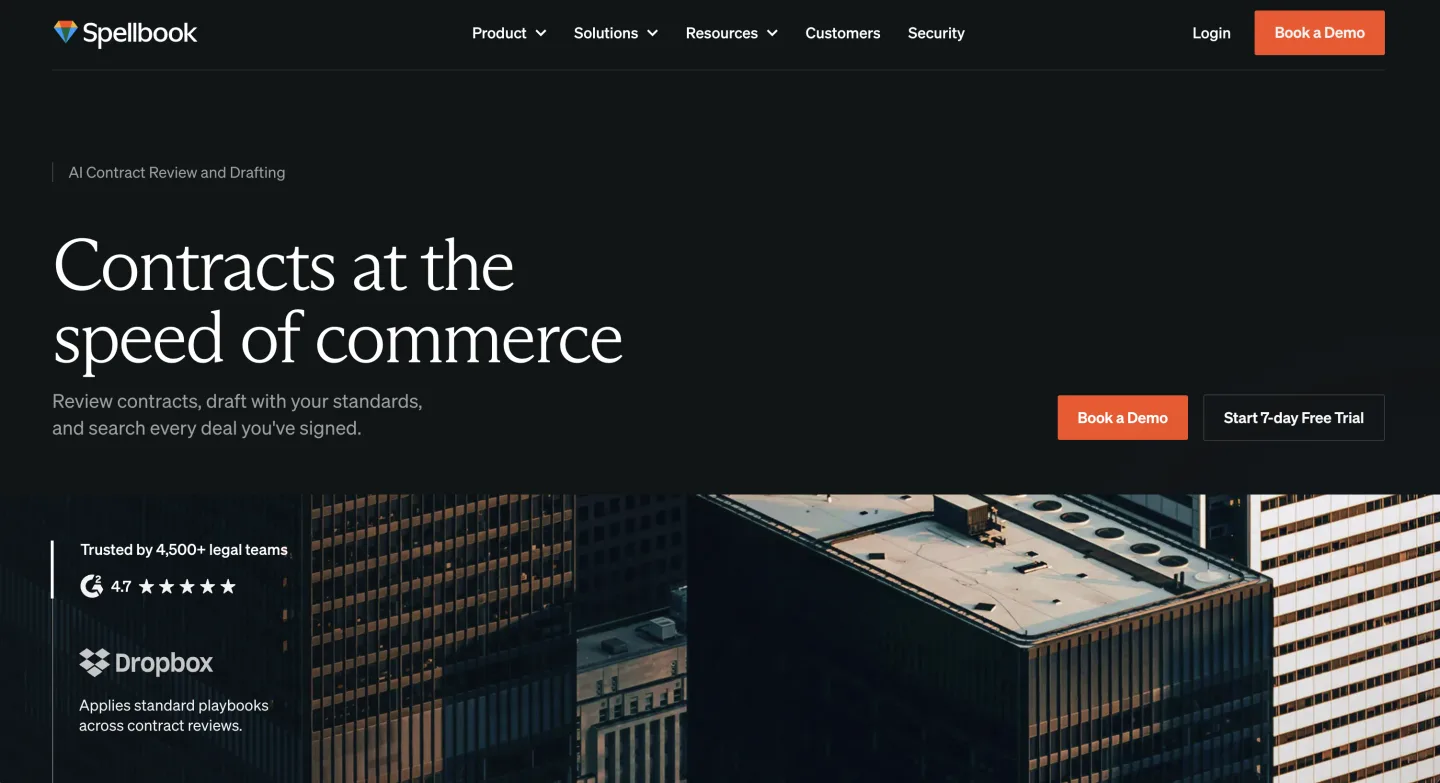
Most Spellbook comparisons stop at the feature grid. That is where the wrong call gets made. The real question for an in-house buyer is not "which tool drafts a better clause." It is "what happens to the work after the document is signed." Spellbook is a contract AI tool that lives inside Microsoft Word. It redlines, suggests clauses, and runs playbooks on an open document. It does that well. But the moment you close the file, the tool goes quiet. Think about the contract you just signed. The compliance question the deal raised. The next four vendor agreements with the same indemnity language. None of that lives in Word. None of it lives in Spellbook.
That gap is the whole post. An in-house lawyer does not get paid to draft in a vacuum. The job is to keep the legal function running. That means drafting, yes. It also means clause-by-clause review. It means redlining the other side's markup. It means comparing the same terms across a stack of agreements. It means answering CCPA and HIPAA questions. And it means keeping a matter file that outlives the deal. Spellbook is good at one slice of that. Vaquill AI is the workbench for the rest, with drafting and review built in.
TL;DR
- Spellbook is a good contract AI tool. You get inline redlining, clause suggestions, custom playbooks, the Associate agent for multi-document work, and the Library feature that drafts from your own precedent. If your day is spent in Word negotiating documents, it is built for that.
- Spellbook's main limit is structural, not a missing feature. It lives inside Word and goes dark after signature. There is no matter workspace and no memory across deals. The signed contract and the compliance work it triggers have nowhere to live together.
- Vaquill is an in-house legal AI workbench. It puts AI drafting, clause-by-clause review, AI redlining with real Word track changes, compliance checks, negotiation playbooks, document comparison, Document Matrix, and matter management in one place.
- The wedge is simple. Spellbook helps you draft and sign. Vaquill keeps the matter. Drafting, review, redline, comparison, and the workspace that holds them all sit in one tool.
- Vaquill costs $99 per user per month ($990 per user per year, about 17% off). It is self-serve with a 7-day free trial. Spellbook's base plan is $500 per seat. Spellbook does not publish pricing, so you need a demo to get a quote.
- Pick Spellbook if Word-native drafting is the whole job. Pick Vaquill if you run an in-house legal function and need the work to hold together after the deal closes.
This is part of our legal AI vendor comparison series. For the standalone product breakdown, see our Spellbook review.
What Spellbook actually is
Spellbook is an AI contract drafting and review platform. It was built by the team behind Rally Legal. Scott Stevenson, Daniel Di Maria, and Matt Mayers started it in 2018 in St. John's, Newfoundland. It plugs into Microsoft Word and uses GPT-5 and other top models to review, redline, and draft contracts. By 2026 it served more than 4,000 legal teams across 80-plus countries, including Nestle, eBay, and Crocs. In October 2025 it raised a $50M Series B led by Khosla Ventures at a $350M valuation. It has reported being on track for $100M in ARR. This is not a thin wrapper. It is a well-funded product with real reach.
The architecture is the key fact. Spellbook is a Word add-in. The AI works where transactional lawyers already work. No second screen, no context switch. That one choice is the source of its biggest strength and its biggest limit. The rest of this post is about both sides of that coin.
Where Spellbook is genuinely strong
Let me be straight before the comparison turns. Pretending a $350M-valuation product has no merits would be the kind of vendor spin nobody should trust.
Top-tier contract AI inside Microsoft Word. Spellbook plugs into Word with inline redlining, clause suggestions, and custom playbooks. For a lawyer whose day is the open document, there is no second screen. The AI works right where the drafting happens. That kills the single biggest reason legal AI tools die in week four: friction.
The Associate agent for multi-document work. Spellbook Associate launched in August 2024. It can plan a task, run it across many documents, check its own work, and adapt. It can build financing papers from a term sheet, scan hundreds of documents for risk, and revise a whole employment package on its own. This is real agent work, not a chatbot with a legal label.
Smart Clause Drafting from your own precedent. Spellbook Library launched in July 2025. It turns a lawyer's past work into a searchable knowledge base. Smart Clause Drafting pulls relevant clauses from your own document history. The output reads like your prior work, not generic AI. For a team with a deep precedent bank, that is a real edge.
Momentum and backing. The $50M Series B. The $100M ARR path. The Canadian Bar Association partnership. The 4,000-plus teams. They add up to a product that is not going anywhere. Buying Spellbook is not a bet on a startup surviving the year.
What do users say? Spellbook is the best-liked AI tool among transactional lawyers, and the Word add-in gets singled out for praise. It carries a 4.1-out-of-5 on the Lawyerist review. The same reviews note two catches. It still inserts wrong citations now and then, so you check its work. And it is transactional-only, so it is weak for litigation.
None of that is in dispute. The question is whether contract drafting in Word is the shape of your whole job, or just one corner of it.
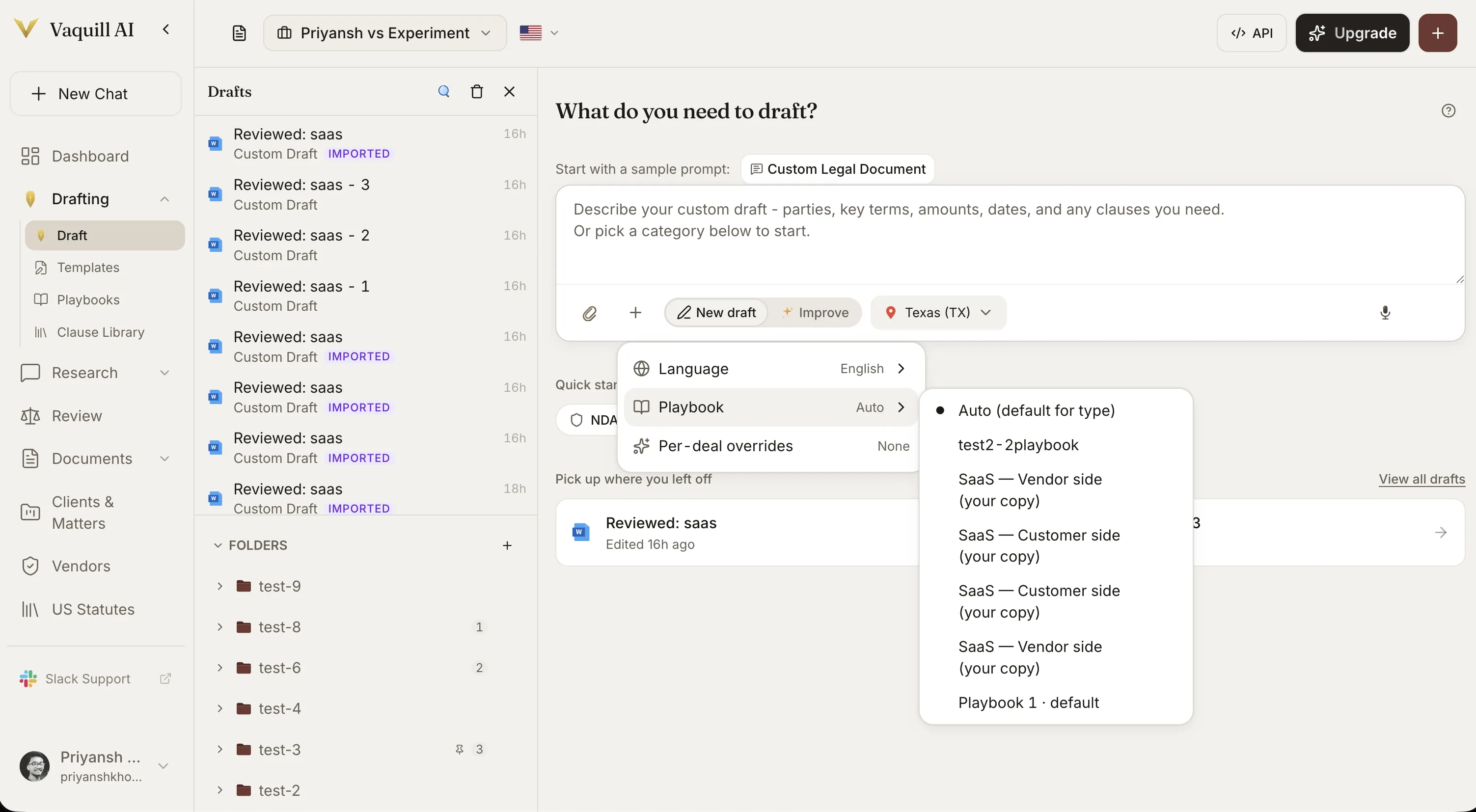
Drafting in Vaquill. Describe a document in plain English, generate it with jurisdiction-aware clauses, and export to Word. Drafting is the start of the workflow here, not the whole product.
How Spellbook and Vaquill compare
| Capability | Spellbook | Vaquill |
|---|---|---|
| Primary purpose | Contract drafting, review, and redlining for transactional lawyers, inside Microsoft Word | In-house legal AI workbench: drafting, review, redlining, comparison, compliance, and matter management in one place |
| Contract drafting and review | Top-tier: inline redlining, clause suggestions, custom playbooks, benchmarking against 2,300+ standards, Associate agent for multi-document work | AI drafting plus clause-by-clause review with green/yellow/red flags, plus a Contract Review and NDA Triage skill in the chat |
| AI redlining | Inline redline suggestions inside the open Word document | AI redlining that exports a real Word file with native Track Changes the counterparty can accept or reject |
| Matter management | None. Project-based organization for contract work, but no matter workspace that holds a deal after signature | Matter workspaces organize work by matter or client, with 100-document chat, a matter inbox, and auto-built chronologies |
| Document comparison | Compares within the contract review flow inside Word | Standalone document comparison that redlines two documents and exports native Track Changes |
| Document Matrix | Not in the published feature set | Pull the same terms across hundreds of vendor agreements, NDAs, or DPAs into one grid |
| Compliance checks | Benchmarks contracts against 2,300+ regulatory and industry standards | Compliance Check skill for CCPA, GDPR, and HIPAA, alongside contract review |
| Negotiation playbooks | Custom playbooks for clause standards inside Word | Negotiation playbooks plus 8 expert skills (Contract Review, NDA Triage, Risk Assessment, Compliance Check, and more) inside the chat |
| Institutional memory | None across matters in the published feature set | Memories remember your jurisdiction, practice area, and clause preferences across sessions |
| Pricing | Custom quotes only, no public tiers, demo required | Flat $99/user/month, $990/user/year (about 17% off), self-serve, no demo |
| Free trial | 7-day free trial | 7-day free trial, no credit card friction, self-serve sign-up |
| Platform | Microsoft Word add-in only (Windows and Mac), no standalone web app for core features | Web app plus Word export, with a REST API and MCP server available |
| Data posture | SOC 2 Type II, HIPAA, zero data retention with OpenAI and Anthropic | PII anonymized before model calls, zero data retention with OpenAI and Anthropic, US data residency, no model training, BAA available |
| Target user | Transactional lawyers (in-house and at firms) whose work lives in Word | In-house counsel, fractional GCs, CLOs, and lean 2-10 person in-house legal teams |
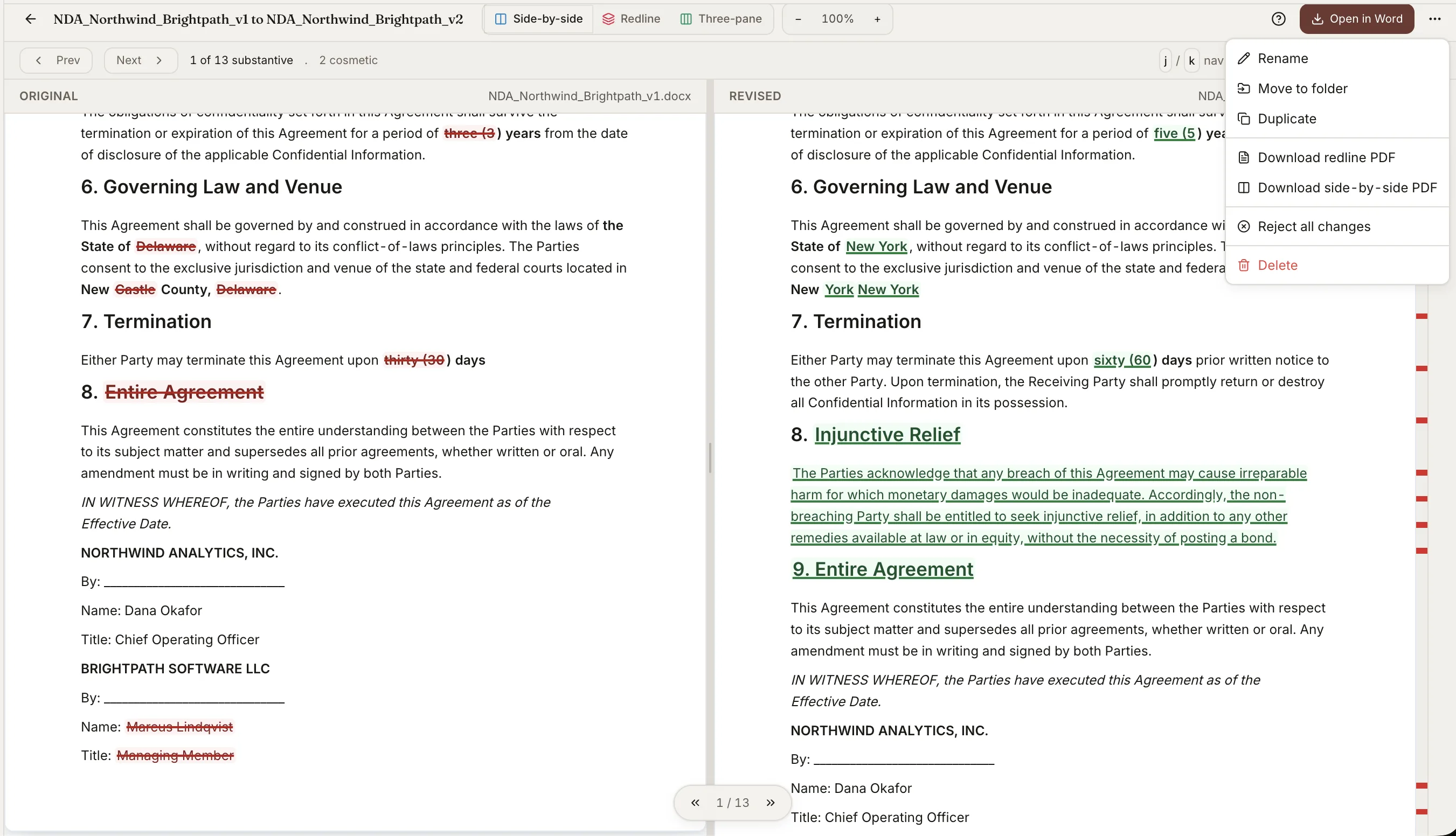
Document comparison in Vaquill. Redline two documents and export a real Word file with native Track Changes, the format the counterparty actually wants back.
Where Spellbook falls short for an in-house function
These are not knocks on Spellbook as a contract tool. They are the spots where a Word add-in stops matching the shape of an in-house job.
It goes dark after signature. This is the one that matters most. Spellbook helps inside an open contract. Once the document is signed and closed, the tool has nothing left to do. The signed agreement, the duties it created, the compliance question it raised, the next renewal: none of that has a home in Spellbook. For a deal lawyer who hands off after closing, that is fine. For an in-house lawyer who owns the relationship for years, the work falls out of the tool right when the in-house job begins.
No matter management or memory. Spellbook organizes contract work into projects. But there is no matter workspace in the in-house sense. The contract, the emails around it, the compliance review it triggered, the related agreements: none of that lives in one searchable place. A board question lands six months later about a deal you closed. Spellbook is not where you go to piece it back together. It also has no documented memory that carries your jurisdiction, clause preferences, and prior positions from one deal into the next.
Word-only workflow. Spellbook runs only inside Microsoft Word. There is no web app for its core AI features. If part of your work happens in Google Docs, in a browser, in email, or in a matter file instead of an open .docx, Spellbook cannot reach it. The thing that makes the drafting smooth also fences the product to one surface.
Opaque pricing with a demo gate. Spellbook does not publish pricing. You book a demo and get a quote based on team size, use case, and contract length. The base plan is $500 per seat. You confirm the full quote on a sales call. Say you want to try a tool this week. The demo gate is friction before you have seen the product solve one problem.
The work scatters across tools. Spellbook covers drafting and review, then stops. So the rest of the in-house stack ends up elsewhere. One tool to compare clauses across the queue. Another to run a compliance check. Another to keep the matter file. Every handoff is a place context gets lost. A two-person legal team does not have time to babysit five tools that do not talk to each other.
Who Spellbook is actually for
Map the strengths and limits to real jobs and the fit gets clear.
Transactional lawyers who live in Word. If your day is negotiating and redlining contracts in Microsoft Word, Spellbook is built for that and cuts real friction. This is the home-run use case.
Teams that draft from their own precedent. The Library feature and Smart Clause Drafting reward a deep precedent bank. The output sounds like your prior work. If you have years of documents worth mining, that is a real edge.
High-volume multi-document deals. The Associate agent handles multi-document work, financing packages, and bulk review well. For a team pushing lots of contract work through Word, the agent earns its keep.
Where Spellbook stops fitting is the in-house function as a whole. That is the part of the job that is compliance, matter tracking, clause comparison across a backlog, and memory across deals. It is more than the open document in front of you.
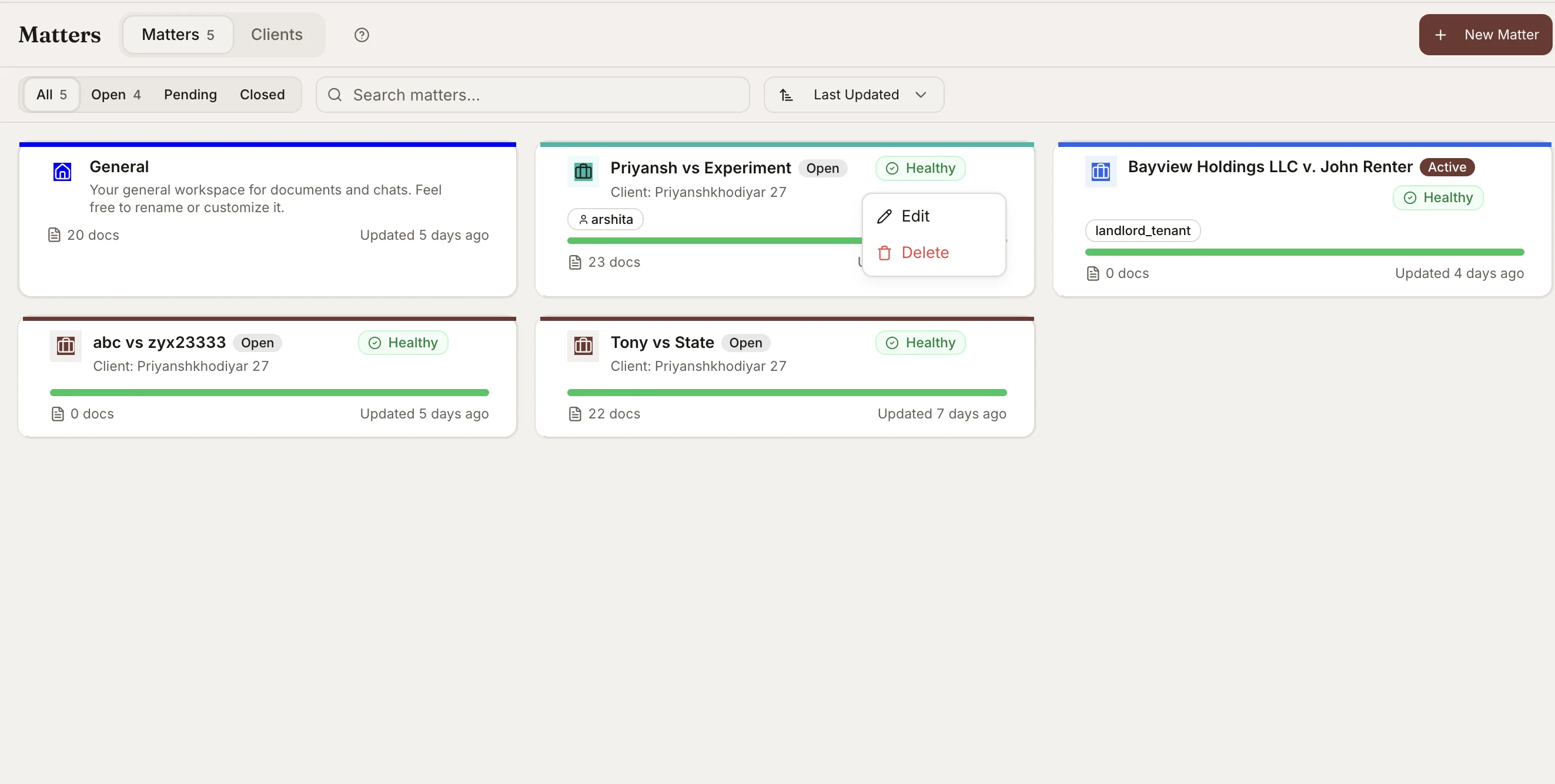
Matter workspaces in Vaquill. Contracts, compliance work, and board questions live with the documents they came from, with 100-document chat, a matter inbox, and auto-built chronologies. This is the surface Spellbook does not have.
When Spellbook is the right call
Pick Spellbook if your daily work lives in Microsoft Word and contract drafting plus redlining is the main workflow. Spellbook is best in class for that Word-native experience. The Associate agent handles multi-document work well. The Library feature is a real edge for teams that draft from their own precedent. Maybe your role is basically "negotiate and close documents." Maybe matter management, compliance, and cross-deal comparison happen somewhere else or not at all. Then Spellbook is the more focused product. Buy it. There is no shame in picking the sharper tool for the narrower job.
When Vaquill is the better fit
Pick Vaquill if you run an in-house legal function and need the work to hold together after the document closes. That covers in-house lawyers, fractional GCs, CLOs, and lean 2-10 person teams. Vaquill is the workbench for the broader job. You get AI drafting and clause-by-clause contract review. You get AI redlining with real Word track changes. You get document comparison and Document Matrix to pull the same terms across hundreds of agreements. You get compliance checks for CCPA, GDPR, and HIPAA. You get negotiation playbooks. You get matter workspaces with a matter inbox, 100-document chat, and auto-built chronologies that keep the deal alive after signature.
It is the affordable answer to GC AI and Harvey, with contract drafting built in instead of treated as the only feature. The data setup is one a small team can defend in a procurement review. PII is anonymized before model calls. There is zero data retention with OpenAI and Anthropic. Data stays in the US. Your data is not used for training. A BAA is available. And it costs $99 per user per month, self-serve, with a 7-day free trial. So you can prove it against your own contracts this week without a sales call. Start at app.vaquill.ai or read the fit case for in-house counsel.
The call is not "which tool drafts better." On a single open contract, Spellbook is excellent. The call is "does the work stop at signature, or does it keep going." For an in-house function it always keeps going. Vaquill is the workbench built for the part that comes after.
FAQ
Does Vaquill replace Spellbook for contract review and NDA triage? For the in-house use case, in most cases yes. Vaquill has a Contract Review skill (clause-by-clause analysis with green/yellow/red flags) and an NDA Triage skill (10-point screen with routing tips), both in the chat. They sit next to drafting, document comparison, compliance checks, and matter management. Not a standalone Word add-in. If your whole workflow is contract drafting in Microsoft Word, Spellbook is still the more focused product. If you want review plus redlining plus comparison plus matters in one place, Vaquill pulls the stack together.
How does Vaquill organize work by matter compared to Spellbook? Vaquill organizes everything by matter or client with role-based access. Each matter has its own inbox. Forward a contract, MSA, or NDA to your matter address and it lands indexed and ready to query. Answers come back in the same email thread. 100-document chat lets you upload a whole deal room and chat across it at once. The Chronology Builder pulls dates and events from all matter documents into an exportable timeline. Spellbook organizes contract work into projects but has no matter workspace that holds a deal after signature.
What is Spellbook? Spellbook is an AI contract drafting and review platform built by the team behind Rally Legal. Scott Stevenson, Daniel Di Maria, and Matt Mayers started it in 2018 in St. John's, Newfoundland. It plugs into Microsoft Word and uses GPT-5 and other LLMs to review, redline, and draft contracts. More than 4,000 legal teams across 80-plus countries use it, including Nestle, eBay, and Crocs. In October 2025 it raised a $50M Series B led by Khosla Ventures at a $350M valuation.
Does Spellbook do AI redlining with real Word track changes? Spellbook works inside Microsoft Word and shows inline redline suggestions in the open document. Vaquill's redlining exports a separate, finished Word file with native Track Changes. The other side can accept or reject each one. That is the format most negotiations expect when you send a markup back.
What is Spellbook's pricing? Spellbook does not publish pricing. It quotes you based on team size, use case, and contract length, and you have to book a demo. The base plan is $500 per seat. Vaquill costs $99 per user per month ($990 per year, about 17% off) with a 7-day free trial and no demo.
Does Spellbook have matter management? No, not in the in-house sense. Spellbook organizes contract work into projects. It has no matter workspace, no email-to-matter inbox, and no auto-built chronologies in its published feature set. Once a contract is signed, the work leaves the tool. Vaquill keeps the matter. Contracts, compliance work, and related documents live in a workspace that stays searchable after the deal closes.
Can Spellbook run compliance checks for CCPA, GDPR, or HIPAA? Spellbook benchmarks contracts against 2,300-plus regulatory and industry standards. That is contract benchmarking. Vaquill has a Compliance Check skill for CCPA, GDPR, and HIPAA that runs next to contract review. So the compliance question a deal raises gets handled in the same workbench.
Is Spellbook a safe pick for memory across deals? Spellbook has no documented memory across matters and no matter file that keeps the work after signature. So that memory has to live in another system. Vaquill carries Memories across sessions (jurisdiction, practice area, clause preferences) and keeps each matter in its own workspace. The legal function's history stays inside the tool.
Sources
- Spellbook official website - 4,000+ legal teams, 80+ countries, GPT-5, SOC 2 Type II, HIPAA
- Spellbook About page - features overview and notable clients (Nestle, eBay, Crocs)
- Spellbook Security page - SOC 2 Type II, HIPAA, GDPR, CCPA, zero data retention with OpenAI and Anthropic
- Spellbook Associate launch - AI agent for multi-document workflows (August 2024)
- LawNext on Spellbook Library - Smart Clause Drafting from firm precedents (July 2025)
- BusinessWire: Spellbook $50M Series B - Khosla Ventures, $350M valuation (October 2025)
- BetaKit: Spellbook on track for $100M ARR - Canadian Bar Association partnership
- SiliconANGLE: Spellbook raises $50M - 10M+ contracts processed
- Aline: Spellbook review - strengths (Word integration, contract review) and limitations (not for research, opaque pricing)
- Lawyerist: Spellbook review - 4.1/5, best-liked by transactional lawyers, still inserts wrong citations, transactional-only
- Crunchbase: Scott Stevenson - Co-Founder and CEO of Spellbook
- Canada.ca: Spellbook founded 2018 as Rally - St. John's, Atlantic Canada Opportunities Agency profile
Want the deeper product breakdown? Read our honest Spellbook review. See the fit case for in-house counsel. Learn how document comparison exports native Track Changes. See how matters keep a deal alive after signature. Or start a 7-day free trial.


