AI legal drafting is good at the blank-page problem: turning a brief, a precedent, and your standard positions into a usable first draft in minutes instead of an afternoon. Its hard limit is just as clear. You own every word that leaves your desk. The model drafts; you verify, edit, and sign. Treat it as a fast junior drafter whose work you always review, and it earns its place. Treat its output as final, and it will quietly insert a wrong cite or a clause that does not match your position.
This guide covers what AI legal drafting actually does (and does not do), the workflow that produces drafts you can trust, how the approach changes across contracts, memos, policies, board consents, and demand letters, a worked example of drafting a single clause from a brief, and the accuracy and ethics guardrails that keep you inside ABA Formal Opinion 512.
This is general information for in-house teams, not legal advice for a specific matter.
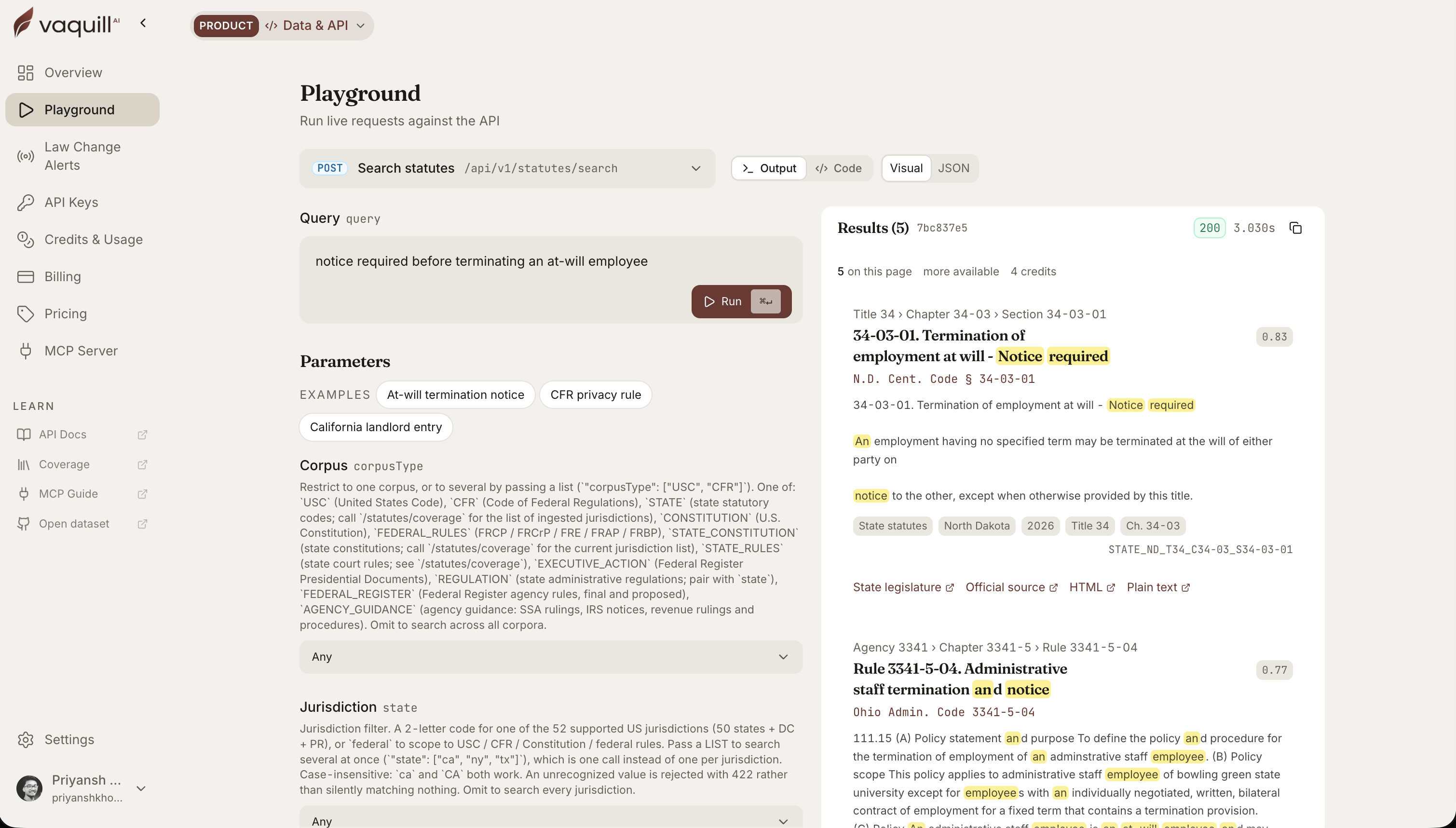 The same corpus behind this article, queried live. Every result carries its citation and a link to the official source.
TL;DR
- AI legal drafting is strongest at first-draft generation, clause assembly from a playbook, redrafting to a position, and plain-language conversion. It is not a substitute for judgment or for verification.
- The workflow that works has six steps: brief and context, playbook or standard, generate, verify against source, redline, finalize. The verify step is non-negotiable.
- The approach changes by document type. A contract draws on a clause library; a memo needs verified law; a policy needs your existing handbook; a board consent needs your corporate records.
- ABA Formal Opinion 512 (July 2024) puts competence, confidentiality, and candor on you. Use a tool with a written no-training commitment, verify every cite, and never let a draft go out unread.
- A tool grounded in your matter, your playbook, and verified law beats a blank-page chatbot, because it drafts from your positions and your sources instead of inventing them.
In the six-step drafting workflow, which step does the guide call non-negotiable?
For the review counterpart to this guide, see our AI contract review lawyer's guide and the sibling AI MSA review guide.
What AI legal drafting actually is
AI legal drafting is software that takes your inputs (a brief, a precedent, your standard clauses, the governing facts) and produces a structured first draft you can edit. It does four things well.
First-draft generation. Give it the deal terms or the question, and it produces a complete draft with the right sections in the right order. A services agreement comes back with scope, fees, IP, liability, term, and boilerplate already in place. The blank page is gone, which is most of the friction.
Clause assembly from a playbook. If you have encoded your standard positions, the tool assembles a draft from your preferred clauses rather than generic web language. Your 12-month liability cap, your mutual indemnity, your net-30 payment terms, pulled in by default. This is where a drafting tool earns trust: it drafts from your line, not a stranger's.
Redrafting to a position. Paste counterparty language and ask for your fallback. The tool rewrites a one-directional indemnity into a mutual one, or tightens a vague termination right into a 30-day-notice convenience clause. You are editing a proposal, not writing from scratch.
Plain-language conversion. It turns a dense clause into something a business stakeholder can read, or the reverse: turns a plain-English instruction into operative contract language. Useful for board summaries, policy explainers, and the email that explains why you redlined a clause.
Increasingly, the draft is where collaboration happens rather than a file you export first. A modern drafting surface lets your team co-edit the same draft in real time, leave comments and suggestions, and redline inline. Mention a colleague and they get an email, so the right person is pulled in without leaving the document. You can also share the draft by link with a reviewer outside the workspace, open indefinitely or set to expire. The generation is the start; the shared editor is where a draft actually gets to final.
What it is not: a substitute for judgment or verification. It does not know your risk tolerance, your leverage, or that this counterparty is your only viable vendor. And every statute, case, and cross-reference it produces has to be checked against the source before you rely on it. A draft is a starting point, not an output you forward.
The drafting workflow that works
A good draft is not one prompt. It is a short loop that ends with you, not the model, making the final call. Six steps.
Step 1: Brief and context
Tell the tool what you are drafting, for whom, the governing law, and the key terms. Vague input produces generic output. "Draft a mutual NDA, Delaware law, three-year term, carve out residuals" gives the model something to work from. "Write an NDA" gives you a template you will rewrite anyway.
Step 2: Playbook or standard
Point the tool at your standard positions or a precedent you trust. A tool that knows your playbook drafts to your line; one that does not drafts to the internet's average. This is the single biggest quality lever.
Step 3: Generate the first draft
Let the model produce the full draft. Read it the way you would read a junior's work: structure first, then clause by clause. Note what is missing as much as what is there, because the common failure is an absent term (no liability cap, no governing law) rather than a wrong one.
Step 4: Verify against source
Not optional. Every cited statute, case, or section number gets checked against the actual source, and every cross-reference (Section 9.2, Exhibit C) gets confirmed to point where it claims. A draft that reads well and cites a section that does not exist is worse than no draft. Our guide on how to verify AI legal citations before filing walks through the check.
Step 5: Redline to your position
Now you edit. Tighten the clauses that drifted from your playbook, adjust for the specific deal, and cut the generic boilerplate the model added on autopilot. This is lawyering, and it stays with you.
Step 6: Finalize and sign off
A human reads the whole thing end to end and signs off. The model never gets the last word.
How the approach changes by document type
In-house counsel draft more than contracts. The workflow above holds across document types, but what the tool needs to draft well changes. The thinner the grounding, the more you verify.
| Document type | What AI is good at | What it needs to draft well | Where you must verify |
|---|---|---|---|
| Contracts | Assembling a full draft from your clause library | Your playbook and a trusted precedent | Cross-references, cap amounts, defined terms |
| Legal memos | Structuring analysis, plain-language summary | Verified statutes and case law, the facts | Every cite, the holding, current law |
| Policies | First draft from a standard framework | Your existing handbook and applicable law | Jurisdiction-specific requirements |
| Board consents | Producing correct corporate form and recitals | Your charter, bylaws, prior resolutions | Quorum, approval thresholds, signatory list |
| Demand letters | Tone, structure, the ask | The contract and the breach facts | The clause cited, the remedy claimed |
The pattern: contracts and policies lean on documents you already own (a playbook, a handbook), so a grounded tool does most of the lift. Memos and demand letters lean on law and facts, so the verify step carries more weight. A memo drafted from a model's memory of the law is a liability; a memo drafted from verified statute text and then checked is a head start.
A worked example: drafting one clause from a brief
Most guides describe what AI drafting does. Here is what it actually puts on the page. We gave a drafting tool a short brief and asked for a single clause, then ran the verify step.
The brief:
"Draft a limitation of liability clause for a vendor SaaS agreement. Our standard: cap aggregate liability at 12 months of fees, mutual, with data-breach and IP-infringement claims carved out above the cap. Governing law is Delaware."
The kind of draft it produced:
"Except as set out below, in no event shall either party's aggregate liability arising out of or related to this Agreement exceed the total fees paid or payable by Customer in the twelve (12) months preceding the event giving rise to the claim. The foregoing limitation shall not apply to (a) either party's breach of its confidentiality or data security obligations, or (b) claims arising from a party's indemnification obligations for third-party intellectual property infringement. This Section shall be governed by the laws of the State of Delaware."
That is a usable first draft. It hit the cap amount, made it mutual, carved out the two categories the brief named, and matched the governing law. The blank page is gone.
The verify and redline step. This is where you earn the byline. Read against the brief, two things need a human:
- The carve-out language references "indemnification obligations" but the brief did not say an indemnity clause exists yet. You confirm the agreement actually has one, or the carve-out points at nothing. The model drafted a cross-reference to a clause that may not be in the document.
- "Fees paid or payable" is broader than "fees paid." That is a drafting choice, not an error, but it is your choice to make. On a deal where most fees are billed in arrears, "payable" materially raises the cap. Decide deliberately.
The model produced a clean draft in seconds and got the structure right. It also planted one cross-reference you have to verify and one word ("payable") that changes the economics. That is the whole relationship: it drafts fast, you check what it assumed. For standard positions and fallback language on this exact clause, see the limitation of liability clause page; the clause library covers the rest.
Accuracy and ethics guardrails
The duty does not move when you use AI. ABA Formal Opinion 512 (July 2024), the ABA's first comprehensive guidance on generative AI, makes that explicit across competence, confidentiality, candor toward the tribunal, supervision, and fees. For drafting, three obligations carry the most weight.
Competence and verification. Opinion 512 ties competence to understanding the tool's limits, including its tendency to produce plausible but wrong output. For a drafter, that means the verify step is an ethical requirement, not a nicety. Every cite, every cross-reference, every defined term gets checked against the source. Our ABA Formal Opinion 512 guide goes through the full set of duties.
Confidentiality and no-train terms. Opinion 512 requires you to evaluate the risk that client information could be disclosed before you put it into a tool, and it flags that many self-learning tools train on inputs. The control: a tool with a written commitment not to train on your data, encrypted in transit and at rest, with defined retention. A consumer chatbot that may retain your draft is the wrong place for a client matter.
Citation verification. Fabricated citations are the signature AI failure, and courts have sanctioned lawyers for filings built on invented cases. A drafting tool grounded in verified law lowers the risk; it does not remove your duty to check. Confirm every authority resolves to a real source that says what the draft claims. The citation verification guide is the checklist.
The junior-drafter frame ties these together. You would not let a first-year associate file an unread draft, cite a case they had not pulled, or email a confidential draft through a personal account. The same supervision duty applies to the model, and Opinion 512 names supervision directly.
Why grounding beats a blank-page chatbot
The difference between a useful drafting tool and a frustrating one is grounding: what the model draws on when it writes.
A blank-page chatbot drafts from its training data, an average of everything on the internet. It does not know your 12-month cap rule, your handbook, or the actual text of the statute you need. It produces confident language that reads right and may be wrong on the specifics, including a cite to a case that does not exist.
A grounded drafting tool draws on three things a chatbot lacks. Your matter: the contract, the facts, the prior drafts, so it drafts in context. Your playbook: your standard positions, so the first draft reflects your line. Verified law: statute and case text pulled from a real source, so a memo cites authority that actually exists. For how the underlying models differ on accuracy, see the best legal AI tools for in-house counsel.
The practical split mirrors review work. A general chatbot is fine for a quick plain-language pass on a draft you will rewrite anyway. For drafting you put your name on, a grounded tool drafts from your positions and your sources, so most of the verification problem is solved before you start. The task moves from "write this for me" to "assemble my standard position for this deal," and that is far safer.
For the negotiation side, where you redraft to a position under pressure, see AI contract negotiation. For turning a playbook into reusable clause logic, the NDA playbook template guide and the in-house contract review playbook cover the method. For prompt patterns that produce better drafts, see 100 generative AI prompts for in-house lawyers.
FAQ
What is AI legal drafting? AI legal drafting is software that turns a brief, a precedent, and your standard positions into a structured first draft of a contract, memo, policy, or other legal document. It is strongest at first-draft generation, clause assembly, redrafting to a position, and plain-language conversion. A lawyer verifies, edits, and signs off.
Is AI good at drafting legal documents? It is good at producing a competent first draft fast, especially when it is grounded in your playbook and a trusted precedent. It is not good at judgment calls, business context, or being trusted without verification. Treat the draft as a starting point you check against the source, not a finished document.
Can AI replace a lawyer for drafting? No. AI compresses the blank-page work, but the lawyer owns the output: the judgment about what position to take, the verification of every cite and cross-reference, and the final sign-off. ABA Formal Opinion 512 puts competence, confidentiality, and supervision on the lawyer regardless of the tool.
How do I use AI to draft a contract, step by step? Give it a clear brief (document type, governing law, key terms), point it at your playbook or a trusted precedent, generate the first draft, verify every cite and cross-reference against the source, redline to your position, and read it end to end before signing off. The verify step is the one people skip and the one that protects you.
Is it safe to use AI for confidential legal drafting? It can be, if the tool offers a written commitment not to train on your data, encryption in transit and at rest, and defined retention and deletion. ABA Formal Opinion 512 requires you to evaluate disclosure risk before putting client information into any tool. Vet the specific tool rather than ruling out the category.
What is the biggest risk with AI legal drafting? A confident draft with a fabricated or wrong citation, or a cross-reference that points to a clause that does not exist. These read exactly like correct output, which is why the verify step is non-negotiable. Courts have sanctioned lawyers for filings built on invented cases.
Does a purpose-built drafting tool beat ChatGPT for legal work? For a quick plain-language pass, a general tool is fine. For drafting you put your name on, a tool grounded in your matter, your playbook, and verified law drafts from your positions and real sources instead of inventing them, which removes most of the verification burden up front. Use general AI for a rough pass, grounded tools for anything you sign.
For the review side of the same workflow, see our AI employment contract review guide. Vaquill AI is a legal AI suite for in-house teams: drafting, contract review, document chat, and matter management in one workspace, grounded in your playbook and verified law, with a written no-training commitment on your data.
New legal AI guides, weekly.
Further Reading
What Vaquill AI Can Actually Do: Agentic Workflows, Verification Depth, and Open Benchmarks
Read postLegal AI in Microsoft Word: Contract Review, Redlining, and Research in a Word Add-In
Read postBuilt-In Legal AI Skills: Which One to Run for Each Task
Read postWhat a Legal AI Agent Actually Does: One In-House Task, Start to Finish
Read postHow Legal AI Memory Works: Stop Re-Explaining Yourself Every Session
Read postAI Contract Negotiation (2026): How In-House Teams Negotiate Faster
Read post
Co-Founder & CEO · Attorney
Arshita leads product and strategy at Vaquill, building the legal AI suite that solo, small-firm, and in-house US lawyers use to run a matter end to end.