

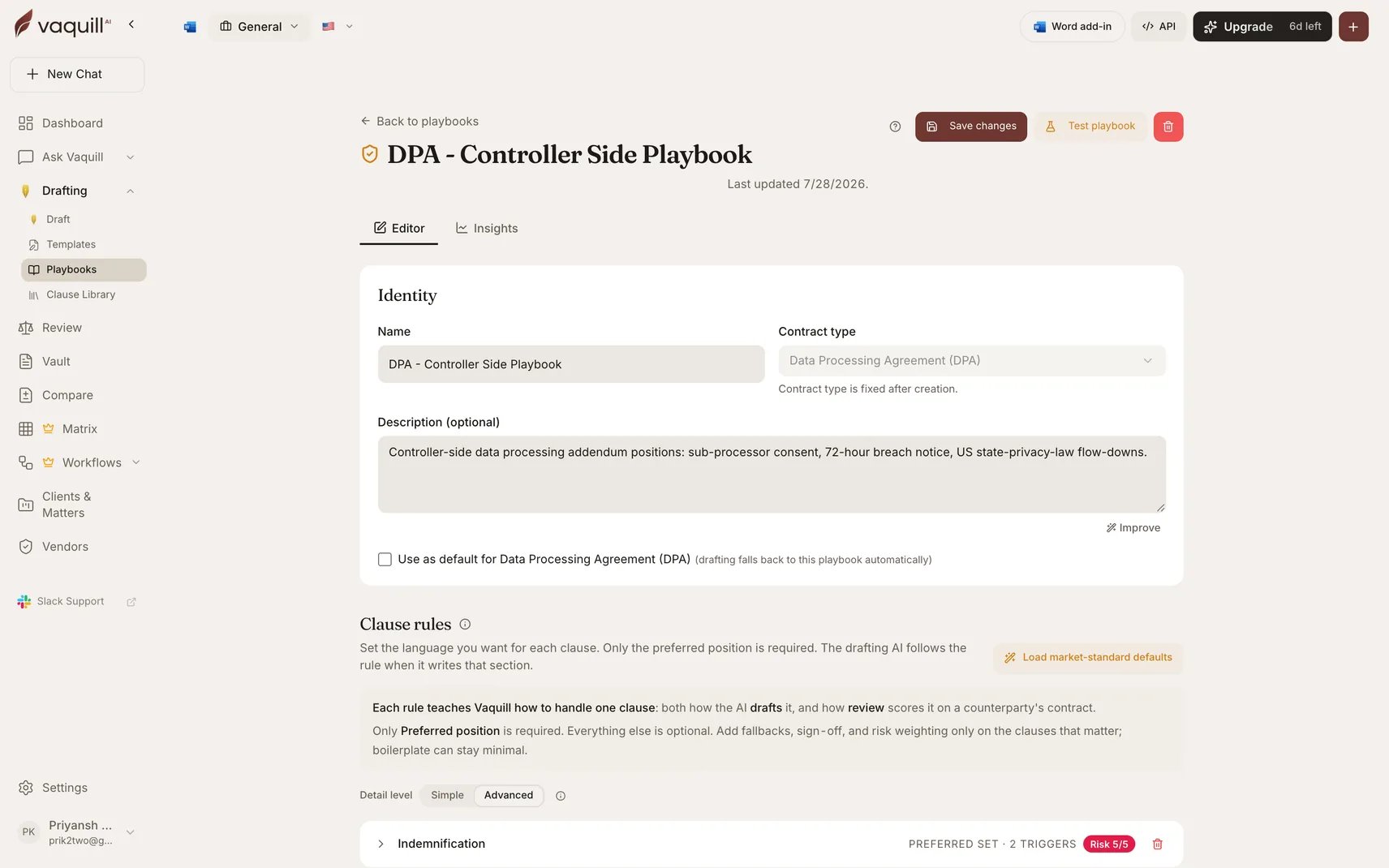
A playbook opened to its structure and positions
The score
The check starts at 100 and deducts for each finding, floored at zero.
Findings are grouped into errors, warnings, and notes, listed errors first.
A clean playbook gets a short confirmation instead: no structural gaps, deal-critical clauses have fallbacks and sign-off, and every conditional rule can fire.
What it checks
Errors
Errors
Something in the playbook is broken rather than merely thin.A clause with no preferred position.
The rule exists but says nothing. Either write the position or disable the clause.A conditional rule with an invalid value.
The rule has no value, or a deal-value threshold that is not a plain number. It cannot be evaluated.A conditional rule that can never raise sign-off.
The rule escalates to a level at or below the clause’s base approval, so firing it would change nothing. Escalate higher or remove the rule.
Warnings
Warnings
The playbook works but leaves a negotiator without instructions at the moment they need them.A deal-critical clause with no fallback ladder.
You have marked the clause must-have but written down nothing to retreat to before walking away.A deal-critical clause with no sign-off gate.
The clause is deal-critical, yet a deviation on it can go out silently.A walk-away line with no fallback ladder.
The clause has a floor but no intermediate positions, which makes it all or nothing.
Notes
Notes
No clause is marked deal-critical.
Nothing in the playbook is tagged must-have, so review has no basis for putting your non-negotiables first.
Limitations
- The check is structural only. It has no opinion on whether your positions are commercially sensible, legally sound, or right for your business.
- Disabled clauses are skipped entirely, so turning a problem clause off makes its findings disappear without solving anything.
- It reads the saved playbook. Edits you have not saved yet are not reflected; save and the panel re-runs.
- The scoring weights are fixed and not configurable.
- A perfect score means the playbook is well-formed, not that it is complete. A playbook covering three clauses can score 100.
Related
Clause Rules
The fields the check is looking for.
Playbook Health
The other half of Insights: how the playbook performs against real deals.
Sign-Off Gates
Why a deal-critical clause without an approval level matters.
Import From Contracts
Where low structure scores usually come from.