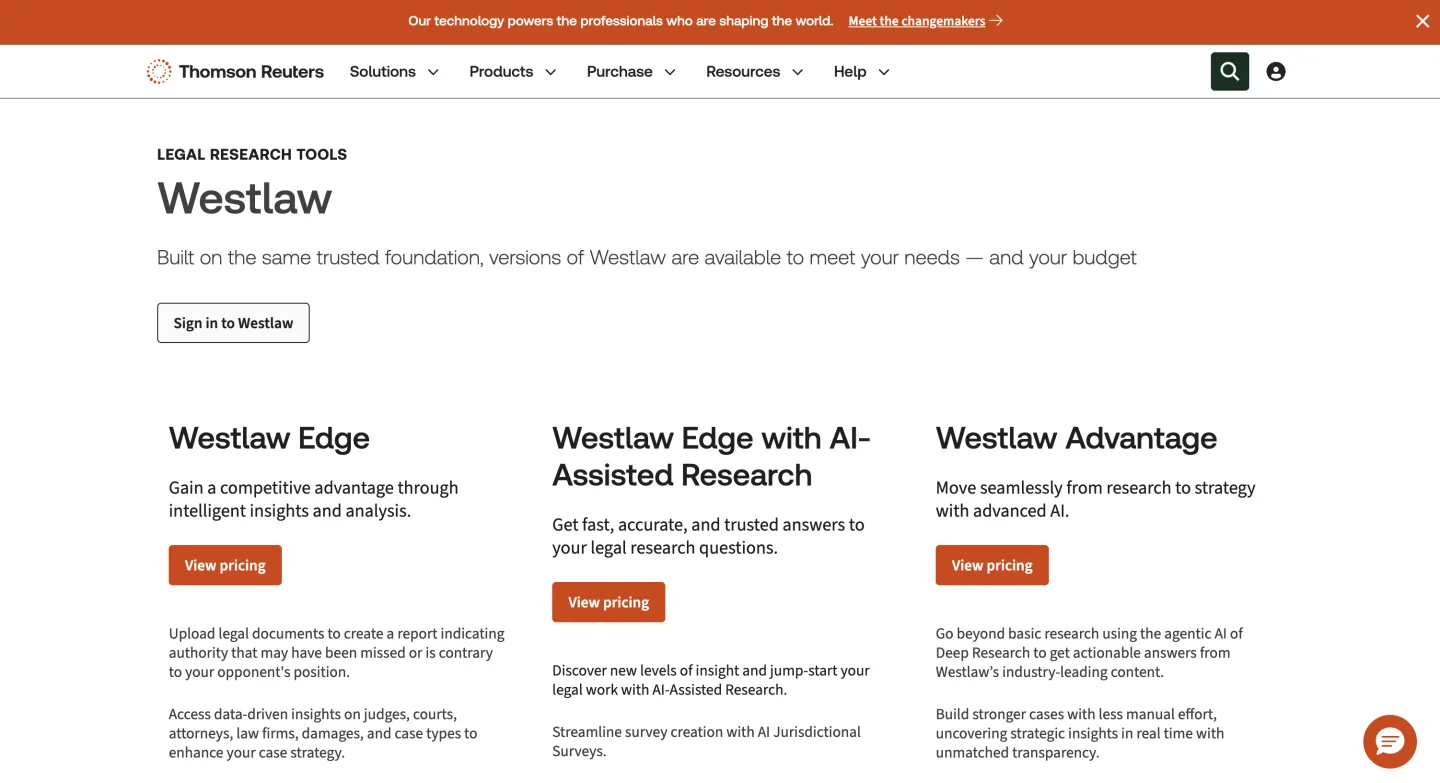
Most "Westlaw alternative" posts make the same mistake. They treat Westlaw and the new tool as the same thing, then argue about price. For in-house counsel, that is the wrong lens. Westlaw is the old guard of research. It is the gold standard for US case law, built and priced for big trial shops.
The job in front of a fractional GC or a four-person legal team looks different. It is "review this MSA, redline it against our playbook, answer the product team's question, keep the matter file in order, and yes, sometimes pull a statute or a case." Research is one line in that job. It is not the whole job.
So the fair test is not cheap research tool versus pricey research tool. It is an in-house workbench that also does research, set next to a research tool with a contract attached. The workbench does drafting, contract review, and AI redlining with real Word track changes. It also does matter management, compliance, the Document Matrix, and workflows. This post shows where Westlaw wins, where it leaves in-house teams stuck, and where Vaquill AI fits better. Westlaw is a strong product. The mismatch is about who it was built for.
TL;DR
- Westlaw is the gold standard for US legal research at the big-firm tier. You get 40,000+ databases, the West Key Number System (150 years of lawyer-edited headnotes), KeyCite, and CoCounsel AI. If you need the deepest US corpus and you have an enterprise budget, Westlaw wins.
- Westlaw is a research tool. Vaquill is a full in-house workbench: drafting, contract review, AI redlining with real Word track changes, matter management, compliance, Document Matrix, and workflows. Research is built in, not the whole pitch.
- Price is the clearest wedge. Westlaw is quote-based and sales-gated, with no public per-seat number. KeyCite and CoCounsel sit in higher tiers. Vaquill is a flat $99/user/month ($990/user/year), self-serve, with a 7-day free trial and no per-feature gating.
- A Stanford and Yale study found Westlaw AI-Assisted Research made up answers in about a third of responses, the worst of the paid tools tested. Vaquill runs every answer through 4-layer checks (exact text match, citation check, meaning check, AI cross-check) with a confidence score per claim.
- Vaquill's research corpus is real. You get millions of US federal and state opinions, the full US Code (54,855 sections), the CFR (219,745 sections), and all 52 state and territory codes (1.95M+ sections), with per-state scoping. The public REST API and MCP server cover statutes.
- Net: pick Westlaw if research depth is the whole job and budget is no object. Pick Vaquill if you are an in-house team that needs one tool for the whole week, not just the research line.
This is part of our legal AI vendor comparison series. For the deeper research-tool teardown, see the Westlaw Precision review and the three-way Westlaw vs LexisNexis vs Vaquill pricing breakdown.
What Westlaw is genuinely good at
No honest in-house review should wave Westlaw off. For US legal research at the top of the market, it is the best. The reasons are worth naming before we get to the gaps.
The West Key Number System. The West Key Number System sorts all US law into 450+ topics and 100,000+ key numbers. Lawyer-editors write a headnote for every published case. This is a hand-built map of the law, 150 years in the making, and no AI system has matched it. If your work means walking US case law through a curated scheme, nothing else comes close.
KeyCite. KeyCite is the most trusted citation check in the US. It does red and yellow flags, depth-of-treatment bars, and AI Overruling Risk. It covers every case in West's National Reporter System plus over a million unpublished cases. For litigators who live by "is this still good law," KeyCite is the gold standard.
CoCounsel AI with Deep Research. CoCounsel Legal brings agentic Deep Research, guided drafting, a Litigation Document Analyzer, and bulk review up to 10,000 files. All of it is grounded in Westlaw content. The tech came from Casetext, which Thomson Reuters bought for $650M in 2023. That is a real bet, not a bolt-on.
A strong US lead. Westlaw holds roughly 34% market share in legal research, with 88.5% US-based customers. It is part of a Thomson Reuters business that brought in $7.48 billion in revenue for 2025. For US law, the mix of editorial content, AI tools, and market reach is hard to beat.
If you run appellate work at a large firm, Westlaw is not a compromise. It is the right answer. The question here is narrower. What happens when the buyer is in-house?
How Westlaw and Vaquill compare
The table below maps each feature to the product. Read it with the framing in mind. Westlaw's column is mostly research depth. Vaquill's column is a workbench that includes research.
| Capability | Westlaw | Vaquill |
|---|---|---|
| US case law database | 40,000+ databases. Every case in West's National Reporter System, plus federal and state opinions, codes, law journals, treatises, and more. Hard to beat for US depth. | Millions of US federal and state court opinions, indexed directly. SCOTUS, all circuits, federal district courts, and state supreme and appeals courts. |
| Statutes and regulations | Full US statute and regulation coverage at enterprise pricing. | 3.5M+ sections of US primary law. The full US Code (54,855 sections), CFR (219,745 sections), and all 52 state and territory codes (1.95M+ sections). Per-state scoping. |
| Citation system | KeyCite, the leading US citator. Red and yellow flags, depth-of-treatment bars, Overruling Risk AI, and 1M+ unpublished cases on top of the National Reporter System. | Citation graph with treatment flags on every case (followed, distinguished, overruled, criticized) and multi-hop links, included at the base price. |
| AI accuracy | CoCounsel Legal agentic Deep Research, grounded in Westlaw content. A Stanford and Yale study found its AI made up answers in about a third of responses. | 4-layer verification (exact text match, citation check, meaning check, AI cross-check), built for the post-Mata v. Avianca world and ABA Formal Opinion 512. A confidence score per claim. |
| AI drafting and contract review | CoCounsel guided workflows for policies, complaints, and discovery, plus bulk review up to 10,000 files (litigation-leaning). | Full drafting space plus contract review with clause-level risk flags, and AI redlining that returns real Word track changes you can accept or reject. |
| Matter management | Folders and work product management inside Westlaw. | Matter workspaces with an email-to-matter inbox, 100-document chat across a whole matter, and auto-built timelines. |
| Document Matrix and workflows | No document matrix or reusable workflow in the published feature set. | Document Matrix across many contracts at once, plus reusable workflows and 8 expert Skills (Contract Review, NDA Triage, Risk Assessment, Compliance Check, and more). |
| Developer API | Thomson Reuters Developer Portal: 137 APIs, enterprise-only, approval required. Not self-service. | Public self-serve REST API for US statutes (US Code, CFR, 50 state codes), an MCP server for Claude Desktop, Cursor, VS Code, and Windsurf, and a Python SDK on PyPI. |
| Per-state scoping | 50-State Surveys for enterprise users. No clean per-state tool in the AI workflow. | Ask "under California law..." or pass us_state on the API. The corpus then filters to that state's chunks only. |
| Target market | ~34% market share, tuned for big firms, part of Thomson Reuters. | In-house counsel, fractional GCs, CLOs, and lean 2-10 person legal teams. Self-serve onboarding, US data residency on AWS. |
| Pricing | Quote-based, sales-gated, no public per-seat price. KeyCite and CoCounsel typically sit in higher tiers. | Flat $99/user/month, $990/user/year (17% off), no tiers, no per-feature gating, 7-day free trial. |
What the suite actually looks like
The comparison is easier to trust with the product in front of you. The shots below show the research surface, since that is the like-for-like piece against Westlaw. For an in-house buyer, though, this is one room in the workbench, not the whole building.
 AI legal research. Ask in plain English and get a cited answer grounded in statutes and case law, with every cite 4-layer checked.
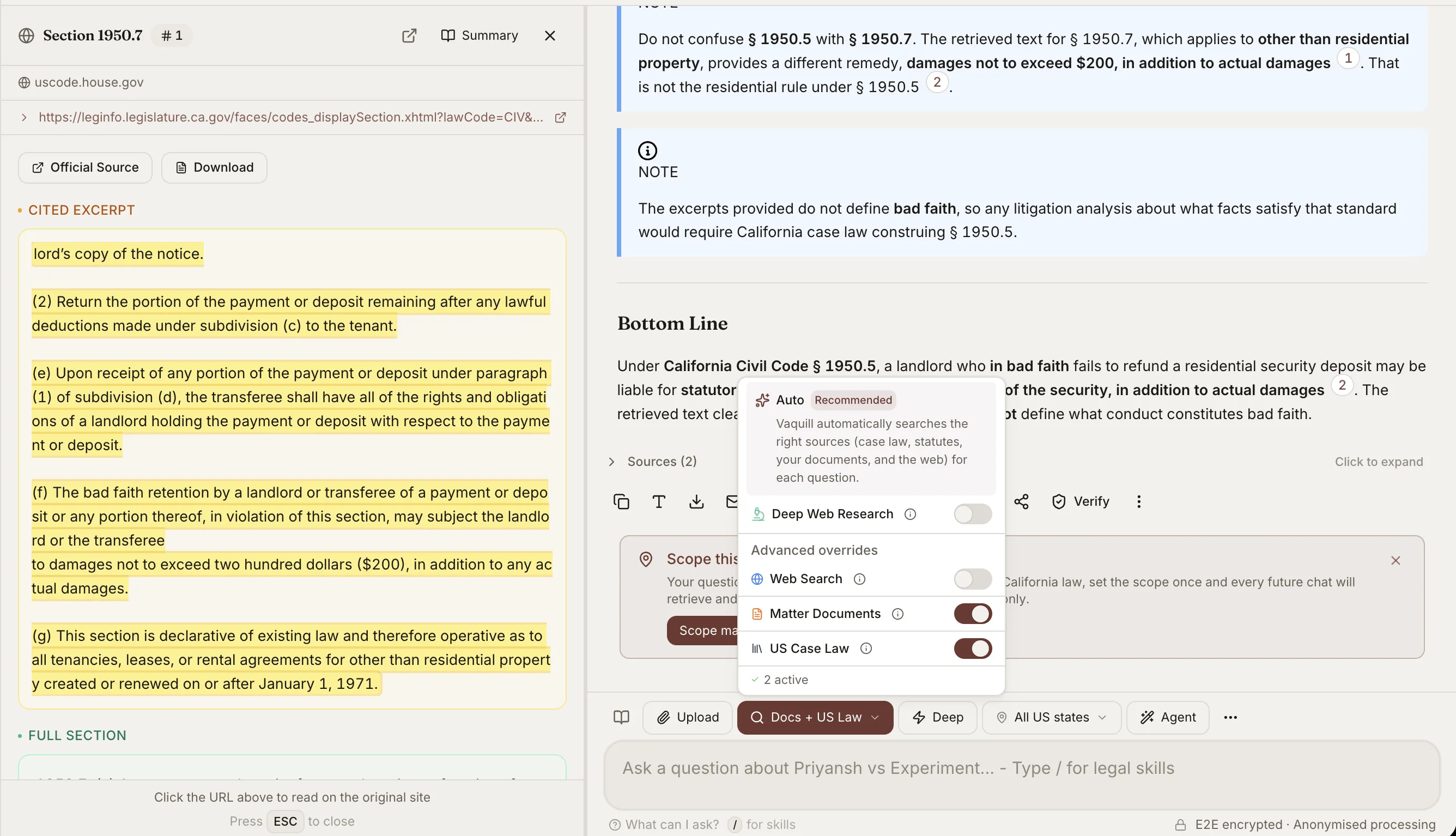 Verified citations. Each answer links to its source with a confidence score, so you can lean on it before it goes into a memo or a brief.
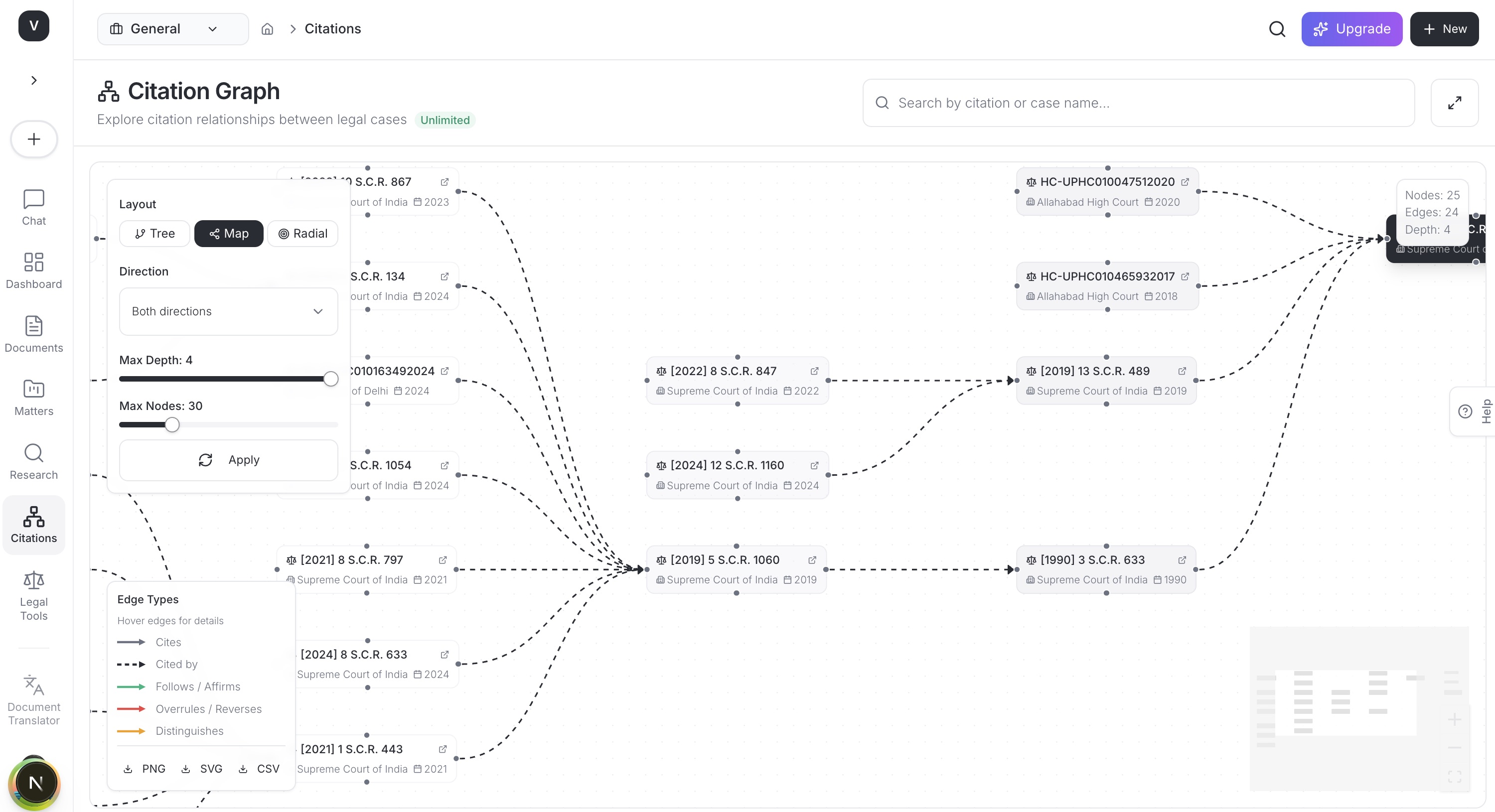 Citation graph. See how any case has been followed, distinguished, limited, or overruled across federal and state courts, at the base price, not gated behind a higher tier.
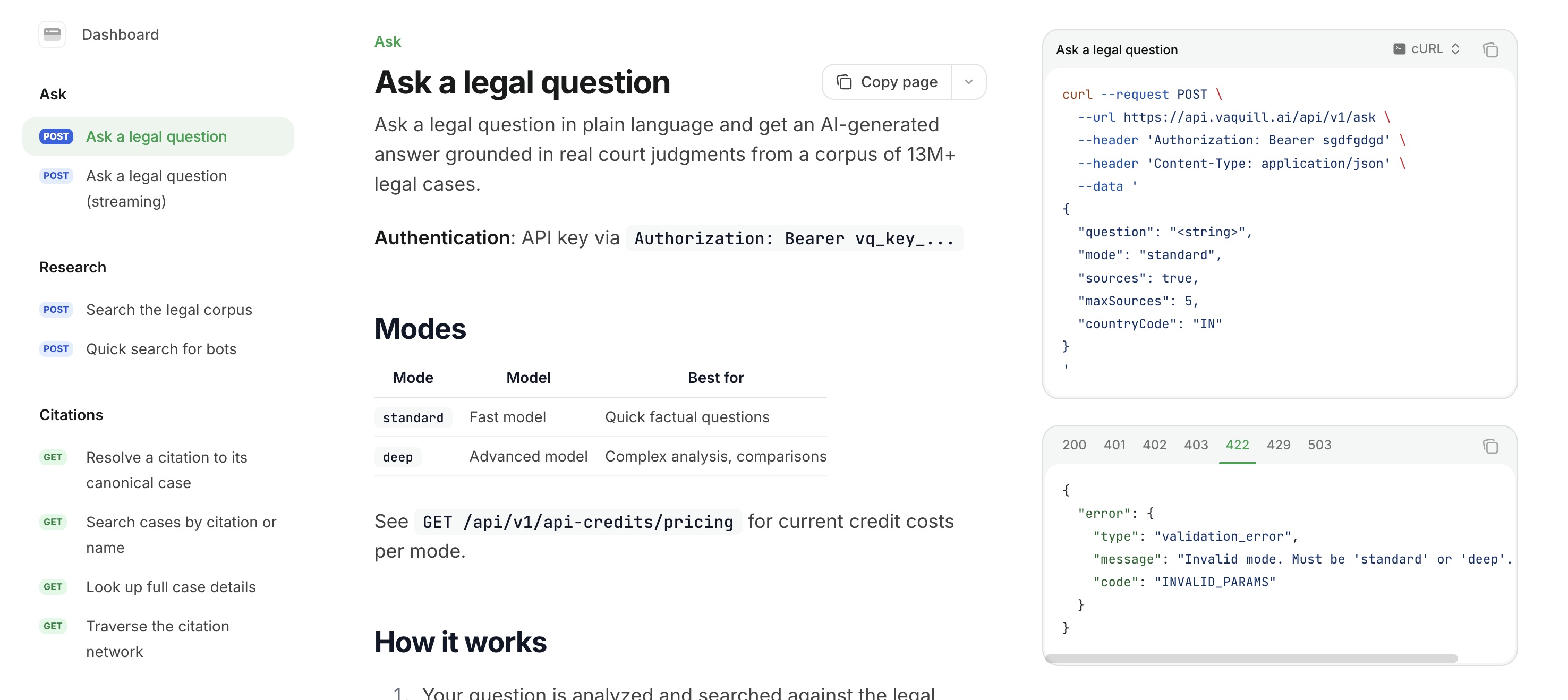 Developer API. Statute search and section lookup over REST and MCP, already indexed and hosted, with no sales approval gate.
Around that research surface sits the rest of the workbench. There is a drafting space and contract review with clause-level risk flags. There is AI redlining that returns real Word track changes, not a chat summary you retype by hand. There are matter workspaces with an email-to-matter inbox and auto-built timelines. There is a Document Matrix that lines up clauses across dozens of contracts at once, plus compliance checks and reusable workflows. That is the part Westlaw does not compete on for in-house teams. It was never built to be the place the whole work week happens.
Where Westlaw leaves in-house teams stuck
None of these are knocks on Westlaw as a research tool. They are the snags you should expect when a tool built for big trial shops meets a four-person in-house team.
Quote-based, sales-gated pricing. Westlaw does not publish a per-seat price. You get a quote after a sales call. For an in-house team, the sales cycle alone is a wall, before you even see the line items. KeyCite and CoCounsel sit in higher tiers on top of base Westlaw. Vaquill is a flat $99/user/month with a 7-day free trial and no per-feature gating.
No self-serve API. The Thomson Reuters Developer Portal lists 137 APIs. All of them are enterprise-only and need approval. A legal-ops team wiring statute lookups into Zapier, Make, or n8n cannot get a key. Vaquill ships a self-serve REST API for statutes and an MCP server out of the box.
AI hallucination risk. A Stanford and Yale reliability study found Westlaw AI-Assisted Research made up answers in about a third of responses, the worst of the paid tools tested. The Yale ISPS write-up covers the same finding. Thomson Reuters has since shipped CoCounsel Legal with fixes, but the result shows why claim-level checks matter. Vaquill's 4-layer verification, with a confidence score per claim, is built for that gap.
Built for big firms. 88.5% of Westlaw customers are US-based enterprise firms. The buying steps, the sales-led setup, and the contract terms all assume firms with hundreds of seats. For an in-house team of three, the friction and the cost are a poor fit.
KeyCite and CoCounsel sit in higher tiers. The two features in-house buyers most tie to Westlaw, KeyCite and the AI workflows, usually need a higher tier on top of base Westlaw. Vaquill includes the citation graph with treatment flags at the $99 base price, no gating.
Research-only scope. This is the big one. Even at full enterprise spend, Westlaw is a research tool. Drafting and contract review live in CoCounsel as side workflows that lean litigation. There is no document matrix across forty contracts. There is no email-to-matter inbox. There is no AI redlining that returns a real Word track-changes file. An in-house team that buys Westlaw still needs a second stack for the rest of the week.
Who each product actually serves
Matching use cases to the right tool matters more than any feature checklist.
In-house teams that need one tool for the whole week. If your week is contracts, redlines, matter Q&A, compliance, and the odd research task, a research tool covers one slice. Vaquill puts the drafting, the redline, the matter file, and the research in one place. You get a 7-day free trial, $99/user/month, self-serve setup, no sales call.
Litigators checking cites after Mata. When the risk is a made-up cite in a brief, the question is whether the cite is real, not how big the corpus is. Westlaw's KeyCite is the trusted citator. Vaquill adds 4-layer checks per claim, with confidence scores and a citation graph with treatment flags across federal and state courts, in line with ABA Formal Opinion 512.
Developers and legal-ops engineers. Westlaw's APIs are enterprise-only and gated by approval. Vaquill ships a public self-serve REST API for statutes, an MCP server for Claude Desktop, Cursor, VS Code, and Windsurf, and a Python SDK (pip install vaquill). If you build on legal data, that self-serve surface is the gap between shipping this week and waiting on a sales rep.
Lawyers who need per-state scoping. Practice in one state and want research scoped there by default? Westlaw offers 50-State Surveys for enterprise users, but no clean per-state tool in the AI workflow. Vaquill lets you ask "under California law..." or pass us_state on the API. It then filters to that state only, across all 52 state and territory codes and their appeals opinions.
In-house teams running many matters. A lean team with dozens of live matters needs order, not just search. Vaquill gives each matter its own workspace. There is an email-to-matter inbox (forward a pleading and get cited answers in the same thread), 100-document chat across the whole matter, auto-built timelines, and role-based access (Owner, Admin, Member, Viewer).
When Westlaw is the right call
Pick Westlaw if you are at a large firm. You may need the West Key Number System, KeyCite, CoCounsel agentic workflows, Litigation Analytics, or 40,000+ databases with niche secondary sources. If your firm has a buying team and a budget for big research, and research depth is the core job, Westlaw is the natural choice. It earned its spot in the market. For the deepest US corpus run through a 150-year editorial machine, it is still the standard.
When Vaquill is the better fit
Pick Vaquill if you are in-house counsel, a fractional GC, a CLO, or part of a lean 2-10 person legal team. The case for it is one tool for the whole week. You get a full workbench. It does drafting, contract review, and AI redlining with real Word track changes. It does matter management with an email inbox and chronologies. It does a Document Matrix across many contracts, plus compliance checks, reusable workflows, and 8 expert Skills.
Research is built in too. You get millions of opinions, the full USC and CFR, all 52 state and territory codes, a citation graph with treatment flags, and 4-layer checks. The privilege setup covers PII masking, zero data retention with LLM vendors, US data hosting, no model training, and a DPA and BAA on request. The self-serve REST API and MCP server cover statutes. Price is a flat $99/user/month with no enterprise sales gating.
For an in-house buyer, the real peers are Harvey, Legora, CoCounsel, and GC AI, the full-suite tools. Westlaw and Lexis are research incumbents, a different class. Vaquill wins on being the workbench the whole team runs on, priced so a fractional GC can sign up in an afternoon. See the in-house counsel solution and the legal research feature for the detail.
FAQ
Does Vaquill have an agentic AI research mode like Westlaw's CoCounsel Deep Research?
Yes. Vaquill's Agent Mode picks which research tools to use on its own. It chains them across up to 5 rounds with 3 tool calls each. Then it pulls results together across millions of US opinions, the US Code, CFR, and all 52 state and territory codes. It reads URLs, opens PDFs, runs Boolean searches, and follows cite chains. Every claim runs through 4-layer checks. Memories tune answers to your state, practice area, and cite style across sessions. The 8 expert Skills (Contract Review, NDA Triage, Risk Assessment, Compliance Check, and more) give you guided playbooks for the busiest in-house work.
How does Vaquill organize work by matter compared to Westlaw?
Westlaw uses folders and work product management. Vaquill sorts everything by matter or client with role-based access (Owner, Admin, Member, Viewer). Each matter has its own inbox. Forward a pleading, contract, or deposition to your matter address and the file lands indexed, with answers back in the same email thread. The 100-document chat lets you upload a whole deal room and chat across it at once. Chronology Builder pulls dates and events from all matter files into a timeline you can export.
Is Vaquill just a cheaper Westlaw?
No. Westlaw is a research tool. Vaquill is a full in-house workbench (drafting, contract review, AI redlining with real Word track changes, matter management, compliance, Document Matrix, workflows) that also has legal research. Price is a wedge, but the real gap is scope. Vaquill is built to be the place the whole legal week happens, not just where you search case law.
Does Westlaw have a self-serve API?
No. The Thomson Reuters Developer Portal offers 137 APIs, all enterprise-only with approval required. Vaquill provides a public self-serve REST API for US statutes, an MCP server, and a Python SDK.
What is Westlaw KeyCite, and how does Vaquill compare?
KeyCite is Westlaw's citation check. It uses red and yellow flags to show whether a case, statute, or rule is still good law. It is the US gold standard, and it usually comes with higher Westlaw tiers. Vaquill gives you a citation graph with treatment flags on every case (followed, distinguished, overruled, criticized) across federal and state courts, at the $99/user/month base price.
How accurate is Westlaw's AI?
A Stanford and Yale study found Westlaw AI-Assisted Research made up answers in about a third of responses, the worst of the paid tools tested. The Yale ISPS write-up covers the same finding. Thomson Reuters has since shipped CoCounsel Legal with fixes. Vaquill uses 4-layer checks with a confidence score per claim, built for the post-Mata v. Avianca world.
What is Westlaw's pricing?
Westlaw does not publish a per-seat price. It is quote-based, set by firm size, state, and features, and you get a number after a sales call. KeyCite, CoCounsel, and the higher tiers add cost on top of base Westlaw. Vaquill is a clear $99/user/month, or $990/user/year (17% off), with no per-feature gating and a 7-day free trial.
Why would an in-house lawyer use Vaquill instead of Westlaw?
Westlaw is built for big-firm research, with quote-based pricing, sales-led setup, and per-feature gating, and its scope is research. Vaquill is built for in-house counsel and lean legal teams as a full workbench: drafting, contract review, AI redlining, matter management, Document Matrix, compliance, and workflows, with research built in. It runs at a self-serve $99/user/month with a privilege setup (PII anonymization, ZDR, US data residency, no model training, DPA and BAA on request).
Sources
- Stanford and Yale study (arXiv): how reliable are the top AI legal research tools
- Yale ISPS: AI on trial
- LawNext: Stanford finds Westlaw's AI hallucinates at twice the rate of LexisNexis
- LawNext: Thomson Reuters launches CoCounsel Legal (Aug 2025)
- TechCrunch: Thomson Reuters buys Casetext for $650M (June 2023)
- LawNext: Thomson Reuters launches a Developer Portal with 137 APIs (April 2024)
- Stanford Law Library: the West Key Number System
- StrongSuit: how KeyCite works
- 6sense: Westlaw market share
- Thomson Reuters: full-year 2025 results
Ready to see the whole workbench, not just the research bar? Start a 7-day free trial at $99/user/month, or read the in-house counsel solution and the legal research feature. For more vendor comparisons, see /topics/vendor-comparisons.


