Short answer: A general-purpose model is fine when the work is low-stakes and you will read the output anyway: brainstorming, summarizing a document you already have, or a rough first draft. You need a domain-specific legal AI layer the moment the output carries a verbatim citation, touches a live matter, or gets read by a court, a regulator, or a board. The reason is narrow and measurable. General models rarely make things up when they summarize text you hand them. They make things up constantly when you ask them to recall specific law. That single gap is the whole buying decision.
TL;DR
- The split is about the task, not the vendor. General models are excellent readers and weak recallers of law. Match the tool to which one the job needs.
- The accuracy gap is huge on legal specifics. On generic document summarization, leading models hallucinate in the low single digits, roughly 1 to 3 percent (Vectara Hallucination Leaderboard, 2026). On specific legal queries, general models hallucinated 69 to 88 percent of the time (Stanford RegLab, published January 2024).
- The market is moving to specialized. Gartner forecasts that by 2027, organizations will use small task-specific AI models three times more than general-purpose LLMs (Gartner press release, April 9, 2025). Treat this as a forecast, not a fact.
- Vendor claims of 70 to 85 percent hallucination cuts are mostly self-reported. Real independent testing supports the direction, not the exact number. Ask any vendor how they measured it.
- The winning shape is hybrid. A general foundation model plus domain modules plus a verification layer beats either extreme for regulated work.
- The buyer test: research or a throwaway draft, a general model is often enough. Cited, matter-bound, or compliance work, you need the purpose-built layer.
In Stanford's 2024 test, how often did general models hallucinate on specific legal queries?
How we approached this
What domain-specific legal AI actually means
A general-purpose model is one system trained to do everything: write a poem, debug code, answer a medical question, draft a contract clause. GPT, Claude, and Gemini are the obvious examples.
A domain-specific legal AI is a system built and constrained for legal work. Same underlying model in many cases, but wrapped in things a raw chatbot does not have. That wrapper is the product: retrieval from primary law, verbatim citation checks, matter segregation, playbook rules, and an audit log.
The confusion in 2026 is that the general-AI giants now ship "legal modes." We covered that wave in general-purpose AI enters legal. A legal mode is a good starting point. It is not the same as a purpose-built layer, and the accuracy data explains why.
The one chart that settles the domain-specific legal AI debate
Here is the finding that reframes the whole argument. General models are not uniformly unreliable. They are unreliable on one specific kind of task.
On generic summarization, where you hand the model a document and ask it to condense what is in front of it, top models score in the low single digits for hallucination. The Vectara Hallucination Leaderboard, an independent open benchmark, has leading models clustered around 1 to 3 percent, with even weak performers under 15 percent (Vectara, 2026). That is a closed-book task. The answer is in the text.
Now change the task. Ask the same class of model a specific, verifiable legal question, the kind where the answer lives in case law it has to recall, not in a document you provided. Stanford's RegLab tested exactly this. In "Large Legal Fictions," published in the Journal of Legal Analysis in January 2024, general-purpose models hallucinated between 69 percent (GPT-3.5) and 88 percent (Llama 2) of the time on specific legal queries. On a court's core holding, they were wrong at least 75 percent of the time.
| Task type | What you give the model | Hallucination rate | Source |
|---|---|---|---|
| Summarize a document | The full text to condense | ~1 to 3% (worst under 15%) | Vectara Hallucination Leaderboard, 2026 |
| Recall specific law | Just the question | 69 to 88% | Stanford RegLab, Jan 2024 |
Why purpose-built matters most for the hallucination problem
A general chatbot answers a legal question by generating the most plausible-sounding text. If it does not know the citation, it produces one that looks right. Ask it to confirm, and it often doubles down. We walk through that failure mode in legal AI that avoids hallucinating cases.
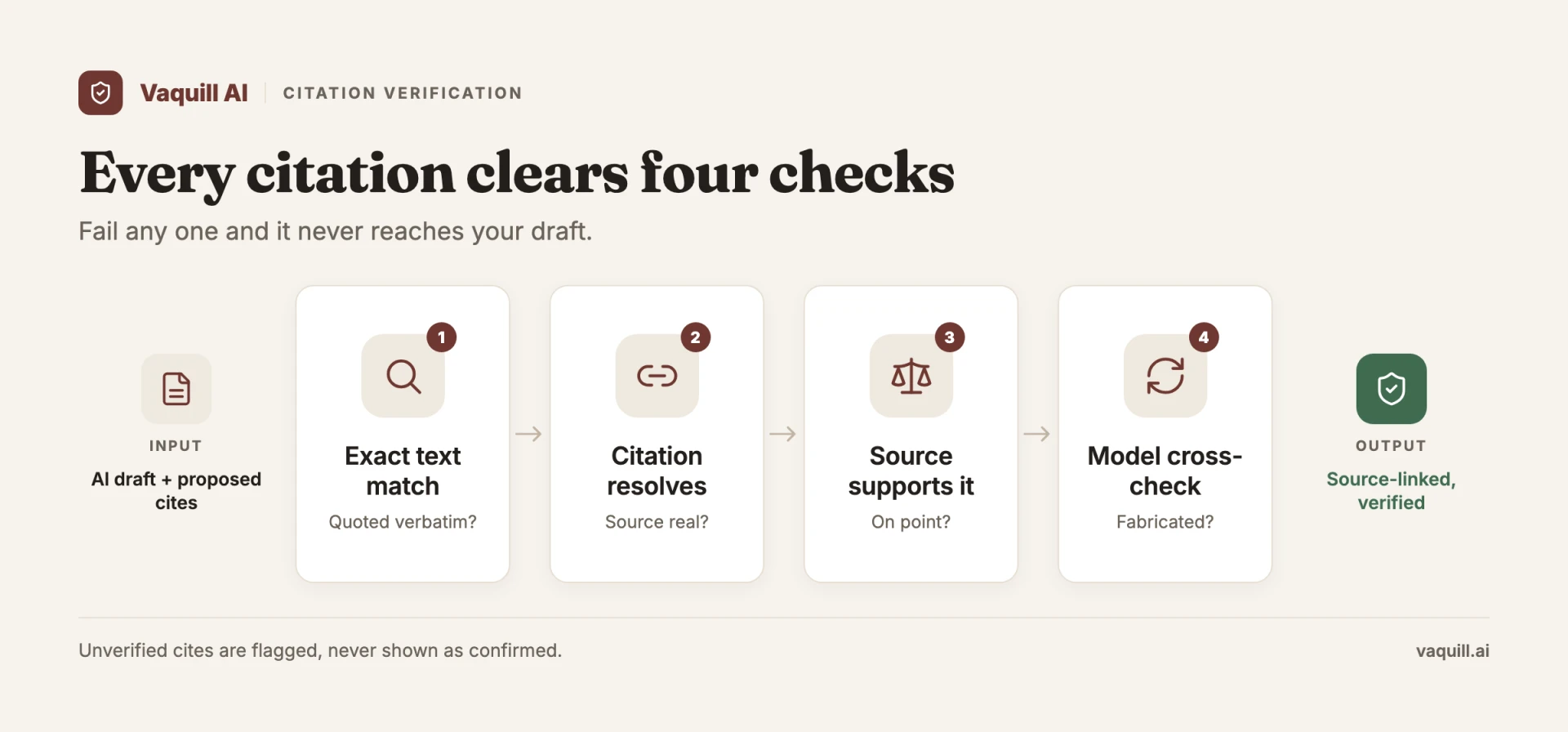
A purpose-built system changes the mechanics so recall is never the weak point. It retrieves the actual primary law first, then answers only from that retrieved text, then checks every citation against the source before it reaches you. This is why the same base model can be 88 percent wrong as a raw chatbot and reliable inside a governed workbench. You moved the legal question from a recall task, where models fail, to a summarize task, where they do not.
At Vaquill AI, four layers of verification sit on top of the model for this exact reason, and the primary law it reads spans the US Code, the CFR, and all 50 states. The point is not the branding. The point is that the design turns off the failure mode the Stanford data exposed.
The decision framework: when general is enough, when it is not
You do not need a purpose-built tool for every task. Buying one for brainstorming is a waste. Here is the line.
A general model is usually enough when:
- You are brainstorming, outlining, or pressure-testing an argument you will verify yourself.
- You are summarizing a document you already have. The answer is in the text, so the hallucination rate is low.
- The draft is a throwaway first pass that a human will rewrite before anyone sees it.
- The stakes of an error are low and self-contained.
You need a domain-specific layer when:
- The output carries a verbatim citation to a case, statute, or regulation. Someone will check it, or worse, will not.
- The work is matter-bound: it touches a specific client or deal, and two matters must stay walled off.
- It is compliance or regulatory work where a wrong standard is a liability event.
- Anything a court, regulator, or board reads under your name.
A concrete example from an in-house team
Here is how the line plays out with real numbers. A two-lawyer legal team I worked with ran both tools side by side for 30 days.
For internal summaries, they used a general chatbot. Paste in a 40-page vendor MSA, get a one-page summary, done. Fast, cheap, and the summary was reliable because the model was reading, not recalling. No purpose-built tool needed.
For anything cited, they routed through a governed workbench. The trigger was a near-miss the month before: a general model had produced a compliance memo citing a state data-breach notice window of "30 days." The actual Texas requirement runs to a different standard, and the number was wrong. Caught on a second read, but only barely. After that, the rule was simple. Any output with a statutory or case citation had to come from the retrieval-and-verify system, where the cite is pulled from the actual code section before it lands. Over the 30 days, the fake-or-mismatched citation rate on that cited work fell to near zero, while the summarize-only tasks stayed on the cheap general tool. The lesson was not "pick one." It was "match the tool to the task, and never let a general model recall law it will cite."
The hybrid architecture is the real answer
The either-or framing is a trap. The teams getting this right in 2026 run both, deliberately.
A general foundation model does the language work: reading, drafting, rephrasing. A domain-specific layer does the legal work: retrieval from primary law, citation verification, matter control, playbook enforcement. This hybrid shape, a general base plus domain modules plus verification, is becoming the default enterprise pattern, and the market data points the same direction.
Gartner forecasts that by 2027, organizations will use small task-specific AI models three times more than general-purpose LLMs (Gartner press release, April 9, 2025). Gartner has separately projected that by 2028, more than half of enterprise GenAI models will be domain-specific rather than general-purpose. Both are forecasts, not measured results, so weigh them as directional signals. The direction is clear enough: specialization is where enterprise budget is heading, because the accuracy math on high-stakes work does not favor a raw general model.
For a deeper look at how the leading purpose-built suites compare, see which legal AI is best for agentic suites, and for the in-house buying angle specifically, legal AI for in-house counsel.
FAQ
What is the difference between domain-specific and general-purpose AI? A general-purpose model is trained to handle any task, from coding to poetry to legal drafting. A domain-specific system is built and constrained for one field, wrapped in retrieval, verification, and controls that a raw chatbot does not have. In legal work the wrapper is the product.
Are domain-specific AI models more accurate than general models? On specialized, high-stakes tasks, yes. General models hallucinated on 69 to 88 percent of specific legal queries in the Stanford RegLab study. A purpose-built system that retrieves and verifies before answering cuts that failure mode by design, because it turns a recall task into a reading task.
When is a general-purpose model good enough for legal work? When the output is low-stakes and you will verify it yourself: brainstorming, outlining, or summarizing a document you already have. Summarizing is a reading task, where general models hallucinate in the low single digits, so they are reliable for it.
Do domain-specific models still hallucinate? They can, but a well-built legal system reduces the risk by answering only from retrieved primary law and checking each citation against the source. The goal is not a model that never errs. It is a workflow where errors get caught before the output leaves the team.
Is a hybrid approach better than picking one? For most in-house teams, yes. Use a general model for reading and drafting speed, and route cited, matter-bound, or compliance work through a governed layer. Gartner's forecasts point to specialized models overtaking general ones in enterprise use, which lines up with the hybrid pattern.
Will general-purpose AI eventually make specialized legal tools unnecessary? Unlikely for high-stakes work. The gap comes from architecture, not raw intelligence: retrieval, verification, matter segregation, and an audit trail. A better base model does not add those on its own, so the governed layer keeps its value.
How do I evaluate a domain-specific legal AI vendor? Ask three things: where the primary law comes from, how citations get verified before they reach you, and whether matters stay walled off from each other. If a vendor quotes a hallucination-reduction percentage, ask how they measured it and against what baseline.
New legal AI guides, weekly.
Further Reading
Claude Fable 5 and Legal AI: What Its Benchmark Records Actually Mean
Read postThe AI Value Gap: In-House Counsel Want AI Results Their Outside Counsel Are Not Delivering
Read postClaude for Legal: What In-House Teams Need to Know
Read postWhat Lawyers Really Think of Legal AI in 2026 (Reddit + Reviews)
Read postSpellbook's Autonomous Contract Management: What It Means for In-House Teams
Read postMost In-House Legal Work Is Not Legal Risk (and AI Is Proving It)
Read post
Co-Founder & CEO · Attorney
Arshita leads product and strategy at Vaquill AI, the US primary law data API. As an attorney, she decides which law we carry, how each section is sourced and cited, and what legal AI and compliance teams need from the data.