In-house counsel walked into 2026 with a new line for their outside firms: show me the AI. Most firms cannot. Thomson Reuters just put a number on the mismatch. Of corporate buyers of professional services, 78% say AI-enabled quality from their providers is very important or essential, but only 6% say most or all of their providers actually deliver it (Thomson Reuters, Future of Professionals 2026, via LawSites, June 2026). That is a 72-point chasm between what clients want and what they get.
Here is the one-line takeaway: in-house teams are now buying legal work partly on AI-driven results, and almost none of their firms can prove they deliver them. The report calls this shortfall the AI value gap. It runs through the whole profession, and it runs through your own department too.
TL;DR
- The demand is real and mostly unmet. 78% of legal and professional-services buyers rate AI-enabled quality from providers as very important or essential; 6% say most or all providers deliver it (Thomson Reuters, Future of Professionals 2026, June 2026).
- The value gap is near-universal. 91% of professionals say their organizations fall short of what AI could deliver (same report, self-reported survey of 1,816 professionals across 62 countries, March to April 2026).
- Adoption is not the problem anymore. 47% of corporate legal departments now report GenAI use, up from 23% a year earlier (Thomson Reuters, 2026 AI in Professional Services Report).
- Nobody is measuring. Only 18% of professionals say their organization tracks AI ROI; 40% do not know if it is measured at all (Future of Professionals 2026).
- The lever for you: stop accepting "we use AI" from a firm and from yourself. Demand a measured result, write it into your outside counsel terms, and track one number in your own shop.
Per the Thomson Reuters Future of Professionals 2026 report, what share of corporate buyers say most or all of their providers actually deliver AI-enabled quality?
What the AI value gap actually is
The AI value gap is the space between AI that is switched on and AI that pays off. Switched on is easy now. Paid off is rare.
The paid-off side has three moving parts, and the Thomson Reuters data breaks along all three.
Adoption already happened. 47% of corporate legal departments say their teams use generative AI, up from 23% the year before, and 41% of law firms say the same, up from 28% (Thomson Reuters, 2026 AI in Professional Services Report). Weekly use is higher still across all professions surveyed: 74% reach for AI tools several times a week. The tools are in the building.
Expectation is high. Each lawyer expects to save about 190 work-hours a year from AI, per the same Thomson Reuters research. That is a forecast, not a stopwatch reading, so treat it as an aspiration your firms and your team have set for themselves.
Delivery lags both. 91% of professionals say their organization falls short of what AI could deliver. And when the client is the one judging, the gap is brutal: 78% want AI-enabled quality, 6% get it consistently. High adoption, high expectation, thin delivery. That triangle is the value gap.
The gap your outside counsel are not closing
This is the part that should change how you run your panel. For years, "does the firm use AI" was the firm's internal business. Now it is yours, because you are paying for the output and you can see when it is slow, generic, or overpriced.
The report ties client patience directly to this. 32% of buyers said they have reconsidered, or plan within 12 months to reconsider, relationships with firms they see as falling behind on AI. Thomson Reuters extrapolates that to roughly $143 billion in U.S. legal and accounting client revenue "under active reconsideration." Your firms are on the wrong side of that number until they prove otherwise.
So stop asking firms whether they use AI. Everyone will say yes. Ask for the result the AI is supposed to produce, and write it into your terms. A few concrete demands that separate real delivery from a marketing line:
- Turnaround, not tooling. Do not ask what platform they run. Ask for a committed turnaround on standard work: an NDA markup back in one business day, a first-pass diligence summary in two. Speed is where AI shows up or does not.
- The efficiency discount in writing. If AI cut the firm's hours on a task, the bill should reflect it. Put an AI-efficiency clause in your guidelines: routine, AI-assisted work moves to a flat or capped fee, not a discounted hourly rate that quietly keeps the hours.
- A named human owner for verification. AI-assisted work product still needs a lawyer who signs that citations and clauses were checked. That is their ethics duty, and it should be a line in the engagement, not an assumption.
- No training on your matter. Confirm your privileged material is not feeding a vendor's model. This is a data-security term, and it belongs in the outside counsel guidelines.
If you are updating those guidelines this year, our guide to cutting outside counsel spend with AI walks through where the hours and the money actually move.
The in-house take: you have your own value gap
Here is the uncomfortable half. It is easy to point the 6% figure at your firms. Point it at your own department too, because the same report says only 18% of professionals track AI ROI and 40% do not even know if it is measured. If you cannot measure it, you are in the 91% by definition.
Let me walk the math I use with in-house teams, on a single unit of work you can actually meter. Take a mutual NDA, because every team runs enough of them to have a real baseline. The numbers below are illustrative of the pattern, not a published benchmark, so run your own before you quote them.
The outside-counsel branch. A firm reviews and marks up a standard inbound NDA. Bill it at 3.5 hours of associate time at $650 an hour, and you are at $2,275 per NDA with a five-day turnaround. Run 200 of those a year and you have spent $455,000 on a task that barely varies.
The in-house-AI branch. The same NDA runs through a grounded drafting and redline tool. AI produces the markup in about 8 minutes. Counsel verifies the flagged clauses and any cited authority in roughly 25 minutes. Call it 35 minutes of counsel time, one-day turnaround. Even loading in-house counsel at a fully-burdened $180 an hour, that is about $105 per NDA, or $21,000 a year across the same 200.
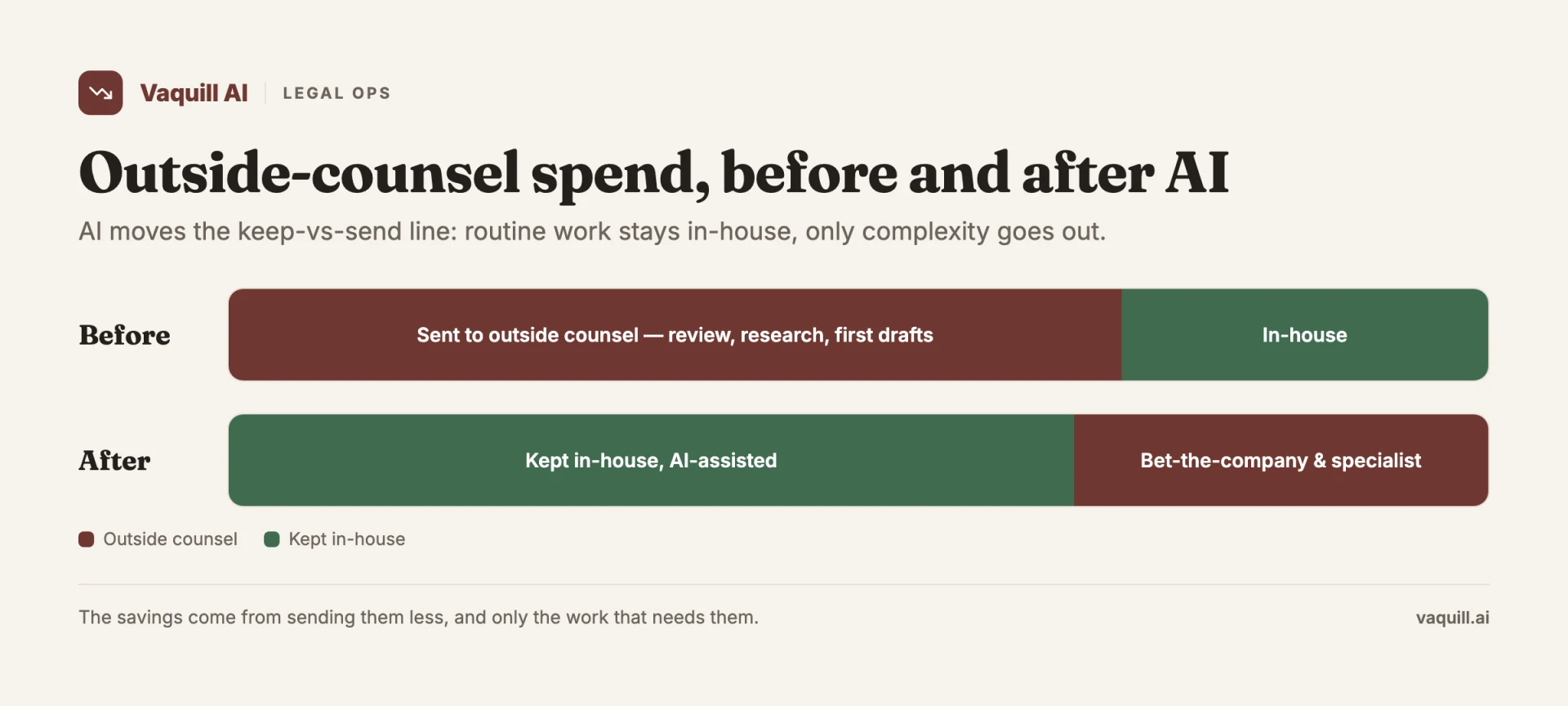
The point is not that every NDA should leave the firm. Some are bespoke and should not. The point is that once you can see the two branches side by side, the value gap becomes a negotiation. You move the routine volume in-house or onto a capped fee, and you free the firm's hours for the work that genuinely needs them. That only works if you measured it first.
The measurement does not need a dashboard. It needs one honest number. Here is a simple frame for what to compare.
| Question | The 91% (value gap) | The 6% (real delivery) |
|---|---|---|
| Do you track AI ROI at all? | No, or do not know | Yes, one owned metric |
| What do you measure? | Seats deployed, queries run | Work shipped without a full re-do, cost per matter type |
| How do firms bill AI-assisted work? | Discounted hourly, hours intact | Flat or capped fee on routine tasks |
| Turnaround on a standard NDA | "We will get to it" | One business day, committed |
For the broader playbook on where in-house AI actually pays, see how the teams getting real returns run adoption differently and why trust in the output is the return that pays.
FAQ
What is the AI value gap? It is the distance between AI being adopted and AI delivering measurable value. Thomson Reuters coined the term after finding 91% of professionals say their organizations fall short of what AI could deliver. Adoption is high, expectations are high, but measured results lag both.
Why do only 6% of legal providers deliver AI value? Because most firms adopted the tools without redesigning the work or the billing around them. 78% of buyers want AI-enabled quality, but only 6% say most or all providers deliver it (Thomson Reuters, June 2026). Running a chatbot is not the same as committing to faster turnaround or a lower bill, and clients now notice the difference.
Can I require my law firms to use AI? You can require the result, which is more enforceable than the tool. Write committed turnaround times and an AI-efficiency fee arrangement into your outside counsel guidelines. That way you are buying speed and price, not a checkbox, and the firm decides how to hit it.
How do I measure AI ROI for my in-house team? Track one recurring matter type. Measure cost per matter and the share of AI-assisted work that ships without a full rebuild, over a single quarter. Only 18% of organizations track ROI at all, so even one honest metric puts you ahead of the field.
Is 47% of corporate legal departments really using generative AI? Yes, per Thomson Reuters' 2026 research, up from 23% a year earlier. That is self-reported survey data, so it counts any use, from summarizing a document to full drafting. High adoption is exactly why measurement now matters more than another pilot.
What should I put in outside counsel guidelines about AI? Four terms: a committed turnaround on standard work, a flat or capped fee for routine AI-assisted tasks, a named lawyer responsible for verifying AI-assisted output, and a clause confirming your matter data does not train any vendor model. Those turn "we use AI" into something you can hold a firm to.
Does high AI adoption mean my department is ahead? Not by itself. Adoption is now common, so it no longer separates leaders from laggards. What separates them is whether they can show a cost or time result. If you use AI but cannot point to one measured gain, you are in the 91% with everyone else.
Closing the gap on your side
The firms in the 6% and the in-house teams pulling ahead are doing the same unglamorous thing: they picked tooling they can actually verify, then measured one result and held it. That is the whole move. Vaquill AI was built for exactly that in-house branch of the math, with drafting and redline grounded in primary law across all 50 states and federal, citations you can open, and a verification pass before the work reaches you. If you want to see what a measurable in-house branch looks like on your own recurring matters, explore how Vaquill AI works for in-house counsel.
New legal AI guides, weekly.
Further Reading
Most In-House Legal Work Is Not Legal Risk (and AI Is Proving It)
Read postThe Legal AI Consolidation Wave: What In-House Buyers Should Watch
Read postHow Much In-House Legal Work Will AI Agents Actually Take?
Read postIn-House Legal AI Adoption Hit 87 Percent: What the Leaders Do Differently
Read postClaude Fable 5 and Legal AI: What Its Benchmark Records Actually Mean
Read postClaude for Legal: What In-House Teams Need to Know
Read post
Co-Founder & CEO · Attorney
Arshita leads product and strategy at Vaquill AI, the US primary law data API. As an attorney, she decides which law we carry, how each section is sourced and cited, and what legal AI and compliance teams need from the data.