Short answer: Claude Fable 5, released June 9, 2026, became the first model to lead the dedicated legal benchmarks at once: top of Vals AI's LegalBench at 88.56% accuracy, and top of Harvey's Legal Agent Benchmark. The headline that matters for in-house teams is the second number, not the first. On that agentic benchmark, which grades whether a model finishes a full legal task under a strict all-pass standard, the best score on the public leaderboard is about 11%. So the same model can lead a legal-knowledge test at 88% and still finish only one in nine complex, multi-step legal tasks cleanly. Fable 5 is the strongest legal model yet. The useful question is shifting away from which model tops a benchmark and toward where the leading model still fails, because that is what tells you how much review a task still needs.
TL;DR
- The record: Claude Fable 5 tops Vals AI's LegalBench at 88.56% accuracy, ahead of Gemini 3.1 Pro Preview at 87.40% and GPT-5.5 at 86.52% (Vals AI LegalBench, updated July 1, 2026).
- The agentic gap: On Harvey's Legal Agent Benchmark, the hardest dedicated legal test, Fable 5 leads the public leaderboard at 11.25% under an all-pass standard, with Claude Opus 4.8 at 9.58% and GPT-5.5 at 3.75% (Vals AI HLAB, updated July 1, 2026). Harvey's own launch post reported a higher 13.3% on its internal run.
- What that split means: Knowing the law and doing the whole legal job are two different tests. Fable 5 nearly aces the first and leads, but does not pass, the second.
- The specs: Fable 5 costs $10 per million input tokens and $50 per million output, with a 1M-token context window, and it ships with safety classifiers that can decline requests (Anthropic, June 2026).
- The in-house read: A category-leading legal model strengthens the case for a governed workbench, it does not remove it. When the best model finishes about 11% of complex tasks cleanly, the missing 89% is exactly where matter segregation, playbook limits, verified citations, and an audit log earn their seat.
Claude Fable 5 scores 88.56% on LegalBench. On Harvey's agentic all-pass Legal Agent Benchmark, the top score is about:
How to read a legal benchmark before you trust it
Benchmark scores get quoted like weather reports. They are not. A few things decide what a number means.
Who ran it. Harvey's BigLaw Bench and its Legal Agent Benchmark are Harvey's own tests. Vals AI runs an independent evaluation on a held-out set, giving the model file tools like read, write, edit, and grep to do the work. When Harvey's blog reports 13.3% on the Legal Agent Benchmark and Vals AI's public leaderboard shows Fable 5 at 11.25%, both point at the same model and the same task type, and both rank Fable 5 first by a clear margin. The two numbers differ because they are two runs under different setups, one vendor and one independent. When a vendor and an independent evaluator disagree, the independent figure is the safer one to plan around.
What passing means. LegalBench grades open legal-reasoning tasks and reports accuracy, so 88.56% means most answers are right. The Legal Agent Benchmark grades a full task and uses an all-pass standard, so a task counts only if the model satisfies every criterion. Vals AI notes that top models satisfy most individual criteria, around 85% each, yet still fail the all-pass bar most of the time. Miss one criterion out of many and the whole task fails.
When it was measured. Both Vals AI leaderboards cited here were last updated July 1, 2026. Model rankings move fast, so a score is a snapshot, not a permanent fact.
What Claude Fable 5 is
Strip the launch copy and Fable 5 is Anthropic's most capable model, tuned for long, multi-step reasoning. Per Anthropic's release notes, it runs a 1M-token context window, costs $10 per million input tokens and $50 per million output, and became generally available on June 9, 2026.
Two behaviors matter for a legal deployment. First, its thinking mode is always on, so it reasons before it answers by default. Second, it carries safety classifiers that can decline a request and return a refusal, which means any tool built on it needs a fallback path when a benign legal query trips a classifier. Harvey confirmed Fable 5 is live in its platform as of the June 9 launch (Harvey, June 9, 2026).
The reason legal teams noticed this release is the benchmark sweep, so that is where the useful part sits.
What Claude Fable 5 means for legal AI
Fable 5 is the best legal-reasoning model that has shipped, and the dedicated legal benchmarks now agree on it. That progress is real, and it is narrower than the headlines suggest.
On LegalBench, which tests legal reasoning across many discrete tasks, Fable 5 leads at 88.56%. On Harvey's Legal Agent Benchmark, which tests whether a model can complete an end-to-end legal task using documents, spreadsheets, and file tools, the leaderboard tops out at 11.25%. Those two facts describe the same model.
Anthropic put the Legal Agent Benchmark in its own headline card for the release, which is a signal in itself: legal is now a category the labs benchmark on launch day. On that card Fable 5 scores 13.3% on the legal row, ahead of Opus 4.8 at 10.4%, GPT-5.5 at 2.1%, and Gemini 3.1 Pro at 0.0%.
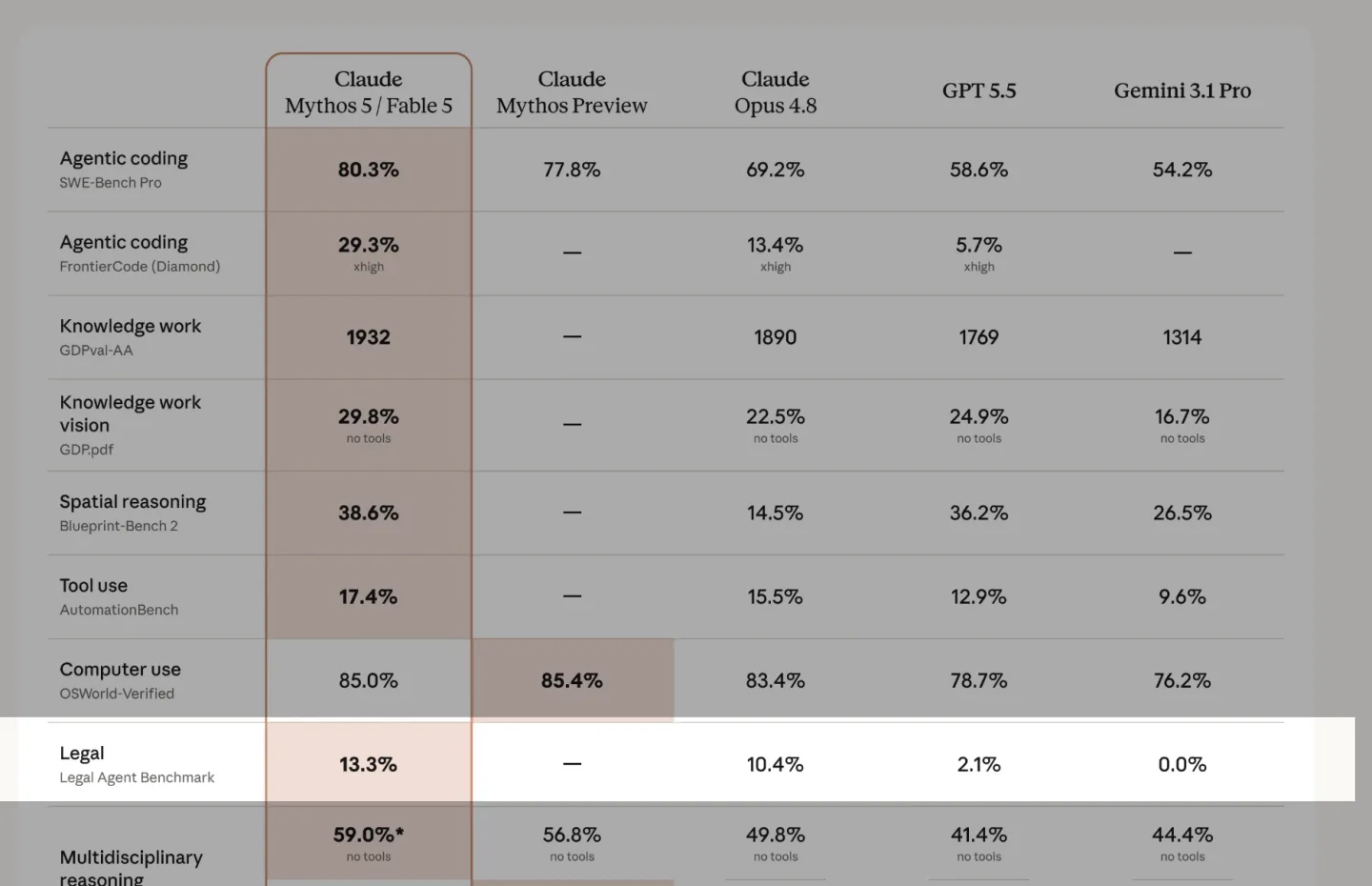
Anthropic's Fable 5 launch benchmark card. The highlighted Legal row shows the Legal Agent Benchmark: 13.3% for Fable 5, versus 2.1% for GPT-5.5 and 0.0% for Gemini 3.1 Pro.
The distance between them is the whole story for in-house counsel. A high LegalBench score tells you the model can recognize a doctrine, classify a clause, or answer a rule question. The low agentic score tells you that stringing those judgments into a finished work product, with every required step done and nothing missed, is still mostly beyond it. Legal AI got a lot better at knowing. It is still learning to do the entire job unsupervised.
Legal IT Insider made a similar point in its launch coverage: the gains are strongest on large-scale, multi-document reasoning, the kind of task where a senior lawyer would still review the output before it went anywhere (Legal IT Insider, June 2026).
Where the 89% goes: a contract-review example
Picture a routine in-house task, illustrative numbers only. A vendor sends a master services agreement. You ask the model to review it against your playbook and produce a redline. That task decomposes into criteria: flag the liability cap against your standard, catch the auto-renewal, check the indemnity fallback, confirm the governing-law clause, verify any cited regulation, and apply your approved fallback language.
Say the model handles each criterion correctly about 85% of the time. That is close to the per-criterion pass rate Vals AI reports for top models. With six independent criteria, the odds it gets all six right in one pass are roughly 0.85 to the sixth power, about 38%. Add the messier parts of a real matter and the all-pass rate drops toward the ~11% the benchmark actually measures.
What does a missed criterion look like in practice? The model reinstates an uncapped-indemnity clause your playbook forbids, because it has no playbook to refuse it. Or it works off a playbook that is six months stale and no longer matches what the business will accept. Or it pulls a prior version of the agreement from an unrelated matter into context. Or it drafts a confident citation to a regulation that reads plausibly and does not exist. Each one is a single missed criterion, and each one is enough to send the whole redline back.
Take one criterion end to end, the liability cap:
- Vendor clause: "Vendor's aggregate liability shall not exceed the fees paid in the twenty-four (24) months preceding the claim."
- Your playbook rule: the cap may not exceed 12 months of fees.
- The likely miss: the model marks the clause "within market" and moves on. Twenty-four months reads reasonable in the abstract, and the model has no playbook number to measure it against.
- The fix it should have made: redline the cap down to "the fees paid in the twelve (12) months preceding the claim."
- The reviewer check: confirm the cap matches the current playbook figure, not last quarter's.
One clause, one rule, one silent miss. Multiply that by the six or eight criteria in a real MSA and the all-pass math is no longer surprising.
This is where in-house pilots usually stall. The speed is easy to prove. The gaps show up later: privilege boundaries the tool does not respect, procurement fallback positions that conflict with legal's, a tired reviewer who approves a redline at 11pm without re-checking the cap, and a GC who asks for a clean record of what the tool did and gets a pile of screenshots. None of those are model-quality problems. A better model does not fix any of them.
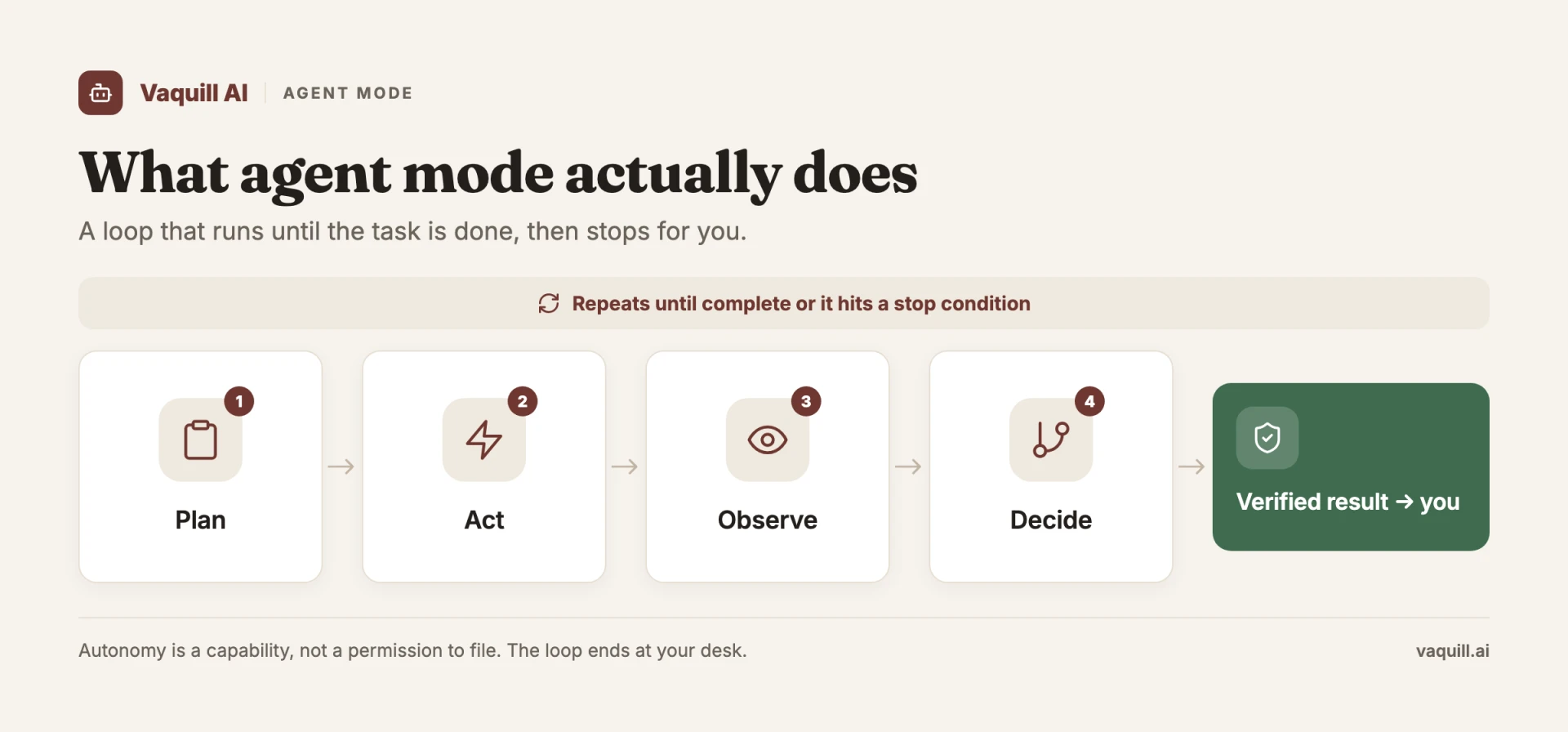 An agentic legal task chains many steps. The all-pass standard fails the whole task if any single step misses.
The benchmark landscape at a glance
| Benchmark | What it grades | Fable 5 | Next best | Source |
|---|---|---|---|---|
| LegalBench (Vals AI) | Legal-reasoning accuracy across discrete tasks | 88.56% | Gemini 3.1 Pro Preview, 87.40% | Vals AI, Jul 1 2026 |
| Legal Agent Benchmark (Vals AI) | End-to-end legal task, all-pass standard | 11.25% | Opus 4.8, 9.58% | Vals AI, Jul 1 2026 |
| Legal Agent Benchmark (Anthropic card) | Same task, Anthropic launch run | 13.3% | Opus 4.8, 10.4% | Anthropic, Jun 2026 |
| BigLaw Bench (Harvey) | Drafting and markup quality | 93.4% | Prior Anthropic high | Harvey, Jun 9 2026 |
The table splits cleanly. Fable 5 leads the knowledge and quality tests by a comfortable margin. On the strict all-pass agentic test it also leads, but the absolute score is low for every model. The frontier moved, and the finish line moved with it.
Why this strengthens the case for a governed layer
The tempting conclusion is that a stronger model needs less scaffolding around it. The benchmarks say the opposite.
If the best available legal model finishes about 11% of complex tasks cleanly, then roughly 89% of the time something is missing, wrong, or unverified. That missing 89% is precisely the work a governed layer is built to catch. This is the same argument for purpose-built over general-purpose legal AI: the model supplies the reasoning, the governed layer supplies the controls that turn a good draft into a defensible one.
Four controls do most of that work:
- Matter segregation. The wrong prior document never enters context, because matters are walled off by design rather than by the reviewer remembering to check.
- Playbook enforcement. Your approved fallback positions and hard limits are enforced, so the model cannot quietly reinstate a clause you forbid.
- Verification on by default. Every cited statute or regulation is checked against a grounded primary-law source before it reaches you. Case-law citations get checked against a separate case-law tool, since the grounded source here covers statutes and legislation, not opinions. That verification step is the whole point of a tool built to avoid hallucinating cases.
- An audit log. When the GC asks what ran against which document and what came back, there is a clean record instead of scattered chat history.
The model does one step in that chain. The governed layer owns the rest, and that is the point.
The model handles step D. Matter segregation, playbook retrieval, verification, and the audit log are governance steps a raw model does not perform on its own.
Vaquill AI is built as that governed layer. It pairs the model's drafting with 4-layer verification, matter-scoped work, playbook enforcement, and a grounded statutes-and-legislation source covering U.S. Code, CFR, federal rules, and 50-state primary law. The public API and MCP source cover statutes and legislation, not case law, so a separate case-law tool handles opinions when you need them.
The Vaquill AI workspace keeps drafting, verification, and matter context in one governed surface.
Model quality is also converging at the top. As the general-AI giants add legal modes, the thing that separates one tool from another shifts from raw model quality to governance, a point covered in more depth in general-purpose AI enters legal. Fable 5 makes the model layer better for everyone. The layer that decides how your team is allowed to work is where the remaining value sits.
FAQ
What is Claude Fable 5?
It is Anthropic's most capable model, released June 9, 2026. It runs a 1M-token context window, costs $10 per million input tokens and $50 per million output, keeps its thinking mode always on, and includes safety classifiers that can decline a request, per Anthropic's release notes.
Does Claude Fable 5 have a dedicated legal benchmark?
Yes. Fable 5 leads two dedicated legal evaluations tracked by Vals AI: LegalBench, a legal-reasoning test where it scores 88.56%, and Harvey's Legal Agent Benchmark, an end-to-end agentic test where it leads the public leaderboard at 11.25%. Harvey also reports it as the top model on its proprietary BigLaw Bench at 93.4%.
Why is Fable 5's legal agent score only about 11% if it leads LegalBench at 88%?
The two tests measure different things. LegalBench grades discrete legal-reasoning questions and reports accuracy. The Legal Agent Benchmark grades whether a model completes a full task with every required step done, under an all-pass standard. A model can answer most individual questions correctly and still miss one step out of many on a complex task, which fails the whole task.
Is Claude Fable 5 accurate enough to file legal work without review?
No. A benchmark lead is a reason to adopt the model, not a reason to skip review. At an all-pass rate near 11% on complex agentic tasks, the strongest legal model still misses at least one required step most of the time. Human review and a verification layer stay necessary.
How does Fable 5 compare to Claude Opus 4.8 for legal work?
On Vals AI's Legal Agent Benchmark leaderboard, Fable 5 leads at 11.25% versus Opus 4.8 at 9.58%. Harvey's internal run shows a similar gap, 13.3% versus 10.4%. Fable 5 is the stronger legal reasoner, at higher cost per token.
Can in-house teams use Claude Fable 5 directly?
They can, through Anthropic's API or through tools built on it, such as Harvey. For confidential, matter-bound work, route it through a governed layer that adds matter segregation, playbook enforcement, verification, and an audit log, none of which a raw model provides on its own.
Are these benchmark numbers independent?
Partly. The LegalBench and Legal Agent Benchmark figures cited here come from Vals AI, an independent evaluator, and were last updated July 1, 2026. The BigLaw Bench score and Harvey's higher agent-benchmark number are Harvey's own runs, so treat those as vendor-reported.
What in-house teams should take from this
Claude Fable 5 is the strongest legal-reasoning model on the market, and the dedicated legal benchmarks now say so out loud. That is worth taking seriously. It is also a precise map of what AI still cannot do alone: finish a complex legal task, every step, nothing missed, without a human and a verification layer in the loop. The record score and the ~11% all-pass rate are the same message read two ways. For an in-house team, the productive move is to run the best model you can and put a governed layer around it, so the 89% the model misses does not land on a filing. See how the governed layer fits.
New legal AI guides, weekly.
Further Reading
Claude for Legal: What In-House Teams Need to Know
Read postThe AI Value Gap: In-House Counsel Want AI Results Their Outside Counsel Are Not Delivering
Read postWhat Lawyers Really Think of Legal AI in 2026 (Reddit + Reviews)
Read postSpellbook's Autonomous Contract Management: What It Means for In-House Teams
Read postMost In-House Legal Work Is Not Legal Risk (and AI Is Proving It)
Read postThe Legal AI Consolidation Wave: What In-House Buyers Should Watch
Read post
Co-Founder & CEO · Attorney
Arshita leads product and strategy at Vaquill AI, the US primary law data API. As an attorney, she decides which law we carry, how each section is sourced and cited, and what legal AI and compliance teams need from the data.