Short answer: yes, CourtListener is reliable for primary law. It holds more than 99% of precedential US case law, the actual opinion text, sourced from courts directly and from Harvard's Caselaw Access Project. The accuracy gaps are real but narrow: some scraped opinions miss a page number or a parallel citation, and it does not yet flag whether a case is still good law. For finding and reading the law, trust it. For "is this still good law," do your own check.
A few years ago I watched a litigator talk himself out of trusting a free legal database in about thirty seconds. "If it doesn't cost anything," he said, "it can't be the real thing." He had spent a career paying Westlaw rates, and the price had become a proxy for trust.
Expensive meant authoritative. Free meant hobbyist. So when someone asks me is CourtListener reliable, I hear that same reflex underneath the question: surely a free website cannot hold the actual case law that bar associations and federal judges rely on.
It can. It does. CourtListener holds more than nine million precedential decisions (over ten million opinions in total) from 2,000-plus courts, and claims more than 99% of all precedential case law published in the United States (CourtListener coverage docs, June 2026). That is not a starter set. That is the corpus.
But the honest answer to the reliability question is more interesting than a simple yes, because "reliable" is doing a lot of work, and the answer changes depending on which kind of reliability you mean.
TL;DR
- CourtListener is reliable for primary law. Published precedential opinions across federal and state courts, plus dockets and oral arguments. For that, it is authoritative.
- It is honest about its gaps. Scraped opinions may miss some page numbers and parallel citations, and trial-court completeness varies by jurisdiction.
- It has no finished citator yet. There is no KeyCite or Shepard's style "this case was overruled" flag today. Free Law Project is building an open AI citator, but it is in progress, not shipped.
- Coverage rivals the commercial giants for primary law, and trails them on editorial layers: headnotes, treatises, and a validated citator.
- It is free because the data comes from public courts and digitization projects, collected by a 501(c)(3) nonprofit, not because it is thin or unmaintained.
According to the post, what is CourtListener's single biggest reliability gap today?
Part of our legal AI verification and hallucination guide series.
For related verification / hallucination / vendor-trust coverage, see AI Case Law Search Explained: How Semantic Search Finds the Right Precedent and What Legal AI Actually Avoids Hallucinating Cases (and Why Most Do Not).
"Reliable for what" is the real question
When a senior associate asks if a database is reliable, they are usually collapsing three separate questions into one. Does it have the law? Is the text accurate? Will it tell me if the law is still good?
Those are not the same standard, and CourtListener scores very differently on each.
On the first, it is excellent. The corpus pulls from court websites directly and from large digitization projects, including Harvard's Caselaw Access Project, which scanned the bound reporters going back over 365 years (CourtListener coverage docs).
If you want Carpenter v. United States, 585 U.S. 296 (2018), or Gideon v. Wainwright, 372 U.S. 335 (1963), or the now-overruled Chevron v. NRDC, 467 U.S. 837 (1984), it is there, in full, with the actual opinion text. The breadth across more than 2,000 courts is genuinely hard to match outside the two commercial giants.
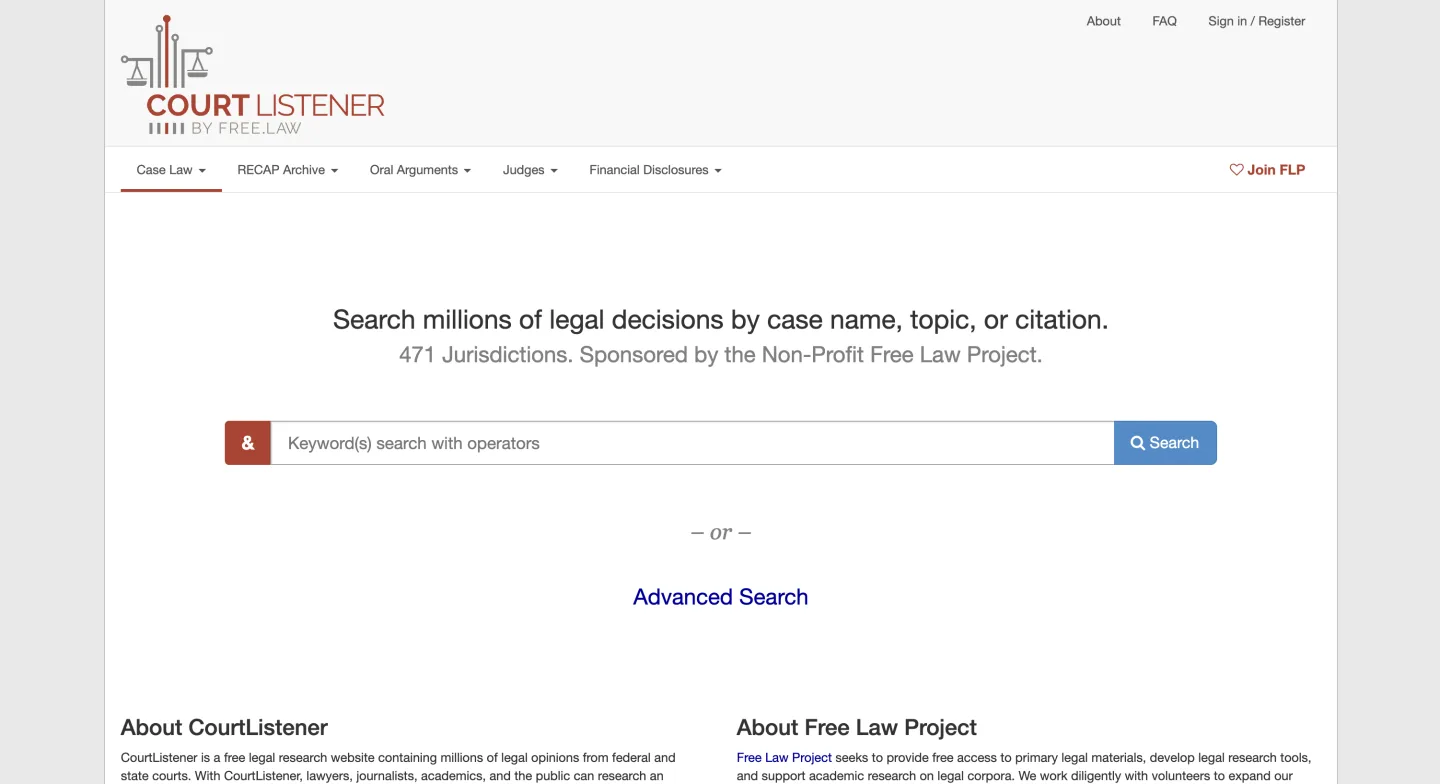
On the second, accuracy, it is good but not pristine, and the project says so itself. CourtListener's coverage documentation admits plainly that opinions gathered by scraping court sites "do not have every page number and every citation."
For a researcher pulling a holding, that is a non-issue. For someone who needs a pinpoint cite to a specific reporter page for a brief, it sometimes means a second source check. That is not a flaw the project hides. It is a flaw the project documents, which is its own kind of reliability.
On the third question, the one about whether the law is still good, CourtListener cannot fully answer yet. There is no finished editorial flag telling you a case was reversed, distinguished, or criticized. No red flag, no yellow flag of the KeyCite or Shepard's kind.
It will show you citation relationships (which opinions cite which), but it will not editorially tell you that Chevron was gutted by Loper Bright v. Raimondo, 603 U.S. 369 (2024). You have to know to read Loper Bright. That is the single biggest gap today, and it is exactly where the commercial citators earn their keep.
This gap is closing. Free Law Project published a progress report on building an AI citator (May 2025), an open tool meant to detect when one opinion overrules another and surface that treatment inside CourtListener search. It is early-stage proof of concept work, not a shipped product, so treat the citator as coming, not here. Until it lands, the validation step stays manual.
What most people get wrong about "free"
There are two misconceptions I run into constantly, and they feed each other.
The first is that free means uncommitted or low quality. People assume a no-cost database must be a thin scrape held together by volunteers on nights and weekends.
The reality is that Free Law Project is a real organization: a 501(c)(3) nonprofit that has spent more than a decade building open court-data infrastructure, with the engineering to back it up. The data is not free because it is worthless. It is free because the underlying material is public record (court opinions, dockets, oral arguments) and digitization projects opened it up.
The price tells you nothing about the quality. The sourcing does.
The second misconception is sneakier, and it is held by people who should know better. It is the belief that a legal AI product's accuracy comes from the model. Buyers sit through demos, watch a slick assistant cite Miranda v. Arizona, 384 U.S. 436 (1966), and conclude the magic lives in the language model.
It does not. A raw model, asked a legal question cold, is a confident liar. The accuracy comes almost entirely from grounding the model against a real corpus of opinions, retrieving the actual text, and forcing the answer to stay tethered to it.
The corpus is the product. The model is the interface. And for US case law, the open corpus that makes honest grounding possible is, more often than the industry likes to admit, CourtListener.
If you want the mechanics of how that grounding works, we wrote a separate piece on how AI legal research actually works with RAG. The short version: retrieval beats recall, every time, for law.
Why the source layer is suddenly critical infrastructure
For most of the past decade, the open-data crowd argued for free law on principle. Access to justice, democratic accountability, the public's right to read its own statutes. Good arguments, but abstract enough that a busy practitioner could nod and move on. Generative AI turned the principle into an operational emergency.
The numbers are now well documented. A Stanford RegLab and HAI study found that general-purpose models hallucinate on legal queries somewhere between 58% and 88% of the time.
The purpose-built tools did better but not nearly well enough: even Lexis+ AI was wrong about 17% of the time, and Westlaw's AI-Assisted Research came in around 34% in the same benchmarking work. Read that again. The most expensive, most editorially curated legal AI on the market got it wrong roughly a third of the time in that test.
This is not academic. It is showing up in sanctions orders. Mata v. Avianca in 2023 was the canary, two lawyers sanctioned for a brief full of ChatGPT-invented cases.
It kept happening. A California lawyer was fined $10,000 after a filing cited 21 fake cases, and running trackers now log well over 600 US matters involving cited authority that does not exist. The American Bar Association weighed in with Formal Opinion 512 in July 2024, essentially telling lawyers that "the computer did it" is not a defense to their duty of competence and candor.
Here is the connection people miss. The fix for hallucination is grounding, and grounding requires a corpus you can audit. If your AI tool tells you a case says X, you need to be able to open that case and read whether it says X.
That is only possible if the underlying source is open, machine-readable, and citable down to the opinion. A closed corpus behind a paywall and a click-through license cannot serve as the public, verifiable backstop the whole AI legal ecosystem now depends on.
CourtListener can. Its opinions are open, machine-readable, and citable down to the individual decision, which is exactly what makes it usable as a verifiable backstop. We made the broader version of this argument in where your legal AI data actually goes, and the provenance question only gets sharper every quarter.
So, is it reliable enough to build on? Yes, with eyes open
I will give the unhedged version. For the work most firms actually do (finding controlling and persuasive authority, reading full opinions, tracking dockets, grounding an AI assistant against real text), CourtListener is reliable. I would trust it for primary law before I trusted any model's unaided memory, full stop.
What it does not replace is your own validation step. Because there is no editorial citator, the discipline of checking whether your case is still good law stays on you.
That is not a knock unique to free data. The Stanford numbers show the paid citators are not a clean substitute either; a green checkmark you did not verify is just a more expensive way to be wrong.
The right posture is the same regardless of source: treat every cite as a claim to confirm, and confirm it by reading the opinion. If you want a workflow for that, we have a guide on verifying AI legal citations before filing.
A practical way to hold the two truths at once:
| You need | CourtListener | Where it is weaker than Westlaw / Lexis |
|---|---|---|
| Published precedential opinions | Excellent, 99%+ coverage | Some missing pinpoint cites |
| Dockets and filings | Strong (RECAP archive) | Coverage varies by court |
| Exhaustive trial-court records | Partial | Completeness varies widely |
| "Is this still good law" signal | Citation links, AI citator in progress | No finished KeyCite/Shepard's equivalent yet |
| Editorial headnotes and treatises | None | Westlaw/Lexis own this layer |
| Auditable source for AI grounding | Best in class, open and citable | You still verify each cite |
If you are weighing CourtListener against a paid subscription, the tradeoff is exactly this row split: it matches the giants on primary law and trails them on editorial layers. We break that decision down in the best Westlaw alternatives for solo and small firms.
CourtListener is not standing still either. The data and search tooling keep improving, the AI citator is in development, and as of May 2026 the full dataset is reachable inside AI assistants through an MCP connector.
If you want the hands-on companion to this piece, our CourtListener MCP server walkthrough covers how to actually wire the data into a research workflow, tool by tool. This post is the why; that one is the how. For a sense of how a different open jurisdiction handles the same problem, the CanLII setup for Canadian research is a useful contrast.
How to use CourtListener safely
Reliability is a workflow, not a property of the database. Here is the discipline I use, and recommend, when CourtListener is the source.
- Pull the full opinion, do not trust a snippet. The breadth is excellent, so open the actual decision and read the holding in context rather than relying on a search excerpt or an AI summary.
- Confirm pinpoint cites against a reporter. For a brief that needs a specific reporter page, check it. CourtListener documents that some scraped opinions miss page numbers and parallel citations, so a second source closes that gap.
- Validate that the case is still good law yourself. Until the AI citator ships, read the later citing cases. Citation links show you what cites what; the editorial judgment is on you.
- Cross-check trial-court completeness. Precedential coverage is near total, but trial-court and docket completeness varies by court, so do not read an absence as proof nothing exists.
If you want a step-by-step routine, we have a guide on verifying AI legal citations before filing. For the developer-facing path, how to use the CourtListener API covers the citation-lookup endpoint that automates the first half of this check.
Where Vaquill AI fits
We build a legal AI suite, so this is a disclosure, not a neutral aside. Our in-product case law research is grounded against US opinions sourced from CourtListener, and every cite the assistant returns is openable, so you can read the underlying decision the same way you would on CourtListener itself. That is the whole point: an answer you cannot check is not an answer.
To be precise about scope: our public statutes and regulations API serves US Code, the CFR, and 50-state codes, not case law. The case law grounding lives inside the in-product research workflow, not the API.
The litigator I mentioned at the start eventually came around, not because someone argued him out of his price-equals-trust instinct, but because he opened a case on CourtListener, read it next to the Westlaw version, and found the same words.
Reliability, in the end, is not about what something costs. It is about whether you can check it. You can always go read the opinion yourself, and in an industry full of confident machines, that is worth more than a paywall.
FAQ
Is CourtListener reliable for legal research? Yes, for primary law. It holds more than 99% of precedential US case law with the full opinion text, sourced from courts directly and from Harvard's Caselaw Access Project. The main caveat is that it does not yet have a finished citator, so you confirm whether a case is still good law yourself.
Is CourtListener accurate? The opinion text is accurate and pulled from authoritative sources. The documented gap is that some scraped opinions miss page numbers and parallel citations, which matters only when you need a pinpoint cite to a specific reporter page. For reading holdings and finding authority, accuracy is not an issue.
How good is Free Law Project data quality? Strong for precedential opinions, dockets, and oral arguments. The data combines direct court publishing, court-website scraping, and large digitization projects like the Caselaw Access Project. Trial-court completeness and docket freshness vary by court, which Free Law Project documents rather than hides.
Is CourtListener free, and is there a catch? It is genuinely free to search and read. The data is public-record court material opened up by a 501(c)(3) nonprofit, so there is no paywall trick. Higher API rate limits sit behind membership tiers, but reading case law on the site costs nothing.
Does CourtListener have a citator like KeyCite or Shepard's? Not a finished one yet. It shows citation relationships (which opinions cite which), and Free Law Project published a 2025 progress report on building an open AI citator that remains in development. Until it ships, validate good-law status by reading the citing cases.
How does CourtListener compare to Westlaw and Lexis? It matches the commercial giants on raw primary-law coverage and the ability to read full opinions. It trails them on editorial layers: headnotes, treatises, and a validated citator. For finding and reading the law it is competitive; for editorial good-law signals, the paid tools still lead.
Can I rely on CourtListener for a court filing? You can use it as your source, but apply the same validation you would to any source. Confirm pinpoint cites against the reporter and read the latest citing cases to confirm the law still holds. Treat every cite as a claim to verify by reading the opinion.
How current is CourtListener's data? It collects case law continuously as courts release it, and since 2020 a growing number of courts publish directly to the platform. Docket and trial-court data can arrive late because of how PACER records propagate, so check timing for anything that depends on the most recent filings.
New legal AI guides, weekly.
Further Reading
Harvey AI Pricing 2026: Per-Seat Cost and the Renewal Increase
Read postLegal AI Tools for Solo Practitioners: 7 Picks That Fit a One-Person Firm
Read postPersonal Injury AI in 2026: What It Actually Does for Plaintiff Lawyers
Read post7 Ways AI Helps Personal Injury Lawyers Win Cases Faster
Read postAI Law Search Engine vs Keyword Search: Find Case Law Faster
Read postAI for Family Law: How Solo and Small-Firm Family Lawyers Use It
Read post
Product & Content
The US primary law data API: statutes, regulations, constitutions, court rules, executive orders and agency guidance across 53 US jurisdictions, each section cited and linked to its official source, via REST, MCP or SQL.