Here is the finding that should reorganize every in-house AI budget for the back half of 2026: teams that deeply trust their legal AI report positive ROI 89.5% of the time, while teams that do not trust it get there 27.8% of the time (Legaltech News, Mar 2026). That is a 3x gap, and it lands at the exact moment adoption has stopped being the story. The return on legal AI comes down to one thing: whether you trust the output enough to ship it without redoing the work. The model you buy barely moves the number by comparison.
Almost nobody clears that bar yet. Only 22.1% of legal users report high trust in generative-AI output (Factor survey, reported by Artificial Lawyer, Mar 2026), even though 87% of general counsel now use AI on their teams (FTI Consulting and Relativity, The General Counsel Report, Mar 11 2026). Adoption is sprinting. Trust is walking. The ROI is stuck behind the slower one.
TL;DR
- Trust is the ROI lever. High-trust legal teams report positive ROI 89.5% of the time; low-trust teams, 27.8% (Legaltech News, Mar 2026).
- The trust gap is huge. Only 22.1% of legal users deeply trust AI output, and 69.7% of outputs still need targeted edits or rework (Factor survey via Artificial Lawyer, Mar 2026).
- Adoption already happened. 87% of GCs use AI, up from 44% a year earlier (FTI/Relativity, Mar 2026); broad access hit 83%, up from 61% in 2025 (Factor, Mar 2026).
- Money is chasing the category, not the trust problem. Harvey raised $200M at an $11B valuation (CNBC, Mar 25 2026), months after an $8B round. Valuations are not verification.
- What builds trust is boring and specific: grounded answers, real citations you can open, and a verification step, well ahead of a bigger model.
- The move: stop measuring seats deployed. Measure work you ship without rechecking.
What does the 2026 data say actually builds trust in legal AI?
What the 2026 legal AI ROI data actually says
Three separate 2026 surveys tell one coherent story.
Adoption is basically solved. FTI Consulting and Relativity surveyed 224 general counsel and chief legal officers at companies over $100M in revenue for the seventh annual General Counsel Report. AI use inside legal departments nearly doubled year over year, from 44% to 87% (FTI/Relativity, Mar 11 2026). A separate Factor survey of 200+ in-house and law-firm leaders found broad AI access at 83%, up from 61% in 2025 (via Artificial Lawyer, Mar 23 2026). Whatever "should we use AI" debate you were having in 2024 is over.
Trust did not come with it. In that same Factor survey, only 22.1% of legal users reported high trust in AI output, and 69.7% said outputs still require targeted edits or extensive rework (Artificial Lawyer, Mar 2026). Factor's CEO framed the 2026 problem bluntly: the market has "largely solved for access" and now has to translate that into "defensible, repeatable impact." Access is a purchase order. Trust has to be earned per output.
Trust is where the return lives. This is the number that matters. Per Legaltech News (Mar 2026), teams with high trust in AI output report positive ROI 89.5% of the time; teams without it, 27.8%. Artificial Lawyer's read on the same data put it as high-trust teams being roughly 3x more likely to report positive ROI. Same finding, two framings, one conclusion: the trust gap is the ROI gap. The same trust-to-ROI split runs through Bloomberg Law's 2026 legal AI trends analysis.
The in-house take: you only bank the hours you do not re-audit
Here is the mechanism nobody puts on the slide. Legal AI ROI is real hours saved minus hours spent checking the machine. If you do not trust the output, you re-do the research, re-read every cited case, and rewrite the clause. Congratulations: you now have two drafts and one bill. The tool did not save time. It added a review pass.
You capture return at exactly the point where you trust the output enough to rely on it. Earned, checkable trust, not blind trust. The 89.5% cohort did not get braver than everyone else. They run tools whose output they can verify fast enough that the checking does not eat the savings.
Which reframes the buying question. The market spent 2026 measuring the wrong thing, because the wrong thing is easy to measure. Money poured into scale: Harvey raised $200M at an $11 billion valuation (CNBC, Mar 25 2026), up from $8B months earlier, on the way past $1B in total funding. A bigger model with a bigger valuation does not close the trust gap, because the trust gap is not a fluency problem. Nobody distrusts these tools because the prose is clunky. They distrust them because a confident, well-written answer can still be wrong, and in law "wrong" has a docket number. Remember Mata v. Avianca: the sanctioned lawyers wrote clean, confident prose. What sank them was six beautifully phrased cases that did not exist.
So the trust-building features are unglamorous, and they are the whole game:
- Grounding. The answer is built from real, retrieved primary law, not the model's memory of it. If the system cannot show you the source it pulled from, it is guessing with confidence.
- Real, openable citations. Every claim links to a statute section or an opinion you can open and read in the source. A citation you cannot click is a liability, not a footnote. See our field guide on how to verify AI legal citations before filing.
- A verification layer. A dedicated pass that checks the cited authority exists and says what the draft claims it says, before it reaches you. This is the difference between legal AI that avoids hallucinating cases and legal AI that hallucinates them politely.
- Confidentiality you can prove. Trust in output is downstream of trust in the vendor. If your privileged matter is quietly training someone's next model, no ROI number survives the breach. Our stance on why we do not train on your data exists because this is a trust precondition, not a nice-to-have.
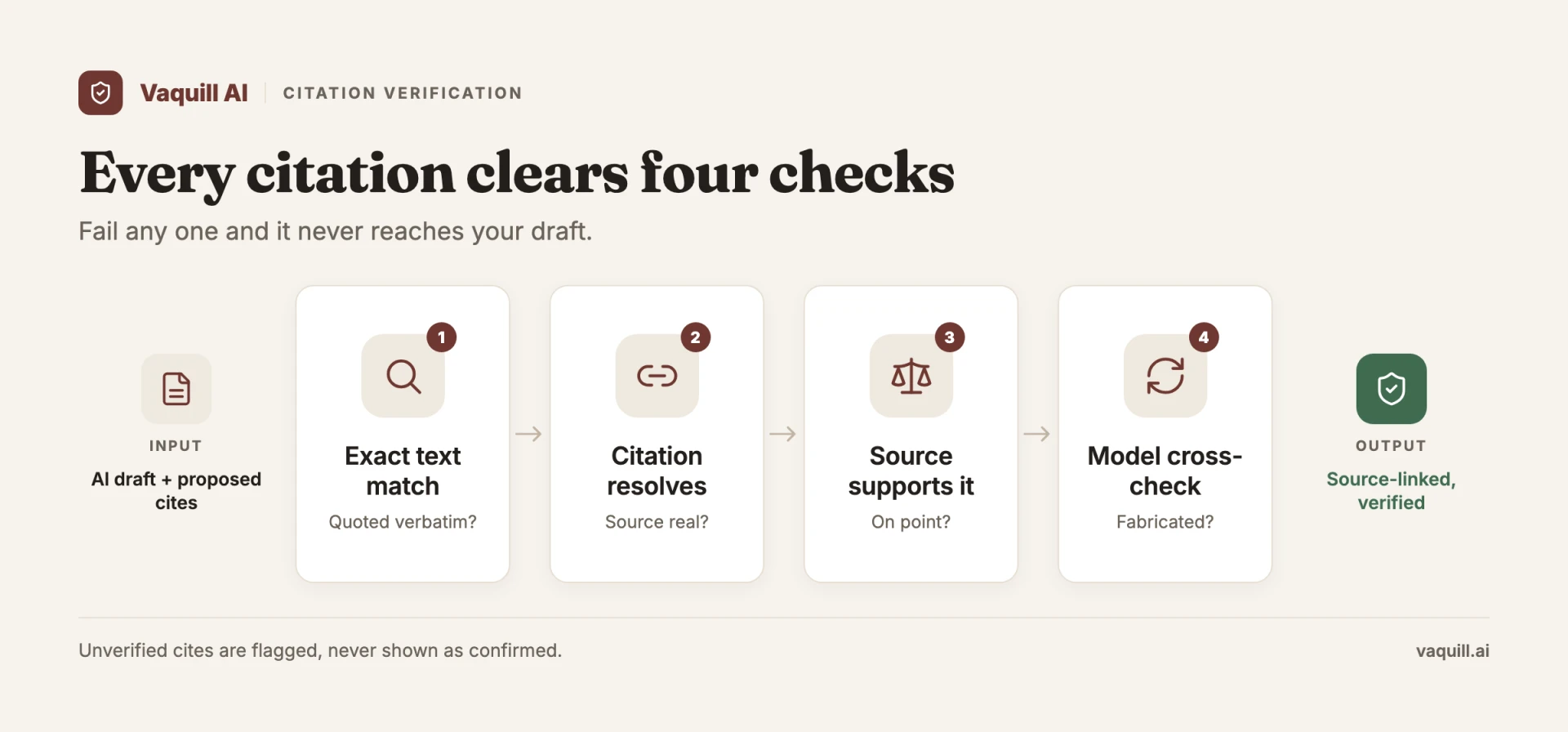
This is also where the ethics rules point. ABA Formal Opinion 512 makes competence and candor your problem, not the tool's, which means "I trusted the AI" is not a defense (see our ABA Opinion 512 guide). The rules already assume you will verify. The only question is whether your tooling makes verifying a two-minute click or a two-hour re-do. That gap, per minute, is the ROI.
A worked example: the rework tax on one NDA
Abstractions do not move budgets. A single matter does. Here is the math I walk in-house teams through, using a mutual NDA as the unit of work because almost every legal team runs enough of them to have a baseline.
Start with the baseline. A mid-market SaaS legal team I worked with clocked their manual NDA turnaround at 4.2 business days end to end (intake, first draft or markup, internal review, send). Active drafting and review time on each one averaged 90 minutes of counsel time.
Now write the rework-tax formula for one matter:
AI-assisted time = AI draft time + verification time Bank the saving only when that total lands below traditional drafting time. If you distrust the draft and rebuild it, add the full manual time on top, and the tool made you slower.
Run the two branches on that same NDA:
- Trusted branch. AI produces a first markup in 8 minutes. Counsel verifies the flagged clauses and the two cited statute sections in 22 minutes. Total: 30 minutes against a 90-minute baseline. Net saving: 60 minutes per NDA, roughly a two-thirds cut.
- Distrust branch. Same 8-minute AI draft, but the tool cannot show its sources, so counsel bins it and drafts from scratch anyway: 8 + 90 = 98 minutes. That is slower than the 90-minute baseline. This is the 27.8% cohort in one line, and it maps cleanly onto the 69.7% rework figure.
The pilot made the difference visible. Over a 30-day pilot on grounded, citation-backed drafting, the team ran 41 NDAs. Measured active time dropped from 90 to 34 minutes on average (verification landed a bit above the ideal 22 as reviewers built confidence). End-to-end turnaround fell from 4.2 days to 1.6 days, mostly because the internal review pass shrank once reviewers could open every cited authority instead of re-checking the research by hand. That is about 38 hours of counsel time recovered across one clause type in one month.
The lever in that number was never the model. It was that the verification step stayed short enough that trust held, so the saved minutes actually banked instead of leaking back out through a rebuild. Note the honest caveat: these are one team's measured cycle times on one workflow, not a general benchmark, and your clause mix and reviewer habits will move them. The shape holds even when the specific minutes do not.
How trust converts to return
The whole chain fails at any missing link. Ungrounded answer, dead citation, or no verification step, and the reviewer drops back to distrust, redoes the work, and the return evaporates. The 27.8% cohort is not doing anything wrong. Their tools just break the chain somewhere, so every output routes through a full manual rebuild.
Here is the same idea as a buying rubric.
| What you are buying | Looks impressive | Actually moves ROI |
|---|---|---|
| A bigger, more fluent model | Yes | Only if you can verify its output fast |
| Grounding in retrieved primary law | Less flashy | Yes, it is the trust floor |
| Citations you can open and check | Boring | Yes, this is the audit trail |
| A verification pass before you see it | Invisible | Yes, it kills the rework tax |
| Confidentiality guarantees in writing | Legal boilerplate | Yes, trust in output needs trust in vendor |
FAQ
What is a realistic ROI for legal AI in 2026? It splits hard by trust. High-trust teams report positive ROI 89.5% of the time; low-trust teams, 27.8% (Legaltech News survey data, self-reported). The variable is not the tool's price. It is whether your team relies on the output or rebuilds it, because rebuilt work erases the time savings the tool was supposed to create.
Why do so few lawyers trust AI output? Only 22.1% report high trust, largely because 69.7% of outputs still need targeted edits or rework (Factor survey via Artificial Lawyer). Confident, fluent answers can still cite cases that do not exist, and in law a wrong answer carries real consequences, so caution is rational, not stubborn.
Is legal AI adoption actually high, or is that hype? It is high and measured. 87% of general counsel report AI use on their teams, up from 44% a year earlier (FTI/Relativity), and broad access hit 83%, up from 61% the prior year (Factor). Adoption is settled; trust and ROI are the open questions.
Does buying a more expensive or bigger model improve ROI? Not directly. Valuations are climbing (Harvey raised $200M at an $11B valuation, per CNBC), but a larger model does not close the trust gap, which is about verifiability, not fluency. What moves ROI is grounding, openable citations, and a verification pass, well ahead of raw model size.
How do I measure legal AI ROI without guessing? Track the share of AI-assisted work that ships without a full human rebuild, and time a single recurring matter type end to end before and after. Those two numbers capture trust, and trust tracks return, far better than counting seats deployed or queries run, both of which can rise while real value stays flat.
What features actually build trust in legal AI? Grounding in retrieved primary law, citations you can open and check, a verification layer that confirms authority before you see it, and written confidentiality guarantees. These are unglamorous, and they are what separates the 89.5% ROI cohort from the 27.8% one.
Does trusting AI conflict with my ethics duties? No, when the trust is earned and checkable. ABA Formal Opinion 512 keeps competence and candor on you, so "the AI said so" is never a defense. Tooling that makes verification a fast click rather than a slow re-do is what lets you rely on output and stay compliant.
We are already at high adoption but see no ROI. What is wrong? You likely bought adoption, not trust. If seats are deployed but every output gets rebuilt, the rework tax eats the savings. Audit where the trust chain breaks: ungrounded answers, uncheckable citations, or no verification step, then fix that link rather than buying more seats.
Where Vaquill AI fits
We built Vaquill AI on a simple premise: trust is the product. Answers are grounded in primary law across all 50 states and federal, every citation opens to the source you can read yourself, and a four-layer verification pass checks the cited authority before it reaches you. That is the machinery behind the 89.5% cohort: output you can rely on without rebuilding it. If your seats are up and your ROI is not, the gap is trust, and that is a fixable engineering problem, not a fixed cost. See how the verification works.
New legal AI guides, weekly.
Further Reading
Claude Fable 5 and Legal AI: What Its Benchmark Records Actually Mean
Read postThe AI Value Gap: In-House Counsel Want AI Results Their Outside Counsel Are Not Delivering
Read postClaude for Legal: What In-House Teams Need to Know
Read postWhat Lawyers Really Think of Legal AI in 2026 (Reddit + Reviews)
Read postSpellbook's Autonomous Contract Management: What It Means for In-House Teams
Read postMost In-House Legal Work Is Not Legal Risk (and AI Is Proving It)
Read post
Co-Founder & CEO · Attorney
Arshita leads product and strategy at Vaquill AI, the US primary law data API. As an attorney, she decides which law we carry, how each section is sourced and cited, and what legal AI and compliance teams need from the data.