The honest answer: agents will take a real slice of the routine, high-volume work in a corporate legal department, but a much smaller slice of the judgment work than the headlines imply. A June 2026 Deloitte Legal analysis puts the near-term ceiling at roughly 30% of in-house work over three to five years. That is a forecast from a survey, not a measured outcome, and the 30% is not evenly spread. It clusters in a few predictable places.
This piece breaks down where that 30% actually lands, what stays human, and the second-order problem nobody prices in: if agents eat the junior-lawyer work, how does a lean team still train judgment?
TL;DR
- The number is a forecast, not a fact. Deloitte's "AI imperative" report projects AI agents could handle about 30% of corporate legal work in three to five years. It is built from a practitioner survey, so treat it as a directional estimate.
- The 30% is lumpy. It concentrates in high-volume, judgment-light tasks: NDA triage, first-pass contract review, intake routing, and obligation tracking. These are the jobs where a wrong first draft is cheap to catch.
- Negotiation, judgment calls, and board-facing strategy stay human. Agents draft the position. A person owns the decision and the relationship.
- The real cost is the training pipeline. The junior work agents absorb is the same work that used to teach judgment. Lean teams have to rebuild that apprenticeship on purpose.
- The practical move: pick two or three high-volume workflows, put an agent on the first pass, and keep a named human on verification and the hard calls.
Deloitte projects AI agents could handle about what share of corporate legal work in 3 to 5 years?
What the Deloitte number actually says
The 30% figure comes from Deloitte Legal's report "The AI Imperative: Reshaping the Legal Industry," led by Richard Punt and covered by Artificial Lawyer at the end of June 2026. The report projects that AI agents could handle around 30% of the work inside corporate legal teams over the next three to five years, and that roughly 20% of the in-house group could become "hybrid engineer-lawyers."
One methodology caveat before anyone puts it in a board deck: this is a forecast shaped by survey feedback from legal leaders, not a study of logged hours. Surveys of people who are already excited about AI tend to run optimistic. Read the 30% as a ceiling for planning, not a promise.
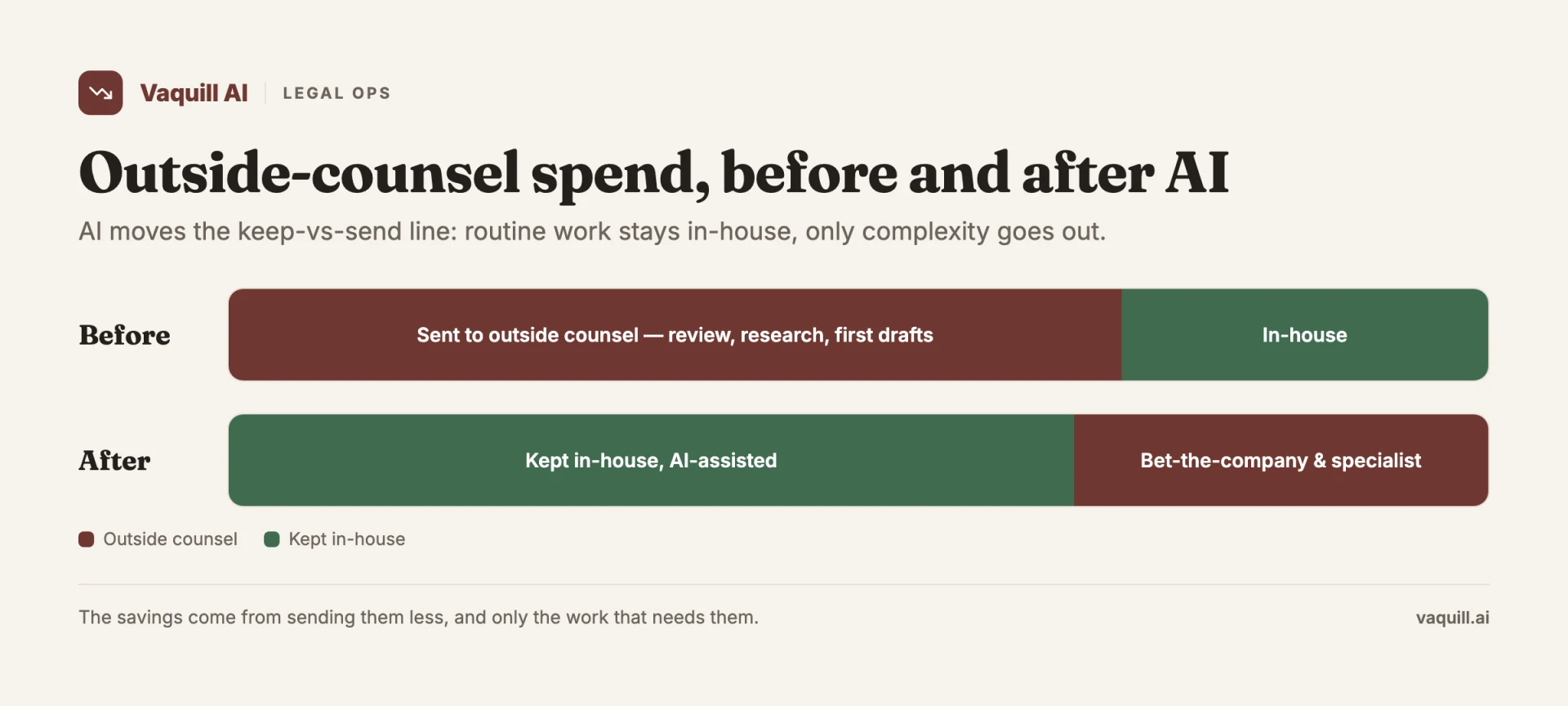
The same report carries two other numbers worth holding onto. It expects hourly-rate billing to fall from about 72% of work to 44% within two to three years, and it flags that external legal spend could drop 20 to 40% over three years as GCs insource routine work. If you want the buyer's version of that spend story, we wrote it up separately in reduce outside counsel spend with AI.
The ai agents legal work map: where the 30% lands
Agents are good at the parts of the week that are high in volume and low in ambiguity, where a bad first draft is cheap to spot and fix. That is a specific quadrant, not the whole job.
Here is the split I would put in front of a general counsel deciding where to point a tool first.
| In-house task | Agent-absorbable? | Why |
|---|---|---|
| NDA triage against a playbook | High | Standard terms, clear fallback positions, obvious deviations |
| First-pass contract review | High | Pattern-heavy, human still owns the final redline |
| Intake and routing | High | Rules-based sorting the legal team should not be doing by hand |
| Obligation and renewal tracking | High | Extraction and calendar work, not judgment |
| Standard drafting from templates | Medium | Fast first draft, human tailors the deal-specific terms |
| Live negotiation | Low | Reads the room, trades concessions, owns the relationship |
| Risk and judgment calls | Low | Someone has to sign, and be accountable for the call |
| Board-facing strategy | Low | Business context and trust the model does not have |
The pattern is simple. Agents draft and sort. People decide and negotiate. The 30% is mostly the drafting and sorting.
What stays human, and why that is the point
Take an NDA. An agent can read the incoming paper, compare it to your playbook, flag the indemnity cap and the governing-law clause, and produce a redline in under a minute. That is genuinely the bulk of the labor on a routine NDA.
What it cannot do is the last mile. It does not know that this counterparty is a strategic partner you cannot afford to annoy over a mutual-vs-one-way fight. It does not know your GC promised sales a 24-hour turn on this account. It cannot decide whether to hold the line or trade the clause for goodwill on the master agreement coming next quarter. That is judgment, and judgment is the job.
The board-facing work is even further out of reach. When the CFO asks whether a new data-processing arrangement creates real exposure, the answer depends on business context, risk appetite, and trust the model has not earned. A lawyer who says "here is the risk, here is what I would do, and I will own it" is doing something an agent structurally cannot: taking accountability. For a fuller picture of how these teams are restructuring around that split, see how AI is transforming in-house legal teams.
The apprenticeship problem nobody prices in
Here is the part the 30% headline skips. The routine work agents absorb is the same work that used to train the next lawyer.
Cite-checking, first-draft memos, document review, redlining a standard NDA: those were never valuable because the output was hard. They were valuable because doing them a hundred times is how a junior lawyer builds the pattern recognition that becomes judgment. Take that rung away and you have a real problem. Thomson Reuters Institute has been writing about this all year, and an Axios piece in May 2026 framed it bluntly for Big Law: AI is erasing the entry-level work that trains elite lawyers, and the talent pipeline depends on it.
The survey signal backs the worry. In the research cited by Thomson Reuters Institute, 72% of lawyers said they were concerned juniors leaning on AI will struggle to develop deep legal reasoning, and 69% worried about verification and source-checking skills. Again, self-reported concern, not measured outcomes. But the mechanism is real: if the doing goes away, the learning that came with it goes too.
For an in-house team this is sharper than for a firm. A two-to-ten-person department does not have a deep bench. If your one junior lawyer spends the year approving agent output instead of producing first drafts, they learn to verify but never learn to build. Verification is a skill. It is not the same skill as knowing what good looks like from scratch.
The fix is deliberate, and it costs time you have to protect. Have juniors draft a clause or a memo cold before they see the agent's version, then compare. Rotate them through the hard negotiations as observers. Treat verification as a taught skill with real feedback, not a rubber stamp. The teams that get this right will decide up front which work stays human for training reasons even when an agent could do it faster.
How a lean team should actually deploy this
The practical read for a small in-house team is not "adopt agents everywhere." It is narrower and more useful.
Pick the two or three workflows that eat the most hours and carry the least judgment. For most departments that is NDA triage, first-pass review of standard commercial contracts, and intake routing. Put an agent on the first pass in those lanes and keep a named human on verification. Leave negotiation, risk calls, and anything board-facing fully human. That is where the durable value sits, and it maps cleanly to the 30% ceiling Deloitte projects.
Two guardrails make or break it. First, verification has to be a real step with a name attached, not a hope. Second, measure your own rework rate in the first month. If you are rewriting a third of what the agent produces, the workflow is not ready, and no forecast changes that. If you are weighing specific tools for this, the agentic suites comparison and our legal AI for in-house counsel guide both walk through what to look for.
If you want a self-serve way to test this on your own contracts, Vaquill AI is a legal AI suite built for in-house teams: drafting, redline and bulk contract review, and 50-state primary law with a verification layer on every output. Point it at a stack of NDAs and see what your real first-pass and rework numbers look like before you commit to anything.
FAQ
Will AI agents replace in-house lawyers?
No. The Deloitte forecast of roughly 30% of work over three to five years is about task absorption, not headcount. Agents take the high-volume, judgment-light tasks. Negotiation, risk calls, and accountability stay with people. The role shifts toward oversight and strategy, it does not disappear.
Which in-house tasks can AI agents handle today?
The strongest fits are NDA triage against a playbook, first-pass review of standard contracts, intake routing, and obligation or renewal tracking. These are high in volume and low in ambiguity, so a human can verify the output quickly.
What legal work should stay human?
Live negotiation, judgment and risk calls, and board-facing strategy. These need business context, relationship reading, and someone willing to be accountable for the decision. An agent can draft the position, but a person owns the call.
Is the 30% figure reliable?
Treat it as a directional forecast, not a fact. It comes from Deloitte Legal's "AI Imperative" report, which is shaped by a survey of legal leaders rather than measured hours. Use it for planning, and validate against your own rework and cycle-time numbers.
How do lean legal teams train junior lawyers if agents do the routine work?
Deliberately. Have juniors draft cold before they see the agent's version, rotate them through hard negotiations as observers, and treat verification as a taught skill with feedback. The risk is that a lawyer learns to check work without ever learning to build it.
Does adopting AI agents cut outside counsel spend?
It can. The same Deloitte analysis projects external legal spend could fall 20 to 40% over three years as teams insource routine work agents make cheap to keep. The savings come from keeping first-pass review and standard drafting in-house instead of sending them out.
Where should a small team start with legal AI agents?
Start with NDA triage, where a wrong first draft is cheap to catch. Prove the workflow, measure your rework rate, then expand to first-pass contract review and intake before touching anything with real negotiation risk.
New legal AI guides, weekly.
Further Reading
The AI Value Gap: In-House Counsel Want AI Results Their Outside Counsel Are Not Delivering
Read postMost In-House Legal Work Is Not Legal Risk (and AI Is Proving It)
Read postThe Legal AI Consolidation Wave: What In-House Buyers Should Watch
Read postIn-House Legal AI Adoption Hit 87 Percent: What the Leaders Do Differently
Read postClaude Fable 5 and Legal AI: What Its Benchmark Records Actually Mean
Read postClaude for Legal: What In-House Teams Need to Know
Read post
Co-Founder & CEO · Attorney
Arshita leads product and strategy at Vaquill AI, the US primary law data API. As an attorney, she decides which law we carry, how each section is sourced and cited, and what legal AI and compliance teams need from the data.