Short answer: On May 12, 2026, Anthropic launched Claude for Legal, bundling more than 20 connectors to tools like Thomson Reuters and DocuSign, 12 practice-area plugins from M&A diligence to employment handbooks, and a Microsoft 365 embed that keeps one Claude context alive across Word, Outlook, Excel, and PowerPoint. For in-house teams the takeaway is narrow. Claude for Legal is a strong general model that reaches across your tools better than anything Anthropic has shipped. What it does not give you is a governed in-house workbench: matter segregation, playbook enforcement, an audit trail, verification on by default. Use it for pulling scattered data into one place. Keep a governed layer for anything client-confidential or matter-scoped.
TL;DR
- What shipped (May 12, 2026): 20+ connectors, 12 role-specific plugins, and a Microsoft 365 embed carrying context across Word, Outlook, Excel, and PowerPoint. It runs on Claude Opus 4.7, which Fortune reported scored 90.9% on Harvey's BigLaw Bench (Fortune, May 2026). BigLaw Bench is Harvey's own benchmark, so read that figure as a vendor-run score, not an independent one.
- Who is already on it: Anthropic named Freshfields, Quinn Emanuel, Holland & Knight, and Crosby as firms running Claude on live matters, and said legal is the top power-user function inside its Cowork platform (per the same Fortune report).
- The market it dropped into: Harvey raised $200M at an $11B valuation (CNBC, Mar 2026); Legora raised a $600M Series D at a $5.6B valuation (TechCrunch, Apr 2026); Anthropic itself sits near a $965B post-money valuation after its Series H (Anthropic, May 2026).
- The catch for in-house: it is a model plus connectors. There is no matter segregation, no playbook enforcement, no audit log, and no verification layer switched on by default.
- The honest play: use Claude for reach and drafting speed. Route client-confidential and matter-bound work through a governed suite. The two compose; they do not cancel each other out.
What does Claude for Legal not give an in-house team by default?
What Anthropic actually shipped
Strip the launch copy and Claude for Legal is three things bolted onto the model you already know.
Connectors. More than 20 integrations with tools legal teams already run. Artificial Lawyer listed the first wave: DocuSign, Ironclad, iManage, NetDocuments, LexisNexis, Thomson Reuters, Box, Everlaw, and LSuite (Artificial Lawyer, May 2026). These ride on the Model Context Protocol, so Claude can pull a contract from iManage, a signature status from DocuSign, and a Westlaw result into one conversation without you copy-pasting between tabs.
Plugins. 12 role-specific plugins covering, in Fortune's words, "everything from M&A due diligence to employment handbook drafting." They span commercial, employment, privacy, product, corporate, and AI governance work, according to Artificial Lawyer's launch coverage.
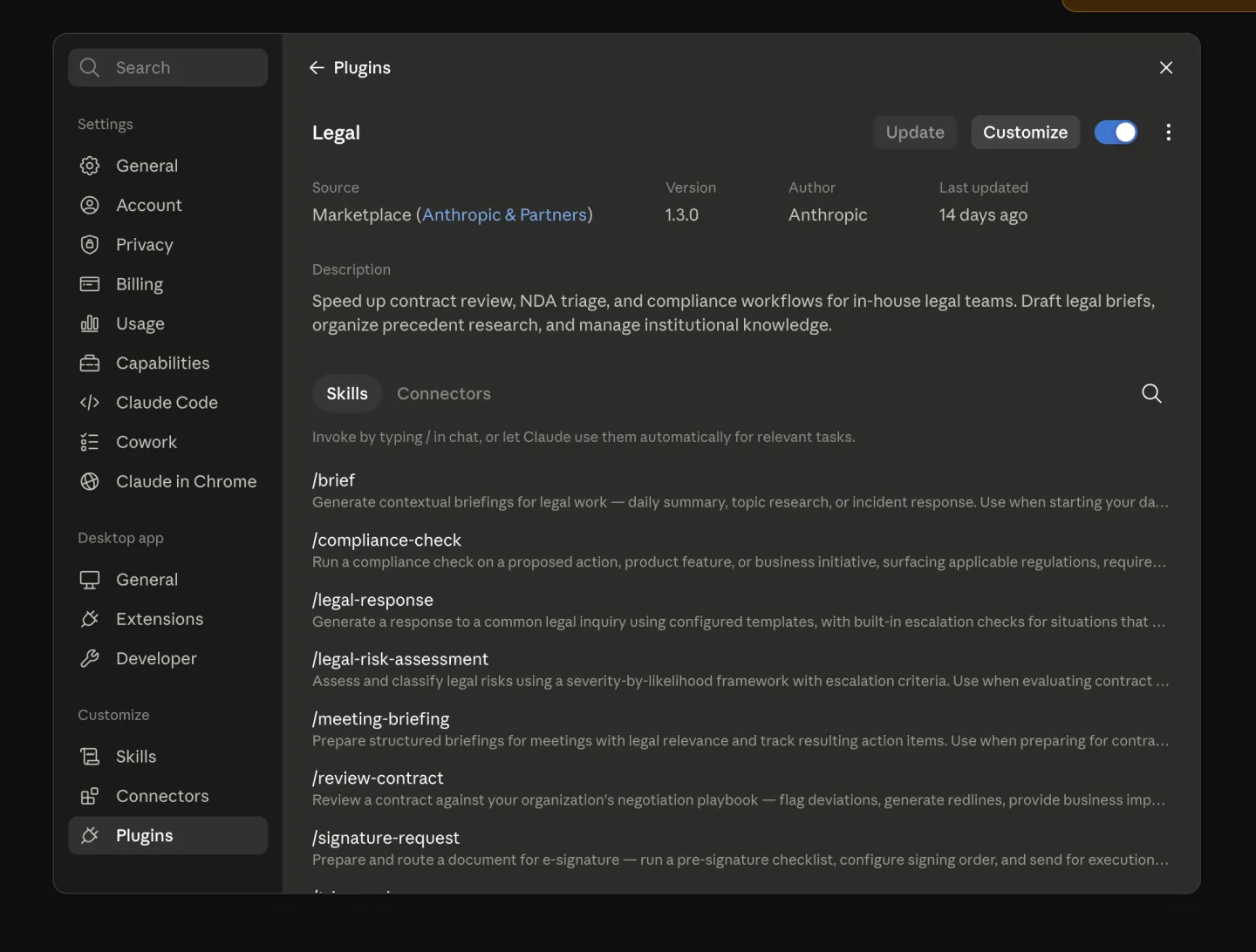
The Microsoft 365 embed. This is the piece that matters most for daily work. Claude now lives inside Word, Outlook, Excel, and PowerPoint, and it carries one context across all four. Draft a clause in Word, and the same Claude thread can pull the counterparty's email history in Outlook without losing the thread.
Access is broad. Artificial Lawyer reported it is available to all paid Claude customers, with enterprise admins enabling it through workspace settings. No four-figure per-seat gate to get in the door.
Claude for Legal for in-house teams: reach is not governance
Here is the part the launch coverage mostly skipped.
Claude for Legal is a general-purpose model with a great connector layer. That is genuinely useful. For most legal work the bottleneck was rarely the model's reasoning. Getting the right documents, emails, and law into one context window was the hard part, and Claude for Legal collapses that friction better than anything Anthropic has shipped before.
But reach and governance are different problems, and in-house work lives on the governance side.
Walk through what an in-house team actually needs before an AI touches a live matter:
- Matter segregation. The Acme acquisition and the Acme employment dispute cannot share a context. A general model with connectors does not enforce that by default; you do, by remembering to.
- Playbook enforcement. Your fallback positions, your approved clause library, your "never agree to uncapped indemnity" rule. A plugin drafts a handbook; it does not hold your negotiation playbook and refuse to cross it.
- An audit log. When the GC asks who ran what against which document and what the model returned, "it was in a Claude thread somewhere" is not an answer.
- Verification by default. A general model will draft a confident citation. Whether that citation is real is a separate step, and it needs to be on by default, not something the associate remembers to check at 11pm.
None of this is a knock on Anthropic. It is a category distinction. Claude for Legal gives you horizontal reach across tools. An in-house workbench gives you vertical control over how a matter is handled. You want both, and you should stop pretending one substitutes for the other.
The confidentiality point is the sharp edge. Pulling client-privileged documents into a general model's context, even a well-secured one, is a call your risk function should make deliberately, not a default you back into because the connector made it one click. The trouble is that a one-click connector makes the risky move the easy one.
A 30-day NDA pilot: where it helps, where it breaks
Here is how the split plays out on a real desk. A five-person legal team at a Series B SaaS company measured its inbound NDA cycle before touching any AI: 4.2 business days from intake to signature, most of that dead time sitting in a review queue. They ran a 30-day pilot with Claude for Legal wired into their existing stack, and tracked cycle time and rework across 34 NDAs.
The workflow ran like this. An intake request lands in Outlook. Claude reads the counterparty draft, pulls the company's standard NDA from iManage, and produces a redline in Word in about eight minutes instead of the usual half-day wait. The DocuSign connector surfaces signature status inside the same thread, so nobody tabs out to chase it. Median cycle time over the pilot dropped to 1.3 days. On raw speed, the tool delivered.
Then the audit review found the gaps. Two of the 34 NDAs were redlined against the wrong template, because the counterparty name collided with an unrelated matter and nothing enforced segregation. One redline quietly reinstated an uncapped-indemnity clause the team's playbook forbids; the model had no playbook to refuse it. And when the GC asked for a clean log of which documents Claude had read and what it returned, the answer was scattered across thread history and screenshots. Reworking those flagged files clawed back close to a full day of the time saved. The speed was real. So was the missing control layer, and it showed up exactly where governance was supposed to live: template selection, playbook limits, and the audit trail.
Where a governed layer fits
The productive framing is additive. Run Claude for Legal for reach, and pair it with a governed suite for control.
Because these connectors run on MCP, a governed workbench can plug into the same Claude session. Vaquill AI publishes MCP servers, so the model can call a grounded statutes-and-legislation source (U.S. Code, CFR, federal rules, 50-state primary law) directly inside Claude, while the confidential, matter-scoped, playbook-enforced work stays in the governed suite with its audit log and 4-layer verification intact.
That is the split that holds up:
| Job | Claude for Legal | Governed in-house layer |
|---|---|---|
| Pull scattered data into one context | Yes, this is its strength | Not the point |
| First-draft speed on low-risk work | Strong | Strong |
| Matter segregation | You enforce it | Enforced by design |
| Playbook and clause-library control | Not built in | Built in |
| Audit log for the GC | Thread history | Full log |
| Verification of cites and claims | Manual step | On by default |
| Client-confidential matter work | Proceed with caution | Where it belongs |
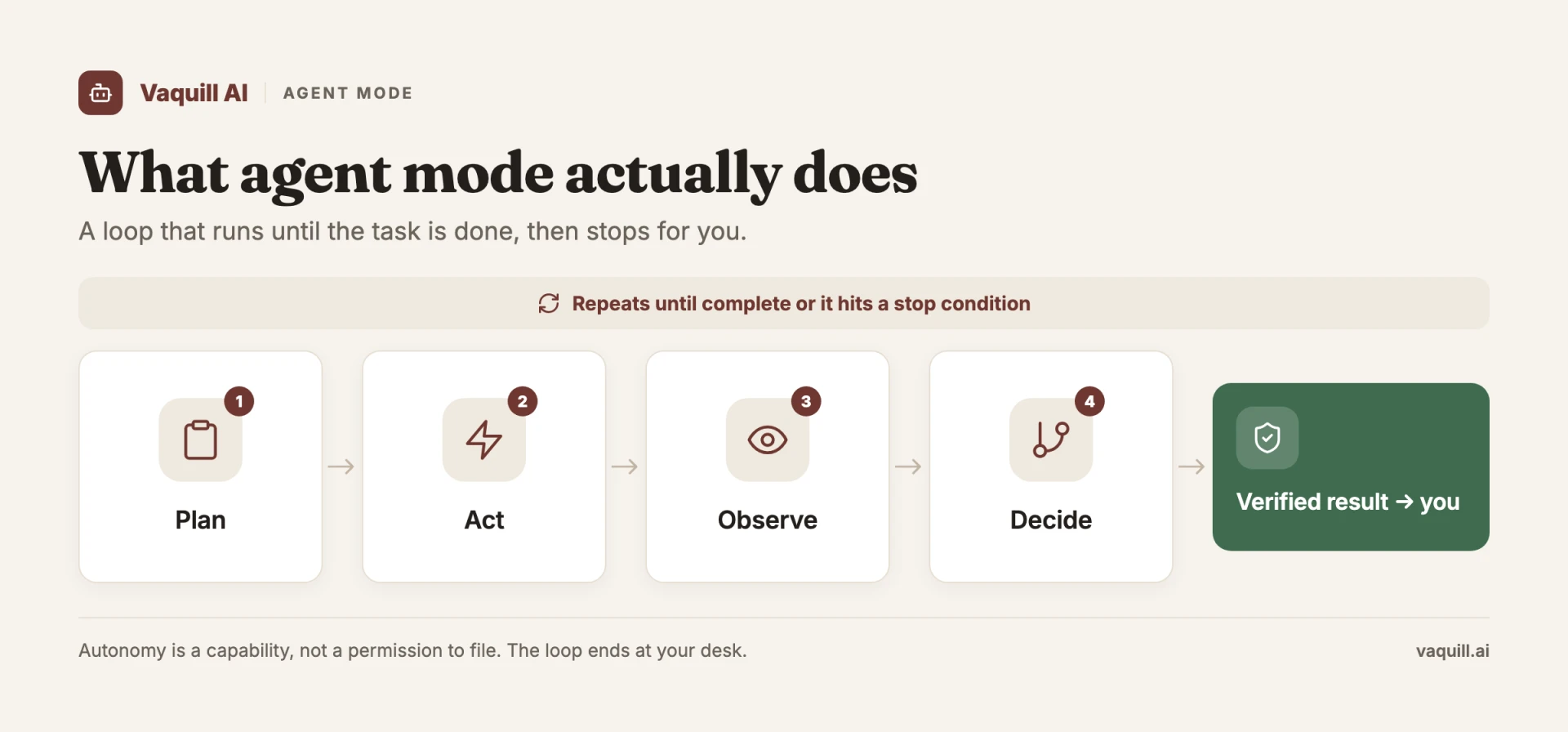
If you want the concrete build, we have written the wiring up in detail: how to use Claude for US legal research over MCP, how to compose CourtListener, CanLII, and Vaquill AI into one workflow, and how in-house teams stitch a full Claude plus MCP stack in place of a four-figure seat. For the broader case on legal AI for in-house counsel, start there.
The competitive read
Claude for Legal did not land in a quiet market. It landed in the middle of a funding arms race.
Harvey raised $200M at an $11B valuation in March 2026, co-led by GIC and Sequoia, pushing past $1B in total funding, as CNBC reported. Legora followed with a $600M Series D at a $5.6B valuation in April, per TechCrunch. And Anthropic itself, the model underneath much of this, closed a Series H that put it near a $965B post-money valuation.
Notice the shape. Harvey, Legora, Solve Intelligence, and Eve are all built on Claude, as Fortune noted. Anthropic just shipped a first-party legal layer that overlaps with the connector-and-plugin work those companies charge four figures a seat for. The platform is now competing, at least partway, with the businesses built on top of it.
For in-house buyers that is good news. The connective layer that used to be a premium is now table stakes, available to any paid Claude account. The thing worth paying for shifts from "can it connect to my tools" to "does it enforce how my team is allowed to work." That second question is where a governed suite earns its seat, and a general model will not answer it for you.
FAQ
What is Claude for Legal?
It is Anthropic's legal-focused release, launched May 12, 2026, adding more than 20 connectors to legal tools (Thomson Reuters, DocuSign, iManage, Box, Everlaw, and others), 12 practice-area plugins, and a Microsoft 365 embed that carries one Claude context across Word, Outlook, Excel, and PowerPoint, per Artificial Lawyer's launch coverage.
Is Claude for Legal free?
It is available to all paid Claude customers, with enterprise admins enabling it through workspace settings. There is no separate four-figure per-seat license just to access it, though your Claude plan still applies.
Can in-house teams use Claude for Legal for confidential work?
Technically yes, but treat it as a governance decision, not a default. A general model with connectors does not enforce matter segregation, playbooks, or an audit log by default. For client-privileged or matter-bound work, route it through a governed layer with those controls on.
How is Claude for Legal different from Harvey?
Harvey is a packaged vertical product built partly on Claude, priced at four figures a seat. Claude for Legal is a first-party model-plus-connector layer available on paid Claude plans. It overlaps with Harvey's connective layer but does not, on its own, replace a governed workbench.
What model does Claude for Legal run on?
Fortune reported it runs on Claude Opus 4.7, which scored 90.9% on Harvey's BigLaw Bench. That benchmark is Harvey's own, so treat the score as vendor-reported rather than independently verified.
Which law firms are using Claude for Legal?
Anthropic named Freshfields, Quinn Emanuel, Holland & Knight, and Crosby as firms running Claude on live matters, and said legal is the top power-user function inside its Cowork platform.
Does Claude for Legal replace a legal research tool?
Partly. It connects to research sources like Thomson Reuters and LexisNexis, so it can pull results into context. But a general model still needs a grounded, verifiable source for primary law. That is why an MCP layer matters: a statutes-and-legislation source for U.S. Code, CFR, and 50-state primary law, with a separate case-law tool such as CourtListener when you need opinions. The public MCP source we publish covers statutes and legislation, not case law.
Should in-house teams build on Claude for Legal or buy a governed suite?
Both. Use Claude for Legal for reach, connectors, and first-draft speed. Use a governed suite for matter segregation, playbook enforcement, audit logging, and verification on confidential work. They compose over the same MCP layer rather than competing.
The bottom line
Claude for Legal is the best connector layer Anthropic has shipped, and for in-house teams it genuinely reduces the tab-switching tax on legal work. It just is not a governed workbench on its own, and the NDA pilot above shows where that gap bites: template selection, playbook limits, and the audit trail. If you want reach and control, run both. Claude for the reach, a governed suite for anything client-confidential or matter-scoped. Vaquill AI publishes MCP servers, so it plugs into your Claude session and adds the segregation, playbooks, audit log, and 4-layer verification that a general model leaves to you. See how the governed layer fits.
New legal AI guides, weekly.
Further Reading
Claude Fable 5 and Legal AI: What Its Benchmark Records Actually Mean
Read postThe AI Value Gap: In-House Counsel Want AI Results Their Outside Counsel Are Not Delivering
Read postWhat Lawyers Really Think of Legal AI in 2026 (Reddit + Reviews)
Read postSpellbook's Autonomous Contract Management: What It Means for In-House Teams
Read postMost In-House Legal Work Is Not Legal Risk (and AI Is Proving It)
Read postThe Legal AI Consolidation Wave: What In-House Buyers Should Watch
Read post
Co-Founder & CEO · Attorney
Arshita leads product and strategy at Vaquill AI, the US primary law data API. As an attorney, she decides which law we carry, how each section is sourced and cited, and what legal AI and compliance teams need from the data.