Short answer: an agentic legal AI is a tool that plans and runs multi-step legal work (research, draft, cross-check) on its own, then hands you a result to verify, and in 2026 there is no single best one. The leading agentic suites (Harvey, Legora, CoCounsel, GC AI, and a few US-focused entrants) sit within a few points of each other on independent benchmarks, so the right pick depends on your work, your firm size, and how fast each tool lets you verify its output. For research-heavy litigation, weight grounding and verifiability. For transactional contract stacks, weight multi-document extraction. For an in-house team on a budget, weight price per seat and published pricing.
A managing partner at a 12-lawyer litigation shop asked me last fall which legal AI is the best. She had sat through four vendor demos in three weeks, every one of them flawless, every one of them ending with a slide that said the tool beat practicing lawyers on some benchmark.
She wanted a name. I told her the honest answer, which is that the question she was asking could not produce a useful answer, and that the better question was sitting right in front of her in those four demos. She just had not been told to look for it.
Here is the thing nobody selling you software wants to say out loud. In 2026, the leading agentic legal AI suites, Harvey, Legora, CoCounsel, and a handful of newer US-focused entrants, cluster within a few points of each other on the independent benchmarks.
Asking which legal AI is the best, as if there is a single throne, is like asking which is the best car. Best for what? Hauling lumber, commuting forty miles, or parking in a city the size of a shoebox?
The accuracy leaderboards are real, and they matter, but they have converged to the point where the top numbers are a near-tie. The actual differentiator is no longer the rank. It is the fit between a tool's capabilities and your work, and whether the tool lets you check what it told you.
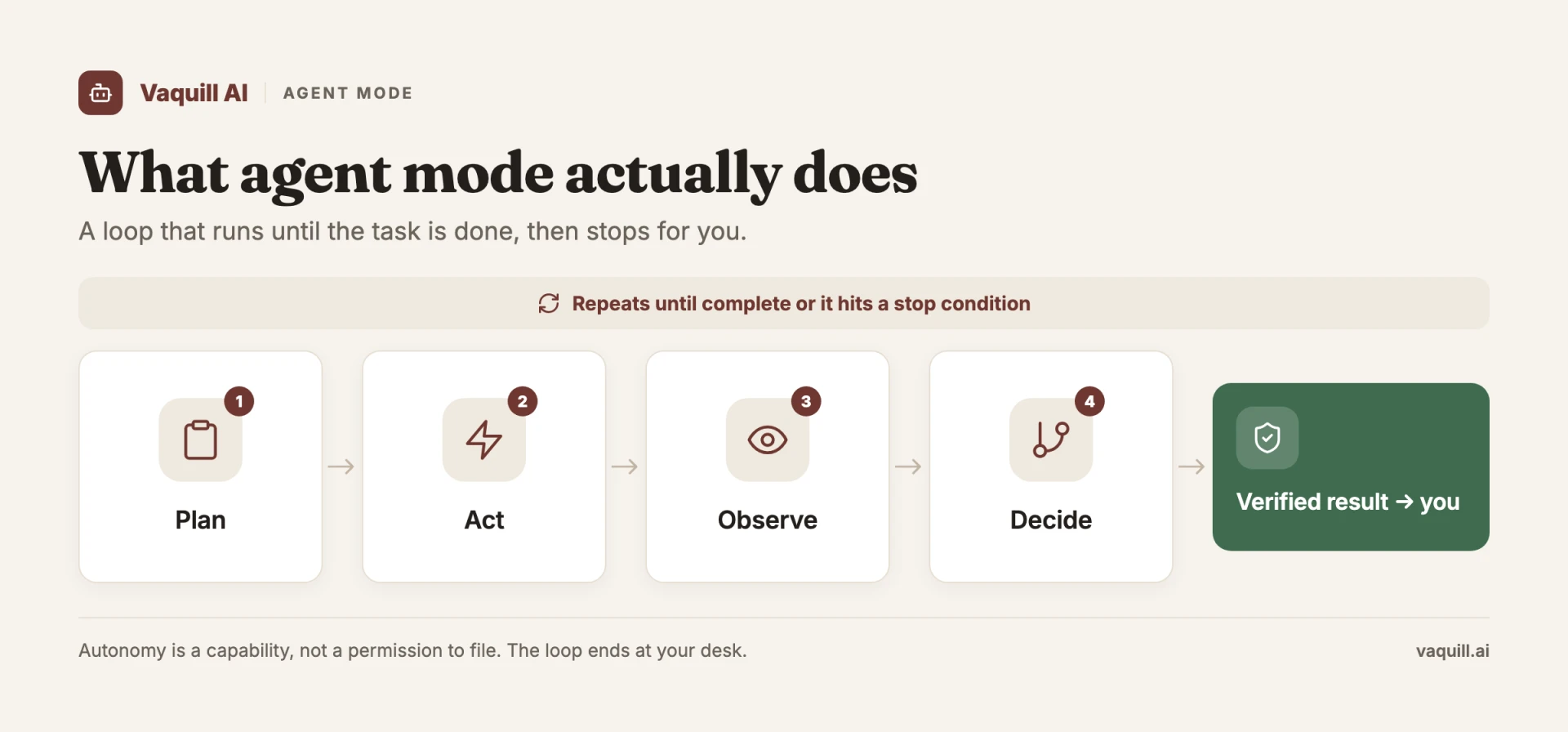
Agent mode is a loop that runs until the task is done, then returns a verified result for approval.
TL;DR
- "Which agentic legal AI is the best" has no single answer in 2026, because the leading suites are bunched within a few points of each other on independent benchmarks. Best is a function of fit, not a leaderboard rank.
- Vals AI's October 2025 benchmark found legal-specialist tools and general ChatGPT landed within about 4 points of each other, roughly 7 points above a practicing-lawyer baseline, then dropped about 11 points on multi-jurisdictional questions.
- The winner changes per task. Vals' earlier round showed different tools topping different tasks (extraction, redlining, research), which is the whole point: match capabilities to your workflow.
- Security is a pass/fail gate, not a scoring axis: no SOC 2 Type II and no DPA that names its model subprocessors, no shortlist.
- Evaluate on five axes, not one number: grounding transparency, capability surface area, multi-document and agentic depth, verifiability, and fit to your firm size.
- A leaderboard score does not absolve your verification duty under ABA Formal Opinion 512, and price does not buy accuracy.
On Vals AI's October 2025 round, how far apart were the legal-specialist tools and general ChatGPT?
Part of our document tools, redline, and matrix guide series.
For related document-tools coverage, see Legal AI Workflows: How Law Firms Chain Multi-Step AI Tasks in 2026 and Autonomous Legal Research: What Agent Mode Actually Does (and Where It Breaks), and a legal AI agent running one in-house task end to end.
Which legal AI is the best? Why the leaderboard stopped being the answer
In October 2025, the independent benchmarking firm Vals AI published the second round of its legal AI report. The number that traveled was that several tools, including general-purpose ChatGPT, scored above a baseline of practicing lawyers on a battery of real legal tasks. Fine.
The detail that actually reframes the buying decision is quieter: the legal-specialist tools and the general models landed within roughly four points of each other, about seven points above the lawyer baseline. Four points. That is the spread separating the "best" tool from the field on the headline metric.
When the gap between first place and the pack is that thin, the leaderboard stops being a decision tool and becomes a vanity stat. You do not pick a litigation strategy on a four-point edge that may not even survive the next benchmark round. You certainly do not rebuild your firm's research workflow on it.
There is a second number from that same report that matters more than the rank, and it almost never makes the demo slide. On multi-jurisdictional questions, the kind a real practice actually generates, performance dropped by around eleven points across the board.
So the tools are nearly tied on the easy stuff and they all stumble on the hard stuff. That is the shape of the field. If your matters routinely cross state lines, the headline accuracy number is describing a test you will rarely sit.
Two more numbers frame the stakes. Adoption is no longer early: the 2026 General Counsel Report from FTI Consulting and Relativity put in-house generative-AI use at 87 percent, up from 44 percent a year earlier (reported via GC AI, 2026). And vendors have started grading their own homework. GC AI's May 2026 in-house benchmark scored GC AI at 86.8 percent and the best general model about 7 points back (GC AI, May 2026), which is exactly the kind of vendor-run number to discount: the vendor wrote the test and picked the tasks. When you see a benchmark, the first question is who owns the scoreboard.
I want to be careful here, because legal AI marketing is awash in restated statistics. The cleanest independent grounding data we have is still Stanford HAI's peer-reviewed 2024 work, which measured hallucination rates around 34 percent for Westlaw's AI and around 17 percent for Lexis+ AI. Those are the original figures.
You will see third-party aggregators float newer-sounding accuracy rankings; treat anything that is not the primary study with suspicion, because most of it is a secondary source dressed up as research. The discipline of asking "who actually measured this, and can I read the methodology" is the same discipline you should apply to the tools themselves.
For the deeper version of the incumbent side of this story, including why Thomson Reuters and LexisNexis both declined to participate in the Vals benchmark while AI-native tools showed up, see the full companion piece: Lexis+ AI vs Westlaw AI vs Vaquill AI. That post is the pricing-and-trust argument anchored on benchmark refusal. This one is forward-facing and about capability. I will not re-litigate the citators.
What most people get wrong
Four mistakes come up in nearly every evaluation I watch.
They treat "best" as one global ranking. It is not. In Vals' earlier round, different tools topped different tasks. Harvey led on a majority of the tested tasks and beat the lawyer baseline on several; CoCounsel posted strong scores and topped the specific tasks it was tested on.
The leader of "document extraction" is not necessarily the leader of "redlining" or "research memo drafting." If you average those into a single number, you have thrown away the only information that would have helped you choose.
They judge by demo polish. Every one of these suites demos beautifully, because the demo is a controlled question with a known answer. The thing that separates them in production is harder to see in forty-five minutes: how the tool behaves on a messy, half-formed question with no clean answer, and whether it tells you where its answer came from.
They confuse single-document chat with the harder capabilities. Uploading one contract and asking questions is the floor. It is not the same capability as extracting twenty data points across forty NDAs into a tabular grid (some suites call this a document matrix), and that in turn is not the same as an autonomous multi-step pipeline that researches, drafts, and checks itself across several moves. Three different capabilities, often sold under the same word "AI."
They assume a high score absolves the verification duty. It does not. ABA Formal Opinion 512 (July 2024) puts the duty of competence and candor on you regardless of which tool produced the draft. The lawyers sanctioned in Mata v. Avianca in 2023 learned that the hard way with hallucinated citations.
No benchmark number transfers that liability off your shoulders. Which means verifiability is not a nice-to-have feature. It is the feature that determines whether you can safely use the output at all.
The agentic suites, side by side
Here are the credible agentic legal AI suites a US buyer shortlists in 2026, with what each is built for, published or sourced pricing, and one honest weakness. Pricing for the sales-led suites is a range because the per-user number depends on the tier and add-on mix; founder-confirmed figures are labeled as such.
| Suite | Best for | Price (per user / mo) | Real weakness |
|---|---|---|---|
| Harvey | BigLaw, enterprise research and drafting | $1,200 to $2,000+, sales-led (also new metered credits) | Highest price; pricing hidden behind NDAs |
| Legora | Multi-jurisdiction review, EU and UK firms | $300 to $800, sales-led (also metered credits) | Reliability complaints past long documents |
| CoCounsel (Thomson Reuters) | Westlaw-grounded research | $225 to $400+ depending on capabilities | Still fabricates citations; thin on appellate |
| GC AI | In-house counsel, fast self-serve | $500, Individual (published gc.ai/pricing) | Little independent forum track record |
| Spellbook | Word-native contract drafting | Base $500, quote-based | Transactional only; weak for litigation |
| Vaquill AI | In-house teams who need grounded research plus drafting | Published self-serve, see pricing | Smaller brand than the BigLaw incumbents |
Prices above are founder-confirmed or vendor-published as of June 2026 (see what Harvey, Legora, and CoCounsel actually cost for the full breakdown). Numbers move; confirm at the demo.
Harvey: built for BigLaw research and drafting
Harvey is the default enterprise pick, and it is priced like one. The suite centers on Assistant, a document vault for bulk analysis, and workflow agents. What users say: practitioners are split. On r/legaltech, the recurring line is that "the associates hated Harvey, but the partners went with it because they think it is magic" (Reddit, Nov 2025). The common gripes are price, NDA-gated pricing, and a sense that the gap over a cheaper ChatGPT or Claude seat is narrower than the invoice implies. Worth it if you are an Am Law firm with a procurement team. Hard to justify for a solo.
Legora: multi-jurisdiction review for EU and UK firms
Legora is the European-built challenger, strong on tabular document review across jurisdictions and cheaper than Harvey. What users say: the cost edge is real, but reliability complaints dominate the same r/legaltech threads (Reddit, Nov 2025): a rocky rollout, retention gaps, and answer quality that users say degrades on very long documents. Good fit for cross-border transactional review. Test it on your longest documents before you commit.

CoCounsel: Westlaw-grounded research
CoCounsel, now rebuilt by Thomson Reuters on Anthropic's Claude Agent SDK, leans on Westlaw content for grounding and is the most transparently priced of the BigLaw-tier suites. What users say: a University of Michigan legal-tech review praises ease of use and time savings but warns it still fabricates citations and runs thin on appellate material, so "verify everything" (Michigan Legal Tech series, 2024). Strong if you already live in Westlaw. The verification duty does not go away.
GC AI: in-house counsel, self-serve
GC AI targets in-house legal teams and is one of the few suites that publishes a price openly: $500 per seat, Individual tier, with team and enterprise on request (gc.ai/pricing, June 2026). What users say: there is little genuine independent forum discussion yet, mostly vendor and press coverage, so treat the buzz with the same skepticism you would any new entrant. The published price and self-serve access are the honest selling points. For the full in-house shortlist, see the best legal AI tools for in-house counsel.
Spellbook: Word-native contract drafting
Spellbook lives inside Microsoft Word and is the best-liked tool among transactional lawyers. What users say: the Word add-in draws consistent praise (Lawyerist rates it around 4.1 out of 5), with the caveat that it still inserts wrong citations and is transactional-only, so it is weak for litigation (Lawyerist review). Buy it for redlining and drafting; do not expect case research.
A capability rubric, not a horse race
Here is the framework I gave that managing partner. Score each tool on five axes for your practice, not in the abstract. The tool that wins on paper for a securities boutique is not the one that wins for a personal injury solo.
1. Grounding transparency
Where does the answer come from, and can you click through to the source? This is the single most important axis, and it is the one demos hide best. A grounded tool retrieves from a known corpus and shows you the underlying authority.
The honest US case-law corpus is not proprietary magic; it is largely the open public record of court opinions, which several products build their case-law research on. Ask any vendor a blunt question: when your tool cites Carpenter v. United States, 585 U.S. 296 (2018), can I open the actual opinion from inside the answer, or am I taking the model's word for it? If the answer is the latter, the grounding is decorative.
A retrieval-grounded system (RAG, not relying on what a model memorized in training) is the difference between an answer you can file and an answer you have to redo by hand. The whole reason grounding matters is that the model's training data is frozen and lossy; Loper Bright v. Raimondo, 603 U.S. 369 (2024) overruling Chevron is exactly the kind of recent shift a non-grounded tool will get confidently wrong.
2. Capability surface area
Make a list of what you actually do in a week. Research memos. Redlining a lease. Building a chronology for a deposition. Extracting indemnification terms across a stack of vendor contracts. Statute lookups.
Now map each tool's features against that list. Most suites cover research and document chat. Fewer do real multi-document tabular extraction. Fewer still chain steps autonomously. And where the tool lives matters: transactional teams live in Microsoft Word, so a Word-native add-in gets used daily while a separate web app gets forgotten by week three.
The breadth you need is the breadth that matches your list, no more. Paying for an agentic workflow engine you will never wire up is the same waste as paying for an unbenchmarked brand.
3. Multi-document and agentic depth
This is where the suites genuinely diverge, and where the marketing word "agentic" gets stretched thin. There is a real ladder of difficulty:
- Single-doc Q&A. Table stakes.
- Multi-doc extraction into a grid. Comparing thirty documents on the same axes. This is a different engineering problem and a different daily-utility problem. If your practice is transactional, this matters more than research accuracy.
- Autonomous multi-step research. A mode that plans, runs several retrieval and reasoning steps, and assembles a result without you babysitting each move. Most agentic suites ship one now under varying brand names. The honest evaluation question is not "does it have an agent mode" (they all claim one now) but "does it show its steps and its sources at each hop, so I can audit the chain?"
Here is the loop on a real task. Ask an agentic suite whether a two-year non-compete is enforceable for a sales engineer in Illinois, Texas, and Washington. A shallow tool returns one confident paragraph. An agentic one plans the three jurisdictions, pulls each state's statute and the controlling cases, notes that Washington and Illinois both void non-competes for workers below an income threshold while Texas enforces reasonable ones, drafts the state-by-state comparison, then flags the questions where its own confidence is low. The output you can actually file is the one where every hop is visible.
A tool that does step three but hides the chain is more dangerous than one that does only step one, because it produces more output you are tempted to trust without checking.
4. Verifiability
Distinct from grounding. Grounding is "where did this come from." Verifiability is "how fast can I confirm it before I file." Can you jump from a cited proposition straight to the pinpoint authority? Does the tool surface a statute like 42 U.S.C. 1983 (the color-of-state-law civil rights provision) with the actual text, or just a summary you have to go re-pull elsewhere?
The faster a tool makes verification, the more of its output you can actually use, because verification is the bottleneck, not generation. A suite that generates ten memos an hour but makes each one take forty minutes to check has not saved you time. It has moved your work downstream.
5. Fit to firm size
The trust, integration, and pricing math that makes sense for a 2,000-lawyer firm is different from a five-person practice. BigLaw can absorb a per-seat price that would sink a solo, and it values a recognizable logo on the invoice for procurement and malpractice-carrier reasons.
A small firm is buying capability per dollar, and the unbenchmarked premium brand is the actual risk, not the AI-native challenger. We worked through the dollars in what firms actually pay for legal research in 2026. The short version: the right answer to "which is best" is partly an answer to "best at what price, for how many seats, doing which work."
Scoring it in practice
Take the managing partner's litigation shop. Their week is heavy on case research, deposition prep, and chronology building, light on transactional contract stacks. So for them:
- Grounding transparency and verifiability weigh heaviest, because every research output feeds a filing and Mata v. Avianca is the nightmare they are insuring against.
- Multi-document grid extraction (the document matrix capability) is nice but not central; they are not redlining forty vendor agreements a month.
- Agentic depth is useful for first-draft research memos, but only if the chain is auditable.
- Fit to firm size pushes them away from per-seat pricing built for hundreds of lawyers.
Run the same five axes for a 20-lawyer corporate group and the weights flip. Document matrix and contract-review skills jump to the top; deep case-law verifiability matters less than turnaround on extraction.
Same field of tools, different winner. That is not a dodge. That is the actual answer to the question, and it is why a single ranking was always going to mislead you.
If you want to see what "show your work" looks like as a standard rather than a slogan, published methodology is the tell. A benchmarks page is one example of the bar to push every vendor against. A vendor that will not publish how it measured itself is asking you to grade its homework on faith.
Where the field is heading
Two predictions, held loosely. First, the headline accuracy numbers will keep converging, which means the marketing will get louder about the leaderboard exactly as the leaderboard becomes less meaningful. Tune it out.
Second, the real competition is shifting to the parts the benchmarks do not measure well: multi-document depth, the auditability of agentic chains, and how fast a tool lets you verify before you file. The suite that wins your firm in 2027 will not be the one that was one point higher on a 2026 test. It will be the one whose capability surface matched your actual week and whose output you could trust without re-doing it.
So the next time a demo ends on a leaderboard slide, ask the boring questions instead. Show me the source. Show me the chain. Show me how this handles a multi-jurisdictional mess, not the clean question you rehearsed. The tool that answers those calmly is the one that is best, for you. There is no other kind of best worth buying.
Our honest pick
For a lean US in-house team that needs grounded case-law research plus drafting and matter document management in one place, Vaquill AI is the suite we would put on the shortlist, because the case-law research is grounded in the public record of US court opinions (you can open the cited opinion from inside the answer) and the price is published rather than NDA-gated. Where it falls short: it is a smaller brand than Harvey or CoCounsel, so if your malpractice carrier or procurement team wants a household logo on the invoice, that is a real reason to weigh the incumbents. Run the five axes for your own week before you decide.
FAQ
What is agentic legal AI? Agentic legal AI is software that plans and runs multi-step legal work on its own, retrieving authority, reasoning across it, drafting, and cross-checking, then stopping for a lawyer to verify and sign off. The distinction from a chatbot is autonomy: instead of answering one prompt at a time, it pursues a whole task and reports back. The suites that matter for US buyers in 2026 include Harvey, Legora, CoCounsel, GC AI, and Vaquill AI.
How is agentic legal AI different from generative AI? Generative AI responds to each prompt you type; you drive every step. Agentic AI takes an objective, breaks it into steps, and executes them with limited supervision, closer to handing an assignment to a junior associate than typing questions into a chatbot. The catch is auditability: the more autonomous the tool, the more it matters that it shows its sources and its steps, because you still own every citation it produces.
Which legal AI is the best in 2026? There is no single best. The leading agentic suites cluster within a few points of each other on independent benchmarks, so the best one is the one whose capabilities match your weekly work, fit your firm size, and let you verify output fastest. Score your shortlist on grounding, capability breadth, agentic depth, verifiability, and price.
Is Harvey worth the price? For an Am Law or large enterprise firm with a six-figure AI budget, often yes; it is built and priced for that buyer. For a solo or small in-house team, the $1,200 to $2,000+ per user range is hard to justify against cheaper suites that cover the same daily work.
What is the most accurate legal AI? On Vals AI's October 2025 round, the legal-specialist tools and general ChatGPT landed within about four points of each other, above a practicing-lawyer baseline. No tool is reliably "most accurate" across every task, and all of them dropped around eleven points on multi-jurisdictional questions. Be wary of vendor-run benchmarks that put the vendor on top: the one who writes the test picks the tasks.
Do legal AI tools still hallucinate citations? Yes. Stanford HAI's 2024 study measured hallucination around 34 percent for Westlaw's AI and around 17 percent for Lexis+ AI (arXiv, 2024), and user reviews of newer suites still warn to verify every citation. A grounded tool that links to the source reduces the work, but does not remove your duty to check.
Which legal AI is best for in-house counsel? In-house teams usually want published pricing, fast self-serve onboarding, and contract plus research coverage in one place. GC AI and Vaquill AI both target that buyer with published prices; the enterprise suites tend to require a sales cycle and a higher seat minimum.
What is the cheapest agentic legal AI suite? Among the named suites, CoCounsel starts lowest at around $225 per user per month, and Legora's range starts around $300. General-purpose tools like ChatGPT or Claude are cheaper still, but they are not grounded in legal sources, so you carry more verification risk.
Is ChatGPT good enough for legal work? It can draft and summarize, and it scored competitively on the Vals benchmark, but it is not grounded in a legal corpus and will confidently miss recent shifts like Loper Bright overruling Chevron. For anything you file, a retrieval-grounded legal tool you can audit is the safer choice.
How do I evaluate a legal AI before buying? Run a security gate first (SOC 2 Type II, a DPA that names subprocessors, a no-training option), then run a capability rubric on your own work, not the vendor's demo. Score each tool on grounding transparency, capability surface area, multi-document and agentic depth, verifiability, and fit to your firm size, then weight the axes by what you actually do in a week.
New legal AI guides, weekly.
Further Reading
Top AI Chatbot for Legal Writing: An Honest 2026 Test
Read postTop Contract Management Vendors for Fortune 500 Legal Teams
Read postWhat Is NDA Triage? How Lawyers Sort Inbound NDAs in Minutes With AI
Read postNDA Triage AI: How AI NDA Review Works and How to Evaluate a Tool (2026)
Read postHow to Draft a PI Demand Letter and Build the Chronology With AI
Read postLegal Document Version Control: Which Platforms Track Versions
Read post
Product & Content
Legal AI suite for US working lawyers: research, drafting, document comparison, document matrix, matters, and citation-verified answers, in one tool.