Open any in-house lawyer's calendar and the surprise is not how much legal risk they carry. It is how little of the week is actually spent on risk at all. A big chunk is routing, chasing, sorting, and stamping standard paper. That work has always been mixed in with the real judgment calls, so nobody could see the split. AI triage is now separating the two, and the result is uncomfortable: most in-house legal work was never legal-risk work to begin with.
This piece is about the nature and composition of the job, not a forecast of how many hours AI will take. If you want the forecast angle, we cover it in how much in-house legal work AI agents will take. Here I want to argue something sharper. Speed is the least interesting thing triage gives you. The real prize is the X-ray. Triage finally shows you what your team does all day.
TL;DR
- Most in-house work is operational, not risk assessment. Intake routing, NDA triage, standard-form review, and status chasing are high-volume and judgment-light. They were always there, just buried inside "legal work."
- AI triage makes the split visible for the first time. When a tool routes the routine, what is left on a lawyer's desk is the actual judgment work. That is the real product of triage, not the time saved.
- The numbers are self-reported but consistent. A December 2025 GC AI study of 100-plus customer teams reports 14 hours saved per lawyer per week. Treat vendor figures as directional, but the direction is clear.
- This reorders staffing. Once you can see the composition, you stop hiring generalists to absorb volume and start hiring for the judgment layer.
- The catch nobody prices in: the routine work you route away is the same work that trained junior lawyers to spot risk. You have to rebuild that apprenticeship on purpose.
What does the post say is the real prize of AI triage for an in-house team?
What "legal work" actually hides
Ask a general counsel what their team does and you will hear "manage risk." Watch the team for a week and you will see something else. A lawyer spends forty minutes deciding which contract goes to which reviewer. Another spends an afternoon reading a mutual NDA that matches the company playbook line for line. A third sends the fourth follow-up email asking sales for the counterparty's signature.
None of that is risk assessment. It is operations wearing a lawyer's badge.
The reason this stayed invisible is simple. All of it arrived through the same inbox, got done by the same person, and got billed to the same "legal" line. There was no clean seam between the fifteen-minute judgment call and the two-hour sorting task. So teams staffed for the total volume and assumed the whole pile was legal work.
Juro's State of In-House 2025 report, which surveyed 160 in-house lawyers across 20-plus countries, gives a hint of how much of the pile is now automatable. In the prior 12 months, 58% of respondents had used AI for contract review, 83% for legal research, and 31% for redlining. Read that as a map of where the routine sits. When more than half a profession points AI at contract review first, that is the profession telling you contract review was mostly not the risk part. One methodology caveat: this is a self-selected survey of lawyers who opted in, so it skews toward the AI-curious. Treat the percentages as a signal of direction, not a census.
How AI triage exposes the in-house legal work split
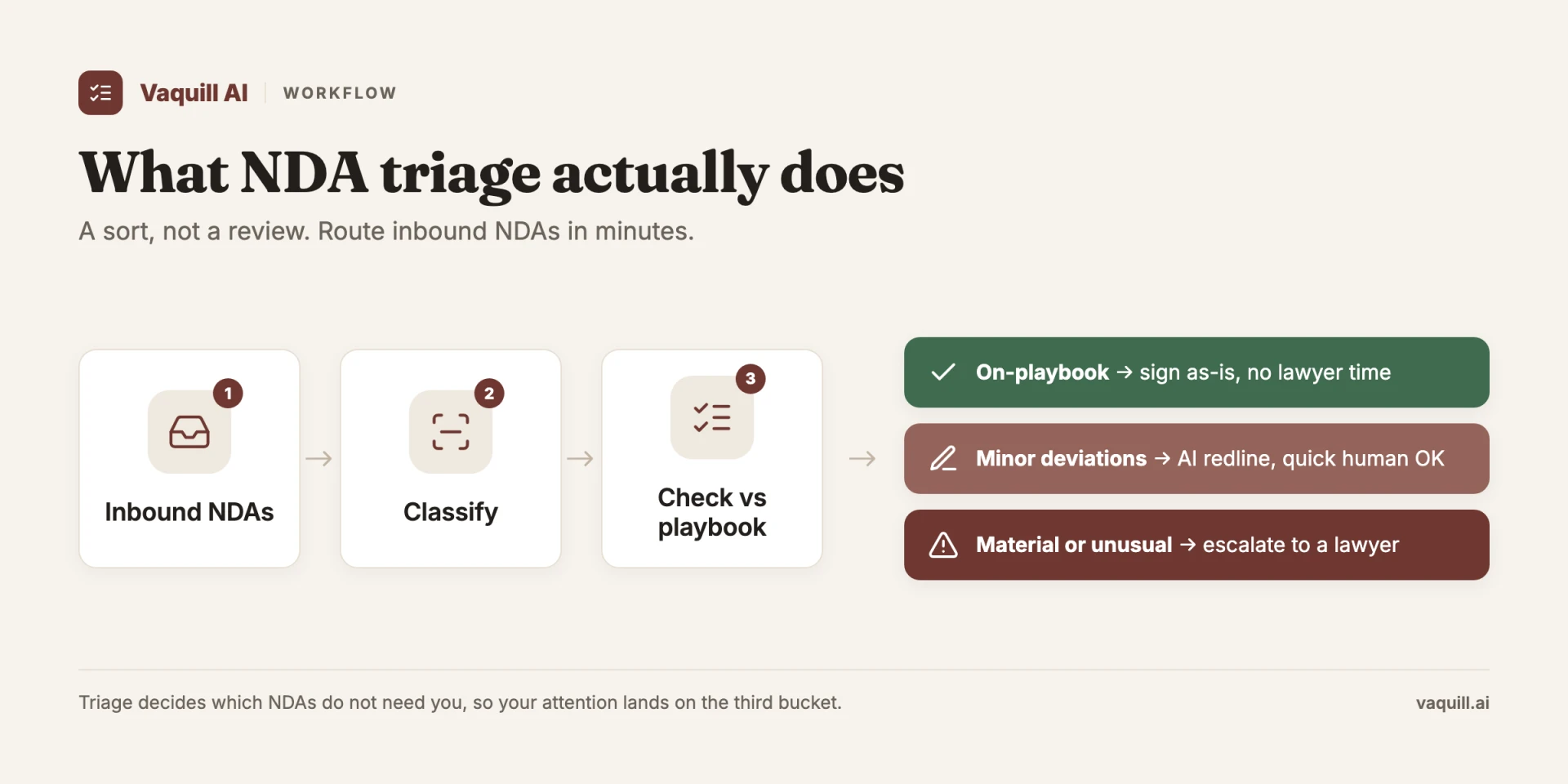
Triage is a sorting step. Work comes in, and something decides where it goes: handle it now, route it to a template, escalate it to a person, or park it for review. When a human does the sorting, the sorting itself is hidden labor. When a tool does it, the sorting becomes a log you can read.
That log is the insight. For the first time you can see, in one place, how many items were pure routing, how many matched a standard form, and how many needed a real decision. The composition stops being a guess.
Once you have that log, the argument changes from "AI saves time" to "AI tells you what your job is made of." The December 2025 GC AI ROI study, run across more than 100 of its own customer teams, reports 14 hours saved per lawyer per week, which it frames as roughly a 35% cut in time on the work the tool handles. That is a vendor study, so read it with the usual discount. But even at half that figure, you are looking at a day a week that was going to work a machine can sort. A full third of the week, gone to the routine layer, is a composition problem, not a productivity one.
Why this reorders how you staff and prioritize
Here is the operational payoff. Once the composition is visible, the hiring logic flips.
The old model hired generalist counsel to absorb volume. More contracts meant more lawyers, because a person had to touch every item. That made sense when sorting and judgment were fused. It stops making sense the moment a tool can carry the sorting.
The capacity squeeze is real and well documented. Thomson Reuters research, cited in Summize's 2026 write-up on building effective legal teams, found that 79% of legal teams report rising contract volumes while only about a third see matching headcount growth. The reflex answer is "hire more generalists." The composition-aware answer is different: put the high-volume, judgment-light work on rails, and hire for the judgment layer you can now see clearly.
Here is the split I would put in front of a GC deciding where to point a triage tool first.
| In-house work | Nature | Route it or keep it |
|---|---|---|
| Intake and matter routing | Operational, rules-based | Route |
| NDA triage against a playbook | High-volume, standard terms | Route first pass |
| Standard-form review (order forms, DPAs) | Pattern-heavy | Route first pass |
| Status chasing and signature follow-up | Pure operations | Route |
| Bespoke contract negotiation | Judgment, relationship | Keep |
| Risk and exposure calls | Accountability | Keep |
| Regulatory strategy and board advice | Business context | Keep |
The pattern is the same one buyers keep rediscovering: the routine layer is bigger than anyone admits, and it is not where the risk lives. For a task-level view of the highest-volume candidate, our explainer on what NDA triage is walks through why standard NDAs are the safest first thing to route. For the broader restructuring picture, see how AI is transforming in-house legal teams.
The apprenticeship problem you inherit
There is a cost to routing all the routine work, and it is not the tool license.
The standard NDA review, the first-pass redline, the intake sort: those tasks were tedious, but they were also how a junior lawyer learned. You read two hundred NDAs and you start to feel which deviation is boilerplate and which one will bite. That pattern recognition is the raw material of judgment. It came from doing the boring work, over and over.
Route all of that to a tool and you have solved this year's capacity problem while quietly breaking next year's training pipeline. The junior who used to grind through the routine and slowly build instinct now gets handed only the hard calls, with none of the reps that prepare you for them. You cannot verify AI's work well if you never did the work yourself.
This is the honest tension in the whole shift. The Juro survey found real strain in the profession already, with 23.3% of respondents reporting burnout in the past year. Triage genuinely relieves that by clearing the routine pile. But if you clear the pile and forget it was also the classroom, you trade a burnout problem now for a judgment gap in three years.
What a composition-aware team looks like
Put it together and the playbook is not complicated.
First, run triage on your two or three highest-volume workflows and actually read the log it produces. You are measuring composition, not just saving time. Second, take the routine layer the log exposes and put it on rails, with a named human on quick sign-off. Third, redeploy the hours you free toward the judgment work that was always the point: the negotiations, the exposure calls, the business partnering. Fourth, and this is the one teams skip, make verification of the routed work a deliberate training track for juniors, so the apprenticeship survives the automation.
A tool like Vaquill AI for in-house counsel can carry the drafting, redline, and bulk-review layer while your team owns the judgment. If you want to see what your own work composition looks like, start with one high-volume workflow in Vaquill AI and read the triage log before you decide anything else.
FAQ
Is most in-house legal work really not about legal risk? A large share of it is operational: routing, chasing, and reviewing standard paper that matches a playbook. The genuine risk work, the exposure calls and negotiations, is a smaller slice than the "legal" label suggests. Triage is what makes that split measurable instead of assumed.
What is legal triage in an in-house team? It is the sorting step that decides where each incoming request goes: handle it now, send it to a template, escalate it to a lawyer, or park it. When a tool does the sorting, it also logs the composition of the work, which is the part that used to be invisible.
Does AI replace in-house lawyers? No. It routes the high-volume, judgment-light work and hands the real decisions back to a person. The accountability, negotiation, and business-context calls stay human. What changes is that lawyers spend less of the week on operations wearing a legal badge.
How much time do in-house lawyers actually save with AI? A December 2025 GC AI study of its own customer teams reports 14 hours per lawyer per week, or roughly a third of the week. That is a self-reported vendor figure, so discount it, but even a conservative read points to a large routine layer.
Which in-house tasks should you automate first? Start where a wrong first pass is cheap to catch: NDA triage against a playbook, standard-form review, intake routing, and status chasing. Keep negotiation, risk calls, and board-facing strategy with a named human.
If AI takes the routine work, how do junior lawyers learn judgment? Deliberately. The routine reps that used to build instinct now move from doing the work to verifying the tool's output. Make reviewing triage decisions an explicit part of a junior's job so the apprenticeship does not quietly disappear.
Does a public legal AI API cover case law? Vaquill AI's public API is statutes and legislation only, covering US Code, CFR, and all 50 states. It does not offer a case-law, citation, or legal-question API. Case-law research is a product feature, not something sold through the API.
New legal AI guides, weekly.
Further Reading
The AI Value Gap: In-House Counsel Want AI Results Their Outside Counsel Are Not Delivering
Read postThe Legal AI Consolidation Wave: What In-House Buyers Should Watch
Read postHow Much In-House Legal Work Will AI Agents Actually Take?
Read postIn-House Legal AI Adoption Hit 87 Percent: What the Leaders Do Differently
Read postClaude Fable 5 and Legal AI: What Its Benchmark Records Actually Mean
Read postClaude for Legal: What In-House Teams Need to Know
Read post
Co-Founder & CEO · Attorney
Arshita leads product and strategy at Vaquill AI, the US primary law data API. As an attorney, she decides which law we carry, how each section is sourced and cited, and what legal AI and compliance teams need from the data.