The most-upvoted thread in r/legaltech this quarter is a pricing post from someone on a firm innovation committee. They posted what the legal AI vendors floated during their evaluation. The comments are 168 deep, and the recurring theme is that buyers cannot get a straight number before a demo. The figures people trade in threads like that run high and inconsistent. Here are the sourced ones.
Harvey is $1,200 to $2,000+ per user per month for unlimited AI usage. Legora is $300 to $800 per user per month for unlimited AI usage. CoCounsel Legal is $225 to $400 and up per user per month, and the CoCounsel-plus-Westlaw bundle a solo attorney actually buys runs to about $639 per user per month (Costbench, June 2026, from the Thomson Reuters configurator).
This post breaks down each price, what you get, and how the math shakes out for a small firm.
TL;DR
- Harvey is $1,200 to $2,000+ per user per month, unlimited AI. Legora is $300 to $800. Both prices are a bundle: the tier you pick plus the per-feature add-ons set your per-seat number. Both also now sell a pay-as-you-go, credit-based metered plan.
- CoCounsel Legal from Thomson Reuters is $225 to $400 and up per user per month, depending on which capabilities you switch on.
- The seat minimum is the real wall: analysts report Harvey at roughly a 25-seat, 12-month floor (about $360,000 a year) and Legora at a 10-seat, ~$30,000 minimum. A 5-lawyer firm cannot buy what it needs.
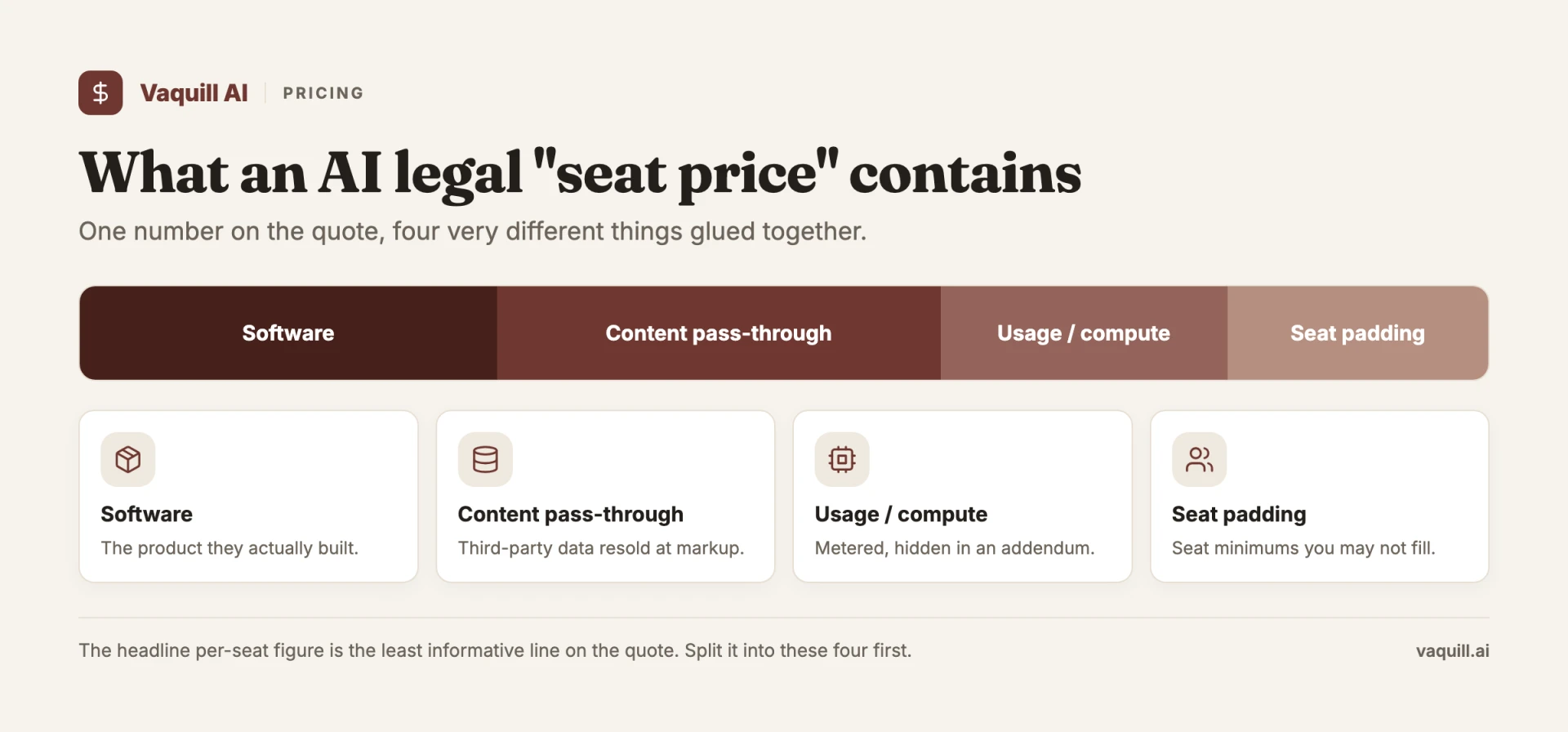
- The seat price is not the bill. Add implementation, training, premium support, and renewal uplift and the analyst-reported Year-1 overhead runs 30 to 50 percent above the headline license.
- Harvey's Year-1 total cost scales with the firm: analysts model $400,000 to $700,000 for a small specialized team, $1.97M to $2.25M for 100 attorneys, and $5M and up for an AmLaw 100 floor.
- A small firm can run a workable AI legal stack on a self-serve, published seat, one seat, month to month, with none of those hidden fees.
How much does Harvey cost? Harvey runs $1,200 to $2,000+ per seat per month for unlimited AI usage, with analyst-reported quotes near $1,200 base and $2,400 with the Lexis bundle. That is well above Legora at $300 to $800 and CoCounsel Legal at $225 to $400 and up per seat. Here is how the three stack up, seat by seat.
Part of our legal AI vendor comparison and pricing series.
What is Harvey's reported seat price?
The valuations explain most of the pricing
Harvey raised a $300M Series E in November 2024 at a $5B valuation, with a follow-on in 2025 that pushed it past $8B. Legora closed an $80M Series B at unicorn status in November 2025 (CEO Max Junestrand confirmed the numbers in an r/legaltech AMA), with $265M raised in total and 400-plus clients across 40 countries. Thomson Reuters paid $650M for Casetext in 2023 and folded it into Westlaw.
None of these are consumer companies. The per-seat prices say so. To earn those multiples, each one has to sign big firms at four-figure per-seat deals.
That goal shapes every call a buyer has with the sales team.
Harvey
Pricing: $1,200 to $2,000+ per user per month for unlimited AI usage. The range is wide because Harvey sells a bundle. The tier you choose and the add-ons you stack on top set your per-seat number. Harvey also now offers a pay-as-you-go, credit-based metered plan for teams that would rather count usage than commit to a fixed seat.
What you get: Harvey serves 235-plus legal customers worldwide, including A&O Shearman, PwC Legal, and DLA Piper. It runs agent workflows for due diligence, contract review, litigation drafting, and research. It integrates with Lexis+ and Practical Law.
What moves the price: the add-on mix. The Lexis integration passes through the underlying LexisNexis license, so a seat with Lexis sits near the top of the range. A seat with fewer add-ons and a lighter workflow set sits near the bottom. The metered credit plan is there for buyers who want to pay per use.
A note on the high end. Our reported range for a standard Harvey seat tops out around $2,000. Third-party analysts who track leaked Harvey quotes report a higher figure once the full LexisNexis bundle is stacked on.
The eesel AI Harvey pricing breakdown (2026) lists a base seat around $1,200 per month and a Lexis-bundled seat at roughly $2,400 per month, with a financial-enterprise tier near $2,500. Those numbers are reported, not vendor-published, so treat them as the analyst read on the top of the market: a Harvey seat with every premium add-on switched on can run to about $2,400, above the $2,000 standard ceiling.
eesel also logs a reduced-scope smaller-firm tier near $399 a seat in the same breakdown. It reads cheap until you remember the seat minimum still applies. A 5-lawyer firm cannot buy its way to a small bill by picking the light tier, because it still has to fill 25 chairs to get in the door.
The honest read. Harvey's product is real. The agentic workflows work, the iManage integration is deep, and it has special access to OpenAI's models as an early partner. For a 200-lawyer firm that already pays for Lexis, the top of the range buys an integrated stack nothing off the shelf matches today.
For a 5-lawyer firm, the same spend buys features nobody will use at full depth. They will run the contract review agent, maybe the litigation drafting agent. They will not run the M&A due diligence agent, because they do not do M&A.
The bundle is priced for big-firm volume, not small-firm reality. That is what the Reddit thread is mad about. One commenter summed up the firm politics: "the associates hated Harvey, but the partners went with it because they think it's magic."
The people who use the tool and the people who buy it are not the same people.
Harvey will not show you a price, but it will show you an ROI calculator. Its law-firm ROI calculator cites RSGI research that power users save about 37 hours a month, that 93 percent of firms report less time on non-billable work, and that 80 percent report faster client delivery. Those are the vendor's own numbers, and they are the entire case for the price: recover 37 billable hours from a partner and the seat pays for itself many times over. The calculator only holds if your lawyers run the agents every day. A 5-lawyer firm that opens the tool twice a week never clears that bar, which is exactly why the price and the value diverge at the small end.
For the full single-vendor breakdowns, see Harvey AI pricing and how much Legora costs. For deeper single-vendor reads, see our honest Harvey AI review and the best Harvey alternatives for in-house counsel. This roundup stays on the head-to-head.
Legora

Pricing: $300 to $800 per user per month for unlimited AI usage. Same setup as Harvey. Legora sells a bundle where the tier and per-feature add-ons set your per-seat number, and Legora also now offers a pay-as-you-go, credit-based metered plan. In June 2026 Legora moved its Agent Pro tier to consumption-based pricing, so heavy agent use is metered rather than flat per seat (legora.com).
What you get: Legora raised an $80M Series B led by Iconiq and General Catalyst, hit unicorn status in November 2025, and ships in 40-plus countries. It runs a tabular review surface for due diligence, agent workflows, and multi-document chat. Customers include Bird & Bird, Hogan Lovells, and Goodwin Procter.
The honest read. The tabular review surface is the real draw. Paste 200 contracts into a spreadsheet view, run the same questions down every row, and you move faster than any chat box for high-volume due diligence. Firms that do M&A or large-portfolio review pay for that one feature.
The wrapper critique has teeth here. Like Harvey, Legora runs frontier models from Anthropic and OpenAI against your documents with a retrieval layer on top.
Users in the Reddit thread call it a "wrapper over Claude," and the same thread carries reliability complaints: a botched rollout people nicknamed the "Letgora" team, gaps in legal hold and retention, and answer quality that slips once a document runs past a couple hundred pages. Whether the table UI and agent scaffolding are worth $300 to $800 a seat over the foundation model underneath is the real question.
For most small firms the answer is no. For a 30-lawyer M&A boutique with 50 live matters, the answer is probably yes.
CoCounsel Legal (Thomson Reuters / Westlaw)
Pricing: $225 to $400 and up per user per month, depending on which capabilities you turn on. CoCounsel Legal is not sold on its own. It rides on top of Westlaw, and the final number depends on your existing license and which AI features you enable.
The number a small firm actually pays is the bundle, not the add-on. Costbench (June 2026) priced it straight off the Thomson Reuters configurator: a solo attorney on Westlaw Advantage with CoCounsel Essentials and All States plus Federal coverage is $639.20 per user per month on a one-year term, or $519.35 on a three-year term. The configurable plans run from about $104 at the floor to $639 at the top, and firms past 10 attorneys get pushed to a sales quote. The Law XY AI CoCounsel review (June 2026) reports the same shape from the standalone side: a Core seat near $225 a month, a Westlaw-tier seat near $750, and total Thomson Reuters spend of $300 to $600 per user per month once you stack CoCounsel on an existing Westlaw license.
So CoCounsel can read cheaper than Harvey on the AI line item and still land near $600 to $750 a seat once the Westlaw subscription under it is counted. That is the figure to model, not the $225 entry number.
What you get: the agentic AI layer Thomson Reuters paid $650M for in 2023 when it bought Casetext, rebuilt on Westlaw's editorial content, KeyCite, and its databases. Deep Research mode, a litigation document analyzer that handles bulk uploads, and Claims Explorer are credible workflows. The August 2025 LawNext launch coverage framed CoCounsel Legal as Westlaw's terminal AI integration. KeyCite by itself is a fair reason to subscribe.
The honest read. Users like CoCounsel. They praise the ease, the time saved, and Parallel Search. They also warn that it still makes up citations and runs thin on appellate material, and the common advice is to verify everything.
That tracks with the Stanford HAI study, which found Westlaw's AI-Assisted Research hallucinated on about a third of queries, the worst of the paid tools it tested. Thomson Reuters has shipped accuracy fixes since, but has not paid for an independent re-test, the kind of grounded-versus-guessing measurement we ran in our open accuracy benchmark.
The split shows up at most firms. Associates judge the tool on accuracy and friction. Partners judge it on optics and integration. The contract gets signed on what partners will approve, not on what associates will use.
For the Westlaw side of the bill in detail, see how much Westlaw costs for a solo or small firm in 2026 and the broader legal AI seat-cost buyer guide.
Where a small firm should actually land
Much of the depth in these bundles is built for M&A teams and 200-lawyer floors: multi-step diligence agents, deep DMS integration, dedicated onboarding. A five-lawyer firm running contract review and research will not touch most of it.
That is the question to answer before comparing seat prices. Work out which surfaces your matters actually need, then check whether a given tier is mostly those surfaces or mostly the enterprise scaffolding around them. A tier that fits the work is cheaper at any sticker than one that does not.
The seat minimum is the real wall for a small firm
The per-seat sticker is not the part that locks out a 5-lawyer firm. The seat minimum is. You cannot buy one Harvey seat. You buy a floor.
Analysts who track leaked quotes put Harvey's floor at about 25 seats on a 12-month minimum commitment. The eesel AI Harvey pricing breakdown (2026), The Legal Prompts pricing comparison (2026), and the Bind Legal Harvey pricing analysis (2026) converge on the same shape: 25 seats times roughly $1,200 a seat times 12 months works out to about a $360,000 annual floor before a single add-on, with the floor climbing from there for larger deployments.
The commitment length is getting longer, too. The commonly reported term is 12 months, but the newer reads find multi-year lock-ins are now the norm. Costbench (July 2026), reading verified purchases, reports a typical 2-to-3-year minimum commitment with a 10-to-25-percent annual escalation, and the AI Vortex Harvey analysis (2026) reports annual contracts as the floor. A small firm is not signing up for one year of a tool it cannot fill. It is often signing up for three.
Legora sits lower but still well past a small firm. The Law XY AI Legora pricing analysis (2026) reports a list price around $3,000 per user per year on a 10-seat minimum, which puts the minimum annual contract value near $30,000. That is the entry ticket, not the typical deal.
So even at the friendly end of each vendor's range, a 5-lawyer firm cannot buy what it needs. It has to buy 25 seats it will not fill, or 10, and pay for the empty chairs.
Hidden costs beyond the seat price
The per-seat number is the part vendors will say out loud. The Year-1 invoice is bigger, and the gap is where the analyst models do their most useful work.
The figures below are reported by third-party analysts who track leaked legal-AI quotes, not vendor-published, so they carry attribution.
- Implementation and onboarding. The Bind Legal Harvey pricing analysis (2026) reports implementation fees from $5,000 to $100,000-plus depending on scope, with $10,000 to $50,000 common. The eesel AI breakdown (2026) reports the same band. Legora deployments carry their own custom-integration and dedicated-onboarding charges, per the Law XY AI Legora analysis (2026), often surfaced late in the sales cycle.
- Premium support. Bind Legal reports premium support priced at about 15 to 20 percent of the annual license value; eesel puts it near 18 percent. On a six-figure license that is a five-figure line on its own.
- Training and certification. Both the Bind Legal and eesel AI models report $500 to $2,000 per user for training and certification.
- Custom fine-tuning. Bind Legal and eesel both report custom model fine-tuning at $50,000 to $150,000, with eesel noting Harvey's CEO has cited bespoke builds that can exceed $5 million.
- Annual renewal uplift. The Bind Legal analysis (2026) reports renewal uplifts of 10 to 25 percent a year, often with no contractual cap, and recommends negotiating a 5 to 7 percent ceiling up front. Bind also estimates total overhead at 30 to 50 percent above the headline license number once these line items land.
The consumer-AI anchor: a 40x markup on the same models
Harvey and Legora run the same frontier models you can buy direct from Anthropic and OpenAI. The gap between what those models cost retail and what a legal-AI seat costs is the number worth screenshotting.
Claude Team runs about $30 per seat per month. ChatGPT's team tier runs about $25 per seat per month. Against a Harvey base seat reported near $1,200 a month, that is roughly a 40x markup on the same underlying models, a comparison the eesel AI breakdown (2026) makes directly: "Harvey's pricing represents a 10-20x mark-up," rising toward 40x at the base-seat-versus-Claude-Team comparison.
That markup is not pure margin. It pays for the iManage integration, the agent scaffolding, the security review, the onboarding.
The honest question is whether that wrapper is worth 40 times the model under it for the work your firm actually does. For a 200-lawyer firm running deep due-diligence agents, sometimes yes. For a 5-lawyer firm running contract review and research, almost never.
You can negotiate them down, but you should not have to
The list price is a starting bid. Buyers who push back report real movement. The Purple Law analysis of Harvey and Legora pricing (2026) recounts a quote over £200 per lawyer that dropped 60 percent "after one email."
The Law XY AI Legora analysis (2026) reports firms negotiating 40 to 60 percent off initial Legora quotes after pushback, and the Bind Legal Harvey analysis (2026) reports multi-year discounts of 10 to 20 percent. The skeptical r/legaltech pricing thread is full of the same advice: never take the first number.
A 60 percent discount sounds like a win until you notice what it tells you. If the price moves that far on one email, the list price was never the real price.
You are buying through an NDA, a demo gate, and a sales cycle, and your final number depends on how hard you push.
Year-1 total cost for a 5-lawyer firm
Stack the line items and the gap stops being about per-seat price. Here is a Year-1 scenario for a 5-lawyer firm, using the analyst-reported Harvey figures cited above.
Note the seat minimum forces this firm to buy more seats than it has lawyers.
| Year-1 line item (5-lawyer firm) | Harvey (analyst-reported) |
|---|---|
| Seats required | 25 (seat minimum) |
| License | ~$360,000 (25 x ~$1,200 x 12) |
| Implementation / onboarding | $10,000 to $50,000 |
| Training / certification | $2,500 to $10,000 (5 x $500-$2,000) |
| Premium support (~18%) | ~$64,800 |
| Year-1 total | ~$440,000 to $485,000 |
License, implementation, training, support, and seat-minimum figures are reported by the Bind Legal (2026) and eesel AI (2026) analyst models and are estimates, not vendor-published prices.
The exact total matters less than its shape: the seat minimum, not the seat price, is what puts a five-lawyer firm's Year-1 into six figures. Twenty of those 25 seats go unused.
What Harvey costs at every firm size
The 5-lawyer scenario is the floor. Harvey's Year-1 bill scales with headcount, and the analyst models converge on the same bands. The eesel AI breakdown (2026) models Year-1 total cost of ownership at three firm sizes:
| Firm size | Harvey Year-1 TCO (analyst-reported) |
|---|---|
| 25 to 50 attorneys | $400,000 to $700,000 |
| 100 attorneys (mid-market) | $1.97M to $2.25M |
| 200-plus attorneys (AmLaw 100) | $5M and up |
The AI Vortex Harvey pricing analysis (2026) lands in the same territory on the license alone: about $720,000 to $1.2M a year for a 50-attorney firm and $2.88M to $4.8M a year for 200 attorneys. Reading verified purchase data rather than models, Costbench (July 2026) reports annual Harvey contracts running $50,000 to $200,000.
The per-seat math, side by side
Here is what a 5-lawyer firm spends per month under each option, for a comparable AI research and document-review setup:
| Stack | Per seat | 5-seat annual | Free trial | Seat minimum | Annual contract | Cancel anytime |
|---|---|---|---|---|---|---|
| Harvey (top of range, full add-ons) | $2,000+ | $120,000 | No | ~25 seats | Yes | No |
| Harvey (entry of range, fewer add-ons) | $1,200 | $72,000 | No | ~25 seats | Yes | No |
| Legora (top of range, full add-ons) | $800 | $48,000 | No | ~10 seats | Yes | No |
| Legora (entry of range, fewer add-ons) | $300 | $18,000 | No | ~10 seats | Yes | No |
| CoCounsel + Westlaw bundle (solo, all states) | ~$639 | ~$38,000 | Demo only | Westlaw-tied | Yes | No |
| CoCounsel Legal (AI add-on, top of range) | $400 | $24,000 | Demo only | Westlaw-tied | Yes | No |
| CoCounsel Legal (AI add-on, entry of range) | $225 | $13,500 | Demo only | Westlaw-tied | Yes | No |
Seat-minimum and trial entries for the competitors are reported by the eesel AI (2026), Bind Legal (2026), and Law XY AI (2026) analyst models; per-seat prices for Legora and CoCounsel are founder-confirmed ranges, and the Harvey range is reported from third-party pricing coverage. The ~$639 CoCounsel-plus-Westlaw bundle figure is the one-year solo rate from the Thomson Reuters configurator, per Costbench (June 2026).
A 5-lawyer firm on Harvey at $1,200 a seat spends $72,000 a year on AI, and that is before the 25-seat floor pushes the real number higher. Note also what the trial and cancellation columns show: every option here is a demo-gated annual commitment, so the evaluation has to happen inside a sales process rather than on your own matters.
The Harvey premium buys the agentic workflow layer, the iManage integration, and the partner-facing brand. Those are real, and they are priced for a 200-lawyer firm.
What the wrapper critique gets right and wrong
The "Harvey and Legora are just wrappers" line is half true. Both run frontier models from OpenAI and Anthropic against your documents with a retrieval layer. So does CoCounsel. So does almost every legal AI product shipping in 2026.
It is also half wrong, in two ways.
The wrapping is the value when it is hard. Harvey's iManage integration, its agent scaffolding for due diligence, and its onboarding are not commodity work. Most of the real product effort lives in that layer. Calling it "just a wrapper" is accurate and lazy at the same time.
The wrapper layer has a price ceiling. The Reddit thread is right that a four-figure seat cannot hold forever, because the models underneath are getting cheaper faster than the wrapper layer is pulling ahead.
Direct API integrations, custom GPTs, and open orchestration frameworks are closing the gap from below. The vendors know it. That is why they are racing to lock in multi-year contracts before the floor drops.
What this means for your firm
Three reads, depending on where you sit.
Solo or 2-to-15-lawyer firm: The blocker is the seat minimum rather than the seat price. At roughly 25 seats for Harvey and 10 for Legora, a firm your size buys chairs it cannot fill, so price the floor rather than the sticker. If you go ahead anyway, negotiate the minimum before the rate, since that is where the real money sits.
Sub-AmLaw firm (50 to 300 lawyers): Run a real 90-day pilot on actual matters. Measure cost per matter, not cost per seat. Most firms this size find the four-figure tier wins only on the slice of work that leans on deep agent workflows. Whether that slice is worth the price gap is a firm-specific call.
AmLaw 100: You are probably already on Harvey or piloting it, and price is not the deciding factor at your scale. The real question is whether the iManage depth, the brand, and the OpenAI relationship justify the multi-year contract. Usually yes at your size, usually no below it.
FAQ
How much does Harvey cost per seat? Our reported range is $1,200 to $2,000+ per user per month for unlimited AI usage, set by the tier and add-on mix. Third-party analysts who track leaked quotes report a base seat near $1,200, a reduced-scope smaller-firm tier near $399, and a full LexisNexis-bundled seat near $2,400, per the eesel AI Harvey pricing breakdown (2026). Harvey does not publish pricing.
Does Harvey publish its pricing? No. Harvey does not list a price anywhere on its site. It does publish a law-firm ROI calculator that cites RSGI research (about 37 hours saved per power user per month, 93 percent of firms reporting less time on non-billable work, 80 percent reporting faster client delivery), but every actual quote comes through a demo and a sales cycle under NDA.
What is Harvey's minimum contract and seat count? Analysts report a minimum around 25 seats on a 12-month term, which works out to roughly a $360,000 annual floor before add-ons, per the eesel AI (2026), The Legal Prompts (2026), and Bind Legal (2026) analyses, with the floor climbing from there for larger deployments. Costbench (July 2026) reports the commitment length now commonly running 2 to 3 years.
Why is Harvey so expensive compared to ChatGPT or Claude? Harvey runs the same frontier models you can buy direct. Claude Team is about $30 a seat and ChatGPT's team tier about $25, against a Harvey base seat near $1,200, roughly a 40x markup on the same models, per the eesel AI breakdown (2026). The premium pays for integrations, agent workflows, security, and onboarding, not for a smarter model.
Is there small-firm pricing for Harvey or Legora? Not really. The eesel AI breakdown (2026) logs a reduced-scope tier near $399 a seat, but the seat minimums (around 25 for Harvey, around 10 for Legora per the Law XY AI Legora analysis (2026)) mean a small firm pays for seats it cannot fill.
What is the real Year-1 cost beyond the seat price? Add implementation ($5,000 to $100,000), training ($500 to $2,000 per user), premium support (15 to 20 percent of license), and the seat minimum, and a small firm's Harvey Year-1 lands well into six figures, per the Bind Legal (2026) and eesel AI (2026) models. Bind estimates total overhead at 30 to 50 percent above the headline license.
What is Harvey's Year-1 total cost for a mid-size firm? The eesel AI breakdown (2026) models Year-1 total cost of ownership at $400,000 to $700,000 for a 25-to-50-attorney firm, $1.97M to $2.25M for a 100-attorney firm, and $5M and up at an AmLaw 100 floor. The AI Vortex analysis (2026) models the license alone at $2.88M to $4.8M a year for 200 attorneys. These are analyst estimates, not vendor-published prices.
What hidden fees should I expect? Implementation and onboarding, premium support priced as a percentage of license, per-user training and certification, custom fine-tuning ($50,000 to $150,000), and an annual renewal uplift of 10 to 25 percent, all reported by the Bind Legal (2026) and eesel AI (2026) analyses.
Can I negotiate Harvey or Legora pricing down? Buyers report yes. The Purple Law analysis (2026) describes a quote dropping 60 percent after one email, and the Law XY AI Legora analysis (2026) reports 40 to 60 percent discounts after pushback. Treat the first number as an opening bid.
Is there a free trial? Analysts report no self-serve free trial for Harvey, with pilots offered only to large prospects, per the eesel AI breakdown (2026). CoCounsel and Legora run demo-gated evaluations. Plan for the evaluation to happen inside a sales process rather than on your own matters.
How much does Legora cost? Our founder-confirmed range is $300 to $800 per user per month for unlimited AI usage. The Law XY AI Legora analysis (2026) reports a list price around $3,000 per user per year, with enterprise deployments estimated at $5,000 to $8,000 per user per year at scale. Legora does not publish pricing.
What is Legora's minimum? The Law XY AI Legora analysis (2026) reports a 10-seat minimum at roughly $3,000 per user per year, putting the minimum annual contract value near $30,000 before add-ons.
How much does CoCounsel cost per user? The CoCounsel Legal AI layer is a founder-confirmed $225 to $400 and up per user per month. Because it rides on Westlaw, the real number is the bundle: a solo on Westlaw Advantage with CoCounsel and All States plus Federal coverage is about $639 per user per month on a one-year term, per the Thomson Reuters configurator pricing in Costbench (June 2026). The Law XY AI CoCounsel review (June 2026) puts total Thomson Reuters spend at $300 to $600 per user per month once CoCounsel sits on an existing Westlaw license.
Is CoCounsel cheaper than Harvey? On the AI line item, yes. CoCounsel Legal at $225 to $400 a seat is below Harvey's $1,200 to $2,000+. Once you add the Westlaw subscription it depends on, the gap narrows: a bundled CoCounsel seat lands near $600 to $750, per Costbench (June 2026) and the Law XY AI review (June 2026). Both still cost many times more than a self-serve seat.
The bottom line
Harvey, Legora, and CoCounsel Legal are real products with real workflows. They are also priced for big-firm economics in a market where those economics no longer fit most US firms. The four-figure top tier is real today. It will not survive two more years of cheaper models and open frameworks.
If you are a small firm doing your evaluation, the number to interrogate is the seat minimum and the commitment length, not the headline rate. A negotiated per-seat discount on 25 seats you cannot fill is still 25 seats. Ask what a firm your size actually pays, and ask it before the multi-year term is on the table.
Sources
None of the vendors here publish a price, so every figure in this post is reported rather than official: Harvey $1,200 to $2,000+ from third-party pricing coverage, Legora $300 to $800 founder-confirmed, CoCounsel Legal $225 to $400 and up founder-confirmed. Each carries a named, dated source linked inline, and each should be treated as an estimate until you have your own quote. The analyst pricing models are:
- eesel AI: Harvey AI pricing breakdown (2026) for base, $399 smaller-firm, and Lexis-bundle seat figures, the seat minimum, hidden fees, Year-1 TCO by firm size, and the foundation-model markup.
- Bind Legal: Harvey pricing analysis (2026) for implementation, support percentage, training, fine-tuning, renewal uplift, and TCO overhead.
- Costbench: Harvey AI pricing (July 2026) for the verified-purchase median (~$175,000/year), the $50,000 to $200,000 annual contract range, and the 2-to-3-year commitment length.
- AI Vortex: Harvey AI pricing analysis (2026) for per-seat bands by firm size and annual license totals ($720K to $1.2M for 50 attorneys, $2.88M to $4.8M for 200).
- Harvey: law-firm ROI calculator for the vendor's own time-savings framing (RSGI research: ~37 hours/month per power user, 93 percent, 80 percent).
- The Legal Prompts: AI legal tools pricing comparison (2026) for the ~$360K Harvey floor and CoCounsel figures.
- Law XY AI: Legora pricing analysis (2026) for Legora list price, seat minimum, and negotiated discounts.
- Costbench: CoCounsel pricing (June 2026) for the Westlaw-plus-CoCounsel configurator bundle figures (~$639 solo, one-year; ~$104 floor).
- Law XY AI: CoCounsel pricing review (June 2026) for CoCounsel standalone tiers and total Thomson Reuters spend per seat.
- Purple Law: Harvey vs Legora pricing (2026) for the post-pushback discount account.
- Anthropic pricing for the Claude Team consumer anchor.
Other primary sources linked inline: the r/legaltech pricing thread, the LawNext CoCounsel Legal launch coverage, the Stanford HAI hallucination study, and the University of Michigan legal-tech review series. Funding and customer counts for Harvey and Legora are reported by the companies and tracked publicly.
New legal AI guides, weekly.
Further Reading
Harvey AI Pricing 2026: Per-Seat Cost and the Renewal Increase
Read postTop AI Legal Research for Solo Attorneys on a Budget
Read postBest AI Software for Plaintiff Law Firms (2026): 11 Tools Compared
Read postLegora Pricing: What a Seat Actually Costs (2026) vs Harvey
Read postvLex Vincent AI Pricing and Coverage vs Westlaw
Read postLexis+ AI vs Westlaw AI 2026: Pricing + Which Hallucinates Less
Read post
Co-Founder & CEO · Attorney
Arshita leads product and strategy at Vaquill AI, the US primary law data API. As an attorney, she decides which law we carry, how each section is sourced and cited, and what legal AI and compliance teams need from the data.