In-house generative AI usage reached 87% in 2026, nearly double the 44% a year earlier, according to the seventh annual General Counsel Report from FTI Consulting and Relativity (March 2026). That number reads like a finish line. The real race starts after it. Adoption is now table stakes. The gap that matters is between teams that plugged AI into a real workflow and teams that opened a chat window, ran a few summaries, and called it transformation.
Here is the one-line takeaway: almost every legal department now uses AI, and almost none of them can prove it paid off. The leaders can. This piece is about what they do that the other 87% do not.
TL;DR
- 87% of general counsel now report using generative AI, up from 44% in 2025 and 20% in 2023 (FTI Consulting and Relativity, General Counsel Report, March 2026).
- Wide use, shallow value. Only 23% of in-house lawyers use AI daily, and 27% had not touched it in the prior six months (Bloomberg Law State of Practice survey, 2026). Adoption is broad and thin.
- Trust gates the return. Just 22.1% of legal users report high trust in generative AI output, and high-confidence teams saw positive returns at 89.5% versus 27.8% for low-trust teams (Legaltech News, March 2026).
- Leaders embed, govern, and measure. They put AI inside the workflow, wrap it in verification and no-train controls, and track hours saved and outside-counsel spend.
- Fit and price beat hype. The teams pulling ahead pick tools that match their actual work and budget, not the loudest brand.
High-trust in-house teams saw positive AI returns 89.5% of the time. Low-trust teams?
What the report actually says
The FTI Consulting and Relativity report is not a vendor blog. It is based on 224 quantitative survey respondents and 30 personal interviews with general counsel and chief legal officers, all at organizations with $100 million or more in annual revenue and 1,000-plus employees, conducted in summer and fall 2025. The headline numbers:
| Metric | 2023 | 2025 | 2026 |
|---|---|---|---|
| GCs reporting generative AI use | 20% | 44% | 87% |
| Legal departments with a formalized tech roadmap | 25% | (n/a) | 53% |
Source: FTI Consulting and Relativity, General Counsel Report, March 11, 2026.
The most common uses stay close to the safe end of the pool: summarization (83%), identifying contract clauses (63%), audio and video transcription (53%), foreign-language analysis (40%), and first-pass review (37%). Notice what is missing. Almost nobody reports letting AI drive negotiation strategy, own a matter end to end, or produce work that ships without a human pass. That restraint is reasonable. It also explains why the adoption number and the value number sit so far apart.
Only 39% of GCs now name AI among their strategic priorities. So even among the 87% using it, fewer than half treat it as a priority worth building around. The rest are experimenting.
Usage is wide and shallow
The counter-number that every GC should sit with comes from Bloomberg Law's 2026 State of Practice survey, which drew on 760 practitioners across law firms and corporate legal departments: only 23% of in-house lawyers use AI tools daily, while 27% had not used them in the prior six months. Of those who do use AI at least a few times a month, one-third say it saves them under 30 minutes a day, and 22% report 30 minutes to an hour. Those are self-reported estimates, not logged time.
Bloomberg Law's own read is blunt: the uneven engagement suggests adoption is surface-level rather than systemic, which produces scattered gains that are hard to quantify. That is the whole problem in one sentence. When AI lives in a separate tab that a lawyer visits when they remember to, you get minutes saved here and there and nothing you can put in a board deck.
Trust is the other bottleneck. A March 2026 Legaltech News analysis of the 2026 GenAI in Legal Benchmarking Report found only 22.1% of legal users have high trust in generative AI output. The same data, self-reported by respondents, showed the payoff splits hard on confidence: teams with high confidence saw positive returns 89.5% of the time, versus 27.8% for teams that did not trust the tool. Trust decides whether a lawyer routes real work through the system or leaves it as a novelty they open once a month.
In-house legal AI adoption: what the leaders do differently
Strip away the noise and the teams getting real value share four habits. The four habits have nothing to do with which model a team picked. They are all about the operating system built around it.
1. They embed AI where the work already happens
The shallow-usage teams treat AI as a smarter search bar sitting off to the side. The leaders put it where the work already happens: intake, drafting, redline, contract review, matter tracking. When AI does the first pass inside the tool the lawyer already lives in, usage stops being a choice you make and starts being how the work moves. This is the single biggest predictor of whether daily-use numbers climb. We wrote the full operational playbook in how AI is transforming in-house legal teams.
2. They govern it
Governance is what converts the 22.1% trust number into daily use. The leaders demand three things before real matters touch a tool:
- Verification. Every AI output that cites law or contract language is checkable against the source, not taken on faith. A four-layer verification pass is the difference between a draft a lawyer trusts and one they rewrite from scratch.
- No-train and data segregation. The vendor does not train on your matters, and one client's data cannot bleed into another's. For in-house teams handling privileged and regulated material, this is a hard requirement.
- Matter segregation and an audit trail. Who asked what, what the model returned, what the lawyer changed. If you cannot reconstruct it, you cannot defend it.
Teams that skip this stall at experimentation, because no competent lawyer will route privileged work through a black box. Our AI governance policy template for in-house legal walks through the controls.
3. They measure outcomes, not activity
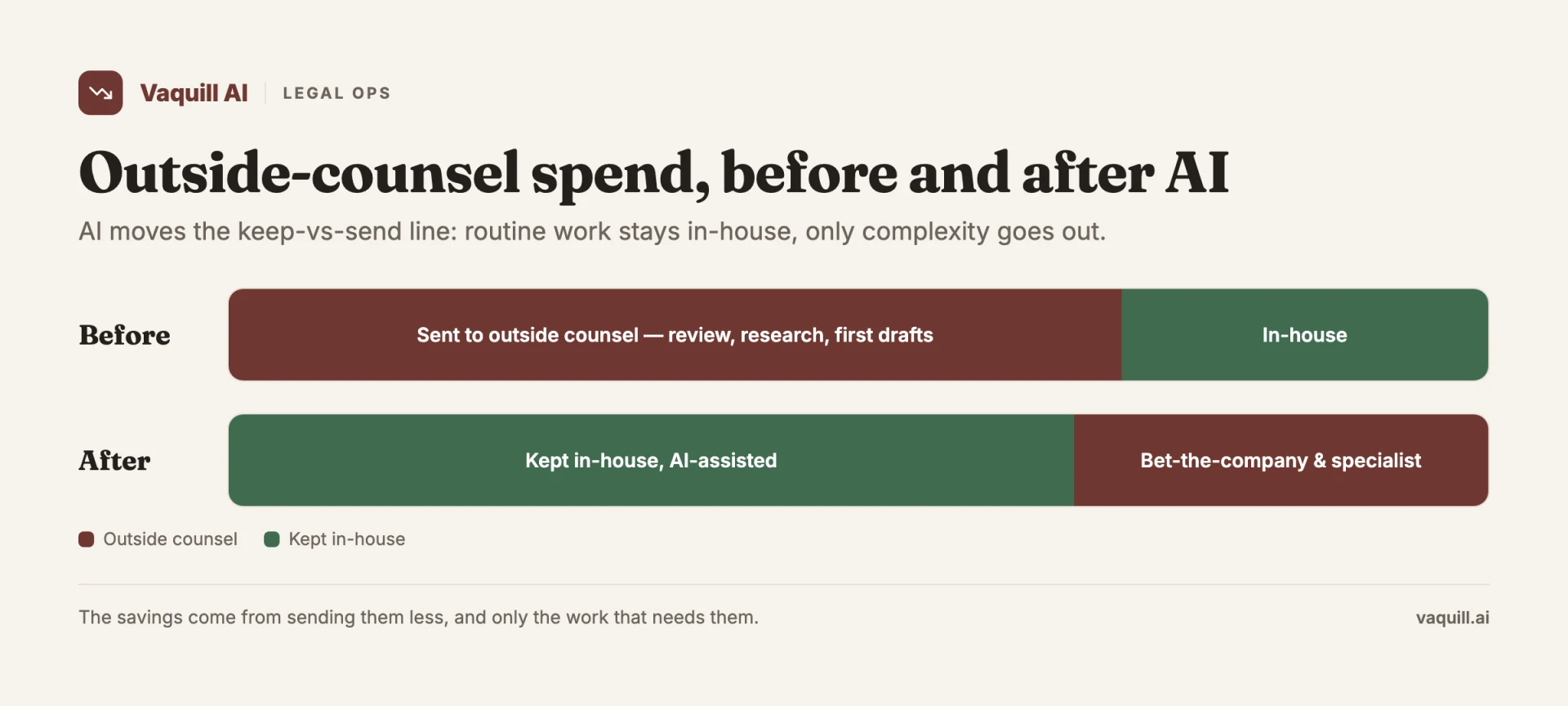
The leaders pick two or three numbers and track them before and after: contract turnaround time, hours saved per lawyer, and outside-counsel spend. That last one is where the money is. When first-pass review and research memos stay in-house instead of going to a firm at $600 an hour, the savings show up on a line the CFO already watches. We break the mechanics down in reduce outside counsel spend with AI.
Be careful with vendor-reported outcome figures. GC AI's December 2025 ROI study of more than 100 of its own active customers claims 14 hours saved weekly per lawyer, a 14% reduction in outside-counsel spend, and roughly $252,000 in median annual savings. The dollar figure is not measured directly; it is derived from an ACC benchmark of $1.8 million median annual outside-counsel spend. These are the vendor's own self-selected customers reporting their own numbers, so treat them as a ceiling to test against, not a benchmark to assume. Run the measurement on your own team. That is the point.
4. They pick on fit and price, not hype
The market rewards the loudest brand, not the best fit. The leaders ignore the noise and ask two questions: does this tool do the specific work my team does most, and does the price make sense at my headcount? A five-lawyer department does not need a seven-figure enterprise platform built for an AmLaw 50 litigation group. It needs drafting, redline, contract review, and reliable primary-law research at a per-seat price that clears in a month, not a procurement cycle. We compared the options in best legal AI tools for in-house counsel.
A 30-day in-house AI pilot, measured before and after
Numbers make the case better than principles. Here is how one eight-lawyer in-house team at a mid-market SaaS company ran the 30-day test, with the figures they tracked.
Before the pilot, their baseline for a standard inbound NDA was 4.2 days from intake to signature-ready, measured across the prior quarter's 61 NDAs. Most of that was queue time, not work time. A request sat in a shared inbox until a lawyer picked it up, ran a manual redline against the team's playbook, and sent it back. Two lawyers handled the bulk of it, and roughly one in three NDAs bounced back for a second internal pass because the first redline missed a fallback position.
Setup took the first week, and it was not glamorous. IT ran a security review of the vendor, legal signed a data processing agreement that spelled out no-train handling and deletion timelines, and an admin set matter-level permissions so the corporate team could not open litigation files and vice versa. None of that is optional for privileged work. Skipping it is how a pilot dies in procurement three months later.
Weeks two through four were the actual test. The AI ran the first-pass NDA redline inside the team's contract workflow, flagged off-playbook clauses, and drafted fallback language a lawyer could accept, edit, or reject. Every suggested change linked back to the clause in the playbook it came from, so the reviewer could verify it in seconds. That verification step mattered more than anyone expected. In an earlier trial of a different tool, lawyers had quietly stopped using it within two weeks, because checking each citation took longer than doing the work by hand, so they never trusted the output enough to lean on it.
By day 30, the numbers moved. Average NDA turnaround dropped from 4.2 days to 1.6, mostly by collapsing queue time. The second-pass rework rate fell from about 33% to 12%. The two lawyers who had owned NDAs got back roughly six hours a week each, which they redirected to commercial deals that had been waiting. The team did not cut outside-counsel spend in month one, because they never sent NDAs out anyway, but they did shelve a plan to hire a contract paralegal, which was the real budget line the pilot justified.
None of those figures came from a vendor deck. They came from a spreadsheet the team kept themselves, which is the entire point of measuring before and after.
From experiment to value: the path
The 87% are all at box A. Most stop at C or E. The leaders push all the way to H, and the thing that gets them there is not a better model. It is the operating discipline around it.
The in-house take
The adoption number is a trap if you read it as reassurance. "Everyone uses AI now" is true and almost meaningless. The real question a GC should ask in the next budget cycle is not "are we using AI" but "can I prove what it saved us." If the answer is no, you are in the 87% who adopted and the majority who cannot show a return.
The good news is that the fix is not another pilot. It is three deliberate moves: get AI out of the side tab and into the workflow, wrap it in verification and no-train controls so lawyers actually trust it, and pick two numbers to measure before and after. Do that and you stop being a data point in next year's adoption survey and start being the case study everyone else cites.
FAQ
What percentage of in-house legal teams use AI in 2026? 87% of general counsel report using generative AI, up from 44% in 2025 and 20% in 2023, per the FTI Consulting and Relativity General Counsel Report (March 2026). The survey covered 224 quantitative respondents plus 30 interviews with GCs and CLOs at organizations with $100 million or more in revenue.
Is high AI adoption the same as getting value from it? No. Only 23% of in-house lawyers use AI daily, and 27% had not used it in the prior six months (Bloomberg Law State of Practice survey, 2026, based on 760 practitioners). Wide adoption with shallow, occasional use produces scattered gains that are hard to measure. Value comes from embedding the tool in real work, governing it, and measuring outcomes. A login alone does nothing.
Why do most legal teams struggle to measure AI ROI? Because usage is fragmented across side tools that no one tracks, and because few teams set a baseline. Without a before-and-after number on contract turnaround, hours saved, or outside-counsel spend, the savings stay invisible even when they are real.
What is the biggest barrier to in-house AI adoption? Trust. Only 22.1% of legal users report high trust in generative AI output (Legaltech News, March 2026, self-reported benchmarking data), and high-trust teams see positive returns far more often than low-trust ones. Verification, no-train guarantees, and audit trails are what build the trust that drives daily use.
Which AI use cases are most common for in-house counsel? Summarization (83%), identifying contract clauses (63%), transcription (53%), foreign-language analysis (40%), and first-pass review (37%), per the FTI and Relativity report. Most teams stay at the safe, assistive end and do not yet let AI own work end to end.
How do I choose a legal AI tool for a small in-house team? Match the tool to the work your team does most (drafting, redline, contract review, primary-law research) and to a per-seat price that clears in a month. A lean team rarely needs an enterprise platform built for large litigation groups. Run a 30-day test on real matters and measure one hard number before you commit.
Does AI reduce outside-counsel spend? It can, when first-pass review, research memos, and routine drafting stay in-house instead of going to a firm. FTI's data shows work moving back in-house as AI makes it fast enough to keep. Track the outside-counsel line before and after to see the effect on your own numbers.
Prove it, do not just adopt it
Vaquill AI is built for the second habit and the third: AI drafting, redline, bulk contract review, and 50-state primary-law research, wrapped in four-layer verification and no-train data handling, self-serve so a small team can run the 30-day test without a procurement fight. If you want to move from the 87% who adopted to the few who can show a return, start with the workflow and the numbers. See legal AI for in-house counsel for how the pieces fit together.
Sources: FTI Consulting and Relativity, General Counsel Report (March 11, 2026); Bloomberg Law 2026 State of Practice survey; Legaltech News (March 2026); GC AI customer ROI study (December 2025).
New legal AI guides, weekly.
Further Reading
The AI Value Gap: In-House Counsel Want AI Results Their Outside Counsel Are Not Delivering
Read postMost In-House Legal Work Is Not Legal Risk (and AI Is Proving It)
Read postThe Legal AI Consolidation Wave: What In-House Buyers Should Watch
Read postHow Much In-House Legal Work Will AI Agents Actually Take?
Read postClaude Fable 5 and Legal AI: What Its Benchmark Records Actually Mean
Read postClaude for Legal: What In-House Teams Need to Know
Read post
Co-Founder & CEO · Attorney
Arshita leads product and strategy at Vaquill AI, the US primary law data API. As an attorney, she decides which law we carry, how each section is sourced and cited, and what legal AI and compliance teams need from the data.