On June 30, 2026, Spellbook launched Autonomous Contract Management (ACM): an AI system that pulls in contracts, redlines them, and tracks them after signature, without a lawyer opening the file first. For in-house teams, the headline is not the redline. Spellbook already did that. The headline is that the AI now acts on your contracts. It no longer waits inside Word to suggest edits.
That shift is real, and it changes the questions you have to ask before you buy.
TL;DR
- What launched: Spellbook ACM, announced June 30, 2026, in early access to select teams, with broader rollout planned for this summer (Artificial Lawyer).
- What it does: three workflows, Intake, Review, and Insight, that triage and redline incoming contracts, run each negotiation in its own workspace, and store and monitor agreements after signature (Businesswire).
- Why it matters: the agent takes action before and after a human looks. The liability surface moves from "AI suggested" to "AI did."
- The insight buyers miss: Spellbook's own Labs report says contract issue rates have not budged in two decades. Autonomy raises throughput, not per-contract accuracy. More volume flowing unattended can mean more absolute errors, not fewer.
- The governance test: before you let an agent run contract work, pin down audit logging, matter segregation, an autonomy dial, verification, and a human gate before anything goes external.
- Our take: the drudgery ACM removes is worth removing. The judgment layer still has to sit with a governed, human-in-the-loop system.
What does autonomy in contract management (like Spellbook ACM) change about accuracy?
What Spellbook autonomous contract management actually does
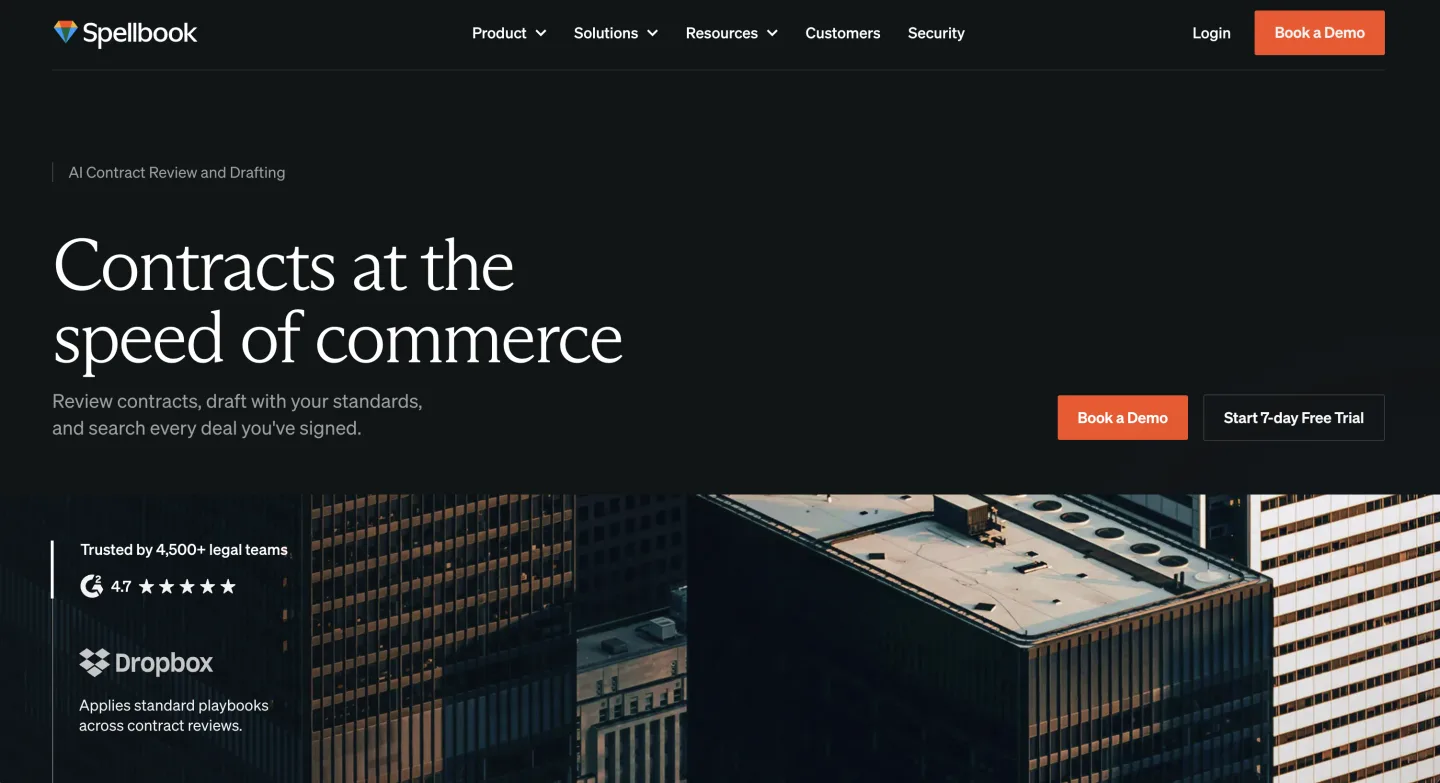
Spellbook is the Word add-in used by more than 4,500 legal teams across 80-plus countries, including Dropbox's in-house team, IKEA, Panasonic, and the law firm Kennedys (BetaKit). ACM is its biggest expansion since the 2022 copilot. It runs across three stages.
Intake. Spellbook pulls new contracts from email, Slack, and Salesforce on its own. It triages each one, redlines it against your standards, and routes it to an owner before a lawyer reads it. Every contract shows up with a diagnostic: where it breaks from your playbook, where the risk sits, what to do next.
Review. Each active deal gets its own workspace. When the other side sends a new turn, ACM reviews it automatically as it lands. Versions stay lined up and comparable.
Insight. After signing, every agreement is stored and searchable, with answers that cite back to the source clause. In the background, ACM flags renewals before they lapse and re-checks old contracts when a policy or playbook changes. A Q4 feature called Spellbook Radar will watch external regulatory changes and flag affected clauses (Law.com).
Under the hood it runs multiple models, including Anthropic's Claude and OpenAI's, and connects to Salesforce, HubSpot, and Google tools. Spellbook is backed at a reported $350 million valuation, on top of a $50 million Series B in October 2025, and took $40 million in debt this March to buy up smaller competitors.
"Autonomous" is a spectrum, and you get to set the dial
CEO Scott Stevenson is careful about what he claims. He says a lawyer's judgment "is still very necessary within our system," and that ACM automates the "fairly scripted" work, the "drudgery in Microsoft Word editing" (Artificial Lawyer interview). He also says the quiet part in the press release: of the intake, triage, and routing, "None of that needs a lawyer."
He is mostly right about the drudgery. First-pass triage and version wrangling eat hours and rarely need a bar card. But the line between "scripted" and "judgment" is exactly where malpractice lives. The moment a counterparty's clause is not in your playbook, an auto-redline is making a legal call unattended.
So "autonomous" is not one setting. It runs from suggestion-only to act-and-notify to act-silently. The buying question is not whether ACM is autonomous. It is how far down that dial you can turn it, per matter and per counterparty.
Where the liability actually moves
With a copilot, a lawyer accepts or rejects every edit. The human is the last actor, so the human owns the output. That is a clean story for your malpractice carrier and your board.
An agent that redlines incoming paper and routes it before anyone looks changes who acted first. If the agent misclassifies an indemnity as standard and green-lights it, the error is already in your workflow before a human sees it. You can still catch it downstream. But the default has flipped from "nothing happens until I act" to "something happened, and I need to notice."
That is not a reason to avoid agentic tools. It is the reason to demand a governance layer around them.
Six questions to ask before you let an agent run contract work
Run these on Spellbook ACM, on any CLM adding agents, and on us at Vaquill AI. The point is not the logo. It is whether you can prove what the agent did.
| Governance control | What to ask the vendor | Why it matters |
|---|---|---|
| Audit log | Is every agent action logged with what, when, and against which standard, and can you export it? | If you cannot reconstruct a decision, you cannot defend it. |
| Matter segregation | Does one deal's context leak into another's redline? Is client data walled per matter? | Cross-matter bleed is a confidentiality and conflicts problem, not a feature. |
| Autonomy dial | Can you set suggestion-only versus auto-act per matter and per counterparty? | High-stakes paper needs a human gate; NDAs may not. |
| Verification | What checks the agent's own output before it moves? Does the legal reasoning cite a source, beyond the plain search answer? | Unverified autonomy delivers wrong answers faster and unattended. |
| Human gate on external send | Can anything reach a counterparty without a named person approving it? | This is the one gate you never fully automate. |
| Data handling | Which models, where does contract data go, and is training opt-out on by default? | Your contracts are your clients' secrets. Know the path. |
Where a governed, human-in-the-loop suite still has to sit
Here is the flow ACM is selling, and the gate we think stays human.
Vaquill AI is built for that gate, not against agents. It keeps each matter walled off, runs drafting and bulk contract review against your own playbooks, logs what happened, and puts a 4-layer verification pass on the legal reasoning before it reaches you. It also keeps the matter after signature, with 50-state primary law on hand when a clause turns on a specific statute. It is self-serve, so a two-person team can start without a procurement cycle.
The honest read: Spellbook ACM is a strong bet on removing contract drudgery, and the drudgery is real. But autonomy without segregation, an audit trail, and a verification layer is just speed. For in-house counsel, speed you cannot account for is not a win.
For a wider view of the field, see our best legal AI tools for in-house counsel roundup and our Spellbook alternatives breakdown. For the mechanics of review itself, the AI contract review guide for lawyers covers what to check. And if you are weighing whether an agent replaces your CLM, start with Ironclad vs DocuSign vs ContractWorks.
FAQ
What is Spellbook Autonomous Contract Management? It is an AI system Spellbook launched on June 30, 2026, that handles contracts across their full lifecycle. It pulls in incoming contracts, triages and redlines them against your standards, runs each negotiation in its own workspace, and stores and monitors agreements after signing. Spellbook positions it as a step beyond its Word copilot.
How is ACM different from a traditional CLM like Ironclad or DocuSign? Traditional CLMs store and route contracts but leave the actual work to people. ACM tries to do the routine work itself: intake, first-pass redlines, version tracking, and renewal alerts. Artificial Lawyer called it a "CLM killer," though that is the outlet's framing, not a proven outcome.
Does Spellbook ACM replace lawyers? No. CEO Scott Stevenson says a lawyer's judgment is still necessary in the system, and that ACM automates scripted, repetitive work rather than judgment calls. The risk is that the boundary between scripted and judgment is not always obvious, so the human gate matters most on unusual clauses.
How much does Spellbook ACM cost? Spellbook has not published ACM pricing as of July 2026. The product is in early access to select teams, with wider rollout planned for the summer. Expect seat-based pricing and a sales conversation rather than a self-serve checkout.
Is it safe to let an AI agent redline contracts automatically? It depends on your controls, not the tool alone. Ask for an exportable audit log, per-matter data segregation, an autonomy setting you can turn down to suggestion-only, verification on the agent's output, and a human approval step before anything reaches a counterparty. Automate the low-variance lanes first.
What is Spellbook Radar? It is a feature Spellbook says will launch in Q4 2026. It watches external regulatory and policy changes and flags contract clauses those changes affect, so teams can update templates and live agreements. It was announced with ACM but is not yet available.
Who is Spellbook ACM built for? In-house legal teams and law firms handling steady contract volume. Spellbook reports more than 4,500 legal teams across 80-plus countries, including Dropbox, IKEA, Panasonic, and the firm Kennedys. Lean teams get the most from automating high-volume, low-variance paper like NDAs and order forms.
Want a contract workflow where the agent does the drudgery but a governed, verified, human-in-the-loop step owns the judgment? See how Vaquill AI handles contract review and matter management, or start on the self-serve plan and pilot it on one contract lane.
This post is for general information, not legal advice. Verify vendor claims and pricing directly before you buy.
New legal AI guides, weekly.
Further Reading
Claude Fable 5 and Legal AI: What Its Benchmark Records Actually Mean
Read postThe AI Value Gap: In-House Counsel Want AI Results Their Outside Counsel Are Not Delivering
Read postClaude for Legal: What In-House Teams Need to Know
Read postWhat Lawyers Really Think of Legal AI in 2026 (Reddit + Reviews)
Read postMost In-House Legal Work Is Not Legal Risk (and AI Is Proving It)
Read postThe Legal AI Consolidation Wave: What In-House Buyers Should Watch
Read post
Co-Founder & CEO · Attorney
Arshita leads product and strategy at Vaquill AI, the US primary law data API. As an attorney, she decides which law we carry, how each section is sourced and cited, and what legal AI and compliance teams need from the data.